Text by Juliette Wallace

This year, the Whitney Museum of American Art celebrates twenty-five years of the museum’s online gallery space: artport. To consider the world a quarter of a century ago is to acknowledge a turning point – intellectually, in terms of the human experience, geopolitically and, in the most literal sense, a turn of the century. It seems fitting that such a momentous rotation aligns with the birth of the Whitney’s artport: the celebration, display and serious consideration of internet art before such a thing had any universal gravitas.
Upon returning to the subject today – at yet another critical moment in our ever shifting society – is telling. More than one-hundred commissioned artworks on display – both online and off – trace the trajectory of artistic practice on the internet and the evolution of the Whitney’s online gallery space. They also offer us a lens into how society at whole has changed and how what may have been an experiment, folly, fantasy or warning back then has come to be now. Of these one-hundred works of art one in particular has captured CLOT’s attention: Demonstrate by American artist, writer and innovator, Ken Goldberg.
Originally conceived of as a “wake-up call” in 2004, the Whitney Museum of Modern Art invites us to reconsider Demonstrate today. Have we, in fact, woken up? The prolific and irrepressibly curious Golderg – known amongst other things for being credited with developing the first robot with web interface back in 1994 – created Demonstrate on the 40th anniversary of the Free Speech Movement. The work – commissioned by the Whitney Museum – took place in Goldberg’s own stomping grounds and the birthplace of the Free Speech Movement, at Berkley University, where Goldberg was (and still is) a professor. In the artist’s words, “Demonstrate” served as a wake-up call, calling attention to privacy and Free Speech in the context of increased visual surveillance[…] [1].
The concept of ‘increased visual surveillance’, which in 2004 was feared as Orwellian, took on an almost perverse quality through the implication of Goldberg’s signature move: engaging the general public through remote-control action. A state-of-the-art robotic web camera was set up over Berkley’s Sproul Plaza, a space of gathering for the students and general public. Online participants shared control of the camera, zooming in to specific moments of activity at all times of the day or night.
Over four-thousand people from across the globe got involved. The public interaction encouraged in this work shifted the first iteration of Demonstrate from being a commentary on a police state into something much more prescient: the fascination of the general public with the private lives of our peers and, as the situation later developed, a desire to be viewed and a passivity in the face of surveillance. Since 2004, the widespread adoption of smartphone cameras and social media have fundamentally expanded our exposure to corporate surveillance [2].
The dynamics in Demonstrate – people in control and watching verses those who are passive and out of control – brings to mind a much more cynical experiment from Berkley’s peer, Stanford. The Stanford Prison Experiment (1971) was an investigation into situational power and its effects on human behaviour. Almost mythical in its place in folklore, the now famous experiment shook foundations amongst equals through assigning the role of either prisoner or prison-guard to a group of civilians. Cut short due to a distressing escalation into both physical and psychological violence by the guards to the prisoners, this experiment showed what could happen when ordinary people are given extraordinary agency. In a much more passive way, Demonstrate explored the same subject through allowing people at home to remotely infiltrate the privacy of the students and civilians in Berkley’s Sproul Plaza.
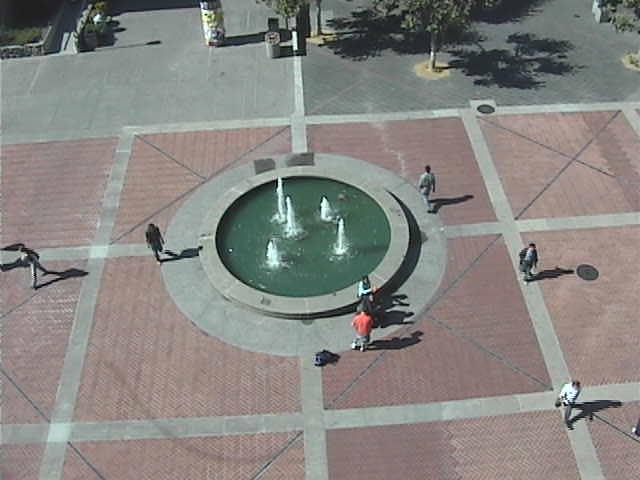


So how does this work translate today? We are aware of the incessant surveillance in our society, so are we, the general public, accepting Cookies because they sound delicious or because we’ve given in? According the Goldberg, “Demonstrate” […] demonstrated the rising potential of digital cameras to infringe on privacy and chill freedom of speech. Having it recreated in the Whitney Museum in 2026 lets visitors consider how these issues have changed and been amplified in the past 20 years.[…T]here’s been a shift from the surveillance in George Orwell’s 1984 toward the scenarios in Aldous Huxley’s Brave New World, where surveillance is less by government and more by companies, where the public willingly accepts surveillance in exchange for free services[…]. Freedom of speech is still being challenged. New threats have emerged since 2004, including the Trump administration’s threats to universities and students’ understandable fears of being doxed or cancelled on social media [3].
So according to Goldberg we’re all f*&$%d? Not quite…What this author learnt through speaking to the artist and exploring artport: A History of Internet Art was that the joy of development and technology is alive and kicking amongst creatives. Yes, there is much to be weary of when things are put in the wrong hands but if there’s any takeaway it’s that the power dynamic needs to be put in check.
It is exactly the type of people included in this exhibition – Goldberg and his peers – that should be using the internet and its protege, AI, for their art as a way to navigate, expose and draw attention to what role these things have in society when controlled by cynical power-hungry billionaires. This action of using art to comment on a critical moment in history has a solid precedent and should be encouraged. With artport: A History of Internet Art the Whitney Museum is doing just that.
Telling, too, is how the exhibition is setup. Rather than turning the 3D into 2D, as was originally the way with the the first artport, the Whitney is now exploring the opposite. Twenty-five years on from the birth of artport people are now just as fascinated with how to turn the digital into analogue as they are the other way around. Thus, the Whitney and its more than one-hundred internet artworks has decided to inhabit both worlds, taking a kind of quasi-nostalgic joy in turning the internet into an inhabitable, three-dimensional realm. The open floor plan of the galleries creates the effect of floating browser windows, bringing the history of internet art into physical space [4].
Perhaps through navigating this realm with our full bodies, not just our eyes, actively rather than passively, the viewer can engage more fully with what the Whitney’s selection of artists had to say in 2004 and how that resonates now. We must not fear that which seems out of our control but, rather, take our own control of them and shift the proverbial gearstick into the hands of those who wish to bring us light rather than blind us. As Goldberg himself says, fear is the enemy of creativity. Something to bear in mind…