Text by Maya Elimelech
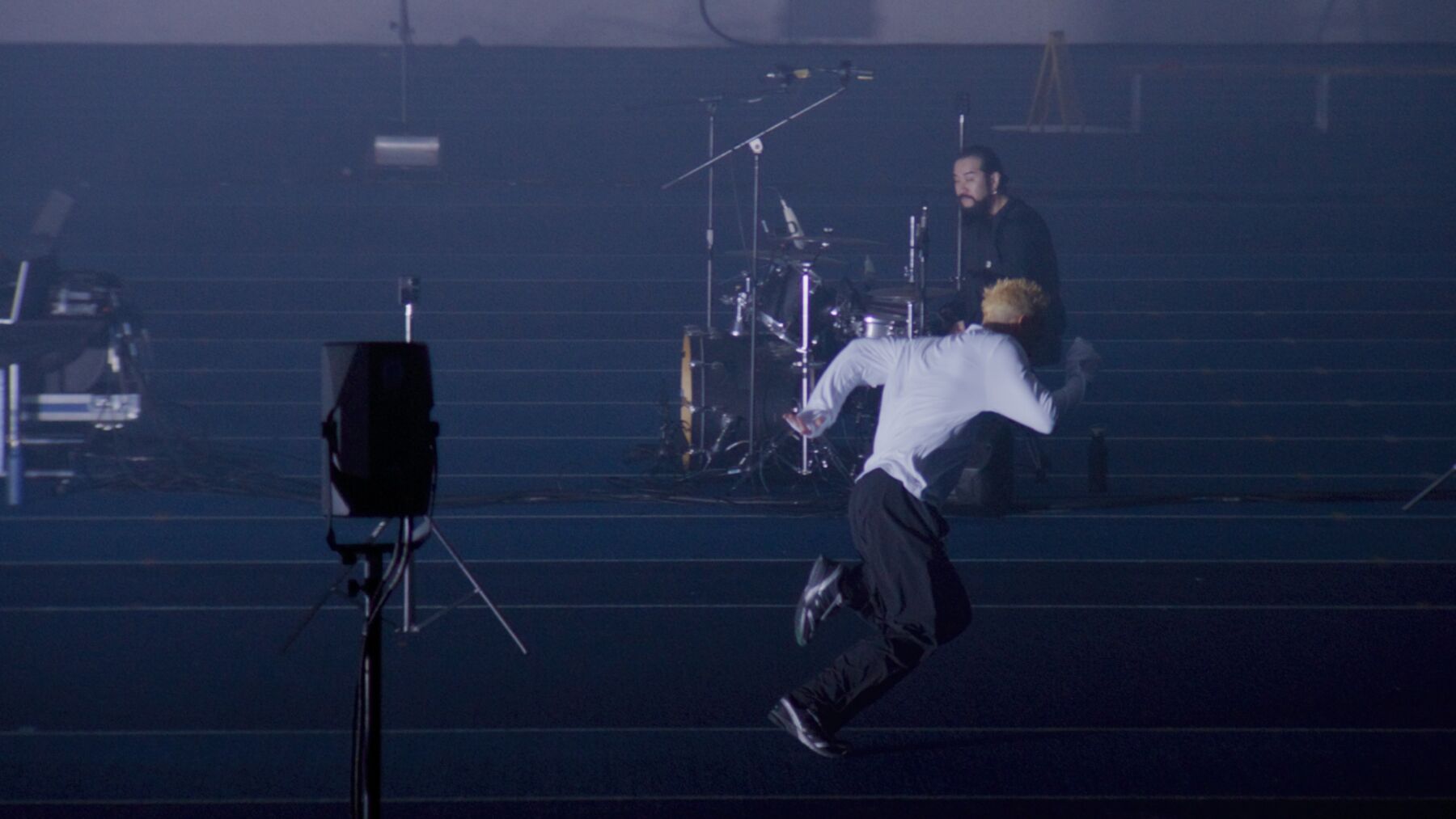
We were herded into a pitch-black room, and the door shut behind us. We will begin by listening to 4’33” by John Cage. The song was silence. I could hear my breath and the breath of my friend beside me; a bag rustled, and shoes scuffed against the concrete floor. The song is about anticipation, attuning the listener to their environment and the sounds around them as a musical performance, priming the mind to become more aware of the next moment, and making our perception more astute.
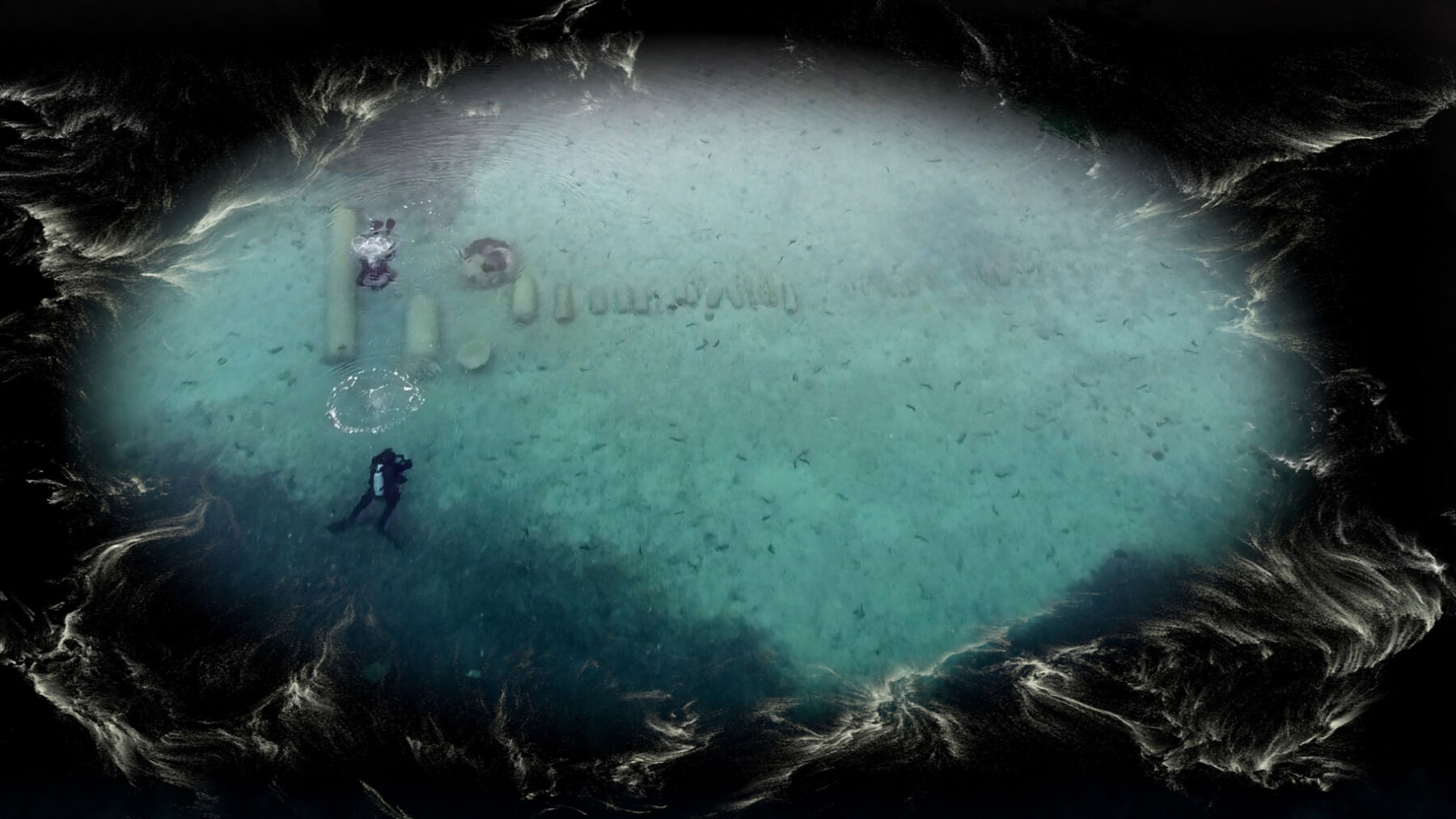
Then, from our darkness, the doors opened to a vast concrete chamber where there were ancient statues of naked women sitting above an underground lake. The lake was a hall, large enough to fit hundreds of people; a former WWII telecommunications bunker built to withstand nuclear disaster. Space influences the interpretation of the work we ingest, so it was fitting that The Feuerle Collection was chosen as the site of the premiere of Rebecca Salvadori’s new film Not Running.
The film, commissioned by adidas, was proposed to experimental director Rebecca Salvadori as an open-ended concept. It is structured as a reflective running workshop where a group of runners take part in exercises exploring how different kinds of live music affect the running experience. The exercises took place at Lee Valley Athletics Centre in London … part essay film and part site-specific live performance without an audience, Not Running examines how sound, light and physical exertion recalibrate our sense of duration and self.
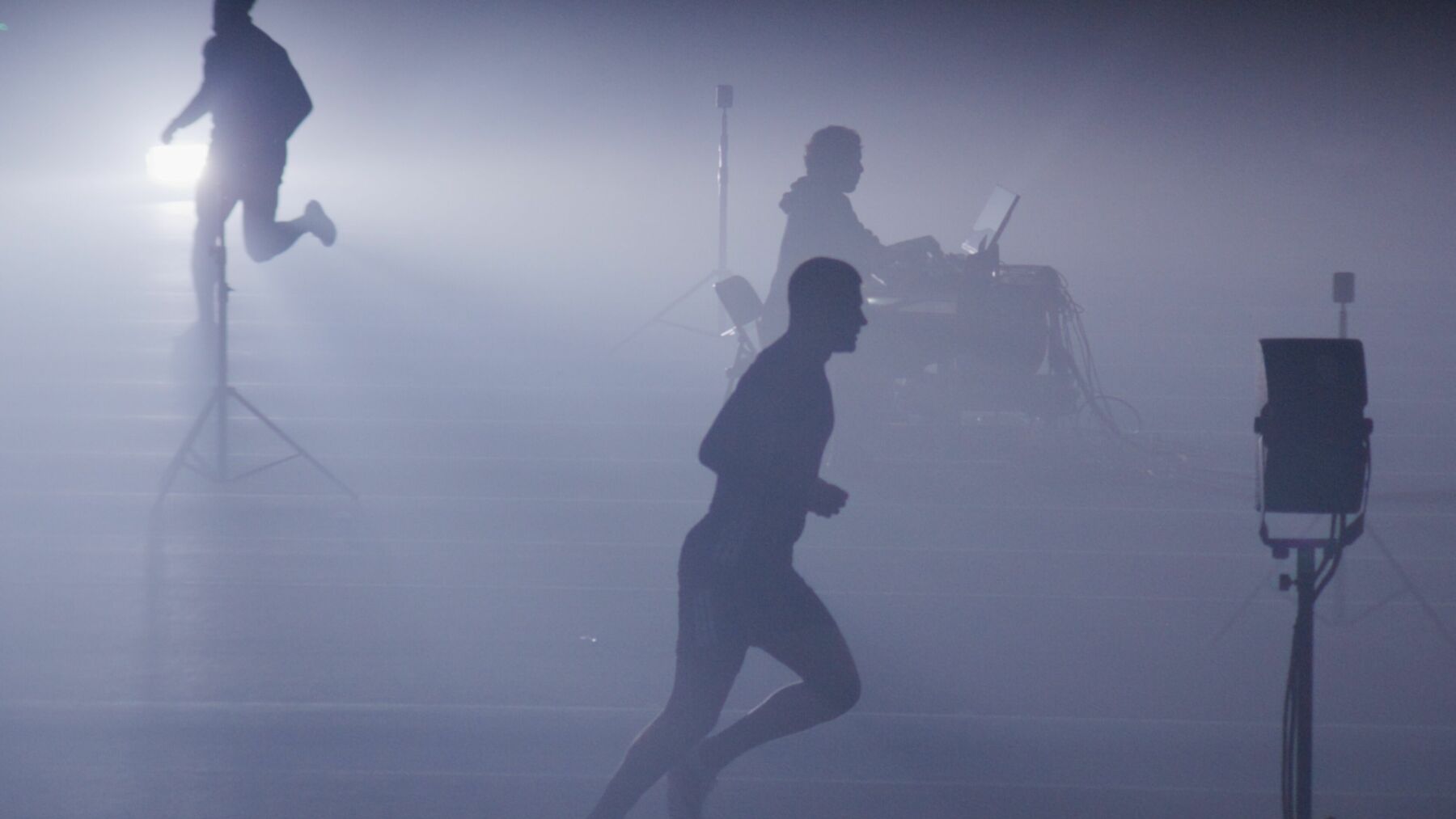
The exercise at Lee Valley Athletics Centre was intended as an experiment to inquire into the effect of different stimuli on the human experience, through the medium of running. We are invited into the process of the film’s creation, and into the minds of its collaborators as we reflect with them. The film was shot in three spatial setups: a 200-meter running track and a spinning beam of light, the same track around twelve speakers with a disorienting, strobe-centred light performance from EhV, and a spirit track with minimal/ no lighting effects. The beam of light, designed by lighting artist Charlie Hope, turns on the track, which different runners try to keep up with at varying speeds.
At one point, the speakers blast a live performance of Every Breath Takes Me Home, interpreted by producer and recording artist Coby Sey and experimental operatic singer Olivia Salvadori (collaborators for several years and two-thirds of the band GAISTER). The song is an original vocal piece composed by Sandro Mussida (who is also the film’s score designer) specifically for the film, set to a poem by Olivia Salvadori. It carries us through the patchwork narrative with droning sine waves and frequencies. We are offered a peek into the minds of three runners: James Pancaldi, Anna Luisa Ruther, and Korede Awe. The film captures the collaborators’ embodied experiences and real-time thoughts in captions across the screen as they adjust to shifting sensory conditions.
The score, also developed specifically for this film, moves in dialogue with the rotating light sculpture and choreographed actions. The composition works with repetition, duration, and spatial rhythm to shape the runners’ perception of time from within. Mussida inhabits the set in a dual capacity, serving as both musical director and performer. Charlie Hope also appears on screen alongside Akihide Monna (Bo Ningen) in a new collaboration under the name EhV. Their performance merges strobe lighting, percussion, and spatial dynamics into a sensory overload that takes shape as both sonic and architectural intervention.
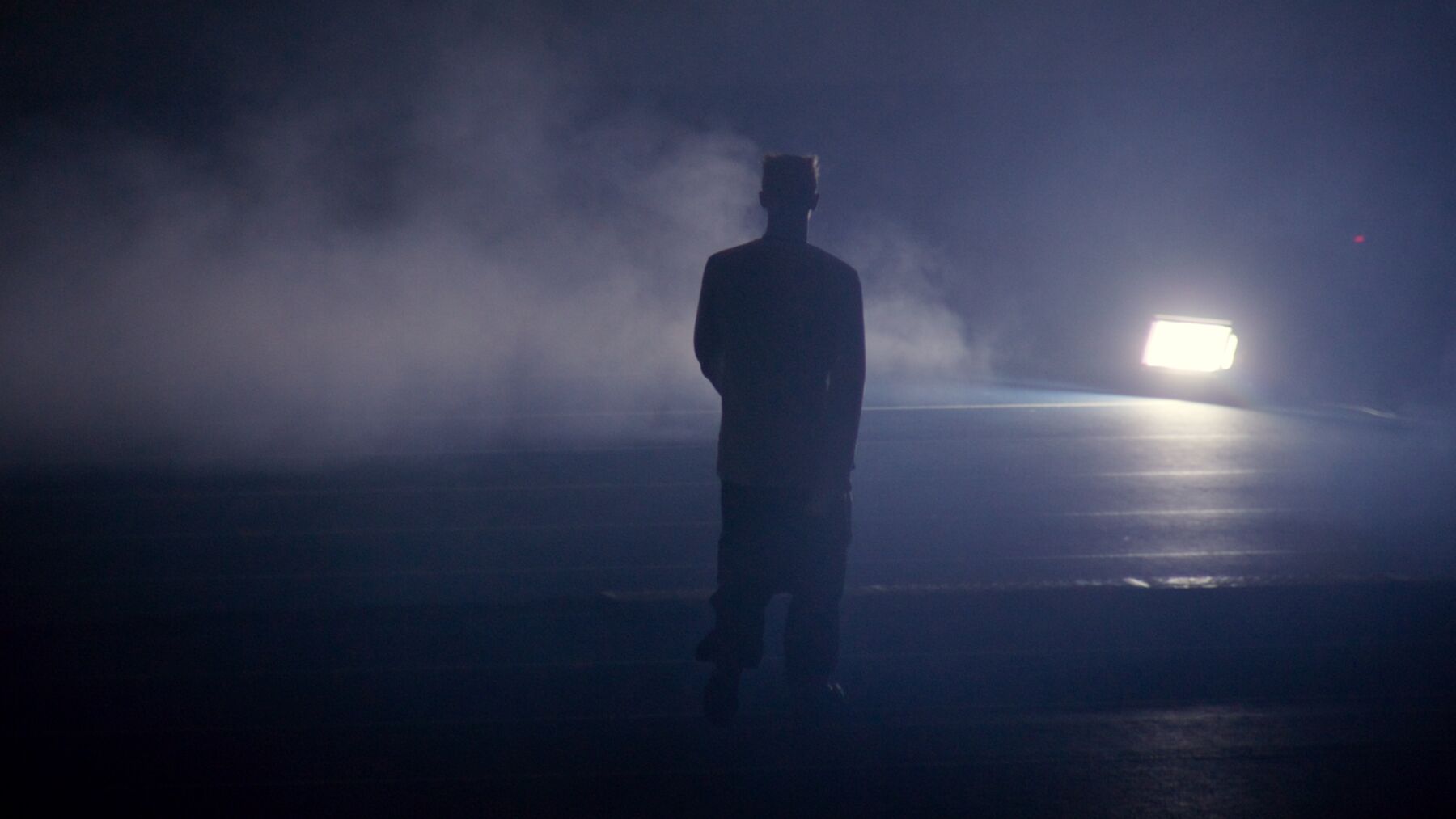
Though the film is about running, it is also about everything but running. The way time is experienced by the runners using the light as a conceptual framework, the relationships built on a shared project, and the dialogue that cycles during moments of effort and rest. It is about the process and what exists in the empty space that the effort created. When a black hole is formed, physicists sometimes describe it as digging a hole in flat sand. On one side, there is the mountain that is created from displaced earth; on the other side, there is a gap, or what is lost from the creation of something else.
Whenever we exert energy into something, time is taken from another area of our lives. When we focus so deeply on the physical, we are able to step into a place where the opposite is also true. Focusing on personal experience serves as a window into collective experience and understanding. Friendship is a mechanism for understanding the self. Portraits of each other are peepholes into our own souls.
To make something precious, you sometimes have to push things to the extreme; something is lost in order for something new to be born. A seed splitting open to become a tree. Pressure turning carbon into a diamond. Beauty and loss existing at the same time.
The three runners can all be thought of as archetypes of runners whom we can see bits of ourselves in. James is an introspective runner who runs in silence, Anna runs with music as background noise to manage overstimulation, and Korde is a 120-meter athlete who is deeply focused on his body and the practical aspects of running. We follow their thoughts as if we are in their heads with them:
I sometimes find it hard to be in the present moment; I feel overwhelmed in the moment. We are both with them alone, and in the Lee Valley Athletics Centre together. There is always something to discover about each other.
Rebecca’s work often explores space, identity, and belonging via portrait. Much of her filmography has been anchored in portraying electronic and experimental dance communities, where the music, lights, and location contribute to creating the environment for ecstatic release and connection, for example, in films like Rave Trilogy (2017-2020), The Sun Has No Shadow (2022), and Tresor Tapes (2022). She has been featured at London’s ICA and international festivals such as Berlin Atonal and Sonár. In 2024, she was nominated for the Circa Prize and the Film London Jarman Award.
In Not Running, running becomes the medium through which Salvadori explores how sound, light and performance can alter our perception of reality, and be used as a vehicle to expose the inner and collective experience. Presence is the throughline, the space, the moment, the people we are physically with. With that understanding, it becomes clear how dance and running are two expressions of the same thing, a moment in which time is distorted, and we enter a place of the other.
I had the pleasure of sitting down with Rebecca Salvadori and Charlie Hope in the days after the premiere. Rebecca spoke with thoughtful clarity as she described her observational approach to filmmaking.
Maybe I should start by saying that I am self-taught in film ,and I always felt somehow that life was perfect already. I was always attracted by the poetry of life, and what was already there: the people that I was meeting, the friendships. So I had a sort of documentary approach to life, which was more about absorbing life rather than constructing it, or projecting an idea.
This observational role to often transformational physical experiences, I learned, is central to the way Salvadori approaches film. Exploring complexity through what is already there, and learning and changing, the more ideas are enacted, is what transforms art into a conversation with life. But for her, observing isn’t about disappearing completely, but rather setting the conditions for things to happen.
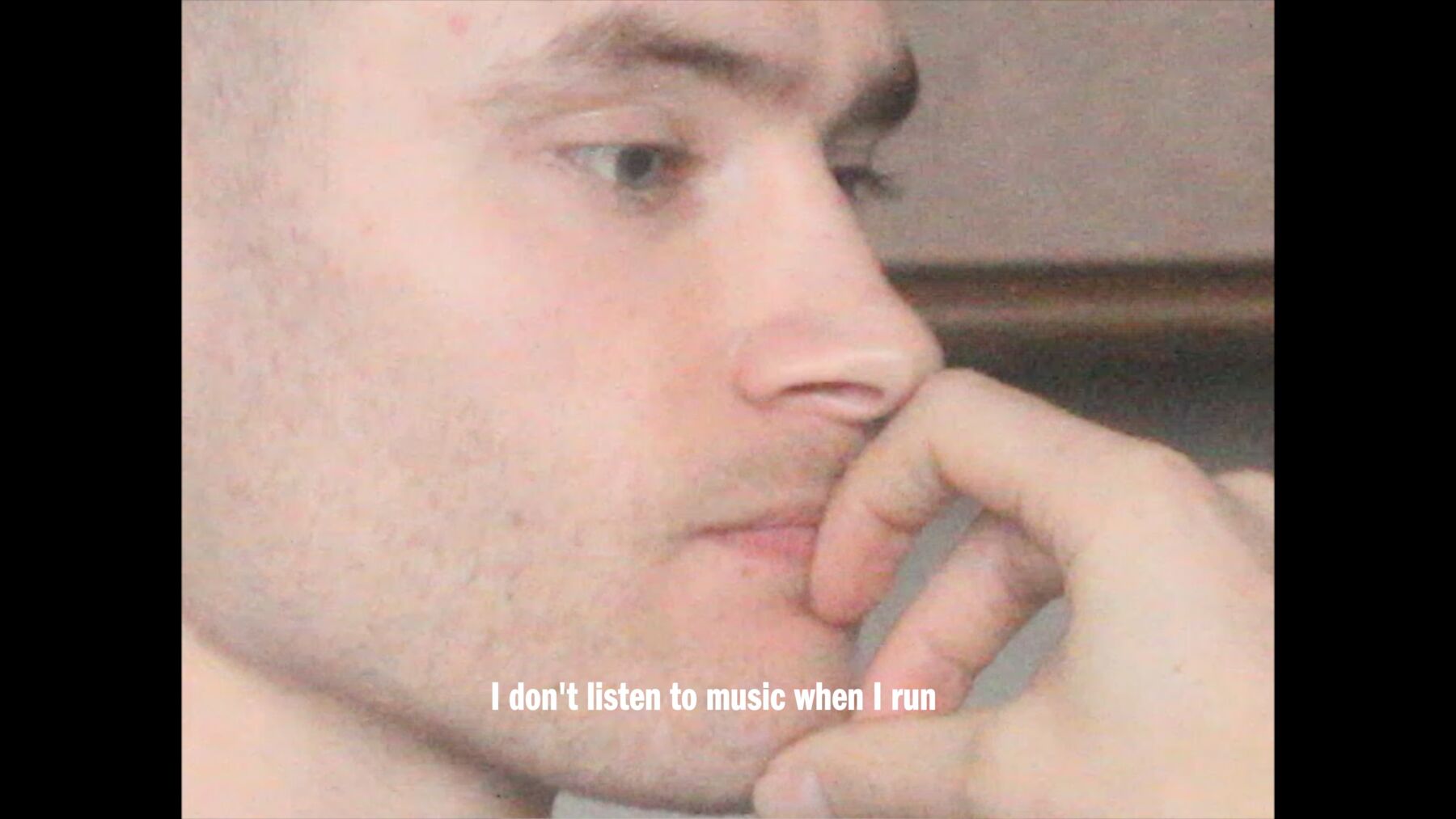
Then the way she films what happens within a set of conditions became her unique way of directing. The conditions for this film, the location, the stimuli, and the participants all existed in a petri dish; the realisations that were made and included reflect a sort of self-portrait for Salvadori, as well as a portrait of everyone involved. This film was collaborative in nature, with around thirty people on set the day of, creating a chorus of voices to sift through, demystify and make sense of.
I come from this tradition of my filmmaking that has to do with creating environments. And then what happens within these specific environments, built by this specific group of people, is the film. And then that connects to more broader existential matters, and desires of understanding. I’ve had the feeling that I wanted to understand this moment of my life in terms of time perception and what it means to direct. What it means to make a film. And understanding these relationships with these friends, people I work with all the time.
A huge part of the project became about the work of creating it, and the nature of the work itself. Understanding time perception became a way of understanding the labour behind the screen. Filmmaking is intensive, time-consuming; work of value always is. It unfolds over time, becoming part of a longer process of understanding both the premise and the practice itself.
In order to make good work, it’s beautiful, but it’s also a sacrifice… it seems like the more you do things the more you understand. You understand your practice, but you also see the limits of it. So the more I understand the more I lose, but I also make something special.
I also spoke with Charlie Hope, who spent months building the film’s light sculpture and performed the live lights with Akihide Monna as a duo under the name EhV. The structure was made using a laser-cut mirror that rotatet to create a fixed timeframe for the runners to follow or outperform. The restriction of using a running track allowed EhV to disrupt the experience in more intense ways, more strobes and disorienting lighting.
The disorientation of trying to run with strobes could be this really chaotic experience, but, actually, speaking with the runners afterwards, the disorientation of it became this really calm experience… We tried to find other ways to physically inhabit the running track and then sensorially transform it. Our practice is, in a way, trying to deconstruct processes of being and then putting them into a different context.
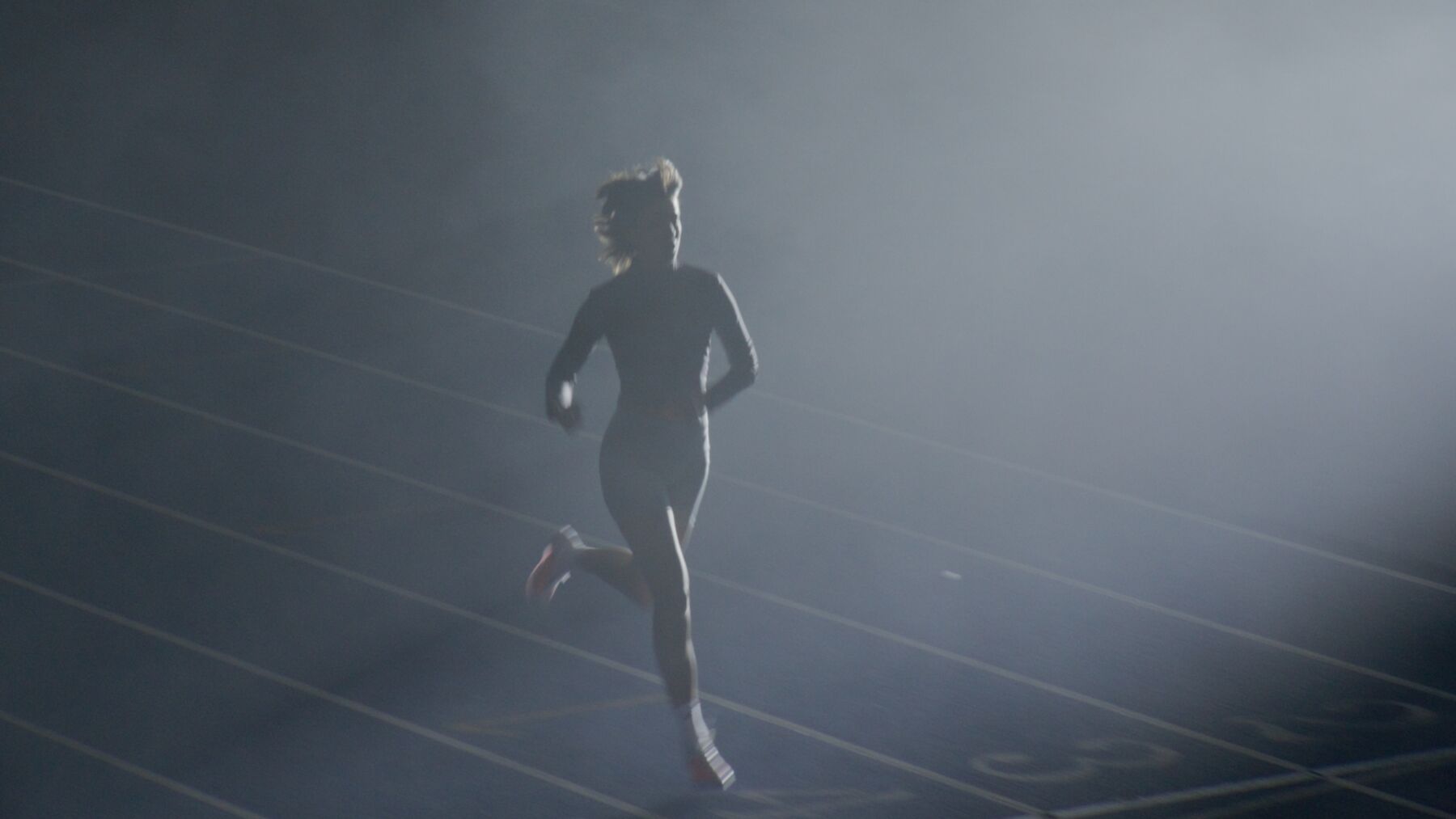
The intention was for all elements of the film to be central protagonists: the visual language, the music, and the lighting.
I think something that was running through all of the collaborations in this is maybe… having a full dialogue among all the elements… whether it’s spoken word, music, film, or lighting, they’re all active protagonists in it. And there’s a strength in that. And you can see bits of that in the film, but also in the screening launch as well.
I return to the premiere, the conditions of which became the stage for the film itself. We were detached from time, in a liminal space with no cell service. Before the film, Mussida performed an intimate, experimental piano piece. He would play a few keys, then pause. The rhythm seemed to exist on another plane. The clock was internal, each moment divorced from the last, not out of necessity but by design, when one is fully present.
Everyone will ultimately experience watching Not Running differently, each with their own set of conditions and connections. There are multiple threads of meaning that exist equally. To me, the track is both a representation of a clock turning and the light of our perception, the narrow beam of our focus. The lighthouse I saw as our own personal panopticon, our awareness of the present moment. [The light] is a metaphor for process, exposure and becoming… Its rotation reveals and obscures, measures and distorts. What does time mean while I am working? While I am writing this? I am fighting against my own atomisation to exist. To work to bridge the distance between us in our narrow beams of light.