Text by Irem Erkin
The gaze is often seen as passive, a way to observe the world from a distance. But what happens when looking becomes an action with consequences? This question lies at the heart of The White Saboteur (Le Saboteur Blanc), an XR installation by French visual artist Barthélemy Antoine-Loeff and digital artist Hugo Arcier, selected for Venice Immersive 2026 as a World Premiere at the 83rd Venice International Film Festival.
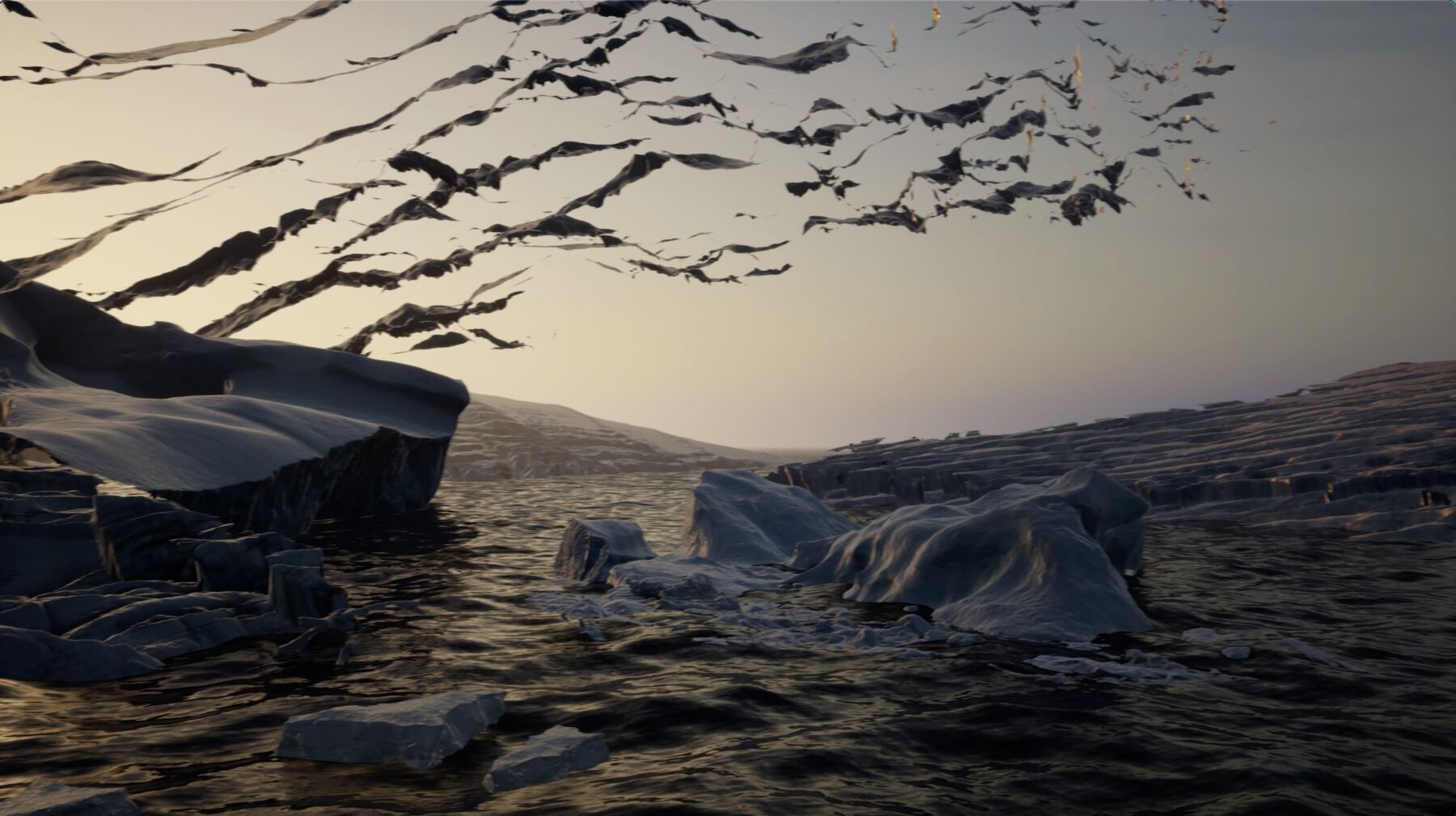
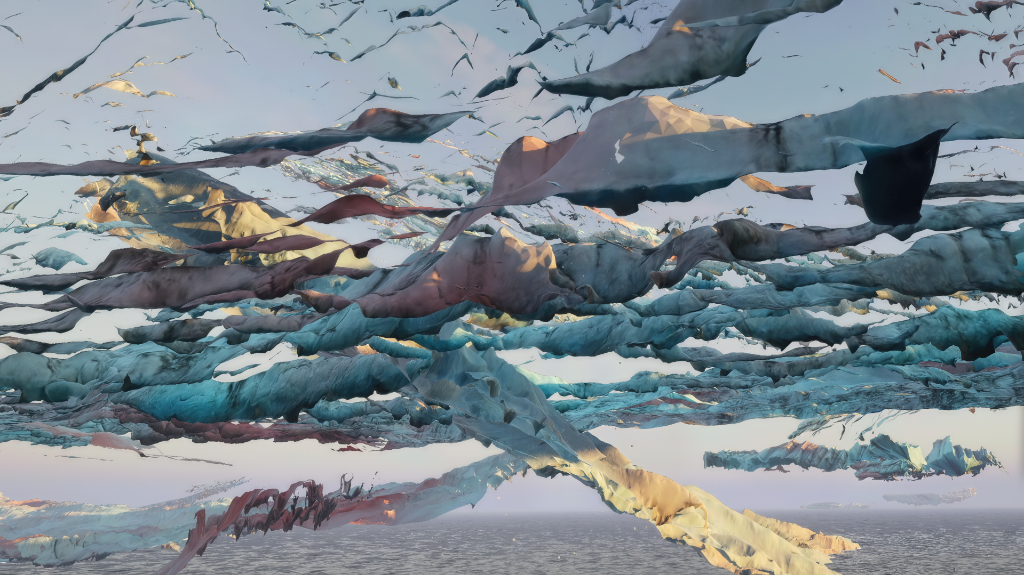
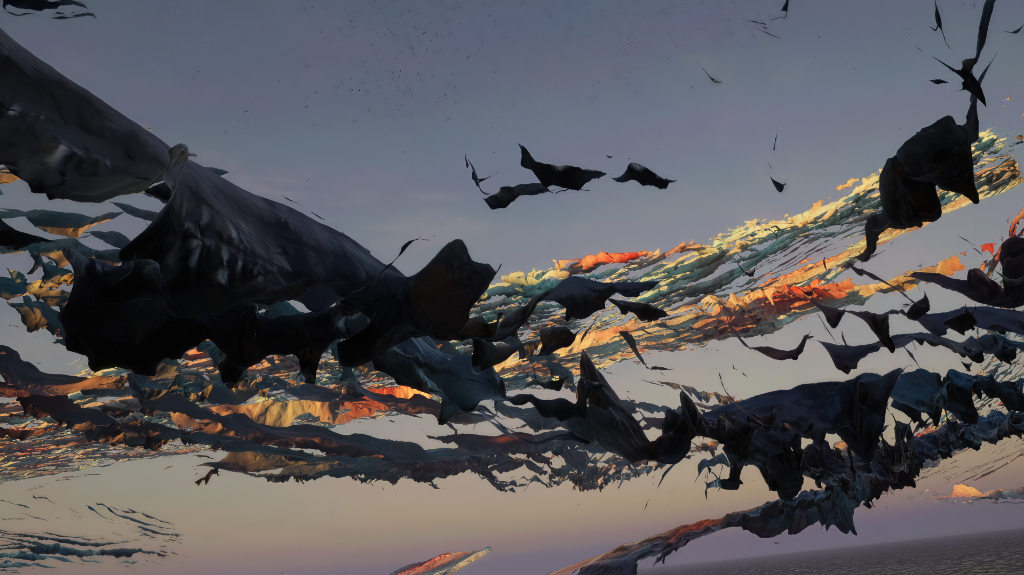
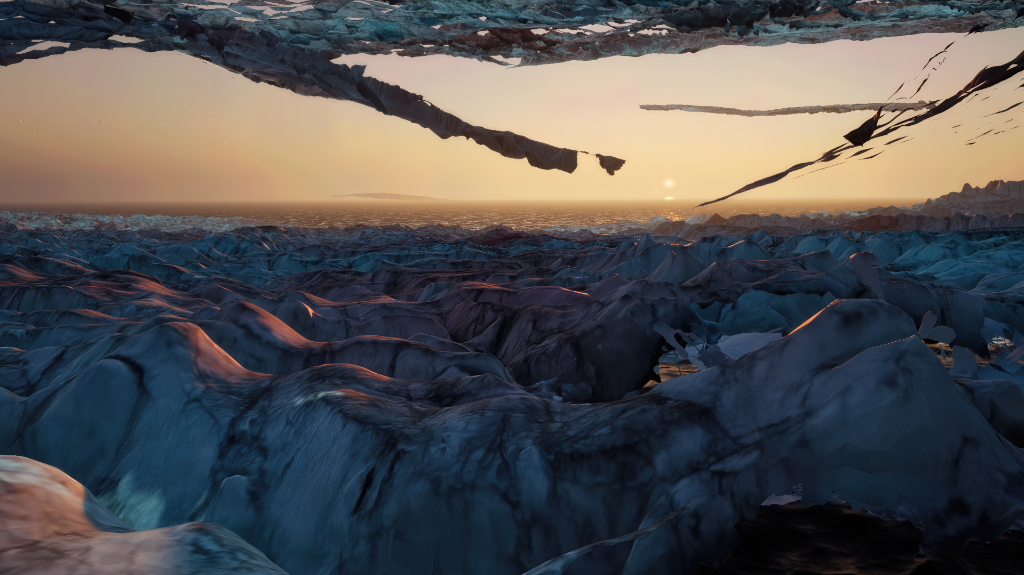
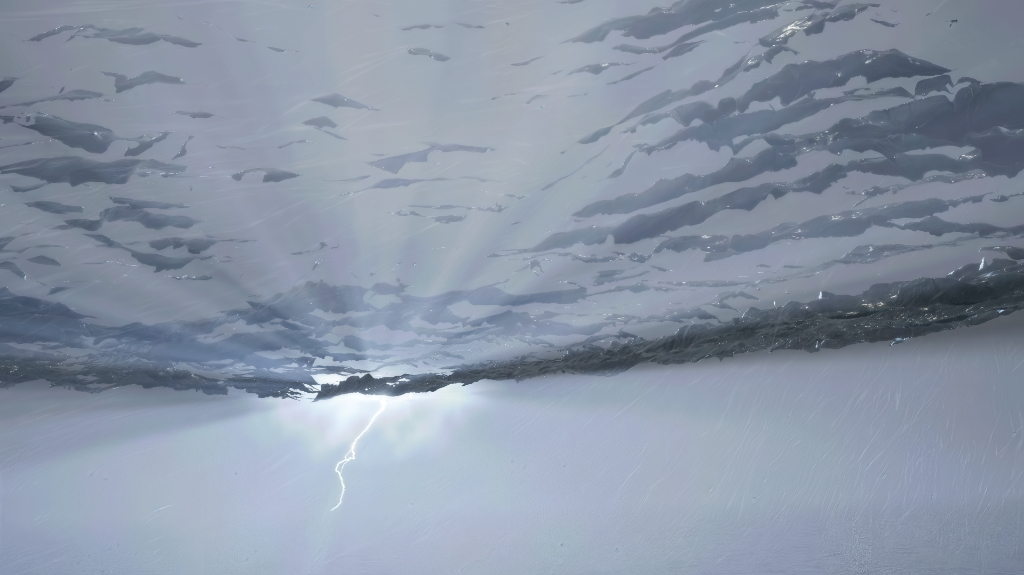
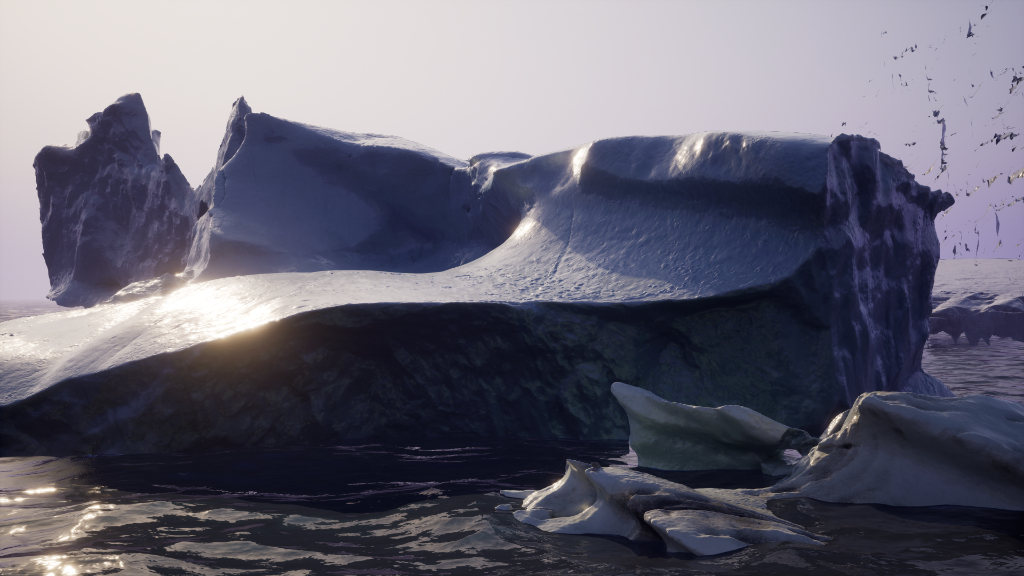
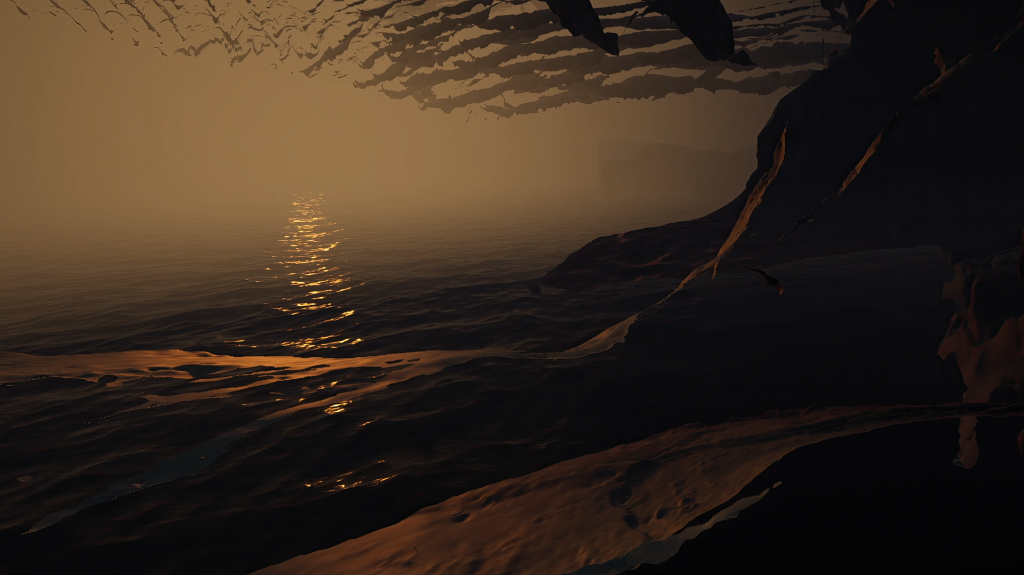
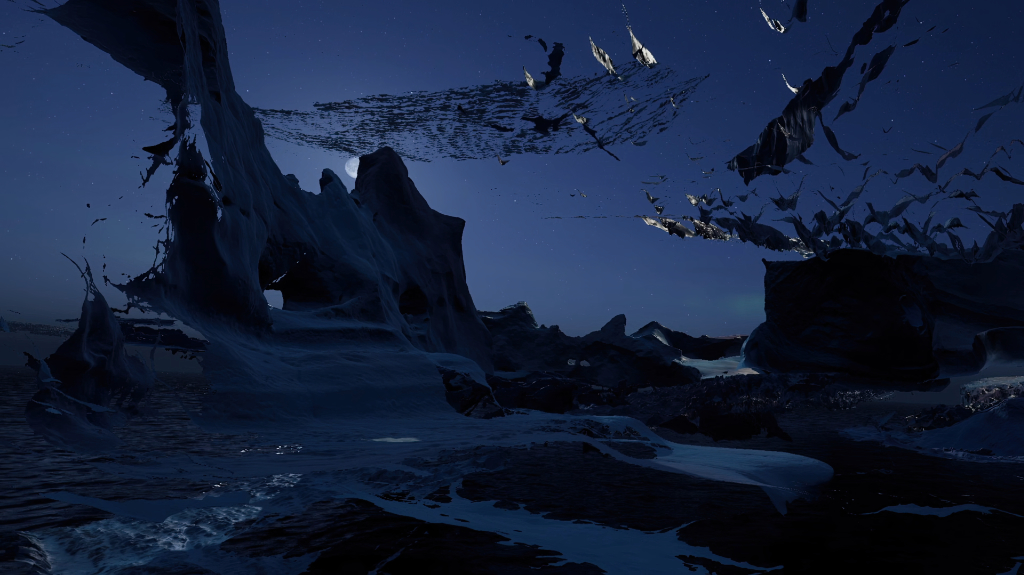
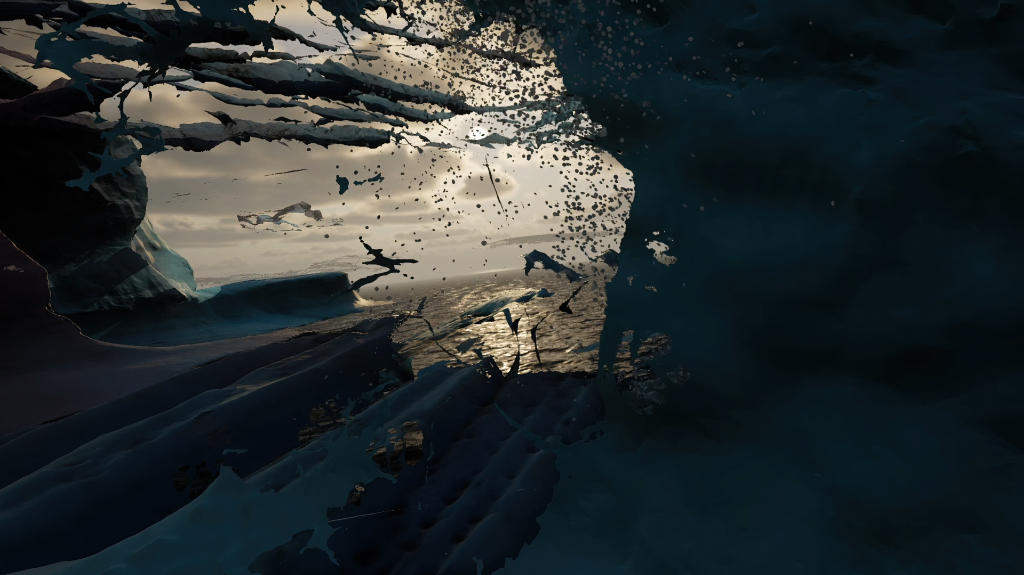
Inside a virtual landscape of icebergs and glaciers, visitors discover that their gaze accelerates the ice’s melting. No controllers operate it, and no instructions guide them; just looking at the landscape contributes to its disappearance. Each visitor inherits the environment left by those before them and leaves it further degraded for the next. As time passes more quickly inside the installation, the ice gradually disappears, until the landscape becomes an endless sea beneath chaotic weather systems.
Acier explains that Interaction through the gaze is at the heart of the work. We wanted this interaction to be very simple and natural, without relying on a technical device such as a controller. This simplicity lets the spectator become an actor: observing this world means destroying it. Visitors are told the virtual landscape evolves and that they’ll inherit a world others have already altered. But the effects of their own gaze remain unknown, and this limited information lets them enter without anticipating what they’ll experience. The distinction matters: knowing glaciers are melting is one thing; feeling implicated in a landscape’s disappearance is another.
In The White Saboteur, each visitor’s gaze alters the environment, turning the distant process of glacier melting into an immediate experience. The challenge is to make environmental data resonate beyond the numbers, so the disappearance of ice feels more intimate than a statistic. For Hugo Arcier, The White Saboteur bridges scientific knowledge and emotional understanding: Data tells us the cryosphere is disappearing. Still, it doesn’t make us feel its loss, he explains.
Outside the headset, a paired projection reveals the consequences of this transformation. As the glaciers recede, their fossilised remains emerge, creating a second landscape that records what has been lost. The two views place the visitor between a world in the process of vanishing and the traces it leaves behind. No narration guides the experience. Visitors explore at their own pace, gradually understanding how their presence shapes the changing landscape.
For Antoine-Loeff, the experience raises questions about our relationship with the natural world. Drawing on Jean-Paul Sartre’s reflections on the gaze, he considers how looking can turn what we observe into an object available to us. The idea opens onto a broader critique of anthropocentrism: the tendency to understand the world through human needs, interests and perceptions, as though other forms of life and the environments they inhabit existed primarily in relation to us.
In The White Saboteur, the landscape appears to offer itself up for contemplation, its beauty inviting exploration and enjoyment. The visitor enters with the familiar expectation that nature is there to be experienced, while the installation gradually exposes the assumptions underlying that expectation. Even the desire to encounter a remote environment, such as the Arctic, can become entangled with consumption practices that contribute to its degradation. In our experience, the gaze is not only a channel through which the world comes to us, but a gesture that takes something from it. The same mechanism applies in the real world: flying to contemplate Arctic icebergs takes something from that world and accelerates its disappearance, Antoine-Loeff reflects.
The visitor’s position remains deliberately uncomfortable. Looking away might seem like a way to preserve the virtual world. Still, it also raises the question of whether turning away offers any meaningful response to a crisis already unfolding far from the headset. The work leaves this contradiction unresolved. The project can be understood, in particular, as a reflection on the world’s progressive digitisation and on how the real world can gradually disappear behind its digital representations. Experiencing a natural environment’s disappearance through technology therefore adds another layer of meaning to the work; Arcier comments on this contradiction.
And while the audience may arrive expecting a beautiful environment, they leave having experienced the limits of that expectation. According to Antoine-Loeff, when a visitor encounters The White Saboteur, some icebergs will have disappeared, and the glaciers will have changed shape; what the visitor encounters is therefore their digital memory. Visitors, in turn, erase this digital trace. This porosity between the real and the virtual offers another layer of meaning to the work: in a way, technology does not preserve the world; it accompanies its disappearance. For him, this reading opens a critical dimension to the work’s use of technology: should you put on the VR headset and hasten this world’s end, or choose not to enter it and let the world endure? Deciding to experience The White Saboteur is a choice. Deciding not to experience it is another choice which, in my view, is equally valid. This contradiction shapes both how the work is conceived and how it is experienced.
The installation was developed in collaboration with glaciologists Dr Heidi Sevestre and Dr Léo Decaux, and it’s based on scientific research that uses photogrammetric data to reconstruct ice formations from specific glacier regions; their textures, colours, and physical details draw on real places, connecting the virtual landscape to environments already changing. Some of the icebergs represented in the work no longer exist, while others have diminished since the data was collected. As Arcier notes, translating scientific data into an immersive experience extends research from scientific circles to a wider audience; The White Saboteur invites visitors to experience the glacier´s loss through the senses.
Dr Sevestre similarly emphasises the importance of helping people connect emotionally with glaciers, allowing scientific knowledge to resonate more than just a series of numbers and feel more immediate. As she explains, scientific knowledge about glaciers remains largely inaccessible. Beyond statistics and models, sensory experiences let people connect emotionally with these distant ecosystems and keep them close to their hearts. She sees the project as a way to foster a meaningful understanding of the disappearance of ecosystems we all depend on. Glaciers are not abstract. Each one has a name, a history, and people who depend on it for water, a livelihood, or their identity. Keeping the icebergs tied to real places stops the work from becoming a fantasy landscape. What visitors see comes from somewhere that exists today and is changing today.
On the other hand, Dr Decaux also highlights the relevance of helping people connect with the reality of glacier loss, especially when scientific warnings alone struggle to convey its urgency: The White Saboteur was created by people for whom these numbers (for example, Swiss glaciers lost 5.5% of their total ice volume!) carry profound meaning- individuals who have found a way to transform scientific data into emotions that people can feel and connect with. However, knowing the scale of the crisis does not necessarily mean feeling its proximity: communicating science effectively to the general public and bringing emotion into the picture is not part of scientific research itself. Projects like this allow our research to reach new audiences and broaden the impact of scientific knowledge.
The installation’s sensory immersion is further extended through sound, which also deepens the audience’s engagement with data. For The White Saboteur, sound artist Olivier Girouard combines field recordings, seismic data captured in Greenland, and a live choir recorded in Germany to design the installation’s soundscape. His recordings evoke snow, cracking ice and Arctic winds, giving the environment a tangible acoustic presence. The landscape becomes something not only to look at but to listen to. Overall, the installation’s elements transform scientific material into an intimate encounter, where visitors experience environmental change through their senses. It highlights the collective consequences of ways of living that are hard to separate from everyday desires and habits. Visitors are both observers and participants, drawn to the landscape’s beauty while becoming aware of their role in its transformation.
The White Saboteur leaves us asking: Can we learn to see the natural world without assuming its existence begins and ends with us?