Text by Ricardo Vicente Paredes
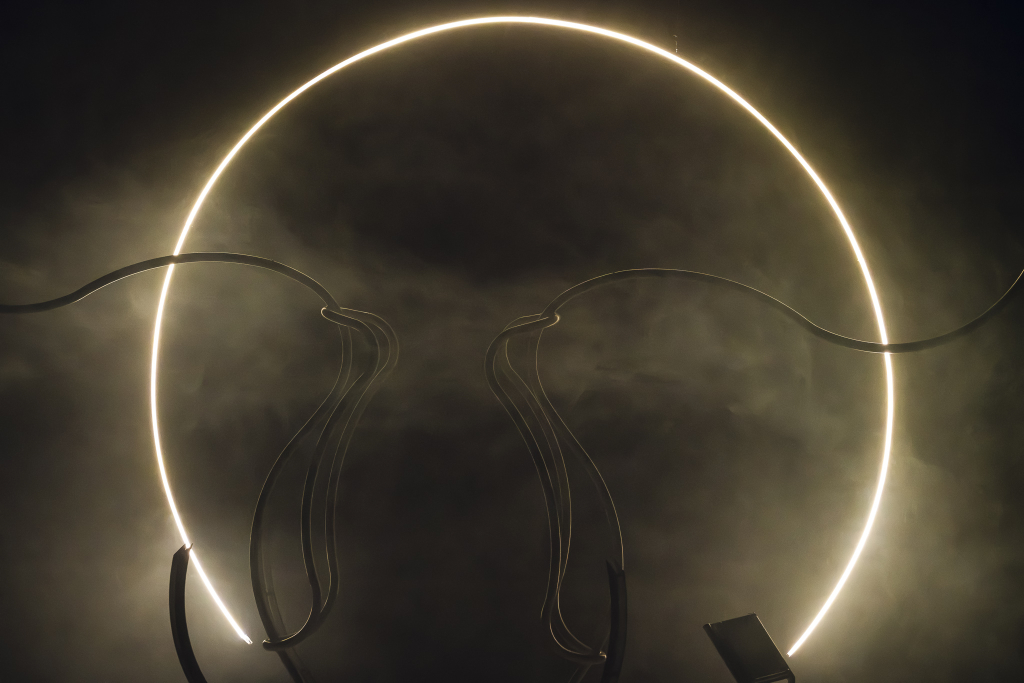
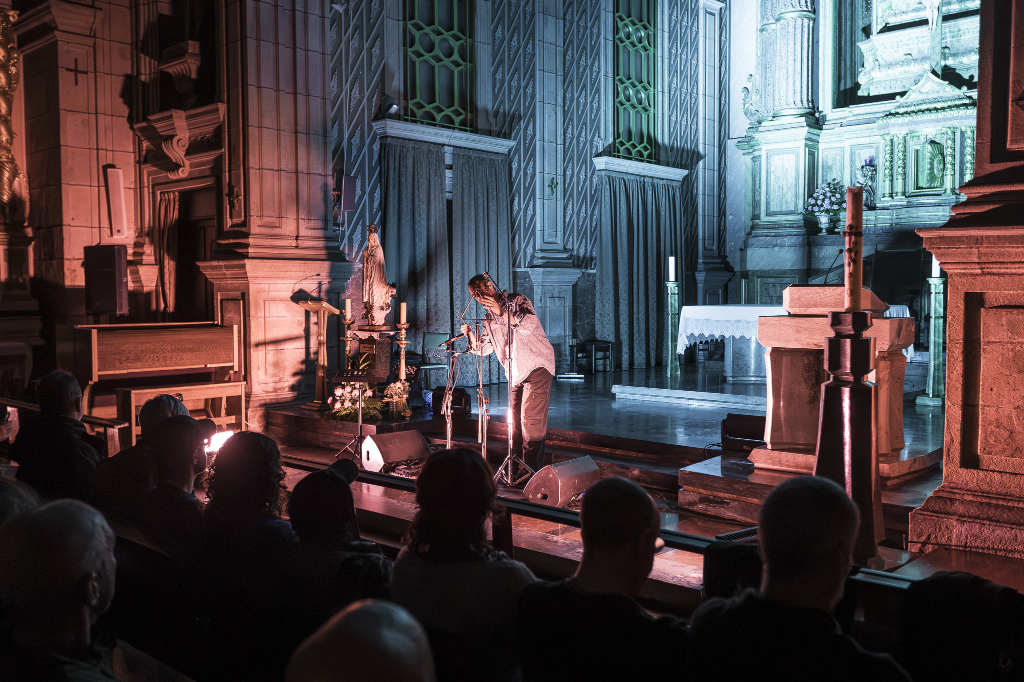
The surprising, striking opening with Silver Streetcar For The Orchestra, a composition Alvin Lucier wrote in 1988 and Sam Slater performed at the Basilica dos Congregados, carried multiple meanings. The first was the impact of bringing back an instrument whose timbre so closely resembles a city’s soundscape. Braga is also the city of bells, whose sound often carries through time.
Lucier’s piece consists of multiple strikes on a metal triangle, as if accelerating time, and is perhaps one of this minimalist composer’s most striking compositions, based on an instrument often relegated to the background in percussion. Yet it conveys a sense of a call to mark the start of the programme. SEMIBREVE — an electronic music and digital art festival now in its 16th edition, with the city of Braga at its heart — blends the Baroque with modernity to create one of Portugal’s most stimulating contemporary cultural gatherings.
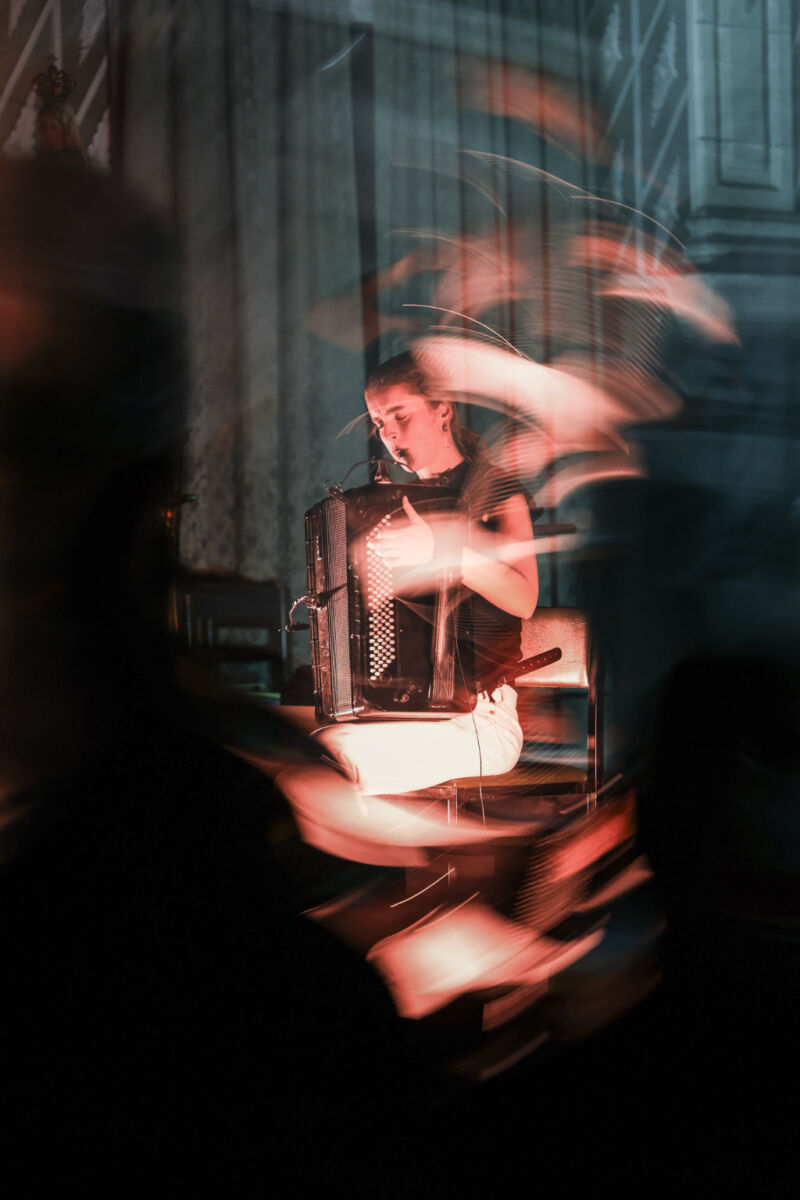
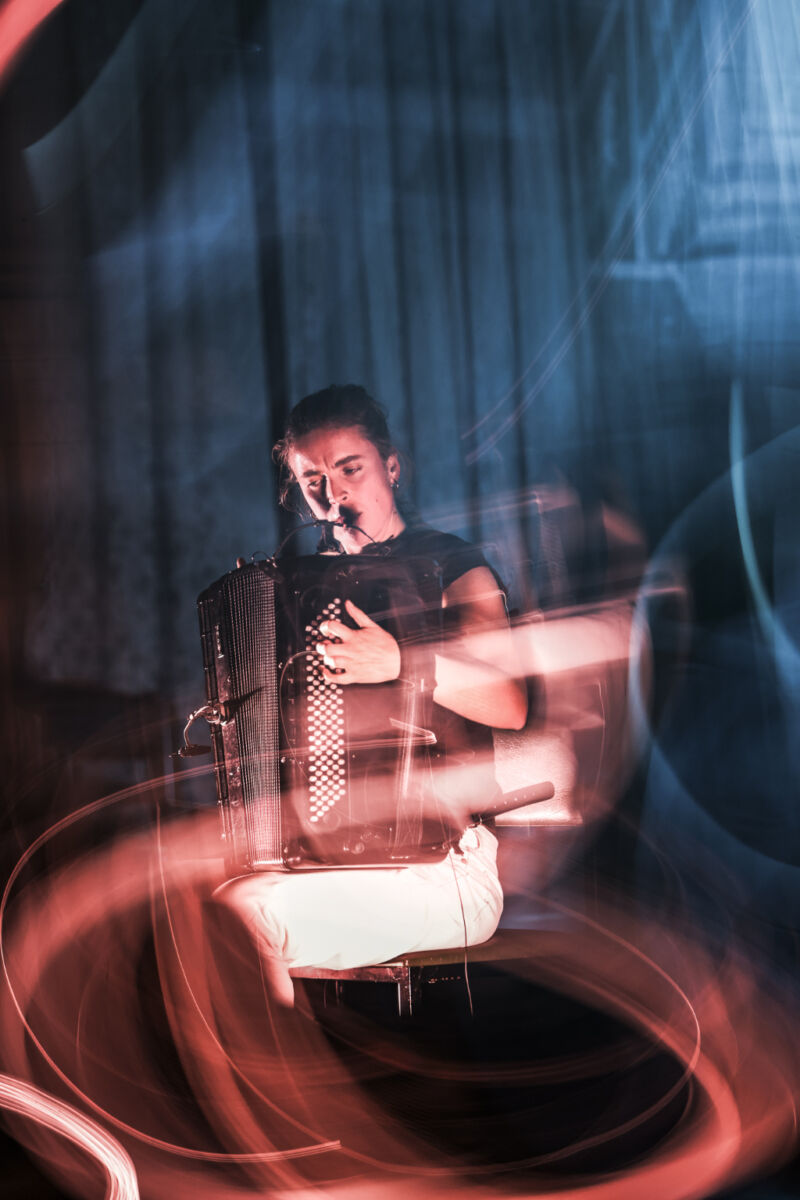
While Slater filled the basilica with the timbral, rhythmic, and temporal nuances of the present day in less than twenty minutes (as stipulated in the score), the artist who followed him enhanced the venue’s spatial volume and texture. The Belgian accordionist Suzan Peeters made her debut at the festival and in the country with a continuous piece for accordion and sound propulsion, drawn from her debut album Cassotto (2025).
In a continuous performance, incorporating moments of silence where the composition was created entirely in unison with the audience in the Basilica, the piece offered devout listening to the accordion’s fascinating, endless possibilities, resonating throughout. A pulsating rhythm, tinged with tremors from a foot massage mat, drove this. A whole world was contained in a bellows-like sound emanating from a voice at the end, sublime and visceral.
The former Republican Guard barracks, converted in 2013 into the gnration space, have gradually become a haven for uncertain ideas. Just as the squares where people are camping out should be in these days of repression in Portugal. Here are the five installations from the Edigma SEMIBREVE Scholar’26—an immediate confrontation with a changing world, with artificial intelligence (AI), despite it. We have long since grown accustomed to avoiding being alone, even when sitting face to face at a dinner table, aware of the sensation of direct eye contact.
The Table of Discomfort by Catarina Alves, Lara Amaral, Nuno Santos, Ricardo Martins & Rita Pereira tests this in this installation. Just as Bruno Mesquita’s Relational Cartography puts the omnipresent surveillance of everyday life into perspective for reflection, drawing on shifting relationships within a space of traceable coordinates in real time and using words (of which we are made). Recognition and surveillance, as in Matthew Biederman’s Situational Compliance, winner of the Edigma SEMIBREVE Award ’26, which Daniela Silva described so well here in CLOT. Time and memory, amidst memorabilia, ranging from the reality we have experienced to the artificial world created by AI.
Líria Varne’s Small Laboratory for Recreating Humans leaves us in a state of open confrontation in a place where the representation of the past may well be recreated and distorted for a supposed comfort derived from the past in the light of the present. Drawing openly on James Bridle’s book Ways of Being, Rita Castanheira’s video installation World Wide Wood fosters a space for contemplative redemption.
It seeks to understand the communicative relationship between plant species as a counterpoint to humanity’s alienation through objects of comfort, screens and their associated networks. There remains, too, the possibility of escape through the fundamental touch of the Adufe, which is unlike even Lucier’s piece at the start of SEMIBREVE. Tomás Camacho’s RePercussão displays a light box whilst recreating the varied touches of the traditional Portuguese membrafone, embodying female identity and affirmation.
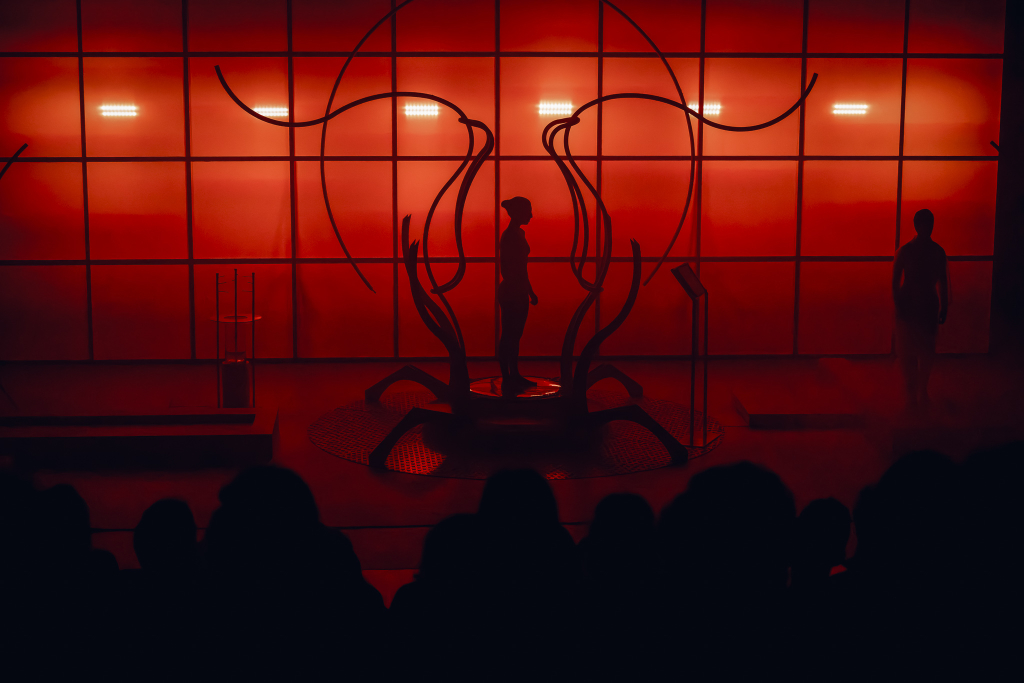
A1-0 N3 by João Carlos Pinto debuts as a generative production by the composer-playwright, blending AI and human thought. It also marks the first production from his studio blegh, co-founded with visual artist Inêves. In this sci-fi-inspired play, a dystopia already just around the corner hits us in the gut as it blends into the character A1. Traces of humanism appear in an artificial body seeking to disguise itself in the possibility, through emotion and mechanics, of behavioural obedience. Do we want humans to coexist with emulated humanoids? A hybrid field of representation spanning dramaturgy, performance and electronic music.
The same performance format as the show closing the opening night at the magnificent Theatro Circo with Flesh and Bones by Malcolm Pardon & Gustaf Broms. Then, fully immerse the audience in the organic world through a forest recreated from the image projected onto Broms’ performance stage. A transformative dimension beneath the drone and sub-bass spectrum of the mutating Rhodes keyboard, entering a realm of Hauntology within the machinery Pardon operates.
A delight for the sensory realms of sight and hearing. In between, acting as a cleansing for the audio-visual palate, came the premiere of /Radiant Rift, commissioned by SEMIBREVE from Nuno Canavarro & Bruno Miguel Pinto. On stage with Pinto (electronics), Dullmea (vocals and electronics), Frederica Campos (harp and electronics) and João Santos (piano and keyboard)—a performance that fell slightly short of the promise, born of expectations beyond the composition’s scope. Not every work will be a pinnacle that stands the test of time; this one will not leave its mark in the same way as the seminal work Plux Quba – Música Para 70 Serpentes (1988), with which Canavarro made his pioneering mark on music.
When an octophonic room restores space for listening, we come close to a state of heightened aural gratitude. Five fundamental works of field recordings are available as sound installations for eight speakers in the Salão Nobre of the Nogueira da Silva Museum: Portals (2024; 16’) by Jana Irmert, Basse Brevis (2024; 18’) by Sarah Davachi, Scalar Towers (2026; 25’) by BJ Nilsen and All Solids Melt Into Aether (2025; 20’) by Maria W. Horn.
An acousmatic delight, and in many passages a transcendent experience, this collaborative production draws on the vast resource maintained and developed by The Groupe de Recherches Musicales (INA GRM) and Sonic Acts. Despite the spurious landscape of sumptuous objects and furnishings all around, one could still close one’s eyes and move more fully from mere hearing to deep listening, in the sense described by Pauline Oliveros.
a,drift by Marta Salogni at the Capela Imaculada da Nossa Senhora da Conceição — Minor Seminary. A SEMIBREVE commission co-curated by Berlin Atonal and Unsound. It was a ritualistic climax of pagan catharsis, where listening felt like the movement of each magnetic tape reel, at the mercy of the conductor’s guidance from behind the mixing desk and oscillator. We drew inspiration from Salogni & Tom Relleen’s Music For Open Spaces (2023).
Still, in this new piece, performed solo, the magnetism drifts towards a profound continental drift, emerging from an asthenospheric dimension where the sense of Perpetuum Mobile is equally present—one of the festival’s finest moments emerged from iterations of A-major harmonies, with acoustics as rare and ephemeral as aural beauty itself.
As a proposal, let us cross-reference the programme of events at Theatro Circo across different days to link two collaborative duos working with sound and image in real time. Whilst, on the one hand, PYUR & Tarik Barri’s Mass Oneiria featured a transmutation of the senses between Barri’s plasmatic visualisations of sound and PYUR’s eruptive sonic emanations, creating an effective synaesthesia.
That same shift from hearing-seeing to seeing-hearing occurred at the premiere of Howlround with Qasim Naqvi & Steven Wendt. In the latter, Naqvi’s soporific progression of modular synthesis stimulated the kaleidoscopic richness of Wendt’s paired projections and primary colour scheme. The researchers further added a fractal element to this pairing, in which geometric sounds were replicated in images and linked through their manipulation in pairs.
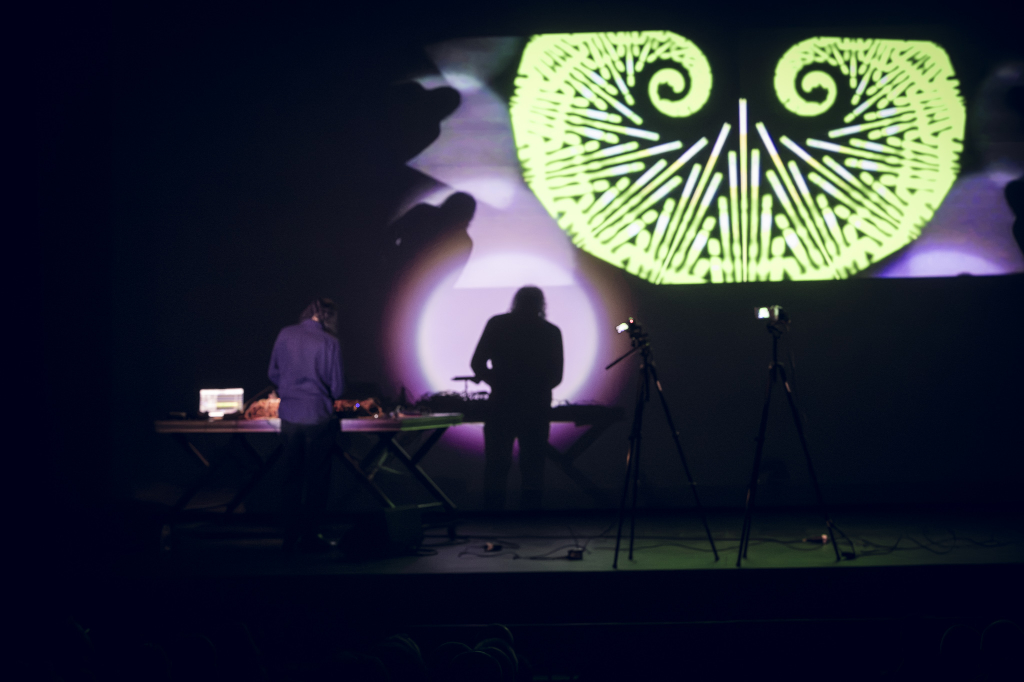
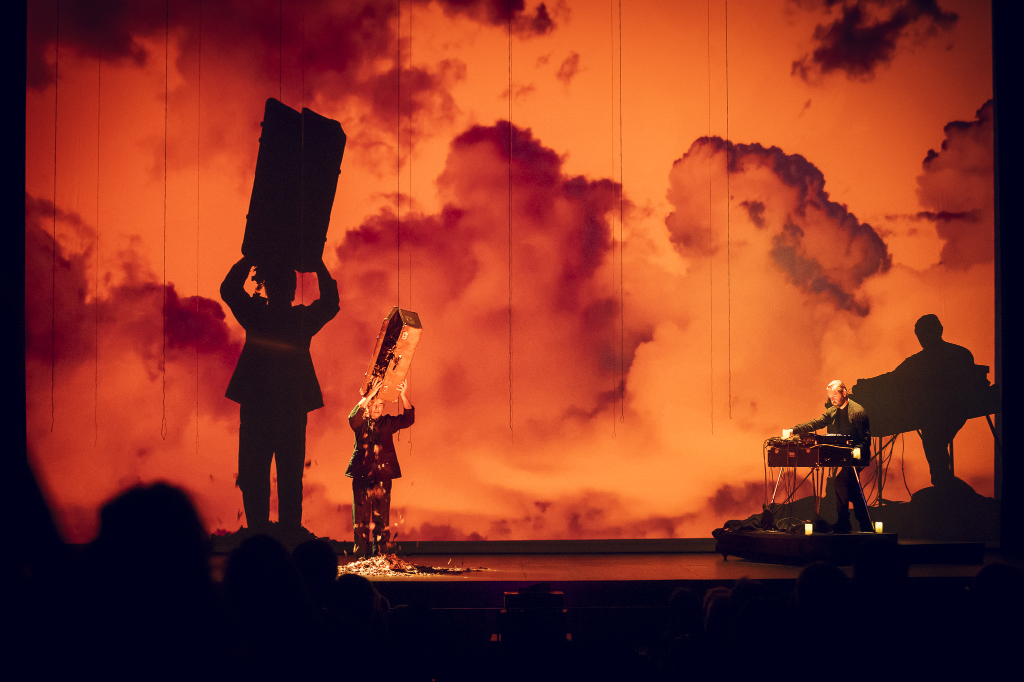
It was time to draw on the idea, discussed jointly by researchers Manuel Bogalheiro & Júlia Durand in the Music, Media, Affections talk, that music influences how we perceive images, while, due to cultural and evolutionary inaction, sound is undervalued compared with the prominence of the image. In both performances, image and sound were inseparable and could not be ranked hierarchically.
We have rarely come across a performance other than Sam Slater & Guests’ Lunng in which primordial and conceptual elements have clashed in such a way. The vocals, electronic orchestration, wind instruments, and strings drive the narrative of the images within a staged setting. With this album and on stage, Slater sets off on the road, as if retracing the path David Lynch set in Lost Highway. A car’s headlight cuts through the dense tapestry of sound and fog. And the delirious euphoria, as if breaking free from a self-punishing psychosis.
Slater drew on Ece Canlı’s transformative, performative voice, Cavid Dhen’s resonant saxophone and the sonic vertigo of Ricardo Jacinto’s cello for the one-off performance at SEMIBREVE. Whether together or separately, the voice-over narrator Slater navigates the narrative without holding back on intensity, a journey the moving image depicts as a road; yet the car ending up in smoke, having passed the road engulfed in flames, becomes a metaphor for reality—an inexcusable brutality in the best sense of combined art.
On the final afternoon, SEMIBREVE clearly demonstrated how classical chamber music instruments can open doors to the unknown, something we so desperately needed without even realising it. Manto, the piece for cello and electronics that Ricardo Jacinto premiered in the Medieval Hall of the Rectorate of the University of Minho, is an electro-acoustic immersion perceived within the realms of mantle convective currents.
The multitude of converging and diverging sounds associated with the instrument, fuelled by the device’s feedback, creates a tectonic sonic dimension. Beneath the enormous stone rafts we inhabit, we sense a semi-fluid telluric engine, never directly observed. Jacinto has brought a sonic visualisation of this possibility, both forceful and moving in its sonic dramaturgy, accessible to predestined explorers.
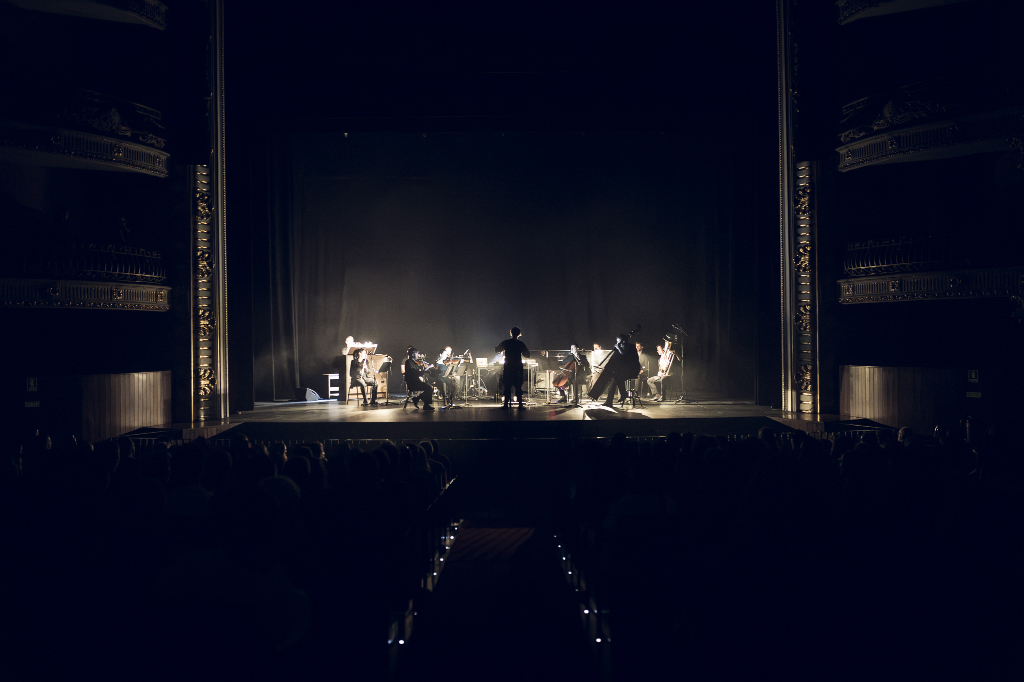
And as the culmination of four days in which electronic sound and visual art served as a stimulus for thought, the final performance at the Theatro Circo featured Saffron on Grey by Christian Fennesz & Oscar Jockel, performed with the Sinfonietta de Braga. A piece for electronics, e–guitar and an expanded ensemble, previously premiered at the Philharmonie in Berlin, which presents the electronic and acoustic elements separately before they merge into a single sonic amalgam. Fennesz creates the electronic composition, while Jockel directs the acoustic instrumental writing and the brass, woodwind, and string sections.
The result is fascinating and transcendent, where the mutability of the sound prompts one to question its origin. Tension and freedom, expansion and restraint are some of the optional paths within the dichotomous frameworks that arise from the system.
The suggestion in the title conjures up images of the life cycles of the most precious stamen flowers, which coloured the grand chandelier in the auditorium a saffron hue. An epic that seemed impossible to celebrate any better throughout an entire SEMIBREVE.