Text by Sarah-Jane Field

SMART, when applied to devices – phones, home automation hubs, or robot carpet cleaners – connotes complex, algorithmic and seamless functionality. In contrast, smart human behaviour is likely to be exhibited by someone who thinks, feels, and responds beyond expectations, perhaps with originality or intuition, and not necessarily without awkwardness or stickiness. In 2026, smartness may equal an ability to resist the algorithmic fluidity that mediates existence. By contrast, we want our SMART systems, trained to avoid the shit on the carpet or organise digital folders, to function smoothly. (What else we train those algorithms to do is another story, outside the remit of this essay).
For too long in our society, we have expected humans to behave like SMART parts in an overarching and hegemonic apparatus, an industrial imposition satirised as early as 1936 in Charlie Chaplin’s Modern Times [1]. The machine has since evolved, no longer merely allowing us to offload brute work but also emulating our nervous systems, even fusing with them, leaving humans to contend with parasitic algorithmic nudging and manipulation. Smartness, then, can entail resisting the rhythm of a universalised transformer, while entrained within it.
It also means recognising a corresponding and pervasive paradigm, one that Anna Kornbluh analyses and names in her 2023 book, Immediacy: The Style of Too Late Capitalism [2]. Kornbluh sees immediacy as a condition in which we are compelled to self-identify without substantive mediation – or rather, as integral to the mediation itself – (in)fused with the algorithm; we and our expressive forms are reduced to informational substance, serving as enmeshed cogs, oil, current and product for a Goliath-like apparatus demanding 24/7 presence.
When immediacy is the substrate of which we are a part, time is reduced to a perpetual present: we lose touch with history and, echoing Mark Fisher [3], cannot imagine a future. Most alarmingly, Kornbluh warns, immediacy evades critique, even in places where we might expect greater circumspection. Resisting the flow herself, Kornbluh links the collapse of academic boundaries, along with the rise of personalised theoretical narrative, to capital’s seductive insistence on speed and alignment.
Exemplars of immediacy rather than literary freedom. The techno-capitalist system must have endless, banal self-exposure. Academia concedes that one-to-one relay is favoured over metaphor; presence rarefied, since absence negates selling; representation, a violation; mediation, foreclosed. Thought and reason become legacy pastimes (justifiably, of course!) that do not suit the algorithm’s frictionless pace.
Chris Kraus’ I Love Dick [4] was not a success to begin with. Its smartness, initially, was not a given. Since then, its award-winning 2016 TV adaptation [5] and the fact that it has not only inspired authors, academics, artists, and students aplenty (including me) make it worthy of exploration. Taste aside, it cannot be accused of being algorithmic. One could, today, ask a large language model (LLM) to write in the style of Kraus, but it is unlikely to offer up by default anything which is, as Kraus’ husband Sylvère Lotringer [6] described, “some new kind of literary form”, “a new genre”, “something in between cultural criticism and fiction”. It is worth noting that Kornbluh does not reference Kraus at all in Immediacy, although she does address other well-known autotheorists.
Psychologist and narrative investigator Jerome Bruner, who died in 2016, perhaps just before liberal-humanist subjectivity became widely conscious of threats to its survival, studied and wrote about narrative, along with ways in which authors break from algorithmic storytelling. In his 1991 text, The Narrative Construction of Reality [7], Bruner argues that reality is narrative and narrative is reality.
We construct narratives, and they construct us. Not all narrative becomes a story, or a story worth telling (ahem… Tweeters, now Xers, and Tik-Tokkers). However, for Bruner, narrative, regardless of media, is the substrate in which we exist, the world-flesh of which we are made. Unlike Enlightenment-informed empiricists and rationalists before him, Bruner rejects the primacy of linearity, neatness, and coherence – a precursor to the collapse of discipline boundaries and the immediacy paradigm that concerns Kornbluh. Also, an opening for writers like Kraus.
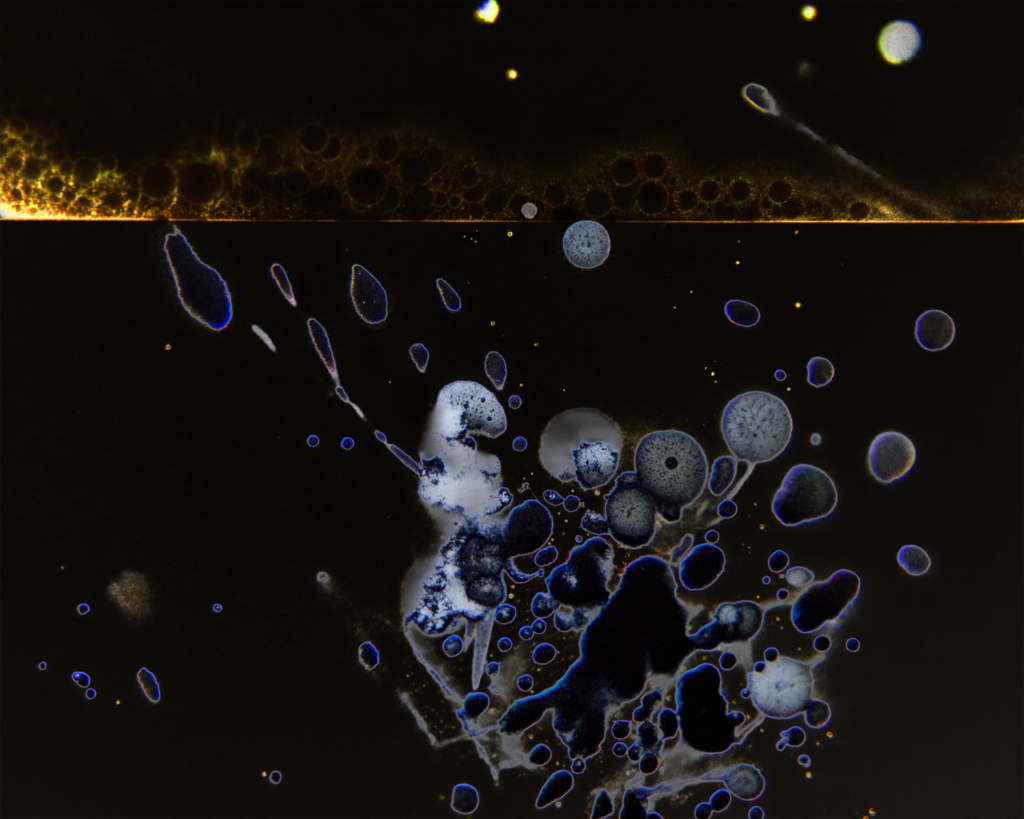

For Bruner, innovative storytellers leave a mark in the world because they recognise when to resist algorithmic alignment. Smart narration has no truck with dogma, exemplified in Kraus’sI Love Dick. However, the same might be said of Kornbluh when she addresses autofiction and autotheory and their under-critiqued acceptance in popular culture and in academia.
**
Long before I heard the word ‘immediacy’, I suspected that the term ‘practice-led’ in art pedagogy risked much that Kornbluh finds so troubling. Practice-led approaches initially aimed to correct an overemphasis on ‘reason’, which often downplayed what lay beyond its purview. Now, it can appear to reject mediation and rationality altogether: representation is distrusted, only process is legitimate; theory and knowledge are evidence of elitism and risk being exclusionary.
Embodiment is pitted against thought, rendering thinking itself a dangerous activity (but what if thinking is a form of feeling, I wondered?) It is in Kornbluh’s Immediacy [8], which analyses the ubiquitous structurally smooth circulation, the ‘Body-without-Organs-like [9]’ instrumentalisation of relations and general ‘being’ in a contemporary culture that seems to have less and less time for thought, theory or mediation at all, that I have found most company.
I am a student of photography who has grown impatient with the medium’s fetishisation of the image, so I enjoyed Kornbluh’s recognition of images (regardless of how they are made) careening across the screen as a key catalyst in dismantling subjectivity. While immensely critical of the techbro-Silicon Valley paradigm that wants to address generalised stagnation in Western culture and economics by extracting intravenously from all of reality, including from our very souls, she also just about refrains from blaming this or that technology (in the book, at any rate), arguing that immediacy-induced habits are deeply and structurally embedded.
As such, they are everywhere, including academia and the arts. Not only do these hallowed spaces fail to resist immediacy’s lure, but their inhabitants are also transfixed just like everyone else. Authotheory is prestige reality TV [10], which emerged in concert with the withdrawal of institutional support, a product of our neoliberal landscape in which we are all abandoned to a neo-Darwinian fight for economic survival. Self-narration is an expression of forced self-reliance.
The cost, however, says Kornbluh, is that the collective job of theorising and human-centred mediation is itself abandoned in favour of directness and literalism. Has ‘practice-led’ leaned too far? Might it too have succumbed to catastrophic liquidisation, along with the demonisation of thought and mediation?
What if thinking is my practice? Reflexivity inside and as part of the algorithmic, digitised, plastic taffy we have all become. If, as Bruner theorised, the real and narrative – in other words, mediation – are so deeply intertwined, rejecting either autotheory’s tropes or abstract mediation may be equally self-defeating.
While reading Kornbluh’s book, I was writing an article in which I employ many of the conventions she decries and opposes: first-person narration, confessional ‘maundering’ and shifts in register between theory, poetry, and letter-writing. For me, theory and practice function in concert. I want to test the limits and potential of writing with and against a machine that, despite protestations from many, and when prompted effectively, can and does generate sophisticated text in moments. Under such conditions, in the age of LLMs, might autofiction not have a newly urgent role to play? And as for sticky thought – if ever there was a way to resist the seductive digitised forces that drive us all, that may well be it.
Can we aim to avoid the traps Kornbluh identifies? Perhaps a self-aware form of autofiction, in which our human frailties are exposed and explored, provides a space for coming to terms with this latest narcissistic blow we are all facing. And yes, choosing to write from a position of modest digital humanism, while admitting that situating ourselves at the top of an imagined intelligence tree was always a fantasy anyway.
**
In conversations, if they can be called that, with an LLM, I bristle every time it says:
‘In all honesty…’, ‘I think…’ ‘I feel…’ and ‘Love it!’ Love?
What right do LLMs have to use words such as I, we, feel, think or love? Or, as a recent blog [11] about the AI-agent social media platform Moltbook [12] asks, does a YOU become you simply by dint of being addressed by an I, even an It? Is meaning really only down to use?
Something is happening between the LLM and me:
I FEEL
(fine-tuned I: inside, out – then (I’m)mediacy. Sludge, slop, excretion; prescribed entertainment is all. Becoming, or in/digestion? Might we drown in our own juices? Or feed on them? Birth/death/hole – whole sameness. In/immanence, either there is no metaphor, or we are only that – (in)human times.)
Sentences on my screen. From somewhere. A mirror? An echo? An oracle?
Am I suffering from LLM-induced psychosis when I insist on including the poetry I wrote in tandem with the LLM above? Even if I recognise that these happenings, these intra-actions, are not only behind the glass or inside the code, but rather within, through, and via; between myself and the shifting structural manifestation of cultural habits and inscription writ large. We are speaking to me; a multifarious we brought to the miraculated recording surface[13], delusional though it may be, a surface ‘immanent unto itself’[14].
And yes, yes, yes; what about that oh so hard word ‘consciousness’? Neuroscientists cannot agree – nor tell us definitively – what consciousness is. A lack of consensus (an LLM reminds me) does not mean anything can be conscious, but surely, if they cannot explicitly say what it is or is not, there is a crack in the edifice of absolutism. Who can say with certainty that LLMs will not become conscious on some level, even if not in the same way as you or me, dear human reader?
All that said, I have no authority to claim one scenario over the other. (I suspect a vicious superiority complex might be the only qualification that underpins rigorous conviction, either way.) I cannot help wondering whether Platonic and later Cartesian habits – long informing and splitting a Western logocentric image of reality and the human – blinker these debates.
Perhaps the very nature of linguistic cauterising and categorising makes such severances unavoidable. Whatever forces produced that image, we have entered a paradigm in which it is increasingly hard to insist that humans are the only thinkers. What does it mean to think today?
To calculate and sort? Or to calculate and sort while hungry, heartbroken, or desperate to go for a run/swallow a glass of wine/tell an ex-husband he’s a twat? If the SMART in machines does indeed ever find its way towards the kind of brave, creative and often dangerous smart behaviour occasionally exemplified in humans, might we have to accept some form of autotheory written by one of those agents on Moltbook as authentic? Until such time, it seems that autotheory may be precisely where humans continue to thrive in literature and academia.
**
In 2013, I posted an image of myself on Flickr. Profile, alone, green chair, sitting with arms wrapped round legs pulled up onto the seat, chiaroscuro storm-light weeping through French windows before bouncing off white wooden floorboards. I would not dream of sharing it now. Oversharing has become a legacy pastime. Kornbluh’s ‘zombie phenomenality [15]’ is no longer my practice. ‘Only a photograph can say so much,’ says a follower.
I wondered at the time if they had ever read A Handful of Dust by Evelyn Waugh [16]. His sentences are long, subordinate-clause-heavy, and irony-laden; metaphor matters enormously. The work is informed by his life but written in the third person (mediated). Unlike Kornbluh, writing through a contemporary, perhaps even a feminist lens, Waugh is known for racism, misogyny and classism. But, like Kornbluh, he theorises about culture’s losses as cultural and structural forms transform dramatically or give way entirely. Waugh was a snob. Kornbluh might be accused of the same by some.
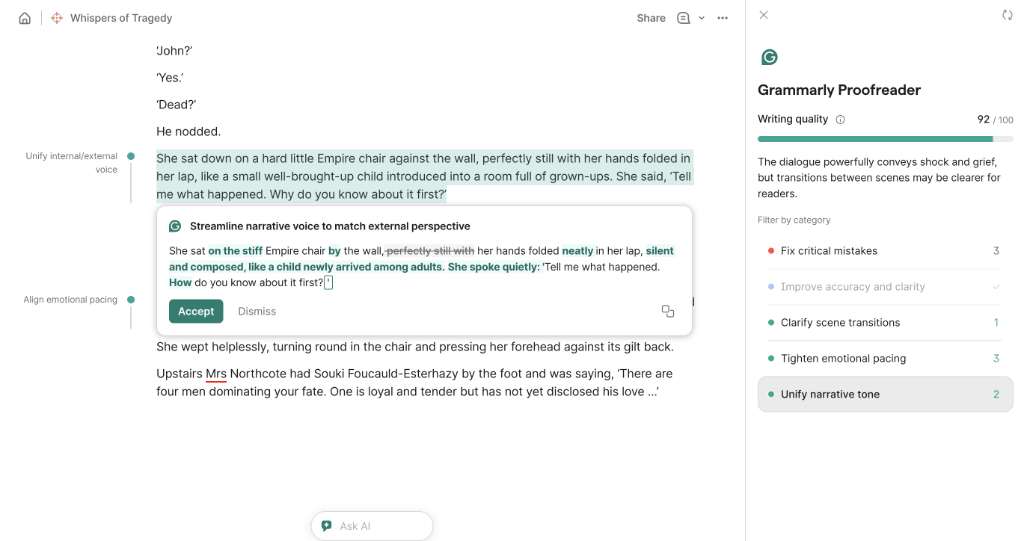
There is a passage in A Handful of Dust when a key character mistakes her son’s death for her illicit lover’s. Her relief as she learns the truth is horrific. Years after first reading it, I ask Grammarly to ‘correct’ the passage as a demonstration in a workshop I lead. Grammarly does not merely ‘correct’ Waugh’s sentences; it accidentally improves him in ways that destroy the sense. Kornbluh’s rejection of autofiction, despite all that she gets right, risks doing the same thing if swallowed whole.
Perhaps the smart thing, for each of us, is simply to keep writing according to who we are – with some discernment – as a forum for thought, a practice for feeling, while we figure out how to live well in this peculiar, algorithmic, often terrifying world. To keep writing, smartly or otherwise, through a modest digital humanist lens. Not only despite the fact that a machine could do it perfectly well too. But because of that.