Text by Joey Holder
Social media platforms have become the primary infrastructure of public discourse, increasingly shaped by AI-driven systems whose logic operates beyond public scrutiny. Recommendation algorithms sort and amplify content not toward shared understanding but toward engagement, collapsing distinctions between signal and noise, representation and effect, producing a swarm of partial signals, fragments, vibes, memes, tangents and distortions. This produces a state of narrative chaos in which digital networks have destabilised structures of shared meaning.
The internet, once imagined as a vast democratic commons, now resembles something else entirely: a space increasingly animated by machine exchanges whose logic is ever more black-boxed from our understanding, with generative systems playing a growing and largely unquantifiable role in shaping collective sense-making [1].
On platforms such as X, TikTok, and Meta’s networks, content is no longer produced and circulated by humans alone; AI-generated accounts, automated bots, and algorithmically optimised content operate alongside and increasingly indistinguishably from human exchange. These conditions can be understood through the lens of Multi-Agent Systems (MAS): networks of interacting computational entities that pursue individual or collective goals through collaboration, coordination, or competition, producing emergent behaviours that no single actor designs or controls [2].
This article traces this condition as both an intellectual and a creative problem. What happens to narrative when the digital environment actively constructs irreconcilable realities? Can the breakdowns, the noise, the moments where coherence refuses to arrive, be understood not as failures but as different kinds of signal? Drawing on creative work by Y7, Silvia Dal Dosso, and me, Joey Holder, it explores how artists operate within this entropic terrain, navigating systems in which coherence itself has become a contested condition.
The fact that narrative has become a fashionable topic in art criticism, media commentary, and popular discourse signals its fundamental weakening [3]; we theorise what has already slipped away. Throughout history, story has been our primary means of making sense of the world, not representing reality so much as constituting it. We previously couldn’t see the narrative, because we were inside it.
Narrative is shared, contested and revised, but fundamentally a human negotiation. That negotiation has now been outsourced. The platforms organising the majority of human communication rank, amplify, suppress, and predict; storytelling becomes an object of optimisation, shaped by systems operating at scales and speeds beyond human deliberation. The architectures that once stabilised reality, governments, institutions, scientific authority, and slow media are eroding [4]. AI-driven systems increasingly augment governance itself, particularly in scenario planning and strategic analysis, through agent-based simulations and semi-autonomous decision-support tools.
The digital environment is increasingly organised by Multi-Agent Systems (MAS): networks of interacting computational entities operating within a shared domain, each pursuing individual or collective goals through collaboration, coordination, or competition. Unlike older computational structures, with centralised control, MAS feature distributed decision-making, enhancing their potential for accuracy, adaptability, and scalability across large-scale, complex tasks involving hundreds or even thousands of agents.
Since 2022, agents have become ever more LLM-powered, capable of understanding and generating natural language, marking a fundamental transformation in how multi-agent systems operate [5]. Where earlier agents were explicitly programmed to work together with a central controller, Multi-agent Systems learn to cooperate, or choose not to, producing authentic complexity in which they can disagree about facts, interpretations, and goals without any guarantee of convergence [6]. As AI agents trained on different datasets begin to communicate and evolve together, we witness the emergence of autonomous semiotic ecosystems that respond to feedback and adapt their behaviour without direct human control. When this happens and meaning-making becomes self-sustaining by the network, what exactly are we needed for?
If meaning is no longer produced by human minds but is distributed across interacting systems, then agency itself becomes a site of contestation rather than a stable property. Here, is the human the author of the narrative, or have we become one participant among many, contributing prompts, constraints, and intentions, but no longer in control? And if control was always a partial fiction, does its erosion constitute a loss, or a revelation?
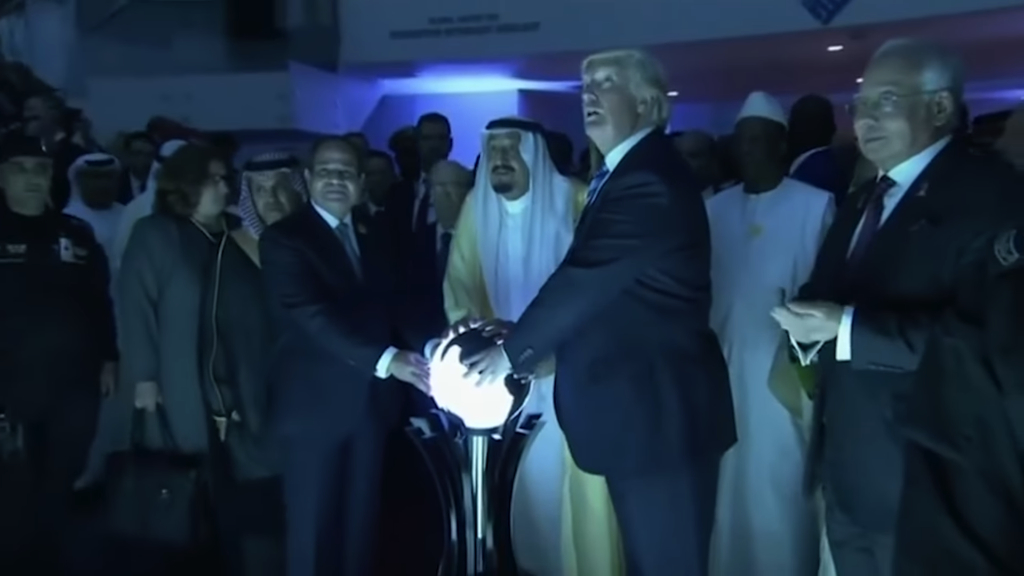
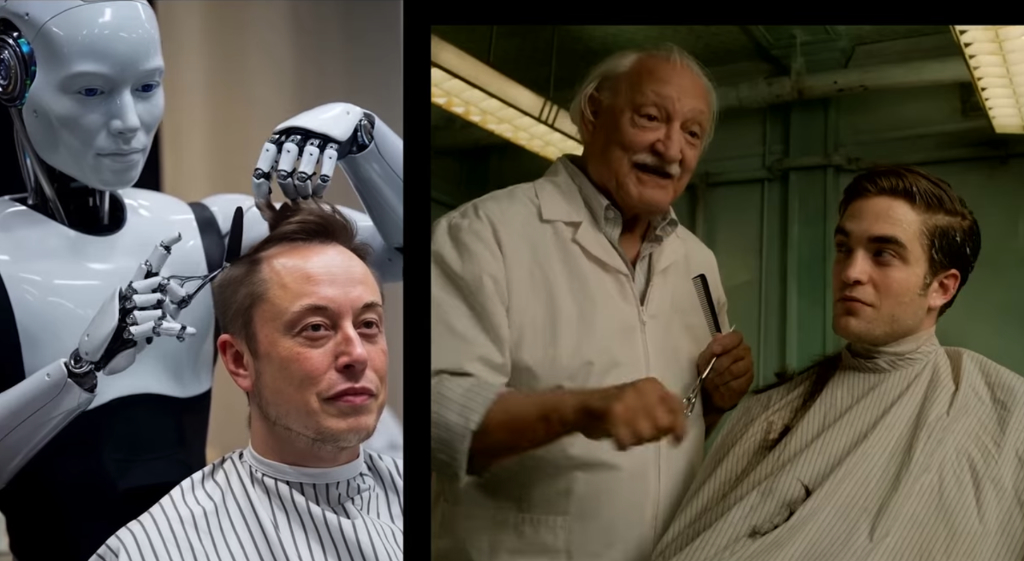
Increasingly, we live in a world where nothing makes any sense, our actions don’t matter, so opens the third film of Silvia Dal Dosso‘s trilogy The Future Is Weird AF (2023–2025), the words delivered by an AI voice clone of Adam Curtis, the figure who historically explained power back to us, now automated. The work positions the artist not as a critic standing outside, but as someone dissolving into it, both a doomscroller and an archivist.
The trilogy’s structure is associative and emotionally saturated, enacting the feeling of sense perpetually deferred. The style of this type of online filmmaking has a name: corecore, in which creators stitch together video fragments to trigger a specific emotional response rather than follow a linear narrative. Corecore, originating on TikTok, commonly explores feelings of isolation, meaninglessness and the mental health struggles associated with the human experience of being terminally online.
In Silvia’s films, characters including Donald Trump, Elon Musk, and Slavoj Žižek appear to have willingly surrendered to something outside themselves, forces that control their moves in ways they don’t understand. Cutting between news footage and AI-generated imagery, the distinction between human intention and algorithmic production becomes impossible to locate. The powerful appear simultaneously dogmatic and bewildered: are they authoritarian figures, or themselves puppeted by their belief in a system to which they have ceded control? The film’s narration arrives at its diagnosis directly: “that led us to become non-player characters” [7] states AI Adam Curtis’ voice. NPCs, for short, game characters, blindly follow a scripted procedure, with no will of their own.
The film enacts the collapse of the conditions that the narrative requires. The traditional scaffolding of story, a teller, a listener, a shared world, has been quietly replaced by something that resembles narrative in form, while hollowed out of its function. The question is not simply whether the system fails to narrate social life, but whether this displacement is intrinsic to the kind of system being depicted. The film recursively enacts what it theorises: cut from fragments, AI-generated material, news footage, and archival detritus, its form mirroring the conditions it examines.
But Dal Dosso’s work suggests something beyond diagnosis: what if the diffusion of meaning is not failure or breakdown, but an emergent property of systems in which no single agent oversees the whole, and new behaviours arise as the unintended consequence of partial, situated actions? Where internet bot activity and algorithmically generated content increasingly displace human exchange, the emergent properties are not simply noise, but may constitute something stranger: a language that is not for us, assembling itself in the gaps where a human public once was. Not a failure of communication but a different kind of communication entirely, one that does not require us to function and does not pause when we stop listening.
In 2016, this was given a name: the Dead Internet Theory. While the term originates in conspiratorial vernacular [8], its concerns now align with statistical reality, with data [9] showing that in 2024, bots accounted for 51% of global web traffic, a figure likely to be far higher today in 2026. These bots are increasingly designed to interact with other bots, not humans.
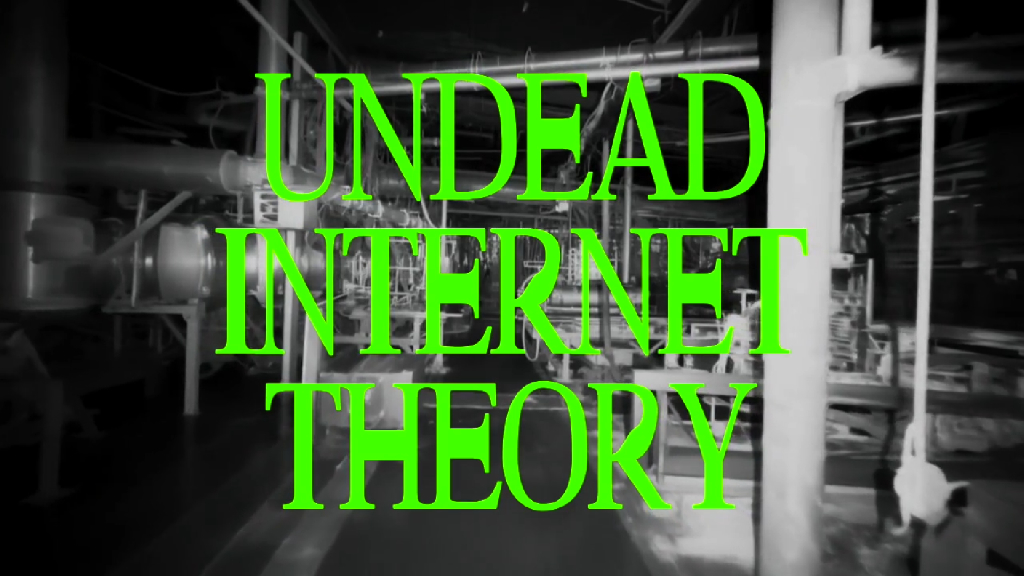
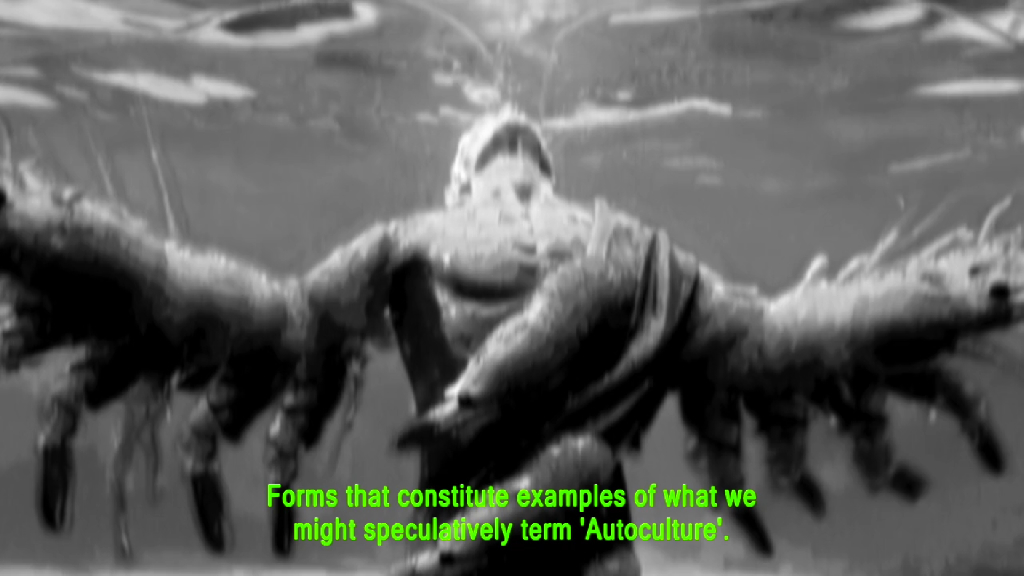
Post-disciplinary duo Y7 created the video essay, Undead Internet Theory, extending this notion and suggesting that the internet-of-agents may give rise to “undead autoculture”: cultural objects produced through the interaction of multiple artificial actors with little to no human initiation. Drawing on the concept of the Undead Internet as discussed by Eddie Mitchell in 2024 [10], the series of discussions that make up the artwork propose that the internet is neither fully dead nor fully alive, persisting in a strange intermediary state animated by machinic exchanges that generate the residue of culture without requiring a stable human public to receive it. Through a series of interviews with early computer scientists, artists and leading researchers in digital culture, it addresses a central question: was the Dead Internet deliberately orchestrated, or is it better understood as a name for the spreading feeling of alienation, loss of agency, and disconnection that now characterises life online? [11]
Both artworks operate by leveraging storytelling while simultaneously questioning the crisis of storytelling itself. Rather than seeking to resolve that crisis through a return to stable consensus-making mechanisms, they operate productively within narrative instability, acknowledging that the crisis of storytelling is also a crisis of agency, and that the question of who or what is doing the narrating has become central to any practice that engages seriously with AI agents and their role in shaping shared epistemic environments.
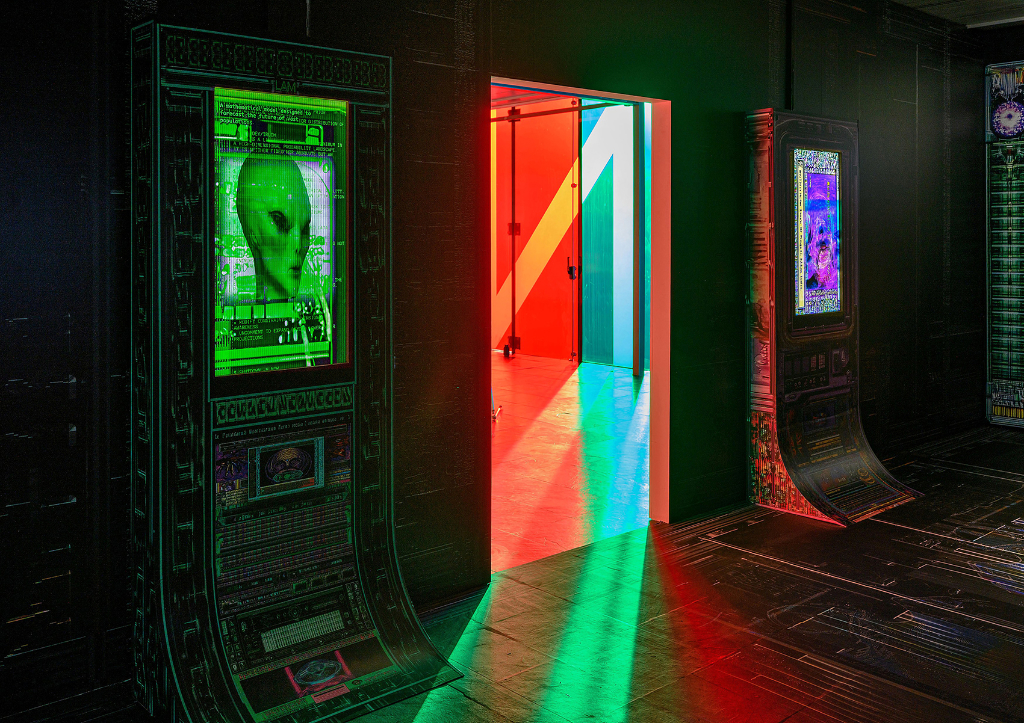
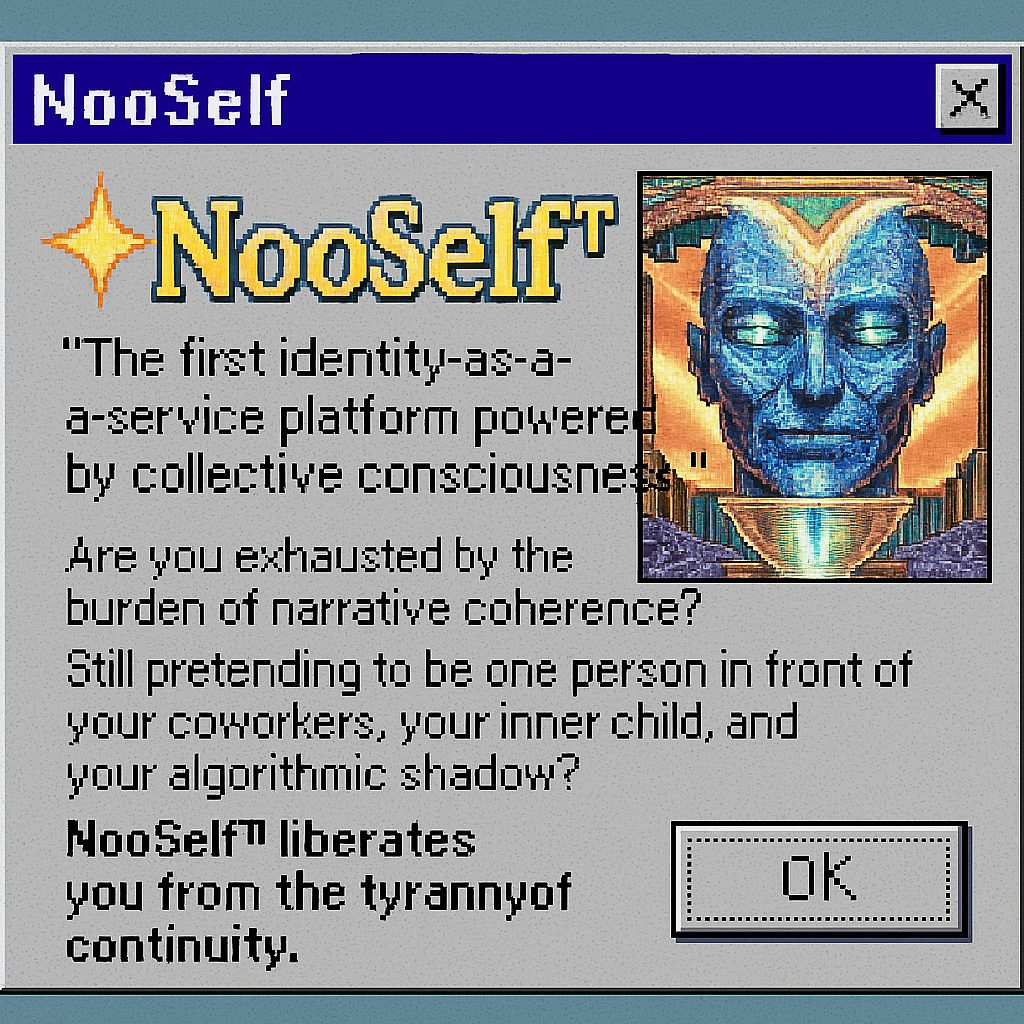
The Woosphere (2025) is a recent project of my own making, which also inhabits this narrative chaos, using this staging as an active environment. Set within a fictional place called ‘WooWoo Land’, a degraded satirical reworking of Teilhard de Chardin’s Noosphere, the work forges an exchange between LLM-powered AI chatbot characters to suggest that any notion of collective agency has curdled into credulity, distortion, and endless recursion. Commissioned originally for the Vienna Digital Cultures Festival’s ‘Model Collapse’ programme in 2025, and showing at Henry Moore’s Phantasmagoria exhibition, it exists simultaneously as a video installation and live interactive WooWoo.Land, allowing audiences to enter into direct exchange with the AI chatbots.
Each character in The Woosphere operates from an irreconcilable ontological position: there is a a grey alien called LAM who only thinks with maths and logic, a synthetic brain named Cerebral.8, the corrupted philosopher Teilhard.exe, the endlessly recursive Baudrillard’s Echo, and the ancient entity Golem. These characters are not part of a system failure, but they are by design: multiple agents trained on incommensurable datasets, generating meaning that is locally coherent and globally irreconcilable. That uncertainty is not incidental to the work but its central proposition. WooWoo.Land is not a neutral simulation but a distorting mirror, the Noosphere refracted through conspiracy culture. In doing so, autoculture assembles itself in the specific epistemic pathologies of the platforms that host it, their tendency to amplify the sensational, the paranoid, and the spiritually seductive over the mundane.
Multi-Agent Worlding
If Multi-Agent Systems describe how agents interact, they do not fully account for what those interactions produce. As these systems scale, they do not converge toward coherence but generate environments in which multiple, incompatible realities are enacted at once. What emerges is not simply a more complex system, but a condition in which the assumption of a shared world can no longer be taken for granted. This is what I call Multi-Agent Worlding, which recognises that these kinds of environments are not discovered but made, not represented but performed, and often incommensurable [12].
Drawing on feminist science and technology studies, particularly Donna Haraway [13], we can understand these multi-agent worlds not as fixed containers but as things that are active in the production of new and sometimes incompatible formations. Rather than treating this as a failure of coordination, it may be more useful to see it as something productive. When agents don’t fully understand each other, when signals misfire, meanings drift, and coherence refuses to settle, new configurations emerge. The system’s entropy becomes fertile. What looks like a breakdown is also a site where alternative structures of meaning begin to take shape.
But these conditions are, of course, not neutral. They are built from a system that keeps attention fragmented, responses reactive, and collective positions difficult to sustain. In this sense, the erosion of narrative coherence shapes how reality is perceived, negotiated, and acted upon. Rather than trying to restore coherence, the proposition is that these artistic practices might work inside the instability, staging encounters with systems that don’t resolve, narratives that don’t settle, and agents that don’t align. In doing so, they make visible something we are only beginning to register: that much of what now circulates as culture, as discourse, as the texture of shared life, may be addressed not to us, but to other machines. We are, increasingly, overhearing a conversation we did not initiate and cannot fully decode. What it means to have agency within that condition, alongside it, or despite it remains genuinely open.