Text by Eleni Maragkou

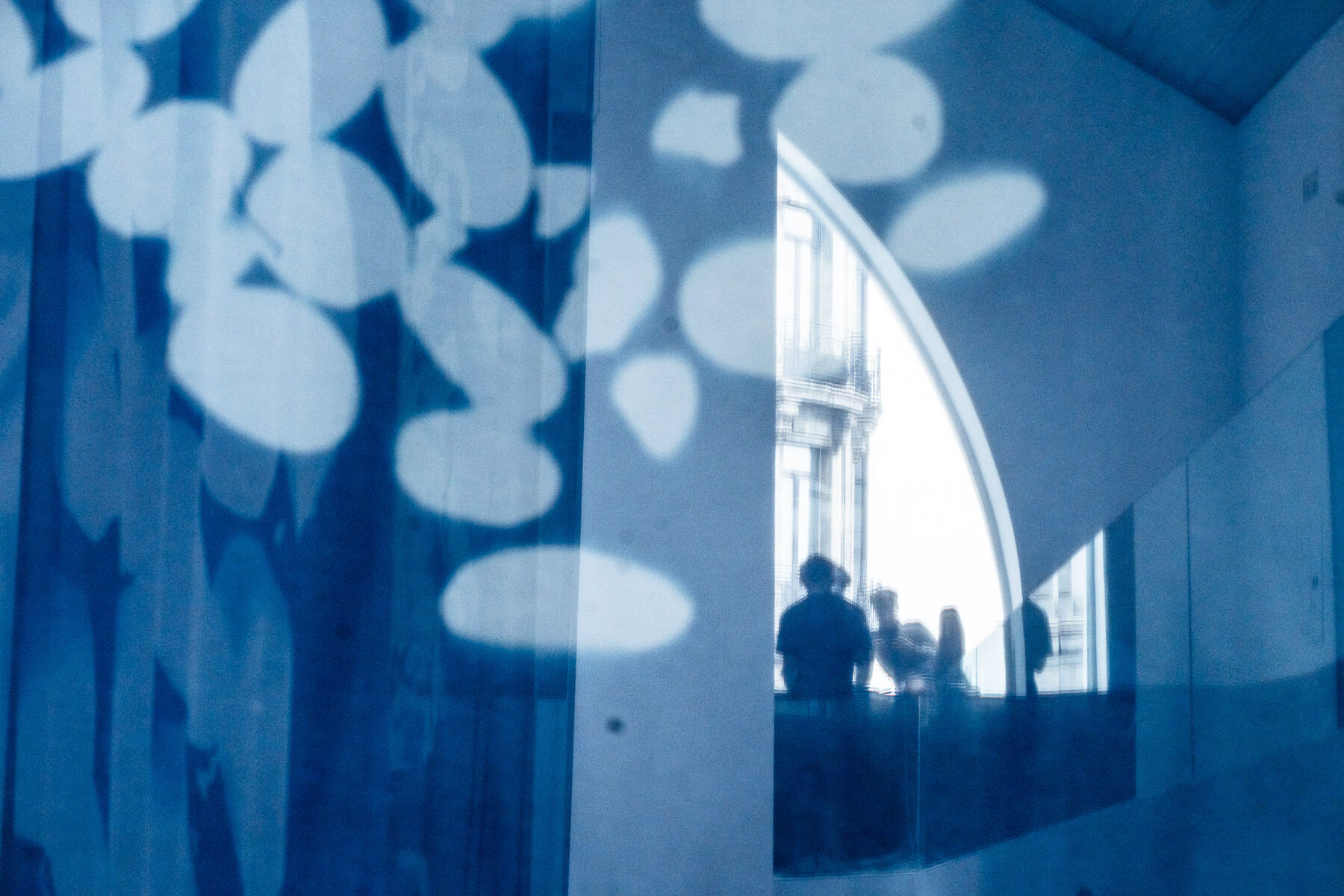
There is a particular vertigo that comes from watching a landscape assemble itself out of other people’s ways of seeing. In Geert Mul’s Horizons (2008), more than two hundred works from the Boijmans collection – each holding a horizon somewhere in its frame – are stitched into a single projected panorama that recomposes with every step a visitor takes. Move, and the sea rearranges.
Move again, and a seventeenth-century Dutch sky slides into the edge of a photograph made three centuries later. The horizon, that oldest promise of orientation, the line by which sailors and painters alike once knew where they stood, refuses here to settle. It is the fitting anchor for an exhibition that is, at heart, about instability.
Pixel Pioneers is the first exhibition Museum Boijmans Van Beuningen has devoted entirely to digital art, staged across two galleries of its mirrored Depot – that improbable building of floating staircases and suspended vitrines that has kept the collection visible since the main museum closed for renovation in 2019. On paper, a museum staging its first digital art exhibition in 2026 is arriving some sixty years after the fact.
But the exhibition’s curator, Amira Gad, is after something more interesting than a belated welcome. She contends that digital art is not a rupture at all but a gradual and logical development from video, photography, and new media, and that the museum is uniquely well-placed to make the argument.


Installation view, Pixel Pioneers, Depot of Museum Boijmans Van Beuningen. Photo Credit: Lotte Stekelenburg.
By the early 1990s Boijmans held one of the most significant video collections in the country. The apprehension and excitement the art world now feels toward the digital, Gad suggests, is precisely the ambivalence it once felt toward video and photography. Seen this way, the show is less an introduction to something new than an act of reintegration.
The thread Gad uses to sew it together is the smallest quantum of the digital image, the pixel, running from analogue video through new media to the AI systems of the present. It is a deliberately unglamorous choice, and a pointed one. Around us, Gad notes, has risen the blockbuster “immersive” spectacle, the ticketed room of 360-degree projections that markets an experience rather than an encounter with art. Pixel Pioneers wants to show that this tendency, too, has a history and a grounding – that before the projection-mapped Van Gogh there were artists thinking hard about what a computer image is, and what it might be for.
That thinking begins with the museum’s own building. In the atrium, Gad has hijacked the Depot’s wayfinding screens, the digital signage that ordinarily explains what is held in which compartment, to stage key moments from the collection’s history: Jeroen Jongeleen’s Running a Circle Clockwise, the first website the museum acquired; or the MetaTABI by Maison Margiela and The Fabricant, whose acquisition in 2024 forced the institution into a brave new world of questions about whether a museum may legally hold a crypto wallet, and on whose phone – and, ultimately, what it now means to collect.
The exhibition’s philosophical core, though, lies in the restoration of Horizons itself, which had not been shown in nearly twenty years. Reviving it took more than a year and exposed a truth we prefer to ignore: digital things are not immortal. Software rots; operating systems are abandoned; the sensor that once made a work respond becomes an unmanufacturable relic. Gad likens it to updating your phone, only for an old app to suddenly stop opening. The 2008 original ran on a thermal sensor, then the cutting edge, that no longer functioned reliably in a climate-controlled museum, and on code Mul had written himself on a Linux system that could not speak to modern hardware or handle a contemporary image database.
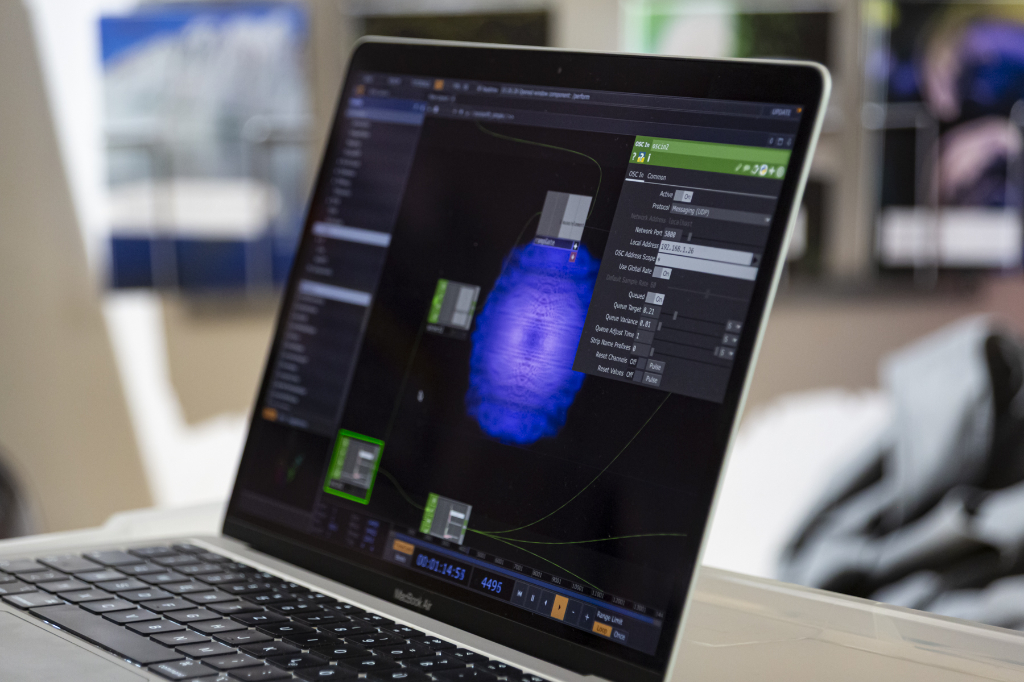
The solution was a hybrid of the two strategies conservators of software-based art now argue over. The team migrated Mul’s original code – preserved intact because it is, as Gad puts it, the artist’s “signature” – onto a more powerful machine. Inside that machine, they emulated the 2008 operating system, so the old code could keep running in a simulation of its native environment. Meanwhile, the obsolete thermal sensor was swapped for a motion sensor.

Van Beuningen. Courtesy of the artist, Annely Juda Fine Art, London, and P·P·O·W Gallery, New York. Photo credit: Lotte Stekelenburg

Consulting Mul, the team concluded that the essence of the work was not the sensor but the interactivity – the fact that the landscape and the sound respond to the bodies in the room. Change the organ, keep the nervous system. The image database, too, was updated with works acquired since 2008, each requiring rights clearance that in 2008 nobody had thought to secure. The result is a work that, Mul notes, will never show the same combination twice; the piece is designed to change.
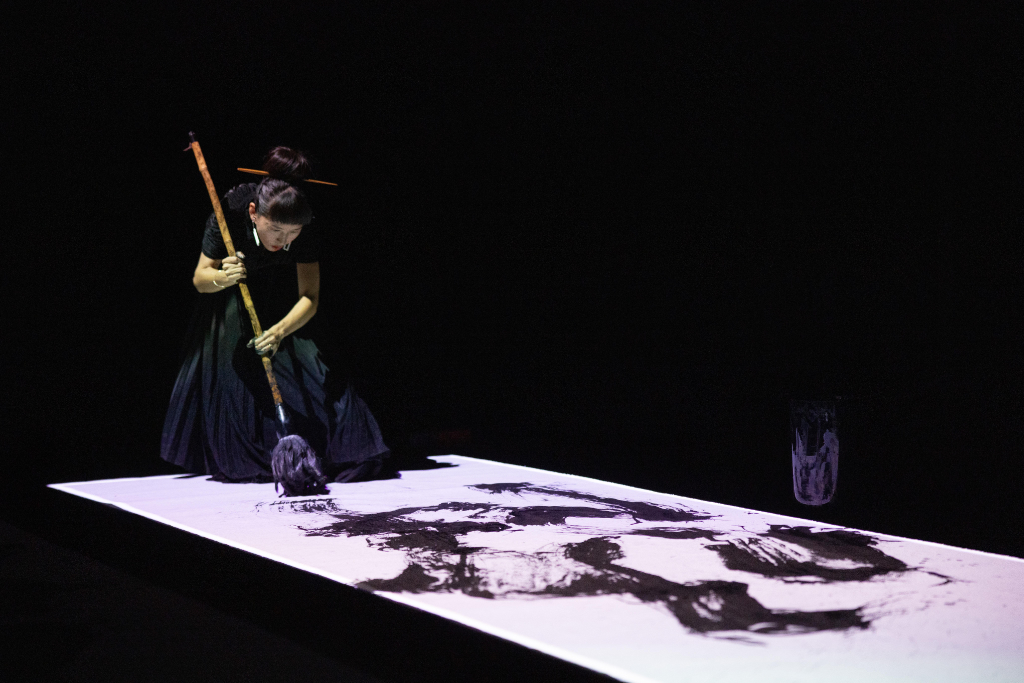
The second gallery loosens into a set of positions rather than a survey; Gad is explicit that the selection is neither encyclopaedic nor educational per se, but a gathering of questions about digital culture. What holds it together is her insistence on the analogue, physical, hand-made substrate of work we often incorrectly think of as immaterial – and on techno-diversity, the deliberate pulling-in of voices from beyond the heavily Westernised digital-art canon.
Christopher Kulendran Thomas shows a new algorithmic painting, generated by an AI he trained himself over years on European modernists, then collaged and hand-painted onto canvas – a Guernica-scaled image of the Tamil massacre in Sri Lanka, an event almost absent from the photographic record. Gad hangs it in conversation with Peter Struycken, who was making computer-assisted paintings in the late 1960s: the same negotiation with the machine – can you make this bluer, remove that – separated by sixty years.
Around them, the gallery fills with pioneers the canon mislaid. Nam June Paik‘s Internet Dweller (1994) gives the newly arrived internet a body of cables and screens, a domestic creature with a nervous system exposed. Suzanne Treister‘s fictional video games, made on an Amiga she worked several jobs to afford, could not be saved in the 1980s and survive only because she photographed them – images the museum has now reconstructed, which Gad rightly calls another kind of restoration; her recent tarot deck, mapping blockchain and Web3 through esoteric imagery, hangs as the same artist’s bookend forty years on.
Feng Mengbo‘s Long March restages a mythologised episode of Chinese revolutionary history as a playable game whose soldier is Super Mario, hurling not grenades but Coca-Cola cans. Larry Achiampong‘s Gaming Room rebuilds a living room around original Sega and Nintendo hardware, where the physical act of gathering to play becomes, for a Ghanaian migrant to the UK, a story of community and control from a position of vulnerability.
Claudia Hart, an architect by training and a pioneer of digital feminism, turns a whole room into the ruins of a crypto empire – Bitcoin and McDonald’s as fallen dynasties – its patterns drawn from Jacoba van Heemskerck‘s stained glass, on the wager that when the empires fall, what remains is art and culture, and mostly the feminist voices within it. A Commodore 64 and an early portable computer sit in a vitrine nearby, as stark reminders: these works were made on these machines, boxy and unslick, not the flat glass we mistake for the digital’s natural form.
Returning before Mul’s endlessly recomposing panorama, I consider how thoroughly the exhibition resists the flattening its own subject invites. It preserves what was designed to change and admits the strangeness of doing so. Declining the easy sublime of the immersive spectacle in favour of something more nuanced, it argues that the pixel has a history and that computers can indeed write a kind of poetry. What lingers is the horizon itself: worth chasing precisely because it keeps moving, receding a step for every step you take toward it.