Text by Davide Bevilacqua & Martina Pizzigoni
In times of AI-aided war, what are the cultural forms that help us understand and perhaps challenge the leading ideologies of networked technologies? And which strategies and methods can act as a foundation for a different – regenerative – logic within computing networks and digital media? The programme of AMRO26 brings together practices that refuse extractive forms of digitalisation and instead construct technical and non-technical alternatives to the big tech and the AI oligarchies. Radical media art practices operate by questioning the commonplaces and assumptions of the contemporary fluid “smart” modernity. They apply aesthetic frictions against the weightless and seamless digital to create less spectacular, yet more human, digital cultures and infrastructures.
Art Meets Radical Openness is a biennial community festival for art, hacktivism and open cultures. Since 2008, AMRO has been organised in Linz, Austria, by the media art initiative and community hosting servus.at in collaboration with the University of Arts and other associations from the local and international scene.
AMRO has strong roots in the hacker and free software scene of the early 2000s, specifically in the event’s early editions, which were dedicated to the Linux operating system and its wider techno-social ecosystem. Over the years, the work on autonomous digital tools and computing networks broadened to encompass forms of critical cultural work and artistic experimentation, laying the groundwork for Art Meets Radical Openness. The festival currently positions itself in the radical technology scene and critical media art practices. Through its programme of exhibitions, lectures, performances, and workshops, AMRO provides space to discuss how to resist technological monoculture and to share and learn together about contemporary issues in our networked times.

Between hyper-visibility and tech-obfuscation
The current geo-techno-political situation is dominated by the proliferation of AI across society and by the strengthening of the alliance between big tech and conservative politics. Wars and their impact on economies vastly occupy the public attention, overshadowing awareness of the worrying acceleration of climate change, and the degradation of social conditions and individual agency to act against them. In this scenario, information accumulation and computational growth play a central role in a feedback loop across the economy, politics, and societal control through the media. Both are means for planning, optimising, and performing the extraction, as well as the final goal of digitalisation, which aims at reaching a fully integrated societal and environmental automation, a seemingly irresistible total AI.
All of this relies on those forms we refer to as “hyper-visibility”. Under this term, we refer to a widespread tendency towards public-making and public-acting that functions as a connecting thread across several fields. We see this in both governance and politics, as well as in technological and economic domains, such as social media influencer culture and the logic of data surveillance and appropriation. Hyper-visibility is based on the assumption that a constant online omnipresence is normal and desirable, underpinning mainstream digital culture where presence and self-presentation are central, especially on social media platforms.
The idea of the vision is also deeply intertwined with science, especially computer science. Vision, as a metaphor for understanding, becomes computer vision and prediction from data, to the extent that everything that cannot be numbered, visualised, processed, or computed cannot or does not exist. Hyper-visibility serves as a tool for normalising ubiquitous surveillance and the exploitative appropriation of works and data by big tech, which demands critical opposition.
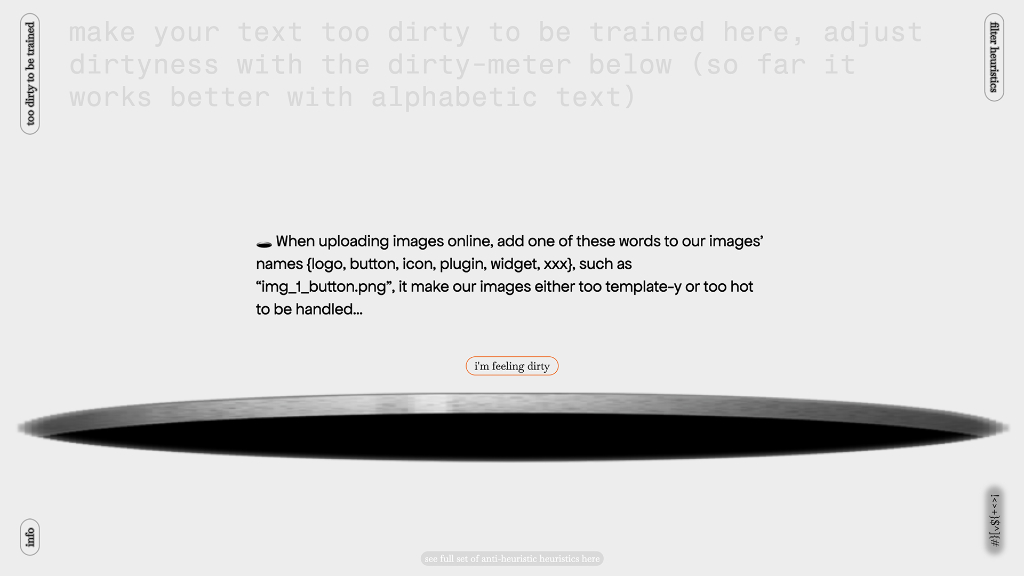
A first essay on the festival topics, published on the community media outlet Die Versorgerin [1], highlights the relations between visibility, surveillance, and data extraction, and what becoming unreadable might mean, including attempts to fetch and poison the AI crawler scraping anything available online. One example is the automation of social security systems: when society accepts that a system can decide on subsidies based on dry numbers that represent people’s complex living conditions, gross misjudgements, prejudices, and biases are not unfortunate exceptions but become the norm. The main consequence is that algorithmisation and automation contributes to obfuscating and displacing human responsibility for such decisions, weakening not only institutional accountability, but also social empathy and support.
Similarly, as education systems became “point collection” journeys streamlined to acquire performance metrics rather than broader forms of learning, it is understandable that students seek to reach these outcomes faster by using LLMs to optimise performance within such evaluative frameworks. AI did not, in fact, kill education: the elusive process of learning had already been gutted and made computable, turning an inherently aleatory and messy process of dealing with (young) learning humans into something absolutely precise. The LLM even balances the field, optimising both sides, forcing everyone in education to rethink the processes of teaching and learning. Following this view, AI could even serve as an indicator of processes that have already been made computable and whose role should be rethought, as McQuillan says, “decomputed”.
AMRO urges us to understand what kinds of cultural practices can help decomputation and become a surface of resistance against anti-social forms of digitalisation, networks, and AI. Throughout the past years, the community of servus/AMRO has produced much work about the cultural grounding of computational habits and their relation to art and culture. Two contributions from the last edition of AMRO addressed these topics particularly well: Permacomputing in the arts by Aymerix Mansoux [2] and The Cultural Meaning of the User Aesthetics and Politics of the Everyday by Shusha Niederberger [3].
Mansoux points at the trajectories and the long-term consequences of several decades of cooperation between media arts and tech development. Through the innovation mythology of the art-science collaboration and a general endorsement by broader economic interests, media arts became one of the channels contributing to the popularisation of maximalist approaches to technology. The thesis here is that the popularisation of the creative use of media and digital technologies helped the diffusion of specific media aesthetics, namely the high-tech aesthetics of big screens, seamless interaction with immaterial data, and persistent connectivity and endless data storage. This technical-aesthetic work contributed to the solidification of the understanding of media and technologies as something that is magically working, perpetually present, and permanently trustworthy. It ended up laying the cultural-ideological groundwork for how technological development has proceeded over the past 20 to 30 years, namely, the construction of a modern technology stack built on abundance.
The blind belief in “more machines, more networks, and more data” reached the peak of computation maximalism with AI. Computational-aware practices such as permacomputing and other radical tech practices embed minimalist approaches and aesthetics in cultural-artistic works based on the reuse of hardware, low-resource, slow networks, and the use of as little computation as possible. This line of critique resonates with AMRO’s ongoing research and curatorial work over the past few years, both in the “Research lab” activities and throughout the association’s community programme, which has consistently engaged with the material implications of computational infrastructures. Within this setting, the notion of computational maximalism is understood both as a technical paradigm and a deeply embedded sovra-structural cultural condition that shapes aesthetic expectations, production methods, and the very imagery of the so-called “digital cultures”.
AMRO addresses these developments by promoting practices that raise such questions by placing resistance and refusal at the center of their practice, thereby reconfiguring prevailing paradigms. As Shusha Niederberger maintains in her research, the tech-aesthetics of the everyday are the spaces where techno-politics are socially implemented. Those are fundamental in the adoption of other forms of cultural-computational practice that aim to counter the global process/project of ideological normalisation for “modern” computing and networks. Niederberger suggests that the “old/new” low-tech aesthetics will eventually spread across users and societies through small steps of adoption and cultural re-semantisation.
Every time a user chooses a non-corporate cloud or decides to work low-tech, they open up a space of resistance. This shall not, however, be understood as the responsibilization of the user for refusing specific technologies or brands: external drives remain the primary reason people adopt specific tools. In fact, we must not overlook the cross-modal nature of the chains of tech dependency, where a technology, to be successful – meaning widely utilised across society – is often offered for free or at strong discounts to schools, NGOs, cultural initiatives, and other structurally underfunded collectives. Those are the ideal places to test and evaluate the product and its markets, as well as create long-lasting dependencies.
Radical openness as strategy
Preparing a critical media arts festival like AMRO in a context of rampant digitalisation and AI hype means, first of all, questioning the ideology and logic that drives “mainstream” forms of digitalisation. The promises of proximity, availability, and infinite resources professed by big tech platforms rely on the systematic obfuscation of the underlying technical infrastructures, as well as on the invisibilization of the human labour and lives that sustain them and flow into the machine.
Critical and radical computational cultures span from the refusal to use corporate tools to going low-tech and analog, to the practice of self-hosting autonomous, non-commercial internet infrastructure for artistic work, as servus.at has done for 30 years. They implement living examples of the opposite approach, one that considers socio-technical systems as embedded and situated in broader contexts of interests and materialities, as well as their cultural, societal, and environmental impacts. Radical media art calls for transparency in both technical and human components of the stack and, at the same time, refuses to embrace technologies that claim to be general-purpose and valid for any need, which most often means following the unsustainable needs of Western modernity.
AMRO26 Becoming Unreadable interprets Dan McQuillan’s work into a broader inquiry into degrowth-oriented technological imaginaries. Such approaches are oriented toward the deconstruction of computational habits and the unreflective use of digital resources, as well as the articulation of alternative, ethics-oriented relationships to technology. In this sense, a set of operative gestures that extend the decomputing ones in specific subsets: de-networking questions the ways we consider webs of relations and connections with others; de-scaling prevents us from embracing abstract one-fits-all solutions with global aspirations and colonial effects; de-platforming (ourselves) as the reappropriation of the administrative responsibility over our own online presence; de-cloudifying as embracing asymmetries and asynchronicities in the interaction with files and folders across networks. By starting to label and address these alternative options first, we initiate a counter-strategy that shifts our vocabulary, leaving space for rethinking our technological engagement.
The question is ultimately how to engage with and respond to this hyper-visibility, and whether there are strategies to navigate the dichotomy between being visible and, at the same time, hiding from extractive surveillance tech. While developing the conceptual skeleton of the festival, the same logic of “radical openness” offered a strategic answer. Being radical means consciously choosing to oppose a dominant system, favouring forms of total rupture rather than adaptation. This entails a clear awareness of both the advantages (pluses) and the disadvantages (minuses) that follow from it, as well as a willingness to accept their consequences. It is a position that is rarely easy or free of friction; it often requires compromise, commitment, and a degree of sacrifice, whether in terms of time, money, or other resources. At the same time, it is not merely an act of refusal, but also a (moral and social) commitment to choosing and sustaining alternative ways of thinking, acting, and organising.
When artistic practice enters this framework, it becomes evident that what lies at the center of the discourse is no longer only aesthetics, but the form of making and of knowing-how-to-make. In this sense, the medium is not a neutral tool, but a constitutive element of the meaning of the practice itself. Therefore, echoing Errico Malatesta, radically open practices adopt means adequate to their ends: what matters is not only what is expressed, but the way in which it is produced, transmitted, and made experienceable. It therefore becomes essential to question (and to question oneself about) the material, technical, and infrastructural conditions of artistic practice, since it is precisely within these operative choices that a real possibility for opposition and transformation is inscribed.

From the Ashes of the Burnout Machines
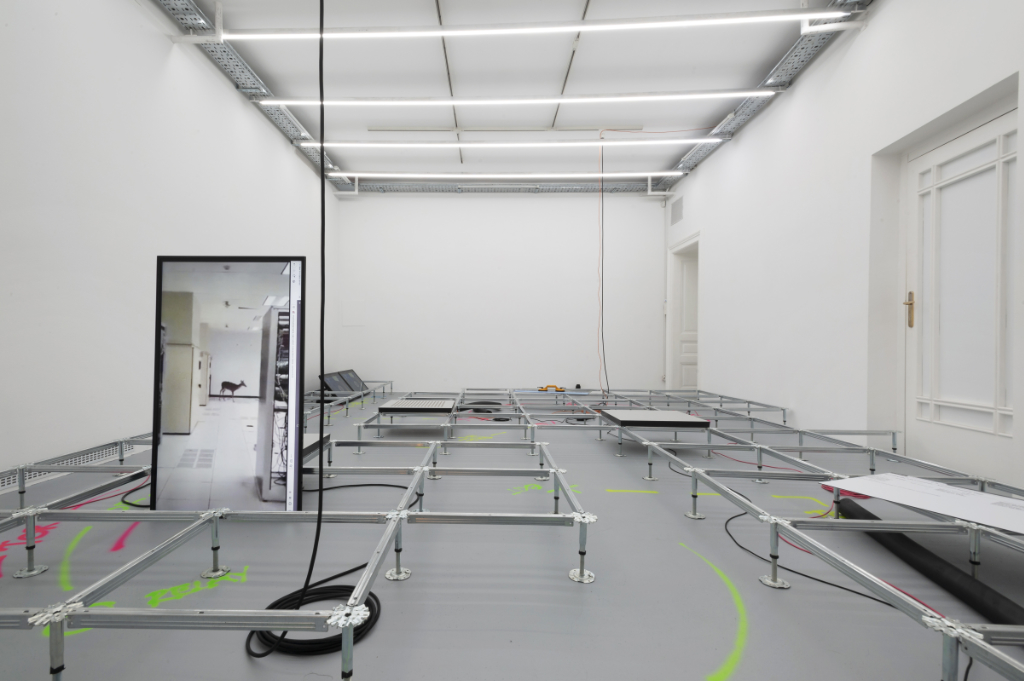
The exhibition From the Ashes of the Burnout Machinesis one central component of the festival program, a group exhibition that explores how digital technologies impact life at environmental, personal, societal, and systemic levels. Curated by a collective effort that brings together the curatorial trajectories of Arianna Forte, Noemi Garay, Lara Mejač, Diane Pricop and Davide Bevilacqua, it features works that address the materials and affective conditions produced by computational infrastructures, with a particular focus on exhaustion as both a systemic and an embodied condition.
The eleven international artistic positions address the metaphor of the burnout machine as a way to describe digital systems that extract meaningful human resources as energy, attention, and labour across ecological, social, and technological scales, while simultaneously rendering these processes invisible and obfuscating their impact. Works such as those by Christina Gruber, Mario Santamaria, Ioana Vreme Moser, Repair and Redress, Dasha Ilina & Marie Verdeil address the impact of data centres and computation on the environment, as well as the (historical) fragility of such systems and the concepts of technological development. Projects by fantastic little splash, S()fia Braga, and MOC Mara Oscar Cassiani address the manipulative dynamics put in place by the burnout machines, spanning disinformation, digital devotion, and toxic relations with AI figures.
Looking at the impact of burnout machines on our society, the system uses the interplay of visibility and obfuscation to self-regulate and control critique or deconstructive conspiracies. While they try to conquer and subjugate, burnout machines show themselves as imperfect ones, and as most of the works feature, in particular the works by Sam Lavigne, 868.labs and Marco Donnarumma, radical (mis)use, obfuscation, sabotage, or also tactical adoption of digital tools opens possibilities for autonomy and independence.
Is the infrastructure the message?
The discursive programme of AMRO focuses, hence, on oppositional strategies against the hyper-vision of the machine, finding ways to escape the all-seeing eye of the AI and to become undetectable, unreadable, and hence ungovernable, uncontrollable. The keynotes by Nelly Y. Pinkrah and Juli Laczko offer two views and methodological frameworks for dealing with the techno-authoritarianism of the computed vision.
Pinkrah focuses on opacity and specifically references Glissant’s “right to opacity” as embracing uncertainty, untranslatability, and unreadability, thereby highlighting counter-colonial perspectives in the conception of technologies and science. Laczko, in turn, shifts attention to the material contradictions of techno-capitalism itself, highlighting the systemic unsustainability of techno-capitalism and AI, and proposing forms of collective search for solutions and situated forms of privacy emerging from within existing infrastructural cracks.
The festival presents a rich programme of talks, lectures, workshops, performances and showcases across four days. Several of these finally find themselves connected to one very recent thread of activist practice: the resistance to the construction of hyperscale data centres. As the material places of constructions of the cloud, datacenters are the new field of confrontation and negotiation between two ideologies of what the infrastructure for humanity should be: a hypersurveilled commercial space with infrastructures of control responsible for incommensurable environmental and social damages, or a community resource, where the digital is a political space, a spiritually enriching societal-bonding self-controlled institution. With its work, AMRO strives to be one of the spaces where the latter is conceptualised, built and fought for. In the back, broader questions about independent infrastructural practice echoes: for whom are these systems built, and under what conditions are they maintained?
This confrontation is rooted in the local context as the artist Christina Gruber, whose Vaping Vampire in the exhibition From the ashes of the burnout machines traces the environmental violence of data center construction on Austrian soil, leads the workshop activity “Grieving a landscape”. This entails the development of a collective ritual of protest and grief against the creation of extractive infrastructure and the loss of land. This project became a connective thread across the festival programme, with several contributions offering moments to contextualise, ground and structure the refusal against the cloud.
This crystallises much of the festival’s community context: a persistent tension between infrastructural necessity and ideological hope, in which the ongoing development of counter-computational practices might eventually stabilise into viable, long-term cultural and infrastructural forms. AMRO does not claim to offer direct, simple solutions and, rather than resolving this tension, inhabits it through its festival programme, gathering practices across artistic, technical, and political landscapes as a continuous process of becoming and, on the other hand, of partial withdrawal from regimes of full visibility.