Text by Leonardo Gabriel do Amaral
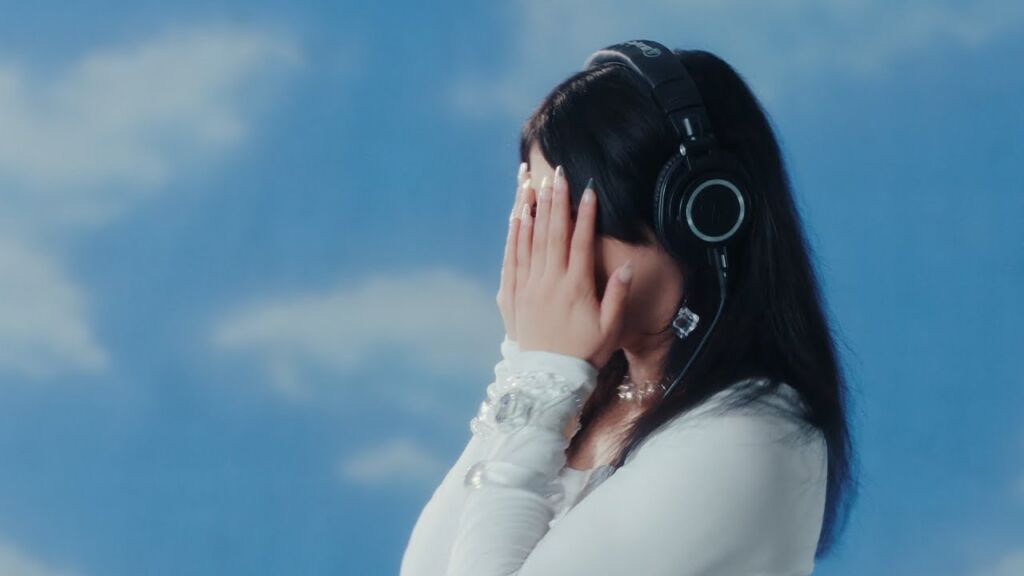
Sometimes, when I’m feeling kind of down, I come back to Jason Farago’s opinion piece in the New York Times, “Why Culture Has Come to a Standstill.” [1] It’s more pessimistic than I usually allow myself to be, but goddamnit, it feels good to indulge sometimes. In it, Farago looks back over roughly the last 160 years of art and argues that, at the start of the Modernist period, artists were driven to “find something new,” to “search for a new language, a new style, a new way of being.” Today, he suggests, that drive has been replaced, or rather, erased. Culture has become a game of critique, response, recycling.
It was already hard to disagree with Farago when the article came out in 2023, in a regurgitated culture of meta-humour, remakes, and sequels. And it’s only gotten worse in the years since, with the advancement of generative AI and social media’s cheap dopamine. Postmodernity feels like an engine running on empty. It’s difficult to imagine a future meaningfully different from the present. Perhaps critique and irony as sustained projects were never viable. Perhaps nostalgia and cultural cannibalism were always doomed.
Or perhaps, as Mark Fisher and, to an extent, Francis Fukuyama suggest, the consolidation of neoliberal capitalism has led us into an economic, political, cultural, and imaginative dead end. [2][3] There is no future, no alternative to make manifest through art. For one or all of these reasons, culture is dead, and the vultures are growing more and more ravenous by the day.
And yet, even when I first read Farago’s piece, there was something in me that resisted this conclusion. Farago himself softens his claim, noting that a recession of novelty does not necessarily imply a recession of cultural worth. He points out that for most of history, artistic production has not depended on constant innovation, citing artists like Bad Bunny as examples of figures who “speak out of parts of the past in a language that is their own.” Still, I’ve always defended a good remix as something that stands on its own.
Art can be hard to dissect as it’s happening. In the world of “fine art”, i.e. painting, drawing, sculpture, photography, the barriers of entry and success are so high that societal and philosophical changes are harder to pinpoint in the moment. Music is different. Its tools for production and distribution are more accessible than ever, and scenes can form, mutate, and dissolve within a few years. What might take decades to crystallise elsewhere can emerge almost instantly in music, especially in hyperpop.
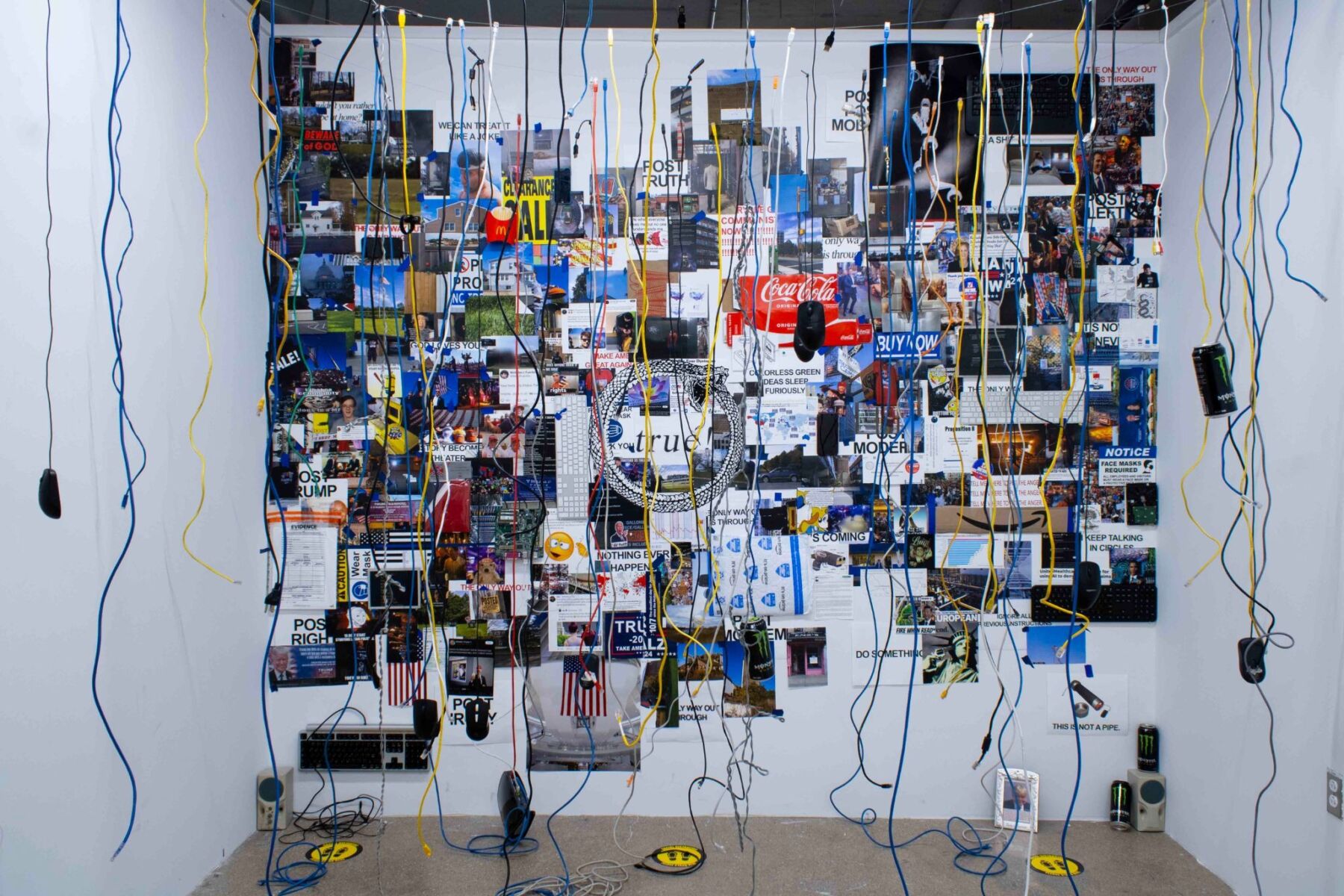
Hyperpop, and now post-hyperpop (as the TikTok fancam and edit producers are calling it), is a genre that captures the 2020s like nothing else. Farago admittedly brings up hyperpop briefly in his essay, arguing that artists like 100 gecs utilise hyperpop as a “Dadaist strategy” to navigate the disorientation they’re living through. As fondly as I remember being 18 and listening to 1000 gecs, I understand this criticism. Hyperpop was ironic, it was overly online, it was absurd, loud, excessive, and saturated with references. But something has changed in the years since 1000 gecs.
The scene has become rich with new talent, sounds, ideas, and subgenres. In more recent work by artists such as underscores, Frost Children, and Ninajirachi, that excess no longer reads as irony. The references remain, but their function changes. They are not deployed as punchlines or empty gestures toward the past. Instead, they are treated as materials still capable of carrying emotional weight. What changes is not the presence of reference, but the belief placed in it.
Before we continue, it helps to define and frame some of these terms and ideas of modernity and irony. Pulling from YouTuber, performance artist, and online theorist JrEG’s video Post-Irony, Meta-Irony, and Post-Truth Satire, there are four stages/levels of irony. [4]
Starting with sincerity, then moving to irony, and then moving to either post-irony or meta-irony, with post-irony portraying the return to sincerity from irony, a sincerity that has passed through detachment and come back changed, that uses the aesthetics of irony to slip past our algorithms undetected, and meta-irony being an absurdist self-referential loop that can only be decoded by those in the know, and even then, may not even have anything to say.
That said, while I think JrEG’s framework was a huge stepping stone, I’d like to offer up my own framework, one that takes into account irony as lived experience, meta-irony as a precursor to post-irony, and the connections between different kinds of irony and periods of modernity.
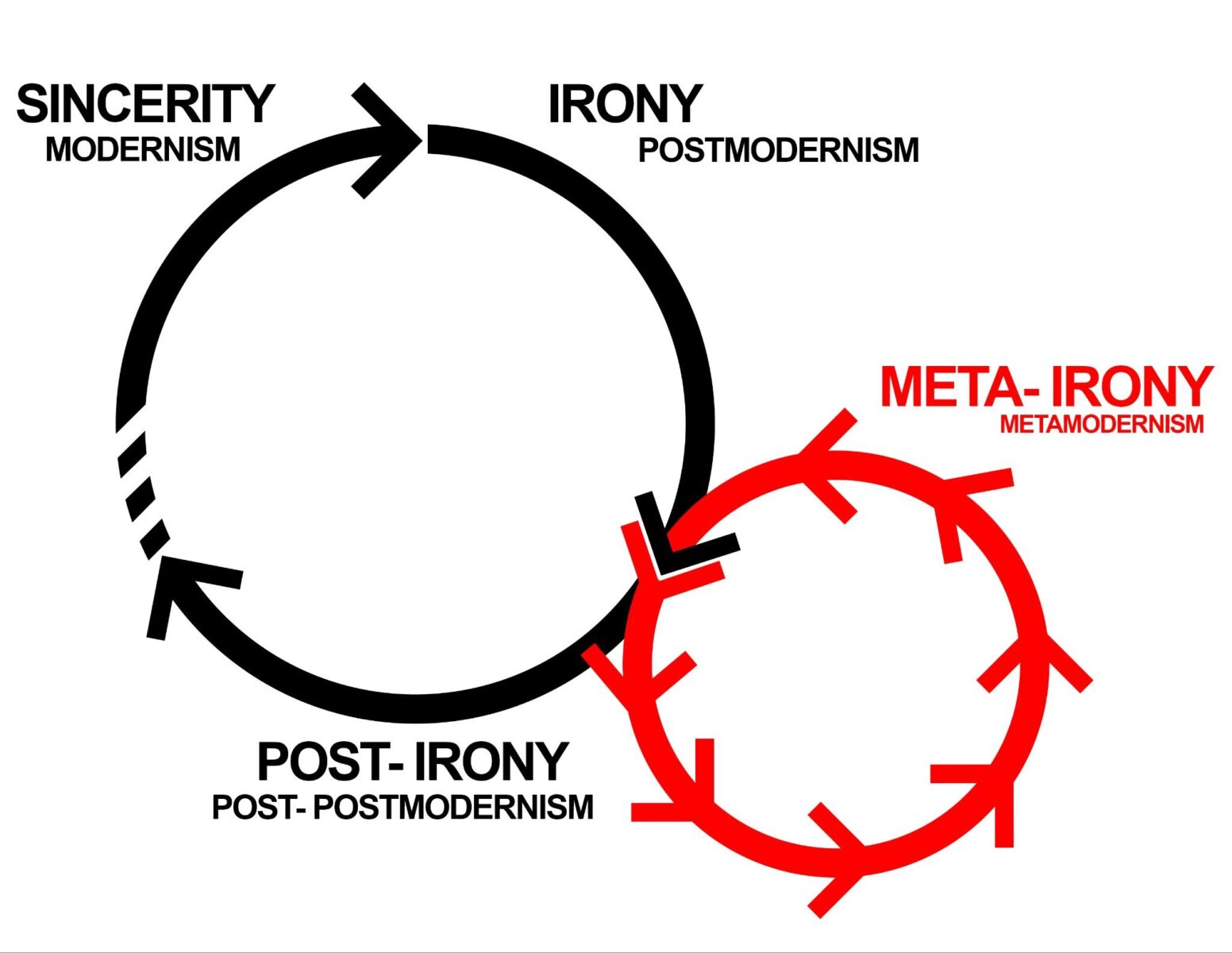
The first thing one might take aversion to in this framework is connecting Sincerity to Modernism, as Modernism started as a project about rejecting and subverting tradition, with painting leaving behind realism and instead embracing abstraction. However, if anything, Modernism was more sincere about art itself than what came before it, uninterested in content and more in technique and material to create something new, something not about painting but purely of it.
From there, we try to kill our masters and our gatekeepers in Post-Modernity, assuming irony and critique as praxis. But we get lost in the sauce, become irony-poisoned, atomised, comfortable, stimulated in a world that is constantly vying for our attention, and we fall into the period of Metamodernism (which we are still somewhat in) and where we go deeper into the cycle of modernity and enter Metamodernism’s own ouroborian cycle of references, remakes, and unending irony. But, as they say, the only way out is through.
Only after experiencing Metamodernism/Meta-Irony can one become post-ironic, to use their lived experience through this cycle as a tool to bring about hope and change. Referentiality might read as insincere to some, but that’s the difference: artists of the Post-Ironic/Post-postmodernist movement don’t reference their past; they revere it, they don’t wear their influences on their sleeves, they allow their influences to become a part of them, to become something new. This is the shift post-hyperpop makes so clear.
Frost Children recently released their sixth album Sister. I’ve been into Frost Children ever since I first heard BL!NK somewhere in 2022. Their music, their look, perfectly crafted into a vibe that feels familiar but entirely their own. Even in 2023, when they released two very different albums, the abrasive and pop-forward aptly-titled SPEEDRUN and the more acoustic and soft Hearth Room, they have always sounded like Frost Children.
Fast forward to Sister, and the album sounds like a culmination of not just everything they’ve ever made, but of everything they’ve ever loved. Be it on the maximalist 2010 pop banger Falling (which has a perfect music video to boot), or the loud and buzzing ELECTRIC, which sounds like a modernised version of Bloody Beetroots, or the title track Sister, which starts off with a beautiful acoustic guitar harmony that eventually swells into a full Porter Robinson’s Worlds-esque drop.
Ninajirachi only recently came on my radar, but her debut album I Love My Computer fits what I’m talking about all too perfectly. I Love My Computer is essentially a diary in which Ninajirachi talks about growing up as a girl online and falling in love with music, using sounds from pop, dubstep, tech-house, and hyperpop to paint an absurd yet incredibly deep and sincere portrait of a relationship. While tracks like Fuck My Computer might come off as over the top and ironic, tracks like iPod Touch, which plays right before it, makes it abundantly clear that this record is as honest as they come, as honest as you can be when you’ve grown up online anyway.
Lastly is underscores’ third album, U. Throughout the years, underscores’ music and world-building has stuck out to me as wholly unique in its sincerity. That might sound a little off to those with passing knowledge of underscores’ concept albums about Americana mythos, but none of her projects have ever come from a place of anything other than pure curiosity and obsession with these environments and the people in them. Regardless, U drops the concept. By her own admission, underscores just wanted to make music.
And she did, Music, the first single off of U, is a gem that will be looked back on for years and years as a turning point in music. Music is a stunningly well-crafted and polished pop anthem, with its thick chorus bass line and stuttering synths placed across a danceable earworm, but more than that, Music is a love song structured around metaphors equating attraction to listening to music, that slowly collapses in on itself. Music is no longer something to which love is compared.
It becomes love itself. By the time underscores start listing genres in the song’s build-up, “pop, rock, electronic, rap,” and repeats “it’s everything to me,” in the drop, the song reveals itself as something closer to devotion. Not to a person, or to attraction, but to the medium itself.
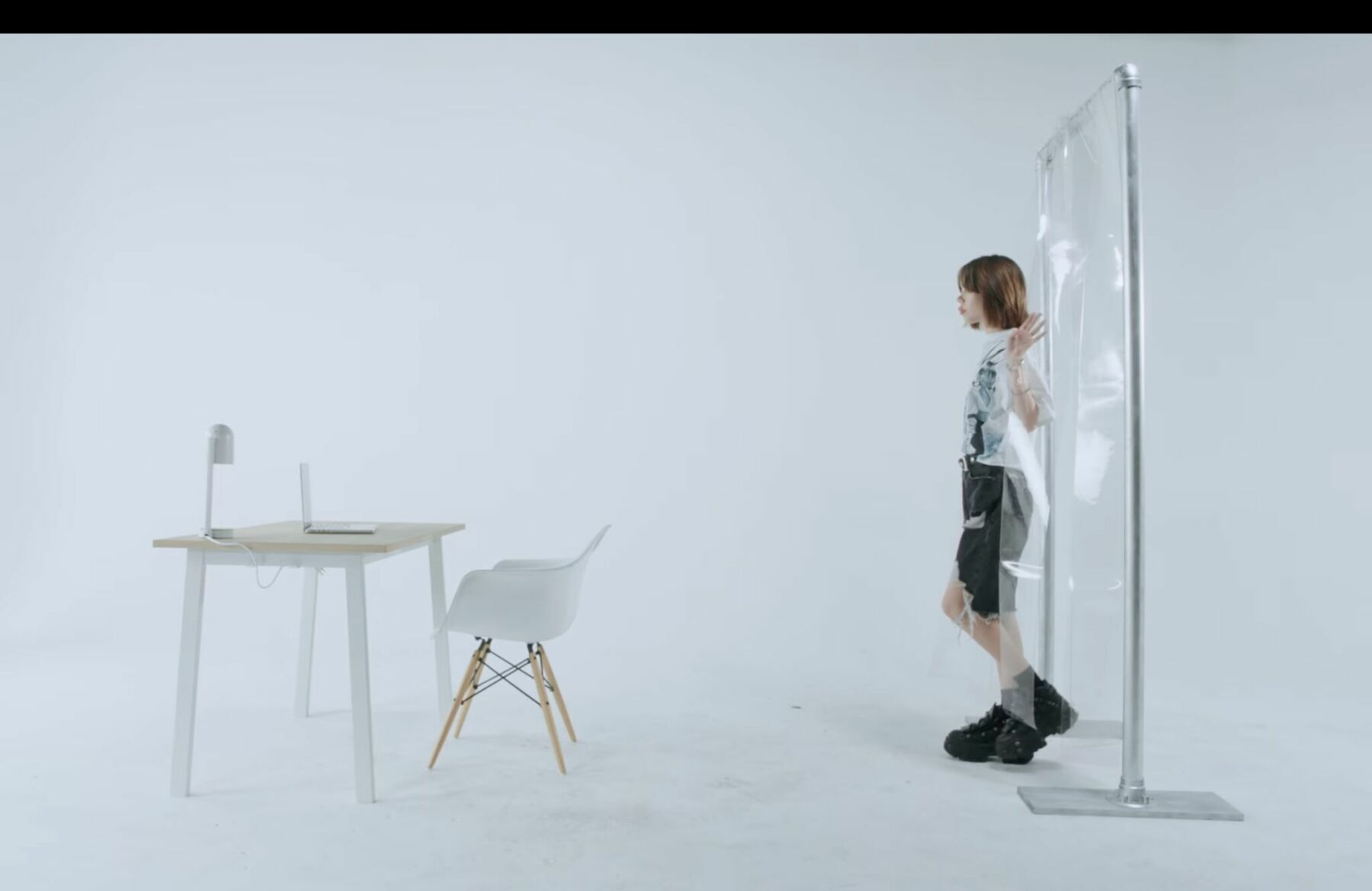
In “Cute Accelerationism” Amy Ireland and Maya B. Kronic write about cutification as “giving into giving into,” a process by which we embrace the machine and allow ourselves to move through it as cutely as possible, becoming “rubberised and plushy, springloaded and squishable” as a survival strategy. Sister, I Love my Computer, and U are all cutified albums, from their sound, thematics, and even the aesthetics, with Frost Children’s contemporary 2010s outfits, Ninajirachi’s artwork reminiscent of Serial Experiments Lain, or underscores’ world of shiny sleek modernist airports, malls, and gallerias.
“The paradox of voluntary surrender to the inevitable is not a performative contradiction or a knockdown argument against accelerationism, but the very topology of its anastrophic passion. The backwash of anticipative intensity tugs you into the current so that whatever forms downstream will always have been inevitable. By definition, demonic possession happens before you know it (…) Anyone who has ever fallen in love gets it.” [5]
On paper, the difference between a track like Falling and something like David Guetta and Bebe Rexha’s I’m Good (Blue) might be difficult to articulate. Both draw from the same sonic lineage. But the difference is immediately audible. One treats the past as a resource to be exploited. The other treats it as something to be cared for.
None of this guarantees the return of the future. These gestures remain fragile, easily absorbed, always at risk of becoming the very thing they resist. But something has shifted.
The Ouroboros has not yet disappeared, but it has begun to behave differently. What was once used to create distance is now being used to create closeness. What once marked exhaustion now carries possibility. As we approach the end-tail of post-irony, the future does not return as something entirely new. It returns as something to be believed in again.