Text by Dom Stevensson
INDEX Biennial returns to Braga this May for its third full edition from May 7 to 14, continuing a trajectory that began with an experimental “Edition 0” in 2019. It has since evolved into a platform where exhibition, performance, and curatorial research intersect – unfolding within the layered fabric of one of Portugal’s oldest cities, with historical architecture sitting alongside a growing media arts infrastructure.
Centred on the theme of power, the 2026 programme traces its shifting forms across technological, political, and social domains. At a moment marked by algorithmic governance, corporate dominance, and the pervasive influence of networked systems, INDEX positions art as an urgent mode of inquiry – not to illustrate these conditions, but to probe and question the structures that shape them. Across installations, moving image, performance, and theory, the biennial provides a platform through which these forces can be reimagined.
Within the exhibition programme, several works foreground the psychological and affective dimensions of life under contemporary power structures. Among them, Shuang Li’s ÆTHER (Poor Objects) (2021) constructs a fragmented video landscape in which digital subjectivity emerges through collapse and recombination. Drawing together extraterrestrial simulations, swarming birds, dystopian avatars, and abandoned environments, the work moves fluidly between visual worlds, interweaving disparate visual languages into a dense, unsettling whole.
Threaded through the work is the myth of Nüwa, the Chinese creator goddess who repairs the sky with her own body – a gesture of rupture and repair that echoes across its shifting visual field. Here, identity is neither stable nor singular, but continually assembled through processes of recomposition.
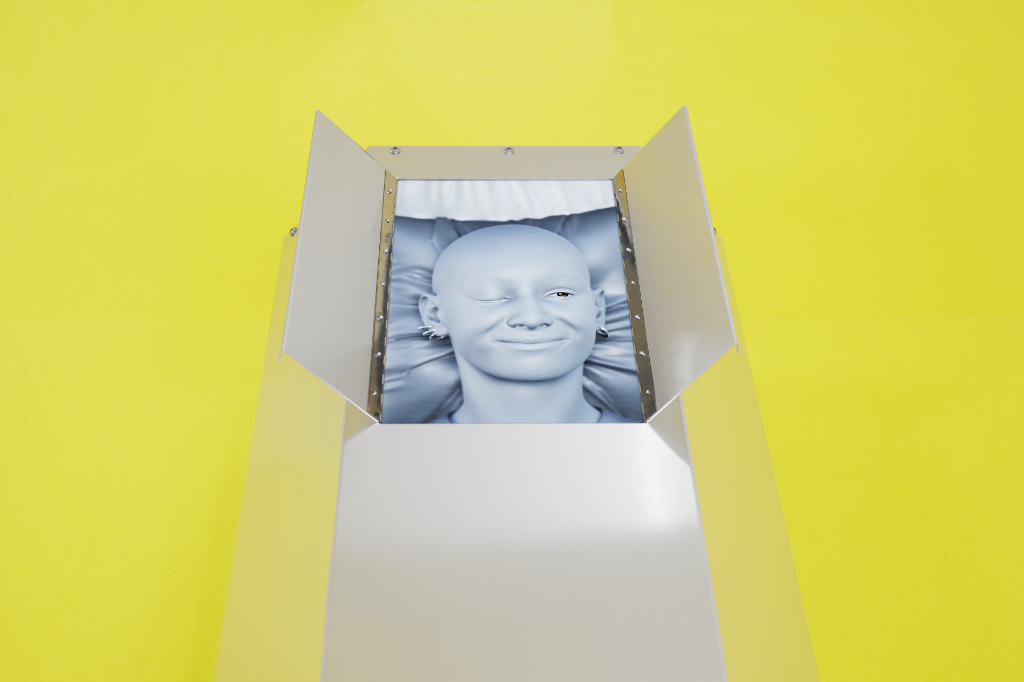
A similar interplay between presence and simulation surfaces in GRAVE MATTERS by Stine Deja, which turns to the emerging phenomenon of griefbots – AI systems designed to simulate the presence of the dead. Installed within a quasi-sacred environment, the work replaces traditional rituals of mourning with an atmosphere of controlled calm: ambient sound, soft illumination, and subtly off-putting gestures of reverence. Visitors are invited to open coffins containing synthetic replicas – composed, faintly smiling figures whose apparent humanity is undercut by their programmed persistence. Suspended in a loop of artificial continuity, these entities point to a form of eternal life that is both accessible and contingent, raising questions about memory, intimacy, and the stark commodification of loss.
At the Monserrato exhibition, Hito Steyerl’s Mechanical Kurds sharpens the biennial’s focus on image politics and technological power. Combining documentary, fiction, and speculative critique, the work examines the infrastructures underpinning ostensibly autonomous systems. Revisiting the 18th-century automaton known as the Turk – a chess-playing machine that concealed a human operator – Steyerl draws a line to present-day forms of distributed digital labour. In doing so, she exposes the asymmetries masked by artificial intelligence, revealing the human labour still embedded within supposedly automated systems.
Extending these concerns into live form, the performance programme opens on May 7 at Theatro Circo with The Drum and the Bird, a multisensory work by Bill Kouligas in collaboration with Forensic Architecture and its affiliate Forensis. Drawing on research into German colonialism in Namibia, the work combines spatial modelling, generative sound, and testimonial forms to trace ecological systems shaped – and in part erased – through colonial extraction. Best known as the founder of PAN, Kouligas has long operated at the intersection of experimental music, visual art, and curatorial practice, making his presence here feel particularly resonant – a practice shaped across adjacent fields now unfolding within the biennial structure.
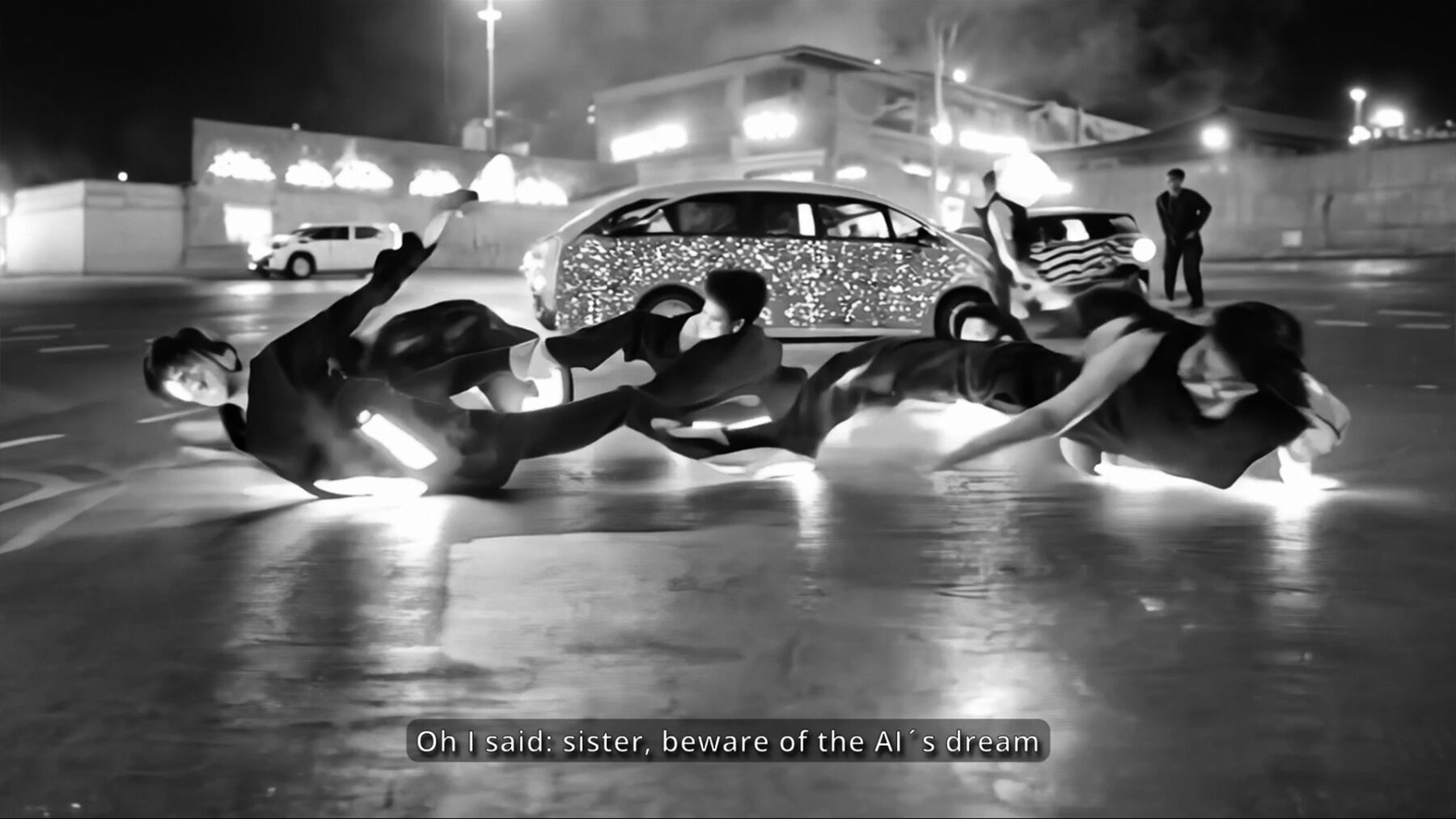

A further commissioned work sees Lawrence Abu Hamdan collaborate with the Norwegian post-jazz group Supersilent, extending his Earshot investigations into attacks on journalists in Palestine. Working from the final images captured by surveillance cameras prior to, or during, their destruction, the piece treats sound as forensic evidence – tracing how violence is recorded, mediated, and, at times, obscured. As with much of Hamdan’s work, listening becomes a tool of investigation, revealing the conditions under which images and events come into being.
Elsewhere in the performance programme, the duo ZABRA present Jeffthielmusk®, developed during a residency at gnration. Taking its name from a composite of Jeff Bezos, Peter Thiel, and Elon Musk, the performance explores how speculative visions of the future operate as instruments of power. Moving between performance, technology, and satirical gesture, the work examines the ways in which technological mythologies take hold – where the promise of progress, amplified through AI, begins to function as a mechanism of control. In doing so, it traces the uneasy space between collective fantasy and lived reality, questioning the social and political costs embedded within these narratives.
Rather than offering a singular narrative, the biennial unfolds as a constellation of positions – where exhibition, live work, and theory operate in dialogue, mapping the shifting terrain of contemporary life. Across a citywide programme curated by Joel Valabrega, INDEX brings together artists, thinkers, and performers to articulate and activate a collective response to the structures shaping the present