Text by Robert Barry
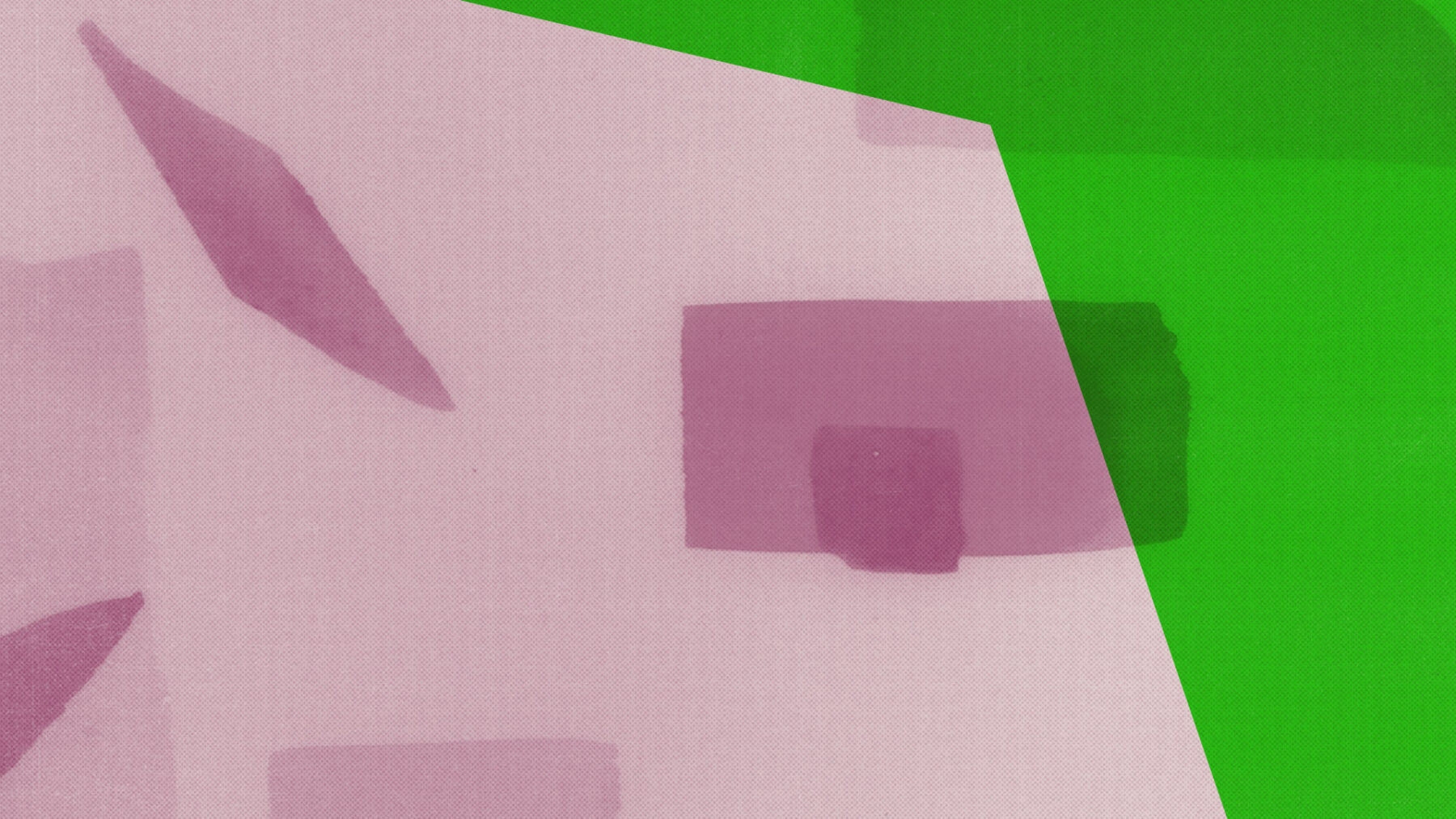
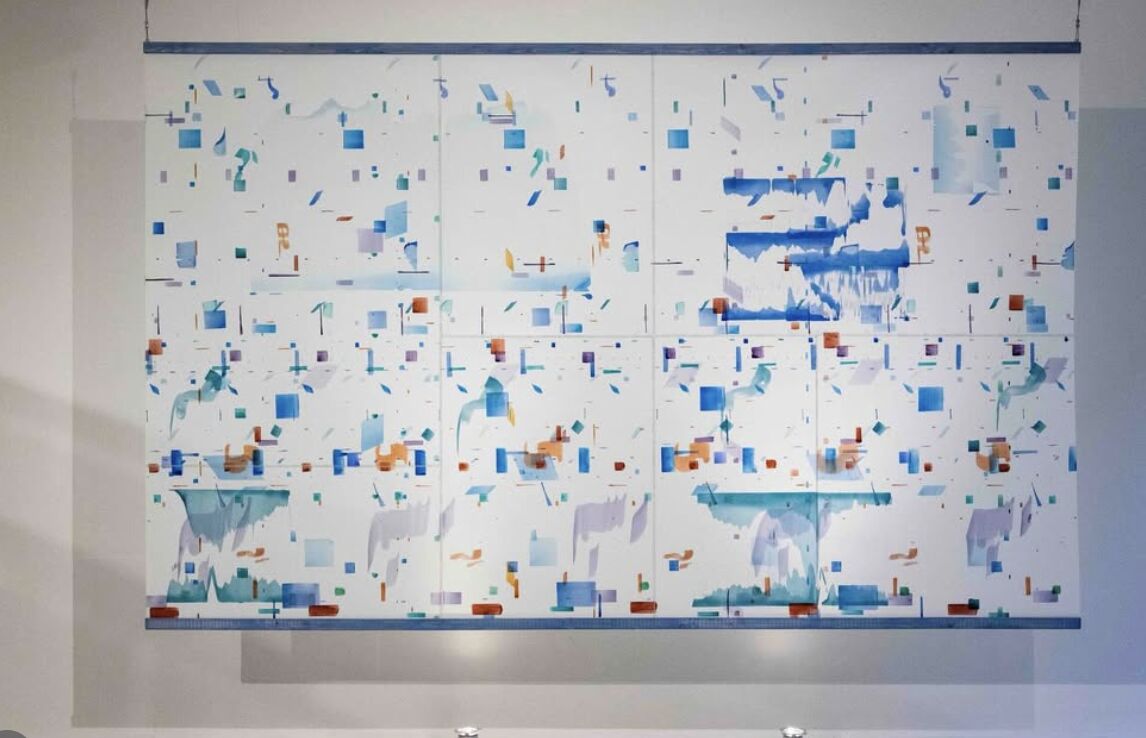
From a distance, Jaleh Negari’s Pattern of Life Analysis II (2025–26) might almost be mistaken for a digital print. You see blocks and shapes in abstract configurations, networks of sky blue rectangles, green dashes and deep orange squares in a field of white space, not a million miles from the early work of computer art pioneers like Manfred Mohr or A. Michael Noll.
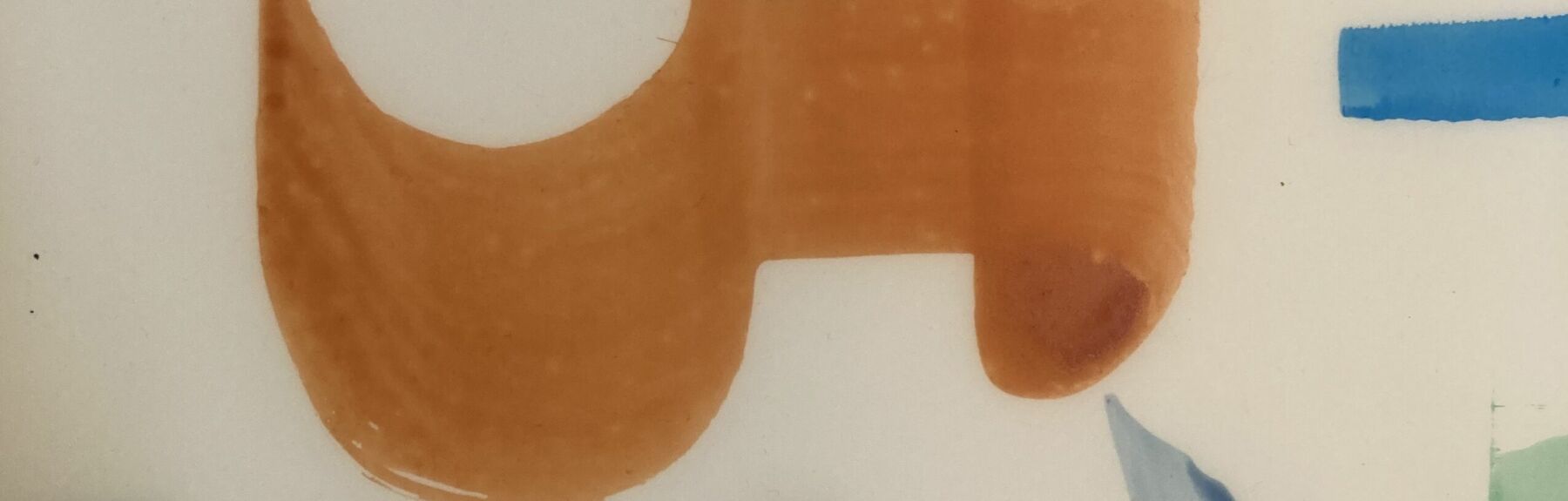
But the closer you get, the more painterly it appears. Edges are slightly smudged and blobby, colour gradients reveal the direction of brush movements. And then behind and between the more geometric shapes, calligraphic figures from the Farsi alphabet, which present as partially occluded, in contest or uneasy congress with the all the straight lines and right angles. The marks reveal the gestures that made them, the hand and the body behind those gestures. Up close, it is positively artisanal. The work’s large size (roughly two metres by three metres) is composed of six unevenly sized sheets of architectural paper, hand-sewn together by the artist and her mother.
Not merely the record of gestures, the work is also the occasion for further, sounding gestures. Negari refers to this series of works as displacement scores and they can appropriately be situated within a history of graphic score-making, going back to such mid-twentieth-century composers as John Cage, Karlheinz Stockhausen, and, in particular, Earle Brown.
There has been, Negari tells me when we speak over Zoom a few days after the opening, a dialogue between graphics and music all the time, since the earliest days of her twin practice as both artist and performer (Negari also plays drums in the Danish group Selvhenter). What fascinates her more than anything is the process of translation between the two: how an image begets a sound, or sound an image. If at first, she felt more aligned to the more conceptual lineage of New York School and other composers (such as Cornelius Cardew, Sylvano Bussotti and Karlheinz Stockhausen) in the world of new music, increasingly works like Pattern of Life Analysis II have to come to occupy for Negari a kind of parallax: their status shifting back and forth between notation and the purely visual. Most importantly, the series became a tool for Negari.
Whether employed programmatically (read this bit as rhythm or focus on these bright lines, etc.) or more openly, they functioned as a way to get to know my musicians’ musical language, their facets, what they could do on their instrument. A set of notations explicitly about displacement and division became a means of connection: a way to get to know people.
To be in-between, displaced and in transition, is for Negari not just an aesthetic concept, but a fundamental part of my life – all my life – to be in-between these languages but also in-between everything that comes with being in-between two cultures. Born in Iran, she left with her family while still an infant, during the war with Iraq that lasted from 1980 to 1988. It was a couple of years into that war, Negari recalls, and my father fled the country. Then, when he got to Denmark, I came with my mother by family reunion. For a long time, over a decade, her parents didn’t dare to go back.
Negari grew up, then, both Iranian and not. European and also not. Between two worlds, two cultures, two tongues. But it’s not only a language thing, she stresses, it’s also a way of being inside your body, your existential views on the world, being between different values. So in a way, I’ve always felt like seeking towards the borderline of something when I work with it. When I was playing hip hop, it was in the borderlines of that scene, when I was playing independent rock music, it was something where we mixed up genres, and I think during the development [of any project], I always seek out these borderlands. This way of using visual tools in my music-making is kind of the same thing. It’s just the way I’ve been living in the world. It feels very natural.
In the gallery, you can hear a twenty-minute looped soundtrack featuring realisations of Negari’s notations by soloists Rosanna Lorenzen (cello), Zekl Jindyl (saxophones), Andreas Pallagaard (electronics) and Arman Ameri Mahani (ghaychak). You can trace the path of Pallagaard’s chunky honks and bloops and Lorenzen’s sinuous slurs along with the marks on the score as you listen. Around and between these instrumental lines and electronic sounds, you can hear field recordings from Shiraz, Mazandaran, and the Kelardasht forest in Iran, captured by the artist during a trip with her daughter in 2022. Negari’s daughter was still an infant at the time, only a little younger than Negari herself had been when her family left Iran for Denmark. I didn’t have this regular relationship with Iran when I was a kid because my parents were afraid of going back, she explains. I wanted to try to give her a less difficult relationship with the country.
On the eve of their visit, a 22-year-old Kurdish woman named Zhina Mahsa Amini was arrested by Iranian morality police for wearing improper clothing. She died while in custody under suspicious circumstances, leading to massive protests in almost every province of the country under the banner Women, Life, Freedom. The demonstrations were brutally suppressed by the regime. Over 500 people were killed, including at least 68 children. By February 2023, some 20,000 people had been arrested. My daughter had a great couple of trips, Negari recalls. But for me and everybody else in the family, it was extremely tense. That tension can be read through the work in the show, which makes a meditation on the fraught nature of identity.
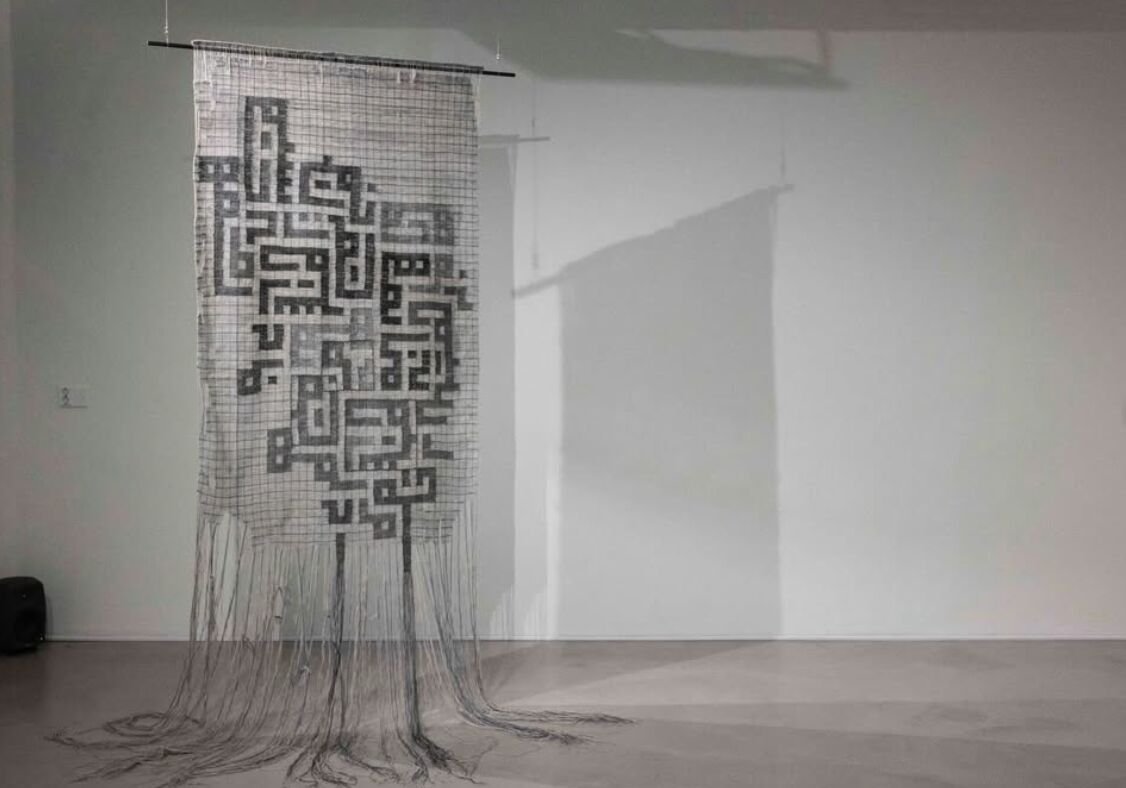
Running through the Persian characters in Pattern of Life Analysis II and the other major visual work in the show, Holy Practice Paper Sketch,are letters which make up the title of a song by Tehran-born pop singer Googoosh (née Faegheh Atashin), popular at the time of Negari’s early childhood. For many diaspora Iranians, Negari explains, Googoosh is the voice of a longing for Iran. But she is also just a voice from my childhood. Growing up in Denmark, Negari’s parents would often play Googoosh’s music at home, pining wistfully for a homeland that no longer quite existed.
After the Iranian Revolution in 1979, Googoosh – along with all female singers – was banned from singing in public, but she stayed in the country, not performing again until she finally moved away at the dawn of the new millennium.I think that’s also why she’s such a strong, collective memory for the diaspora, which shares this haunting feeling of being away, longing to go back, but not being able to go back.
The song is called Ma Be Ham Nemiresim (‘We Don’t Reach Each Other’). The show’s title reverses the proposition: ‘We Reach Each Other’. The blocky patterns of Holy Practice Paper Sketch feature both the original and its negation, winding around each other like a game of Snake on hard mode.
There’s an uncertainty there, a hemming and hawing between a hoped for reconciliation between seemingly opposing cultural traditions and the fear that reconciliation might not come. The tapestry itself is visibly incomplete: the edges are frayed, threads hang loose. As an image of hybrid identity, it suggests something to be worked on: the self as a project – and an unfinished one.