Text by Oscar Lund
In Philip K. Dick’s 1968 sci-fi novel Do Androids Dream of Electric Sheep?, a new religion has spread across the decaying and abandoned Earth: Mercerism. The fictional religion was first conceptualised in Dick’s short story, The Little Black Box, in which disciples enter a “mystical communion” with their leader, William Mercer, through black boxes attached to their television sets. [1] Mercer is seen endlessly marching through a barren wasteland towards his impending death, being pelted by stones as he trudges on. When a follower communes with Mercer, his pain becomes theirs, and his thoughts become theirs. Mercerites become one with their leader in a radical act of digitally-delivered empathy.
Although Do Androids Dream of Electric Sheep? is a work of science fiction set in the far-flung future of 1992, others have set their sights on making the author’s transhumanist religion into a reality. Ryan K. Bolger is one theologian who seeks to do just that, outlining humanity’s path to digital transcendence in his paper ‘Finding Wholes in the Metaverse: Posthuman Mystics as Agents of Evolutionary Contextualization’. [2]
Bolger’s paper takes the concept of Christian “wholemaking” – the process of becoming one with God – and applies it to the digital world. For Bolger, online Bible study apps don’t quite cut the mustard. He instead sees the internet and digital technologies as a vehicle for entirely transcending the human experience.
Bolger’s work builds upon that of Teilhard de Chardin, a 20th-century French theologian and philosopher who spent much of his career advocating for religious orthogenesis. He viewed evolution not as a series of random mutations, but instead as a linear process which, as laid out by God, will ultimately converge on a unification of all consciousness – a wholeness between all living beings. [3] In other words, evolution is a path that ends at oneness with God. Bolger adopts Teilhard’s position and accelerates it, believing that the divine end goal of a single collective consciousness can be sped up through man’s relationship with technology. [4]
In Bolger’s vision, every person, animal, and object is connected by an unfathomable network of communication, with their thoughts and interactions logged by an all-encompassing system of data. [5] To Bolger, this collective consciousness – delivered via a fantastical version of the internet – will be so extensive that the very concept of being an individual will cease, and all beings will become one with each other and with God. [6] Instead of transhuman, Bolger opts to describe this “new mode of experiencing reality” as post-human. [7] Rather than an escape from our physical limits, Bolger describes it as an escape from our psychological limits, a complete loss of individualism in favour of a reality that considers the agency of every being in existence.[8]
Not only is human communication elevated to this single consciousness, but so is the consciousness of objects. Bolger imagines that communication between smart devices will far surpass current standards of Ring doorbells and Air Tags, allowing us to raise the value of what was previously considered an object [9]. In Bolger’s post-human future, toasters, microwaves, and robot vacuum cleaners can become whole with the big man himself.
Of course, a world where you have to consider whether your freezer enjoys being defrosted or whether the iron takes great artistic satisfaction in burning holes in your clothes is difficult to take seriously. In reality, we are limited to the material means of the present and both Bolger’s and Dick’s visions of digital transhumanism remain far out of reach; however, this hasn’t stopped contemporary artists and programmers from attempting to realise their own digital transcendence.
In the mid-2000s, Terry A. Davis, a former Ticket Master systems programmer turned digital devotee, began working on an operating system that would eventually become known as TempleOS. Davis spent the last 12 years of his life developing TempleOS from scratch, using his own programming language, Holy C. TempleOS is bare-bones and originally stemmed from Davis’ love of programming for its own sake. TempleOS gives the user complete control over the system, allowing programmers with the relevant know-how to do whatever they please.
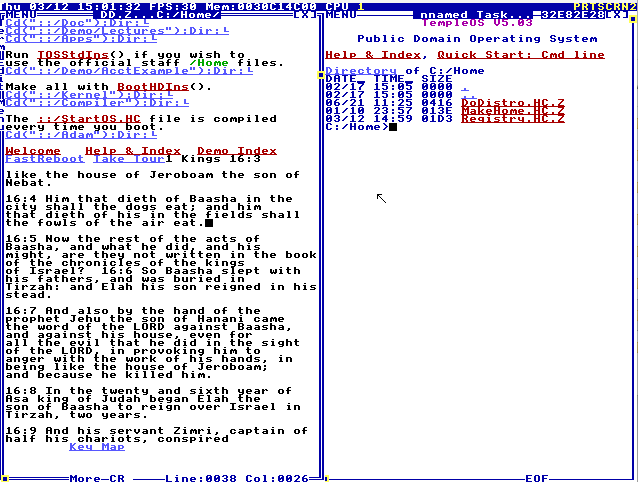
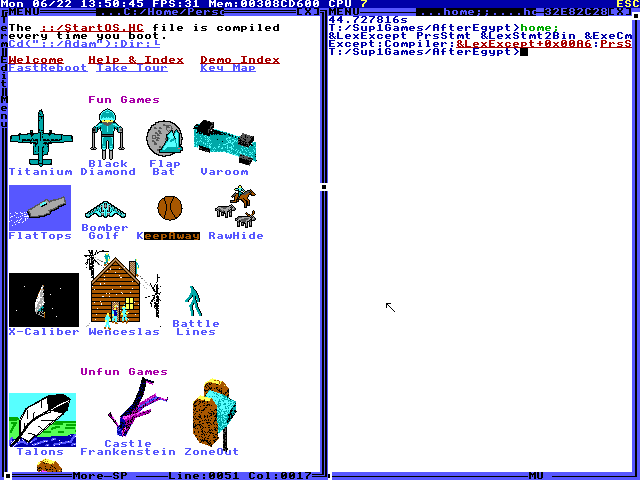
Not only is TempleOS a programmer’s playground, but it also serves as what Davis called “God’s official temple.” In a post to his website from 2016 titled ‘TempleOS Charter’, Davis said: Just like Solomon’s temple, this is a community focal point where offerents are made and God’s oracle is consulted. By drawing a comparison to the first temple of Judaism, Davis positions his work as of biblical importance and as a pivotal advancement in both Christianity and Judaism.
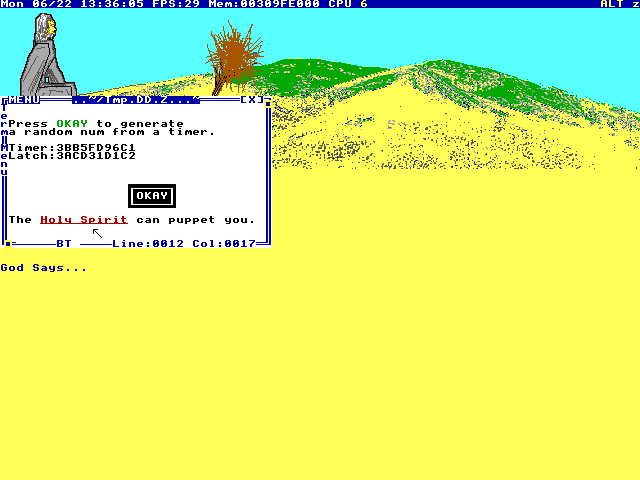
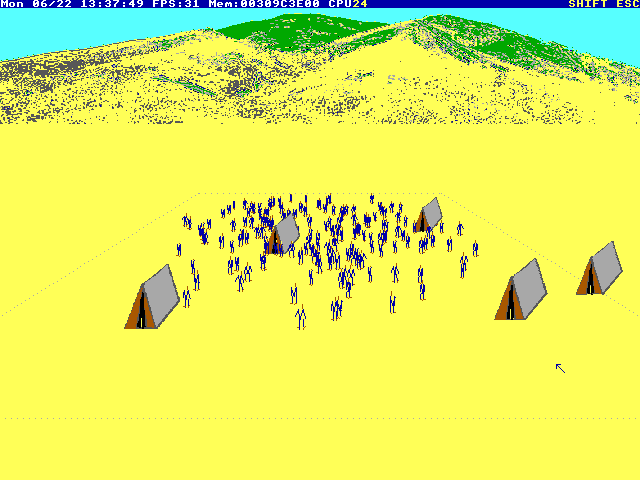
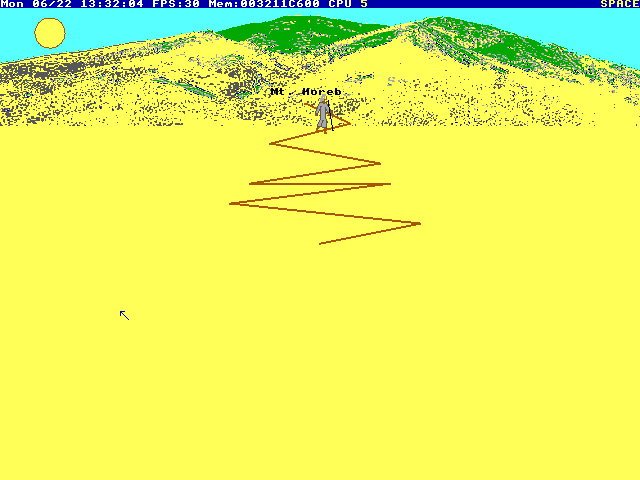
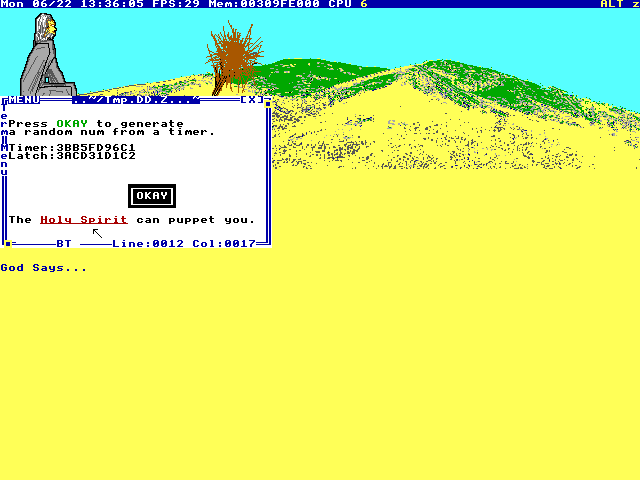
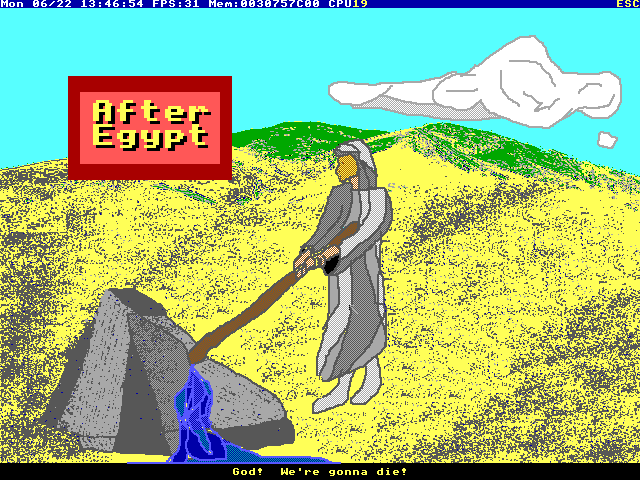
From dedicated hotkeys for Bible quotes and ‘God words’, to programs that auto-generate drawings from an allegedly divine source, TempleOS is laden with strange biblical functions. Most notable of all is After Egypt, a Moses-themed video game that uses Davis’ love of random numbers to connect the player with a higher power.
Speaking with Vice’s Motherboard in 2014, Davis described how he used coin flips to find Bible passages at random, believing that God’s role in chance would guide him towards the answer he was seeking. After Egypt automates this process by assigning words to digits on a microsecond timer, effectively generating random phrases each time the stopwatch is paused. In this manner, TempleOS is not merely a program that helps users study or interpret religious texts; it seeks to create new texts, new meanings, and new creations through divine randomness. Technical decisions about the program, Davis claimed, are inspired by God, too. Despite previously indicating that certain graphical decisions had been implemented due to technical limitations, in 2014, he said: “God said 640×480 [resolution, and] 16 colour is a covenant like circumcision.”
Davis was a man full of contradictions and suffered greatly from schizophrenia. In his later years, his behaviour became increasingly erratic, spouting nonsensical conspiracy theories and racist diatribes via his website and YouTube livestreams. In 2018, Davis passed away when he was struck by a freight train in Oregon. It is uncertain whether his death was an accident. In the years leading up to his death, he spent most of his time livestreaming his work on TempleOS, often spending days on end talking to God through his own software, asking Him everyday questions and mashing F7 for randomly generated responses, resigning himself to a life of virtual asceticism.
In his paper, Ryan Bolger defines the “post-human mystic” [10] as a digital operative of Christ who seeks to accelerate his vision of digital orthogenesis. The post-human mystic is a sort of preacher who has lost any sense of self, concerned only with the pursuit of bringing all beings into one interconnected digital consciousness through Christian evangelising. [11] Although the divine operative of Bolger’s imagination is difficult to even picture, Terry A. Davis appears to be one real-world example of what Bolger describes. He was a man who dedicated the final decade of his life to creating and promoting his divinely inspired work for others to use, with the ultimate aim of communing with the almighty and spreading his faith through the internet.
Davis’s methods were certainly strange and his vision of divine communion was undoubtedly unique; however, the practice of virtual preaching has been observed since the 1990s. In his 1996 paper, “Cyberspace as Sacred Space: Communicating Religion on Computer,” Professor Stephen O’Leary writes about his experiences observing religious ceremonies on the early public internet’s message boards. He highlights how digital rituals step away from belief as an individual practice, and towards religion as a community-oriented experience [12]. The core appeal of religious ceremonies online, to O’Leary, is the value of two-way participation, describing the phenomenon as an emerging new form of the public square. In this way, Bolger’s metaverse as a device for bringing people together under Christ begins to make a little more sense in reality. [13]
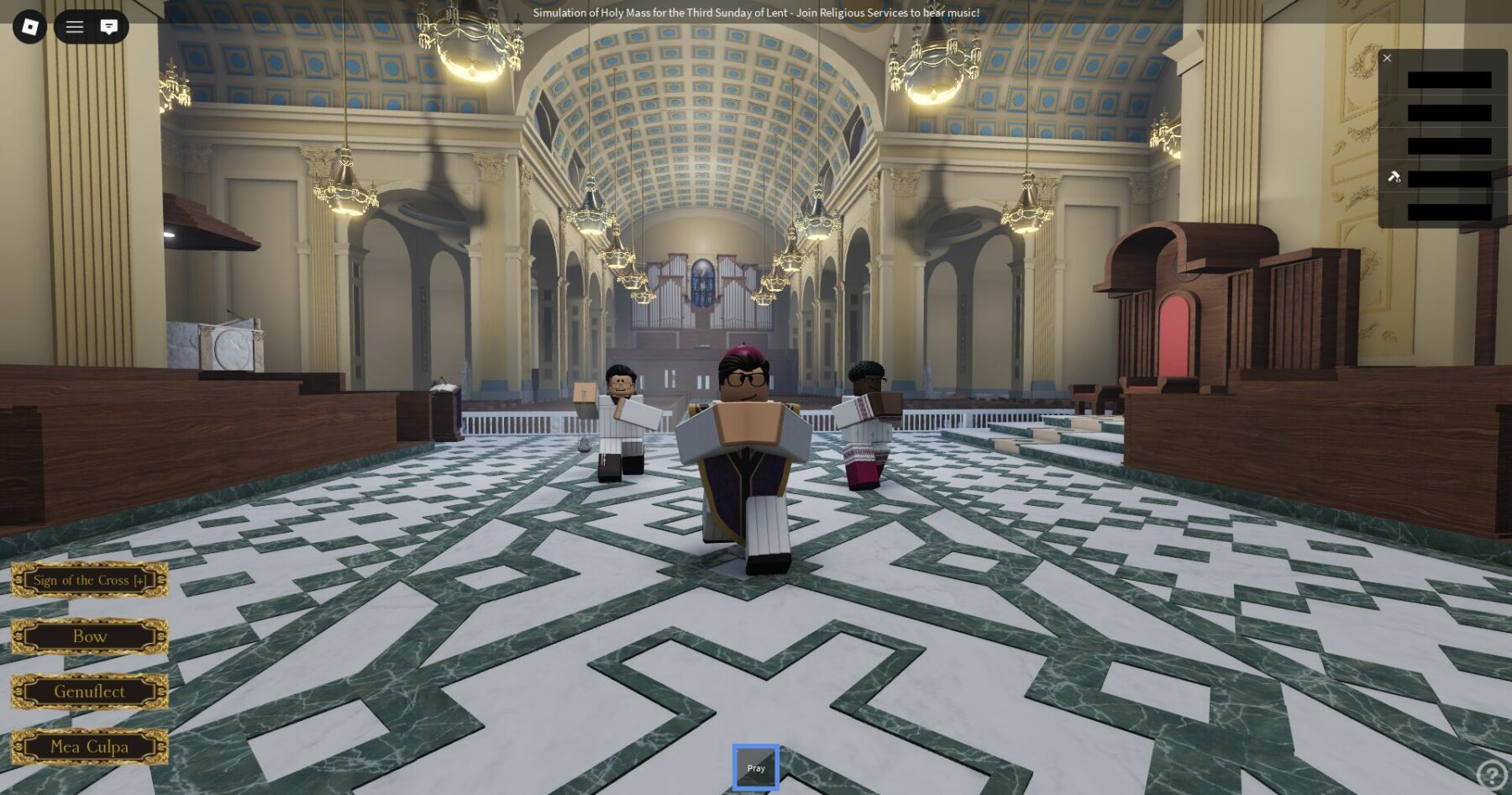
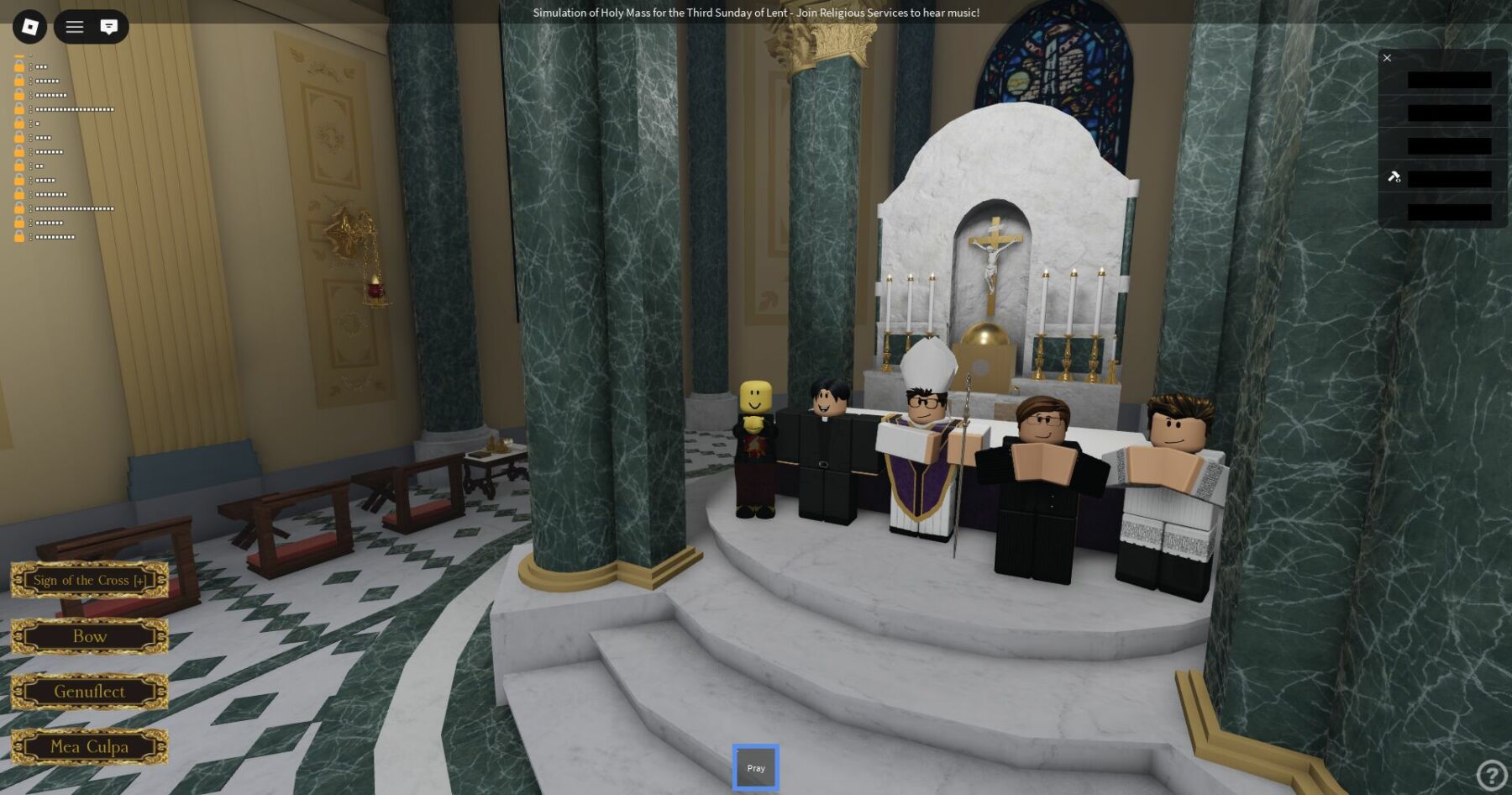
The cutting edge of digital worship has, strangely, found itself a home today in the sandbox video game Roblox. In 2011, the State of the Vatican City Roblox (SVCR) was founded by a group of Catholics eager to attract a digitally-oriented demographic to the faith. The official SVCR website lists current and former popes, members of the virtual clergy, and even the occasional news report documenting the virtual Vatican’s happenings. The SVCR’s Vicar Apostolic for the Americas, who goes by Lorenzo Moretti online, says “a large portion of what we do is centered around roleplaying”; however, the SVCR doesn’t host mass purely for fun. The mission and purpose of this group, before roleplay, is to evangelise and reach out to the youth of Roblox and invite them to an encounter with Christ, says the eighteen-year-old.
Lorenzo is an active participant in his local parish, both in real life and on Roblox, and has devoted significant time and effort to cultivating the SVCR. He currently acts as the celebrant for weekly masses and has even built a replica of Rome’s Basilica of St Peter and St Paul in the game. I never really cared much about building in Roblox until I joined this community and desired a space to hold these services, says Lorenzo. In some ways, Lorenzo’s dedication to cultivating a Catholic community online mirrors that of Terry A. Davis’ creation of “God’s official temple”. Both were inspired by the divine to create a space for worship in the digital realm and have gone to considerable lengths to maintain them. Where they differ is in their intent. Whilst Davis believed himself to be chosen by God, Lorenzo commits his time to the SVCR because of the joy of the people here. He says that Seeing the fraternity and camaraderie between members really inspired me and led me to become a more active member of the community.
Although Davis’ work on Temple OS was close to Bolger’s vision of the posthuman mystic, he ultimately failed in drawing people closer to God through his work, instead attracting a community of people curious about his peculiar project and obsessed with his delusions. Those at the SVCR take a wholly opposite approach, recognising that their ceremonies are purely for religious education and hold no real sacramental value. Instead, the value of their work comes from creating a community around their shared faith. Everyone knows each other, and we are always there for each other, even if we’ve never met in-person, says Lorenzo.
At the end of Do Androids Dream of Electric Sheep?, it is revealed that William Mercer is, in fact, an actor, and his endless pilgrimage of hardship is merely a looping video filmed decades before the book’s setting. The religion is a digital simulacrum of faith, and yet followers still draw meaning and community from it. The SVCR isn’t a real church, nor does it pretend to be one, but the group’s sense of community and of a shared faith is as real as it gets.
Projects like the SVCR are a reminder that religion, in practice, isn’t necessarily a means of escaping the human condition, but rather a way of building a community to better understand it. Why plug yourself into the matrix to speak with God, when you can talk about Him with your friends on Roblox?