Interview by Ludovica Bulciolu

Thinking back to the early 2000s and the prosperous, sparkling emergence of the post-internet art scene, one thought goes towards analogue practices that treated the object as a porous system to inhabit, protect, and argue from, while another embraced technology-derived approaches, integrating the tools of tech as a means of questioning the monstrous machine of modernity itself.
At the helm of these conversations was Irish artist John Gerrard, who has worked for almost two decades with the technologies of simulation to examine systems so pervasive and omnipresent they have become difficult to see. Petroleum, industrial agriculture, military infrastructure, climate catastrophe and, increasingly, the computational systems through which contemporary life is organised are at the very heart of his practice.
His works are often recognisable as landscapes or scenes, yet they resist the conventions of documentary image-making: built from photographs, satellite data, motion capture, real coordinates and real-time computation, they occupy an uneasy space between sculpture, film, photography and performance.
Reality is no longer a continuously unfolding world governed by its physical laws, but rather becomes an experimental exercise in motion where durational, simulated elements silently evoke the tragic conditions that make (im)possible our material contemporary existence. This interest in simulation emerged early in Gerrard’s practice.
Dust Storm (Dalhart, Texas, 2007), developed from the historical dust storm that struck the American Midwest in 1935, established his approach of beginning with a specific place, material and archive before constructing a virtual environment. The methodology continued through works such as Exercise (Djibouti, 2012), in which motion-captured athletes perform a perpetual military exercise on a digitally reconstructed landscape. The work draws together sport, choreography, war-gaming and military technology, producing what Gerrard describes as a performance that exists permanently within the simulation, whether or not anyone is watching.
With Western Flag (Spindletop, Texas, 2017), Gerrard turned to the infrastructure of petroleum. At the site of the first major oil strike in the United States, a column of black smoke forms the shape of a flag, giving visual and political form to the otherwise invisible presence of carbon dioxide. The work exemplifies Gerrard’s core strategy: rather than illustrating an environmental crisis, he constructs an image that allows its underlying systems to remain strange, uncanny, and open to interpretation while becoming intuitively perceivable.
As technologies themselves have become widely exposed to their murderer-nature, the artist’ approach has become increasingly complex, gradually shifting to image-making as a clearer way of inducing meaning and conveying criticism. In SPIRITS (2025-26), Gerrard brings his long investigation of petroleum into contact with plastic, artificial intelligence and the networked image.
The browser-based artwork transforms 96 discarded shoes and sandals collected from beaches across four oceans into luminous Gaussian-splat simulations, unfolding across the solar year and inviting viewers to manipulate the objects through their phones. The work unfolds across four 24-hour events tied to the solstices and equinoxes, when the spirits gradually appear on LACMA‘s webpage*, one rising with each passing hour, creating a constellation of found objects and oceanic memory. This piece makes consumption and technological mediation inseparable: plastic is petroleum, the image is data, and the viewer’s own gesture becomes an equal part of the system being examined.
This tension is central to Gerrard’s practice today. If tools once appeared as to be offering a possibly neutral or euphoric technological frontier, they are now heavily entangled with extraction, surveillance, corporate power and bloodshed. Yet the artist found a way to continue working from within those systems, attempting to redirect their responsibility towards a poetic and symbolic system of ‘movement, attention, contamination’, allowing for these structures surrounding us to finally become a bit more tangible or visible.
*The online exhibition is presented by LACMA’s Art + Technology Lab. SPIRITS runs until 21 Dec 2026, unfolding across LACMA’s webpage over the course of a full solar year.




Your work addresses the power structures of technology and how they affect the environment, its infrastructure and life at large. What inspires you today to make the work that you do?
The same thing that always has: a sense that we live inside systems so large and so normalised that we cannot see them. Petroleum is the clearest and most historic example. It is in the shoe, the road, the food, the clothing on many bodies, and often not registered as a single material with a single origin and a catastrophic end. Petroleum is also not taught in any meaningful sense, nor energy generally.
Ask any university student what the Haber-Bosch process is, and they will blank – and yet – it is the process that transformed all of life in the 20th century from war to bread. More generally, I try to make work to slow down the social brain, to hold one of these systems still long enough to look at it closely. What feels urgent now is that the tools I use to do this – simulations, game engines, neural networks – are themselves part of the power structure I am examining. That tension is the live wire.
SPIRITS SUMMER SOLSTICE DANCE, your latest project launched at LACMA with Richie Hawtin, translates your ongoing investigation into petroleum, plasticity, and the material conditions of contemporary tech into the register of sound. Can you tell us more about this project? Why did you choose to work with Gaussian Splatting technology in developing the piece?
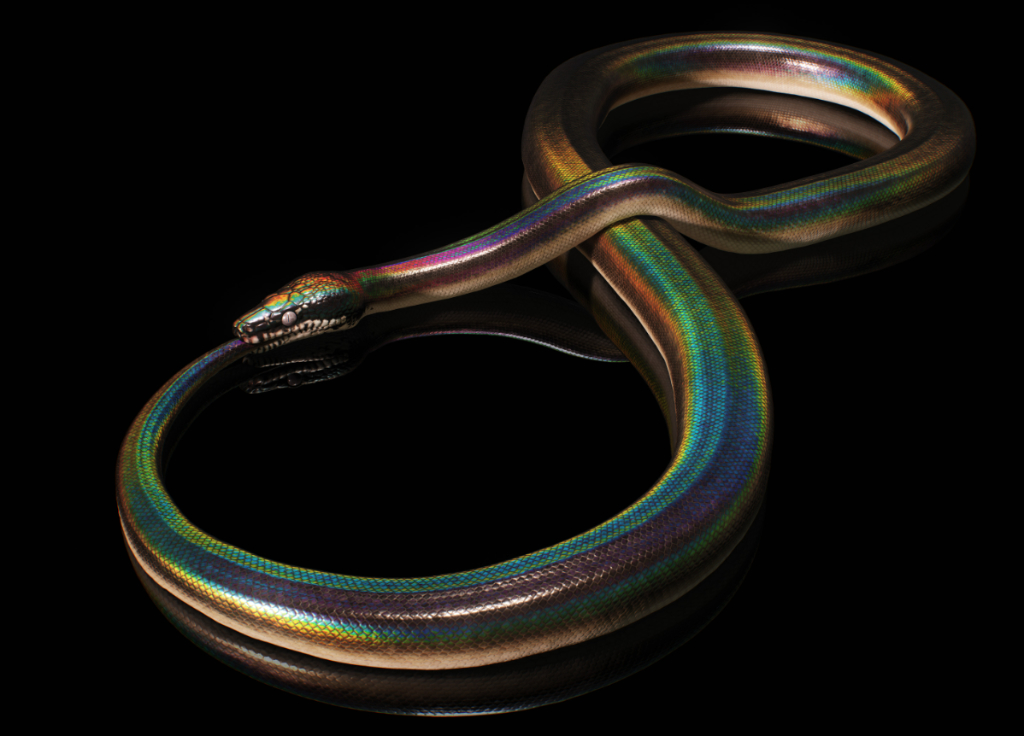
Richie and I first worked together on iridescent.stream, a real-time petroleum serpent – an ouroboros, the snake that eats its own tail – coiled as a lemniscate, a figure of eight held open, rendered in oil-on-water rainbow physics. That collaboration is where the sound and the simulation first fused for us, with the contribution of bronze.ai, and it set the ground for what became the SPIRITS launch. Richie is one of the most influential figures in electronic music – four decades of minimal techno as Plastikman, from Sheet One through Consumed to EX – and what has always drawn me to his work is its subtractive rigour.
He builds by taking away. He came to Detroit at the epicentre of techno, an alternative future imagined from within the factory’s ruined husk. That energetic and social lineage is the sonic ground on which the whole work stands. Moreover, Richie is an extraordinary performer, and as a DJ his construction of music live using the Model1 is unparalleled. At the core of the launch at LACMA was the presence of that brilliance in the museum setting, where it felt deeply appropriate.
SPIRITS itself renders 96 discarded plastic shoes from four oceans as what I call image objects – built from photographic data sets that train a neural network, which produces millions of tiny overlapping points of coloured light, each one a soft translucent blob, a Gaussian. The result holds depth, reflection and iridescence in a way that feels captured rather than constructed – closer to light on water than to a model. For a work about petroleum, that was exactly right. Oil is light. Plastic is oil.
The rainbow on the surface of our splatted shoe is the same rainbow you see in a puddle of petrol, and so the medium and the subject turn out to be one substance: refined light, held as data. These reside on LACMA.org for the 2025-2026 year and are a global public art project, most ideally to be experienced on the phone.
The Summer Solstice Dance at LACMA was the formal launch of the project and the premiere of the summer season upon the solstice – June 21 2026. For it, I designed a set responding to the solar wheel – made up of a central dance floor, a four-point square, with four oceanic sentinels for the Pacific, Indian and Atlantic Oceans and one for the Mediterranean Sea – each holding chromatic references to local deities.
At the fore, a very large LED behind the musicians and settled beneath the serpent-like Geffen Gallery by Peter Zumthor, which wriggles over Wilshire Boulevard, its belly full of 5000 years of human making. And below the La Brea Tar Pits, holding vast reserves of ancient sunlight studded with a layered clock of animals, plants and pollens who became trapped within it. Rich terrain.
Upon the commons – the cement plain that separates the underworld from the overworld – I called up ancient global solar signs; a solar wheel informed both the bar and the seating area, which was constructed from local grasses baled as hay. Finally on entry there was a 21st Century river table made from local Californian wood, remnants of wildfires, and set with prismatic questions and provocations (see jesy.love), and at the end of the entire sculptural tableau a death table for the 20th century set with mid-century tar balls gathered from the Mediterranean shores and lost plastic shoes from the Autumnal Atlantic series, all formed as corpses.
Autumn sandals were found on the shores of Morocco—very worn, old and monochromatic. The liquid and often tragic sea borders of Europe compartmentalise vastly different economic and social differences on their shores, and these are vividly reflected in the shoes one finds there.
Finally, at the event we premiered Peak Oil, a psychoacoustic composition using dichotic listening – the words “peak oil” moving ear to ear at high repetition until the phrase dissolves and returns. Two musicians Richie invited, Anastasia Giovani and 92jelani, inherited the SPIRITS worlds and performed them live using touch screens on the LED wall as the sun set.
Then Richie led two and a half hours of dance, his DJ set obliquely responding to the simulations in real time. What he brings is four decades of knowing how a room of bodies moves through rhythm and repetition: when to build, when to hold, when to release. That is authorship of its own kind, and it was central to what the night became in front of the oil apparitions upon the screen.
How do you approach the research process for each of your projects? In particular, how do you engage with local archives, histories, and forms of knowledge that may initially be unfamiliar, and how do these shape the development of the work?
Each work begins with a place and a material rather than an idea per se. I am thinking of dust here,, for instance, and an image of the terrible dust storm of April 14 1935, in the US,, which later became my work titled Dust Storm (Dalhart, Texas), which opened at Marian Goodman Gallery in NYC in 2007. More generally, I then travel, I read, I gather these found network images and at a certain point I find myself as a sort of witness on the ground. And these landscapes are often far stranger than fiction.
For SPIRITS at LACMA, it was beaches and thousands of lost plastic shoes found upon them. I try to enter local and specific knowledge without pretending to master it – the work holds my position as an artist looking hard, not an authority. The research shapes the form: the real coordinates, the real sun, the real duration all come from that grounding. The simulation is only convincing because the research underneath it is exact.
From there we introduce what we have come to call function crafting – be it in the movement of virtual smoke or in SPIRITS, where we build a second portrait of a shoe as a 3D mesh and overlay it over the Gaussian portrait. This allows cultural languages to be called by the public through touch. In the summer, this is minimal – touch calls the rich gloss of petroleum upon the worn surfaces of the SPIRITS objects.
In Spring it is a more complex narrative – one scrolls through prism at the first touch (indicative of light historically striking the earth), then iridescence, symbolic of both vigour and beauty but also petroleum, then culture begins to rise – firstly as acid house references rising from the retreat of petroleum from places such as Detroit, then a break for what we call an oceanic chill out.
You enter these spaces through touch on a screen, and here the digit is the consumer – thus as one pushes the systems the ocean bruises and in time bleeds – before being consumed by flames – modelled on the Pacific Palisades fires in LA in 2025.
Finally, one arrives at the void – where the system is exhausted, and there is nothing left to consume – a little like the aftermath of a forest fire – and this is a charred version of the shoe – which is algorithmic – accompanied by a late-night open, space-filled techno score called by the public alongside. It is best to experience these oneself – find them here.
All of these moments are informed by visual research, and that is for the most part happening online. I have thousands of images of wildfires globally to draw from, of rave flyers, of bloody dolphin kills, of bruises, of iridescent beetles and butterflies; again – to repeat, the moment we drift from primary sources, the work gets instantly weaker. The closer we look at the real, the stronger the simulations get, and that is a lesson learned over decades.
Let’s talk about simulation. The environments you create often convey a strong sense of performance, duration, and presence. How do you understand the role of performance within these digital landscapes? In the case of (Exercise) Djibouti at Modern Art Oxford, how did the performative element interact with the simulation itself?
This is a big question and worthy of a separate conversation. To answer very concisely, I would say that performance is central even when no human is present. In Exercise (Djibouti), two teams of computer-generated athletes, built from motion-captured Olympic athletes, meet at dawn on a simulated mud flat and run a figure-of-eight to exhaustion, controlled by prismatic smoke that develops across the calendar year in real time. Nobody is ever there, and yet it is pure performance derived from life – military drill, sport, dance, all at once.
The simulation does not represent a performance that happened elsewhere. The performance exists only within the simulation, perpetually, whether or not anyone is watching. That perpetual unwatched performance is the thing I keep returning to. Within the Exercise works,,, I learned the origin of the engine,, specifically in war gaming,, and I want to look at it directly. And how those origins in time bled into popular culture via the shooter game. Ironically, in the last decade we see a full circle where the top players are now the most sought after to fly military drones – which does pose deeper questions about social exchange, as do movies like Top Gun, where all kit was lent directly by the US military.
If I were to end with a broad statement, I feel that even in these days of AI and AI hype, the simulation, the model of the real, is simultaneously a most powerful and perhaps THE most artistically neglected space. I find it perplexing. Perhaps the art school simply has missed it. Or the art market, or something – but it is largely true in my experience. And where it is not true, the results are largely deeply out of step with broader culture, production and sophistication.
How do you deal with the representation of time and duration?
My offline works are typically locked to the clock and coordinates of real places. They run in real time, with the actual sun, moon and stars of that longitude, and they cannot loop or repeat – they unfold continuously, for the most part across a full year. This is in contrast to film, which is fixed and replayable. Duration in my work is a strange form of honesty: the thing keeps happening whether you watch or not, the way the world does. You are never seeing a recording, a past, a fixture. You are looking through a window at something that is unfolding now, in a place that semi-exists.
Two terms here: orbit – where the camera in the engine slowly turns around a subject as a sort of prowling eye. And physics, where the physics of the real are captured by scientists and in time absorbed by us. It is in the liminality of these two conditions that the works sit – quasi representational, quasi live and informed by the ice-cold feel of the military-grade sim engine in the offline works.
The online works using WebGL (a browser-based game engine) are in flux – the earlier hold the annual register – the newer Gaussian works do not. In the SPIRITS worlds, we constructed a false beach with a false sun and sky to photograph them in the round – so the sun is present in the shadow and feel, but does not move – for now.
Your works occupy a space between documentation, simulation, and fiction. Why is simulation the framework through which you choose to engage with often-very-violent realities? Is there a tension existing in your work between documentary and speculative narrative?
Simulation lets me approach violence obliquely. A documentary photograph of a flare stack or a lost plastic shoe freezes the subject – you see it, you file it, and you move on. A simulation can keep it open and uncanny. It is recognisable, and yet you cannot quite place what kind of thing it is, and that not-knowing keeps you looking. The tension between documentary and speculation is the engine of the work. Everything is built from real data – real sites, real coordinates, real bodies – but nothing depicted ever actually happened in that exact form.
It is true and invented at once, which is, I think, in some manner how power actually operates. I must also nod to my friend Reza Negarestani here – the Iranian philosopher and writer – whose Cyclonopedia: Complicity with Anonymous Materials is something of a ghost in the machine. Oil as a sentient being – ravenous and murderous, an agentic entity – the blood of a dead sun which lubricates the movements of capital, war, and geopolitics from below.
A demonic, planetary intelligence using humanity as a vector to reach the surface and burn. In my more liminal moments, I acutely feel this, and I think it is present across the work.
Looking back at your earlier works, how do you understand their relationship to your current practice? Considering the morbid role and implications that contemporary tech giants have been involved in over the past few years, how has your relationship to the tools and systems you investigate changed over time?
The through-line is clear to me. The Smoke Tree series from 2006 took an intangible material, smoke, and captured it as a sculptural form to speak of heat and change. This relation continued into works such as Western Flag and, in time, into Spirits – where materials not fully available in historic systems arrive through technology. What has changed is my relationship to these tools.
When I began, simulation felt like a more neutral or even euphoric frontier. Now those same technologies belong to some of the most powerful and least accountable companies on earth, entangled in surveillance, extraction and worse. I have, however, not stopped using them – I feel you can work inside the system you are examining – but I use the tools with far fewer illusions.
The tool is no longer innocent, and the work has to hold that. As I said in an interview recently, I work with technology not in the service of dominance or power but in the service of poetry and a hoped-for but difficult socio-spiritual movement. We cannot cede territory to all of technology just because the main actors are bad. We are small actors for sure, but that does not mean we cannot speak up, speak large as in LACMA and speak directly to the public through devices such as smartphones. Indeed, I fear art has to do this.
In this regard, can we speak about place vs network, please? SPIRITS at LACMA is the first solo show in the history of the museum to be presented only in the browser – by choice. Must one travel to Los Angeles to experience this work? No. Does this make it less important? That is for the public to decide.
If there is one thing that is very clear to me is that the space of social media is completely locked down – what is known as web2 (the classic webpage) is in effect historic and all attention is on the big feed(ers) – instagram, tiktok et al – but to enter there you enter on their terms – 20th century 2D content, principally amusing content. How big tech will respond to a hyper-real, dimensional web driven by Gaussian splatting will be an interesting story in the coming years, but one can be sure the reins will be held tightly. We shall see …
Your works often engage with highly political subjects, from energy infrastructure to technological power structures, yet they are presented through an observational approach. How do you navigate the relationship between political engagement and artistic practice?
Good and difficult question. When posed similarly, I often speak about movement, to be moved, and how that is both emotional and physical and, by extension, political. A powerful artwork may move the public – as in change them in some fundamental manner – how they see the world, how they FEEL and by extension how they act and do. I try to build such a situation and let the public stand inside it.
The politics are in the material and in the structure which may otherwise be obscured: a flag of smoke, a shoe which reveals its (s’oiled) disguise through touch. The observational distance is a form of respect for the viewer: you are trusted to arrive at a meaning yourself, which makes it yours and therefore harder to dismiss. I would rather move someone to look differently at the shoe on their own foot than instruct them politically.
Quiet work can carry more charge than loud. In this light, while, in a funny sense, it does not look like it, I am a minimalist! And definitely would see myself in a lineage of conceptual art. Take Broodthaers’ ‘Fémur d’homme belge’ as a key starting point for such an approach or understanding. It strongly affected me as a young artist, and I carry its resonances with me now. If we fold in subjects of medium, things get more complex, as outlined in the question above.
What’s your chief enemy of creativity?
I am very grateful that I have worked as an artist, and only as an artist, for two decades, and across that time have been supported by brilliant producers, programmers, gallerists, curators, patrons, museums, and many, many others. It has not always been easy, and I have my fair share of crises and disappointment, but as of now I cannot summon one real enemy of my creativity – I conceive of the work consistently and get to make it.
I do not complain whilst I also acknowledge that I operate in circumstances of safety, security and freedom that are far from the global or even the local norm. I acknowledge this every day and commit to make the best and most rigorous work I possibly can in such extraordinary circumstances.
You couldn’t leave without…
Critical process.