Text by CLOT Magazine

Entangled Realities: Living With Artificial Intelligence is an international group exhibition hosted at HeK (House of Electronic Arts Basel), an interdisciplinary art institution dedicated to digital culture, new technologies, and the new art forms of the information age. The exhibition opens on May 9 and focuses on artificial intelligence and its effects on human lives and society.
With this exhibition, Hek is committed to addressing how one of the most important technological advancements of the 21st century is changing the paradigms of art and artistic creation. On October 23, 2018, Christie’s auctioned an AI-created piece at a major auction; the first question that came to mind was authorship: Who is the artist/author? The tool producing the piece, the man who wrote the code, or the men who had the idea to produce the artwork?
Does the artist see AI more as a tool or as a creator? CLOT Magazine spoke to artist Anna Ridler and research scientist David Pfau, who investigates artificial intelligence and machine learning. Their project, Blomenveiling, will be showcased at Entangled Realities: Living With Artificial Intelligence. For Anna Ridler, artificial intelligence is both the tool and the creator: ‘I see it as both a material (the dataset or imagery I give it), a tool (the way that it creates the eventual images that it produces) and a process (the way that I work with AI is quite iterative – I collect data, feed it through the algorithm, change the data, rerun the model – the work changing all the time throughout). There is an interesting tension between the algorithm’s rules and the creativity it sparks. It is very much me who is making the final creative decisions – although machine learning can copy and suggest, it is very much me who is making the work, she told CLOT Magazine.
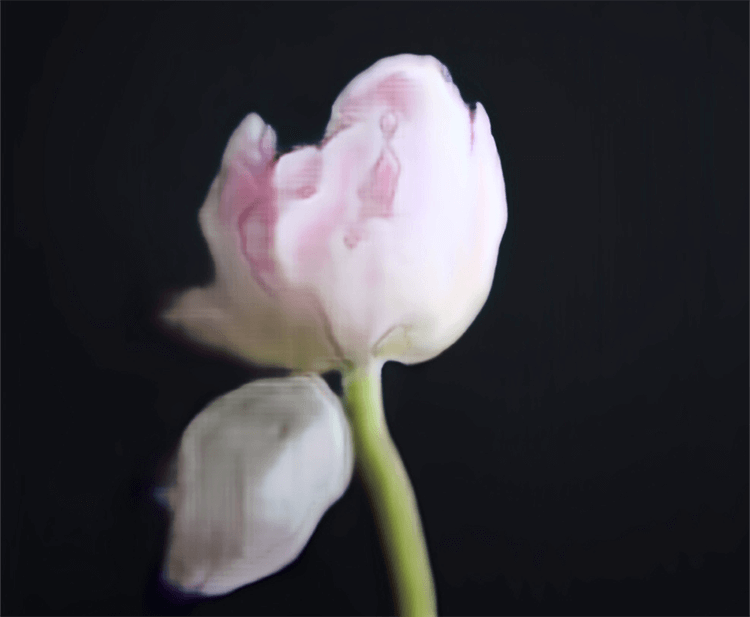
Blomenveiling is a sort of flower auction: short moving-image pieces of tulips created by artificial intelligence will be sold at an auction using smart contracts on the Ethereum blockchain. The smart contracts that define the work and how it can be sold will include code that makes the video work mirror how real tulip bulbs behave.
This raises the question of how AI and blockchain are challenging old paradigms in the art market: on one hand, with AI you can generate infinite works on demand. On the other hand, blockchain has almost the opposite effect, though. It takes an effectively limitless resource – information – and makes it artificially scarce. That’s a frightening prospect in many ways, but it’s one we wanted to explore in this piece. Anna Ridler and David Pfau reflect.
Blomenveiling examines not only value, desire, and economic dynamics but also human-machine interaction. This makes it relevant to how artists use AI to produce their artworks, sparking a wide conversation inside and outside the art world. Media art has a long tradition of artists using the latest technologies to push and explore their boundaries, and machine learning fits squarely within it.
When making art with it, you are really making art with two separate things: an algorithm and a training set. Training sets are reflections of their context – they inevitably come to enshrine certain cultural or social attitudes because they are always compiled by human beings; they are the products of people (and a similar thing could be said of algorithms; they too are the products of people) – and using AI is a way of exploring this; it allows us a way of reflecting back on ourselves and the world that we have created, Anna Ridler and David Pfau continue.
Entangled Realities focuses on the effects of AI on human life and society, and its reality-building effects. What challenges do artist Anna Ridler and research scientist David Pfau imagine are ahead for this reality-building effect?
Reality-building is supposed to happen organically. We tell each other narratives to frame and make sense of the world around us, and we trust that these stories are told by people who see the world the way we do. Now, so much of our consensus reality is being created by the software we hardly understand – financial markets where bots endlessly trade with other bots, social media algorithms that control what narrative we see, even AI fakes that make us doubt our own ears and eyes. It’s going to become harder and harder to sort out where the human influence is.