Text by Rodrigo Guzman-Serrano
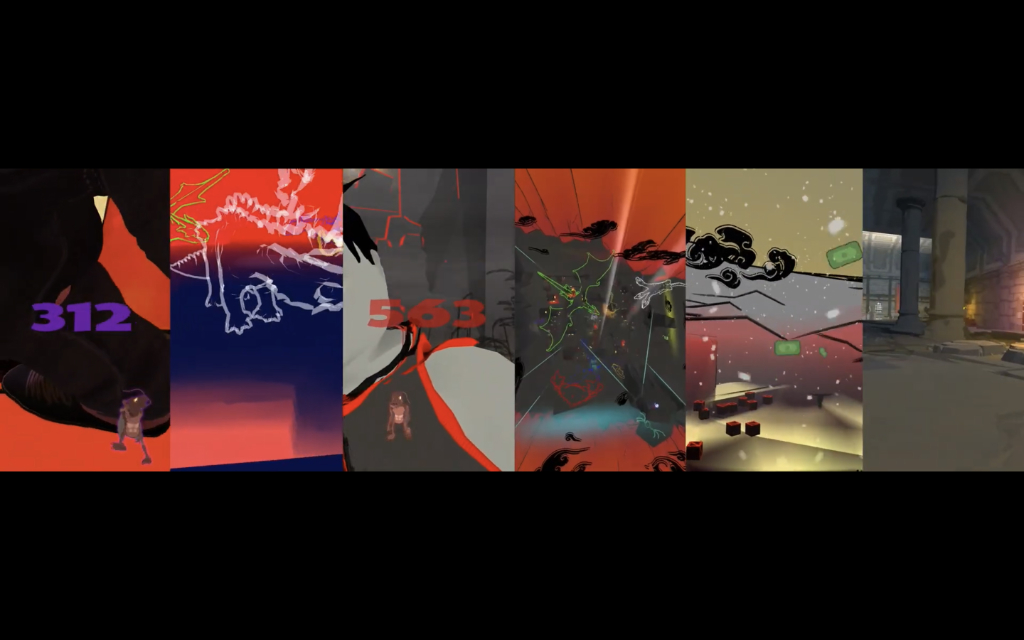
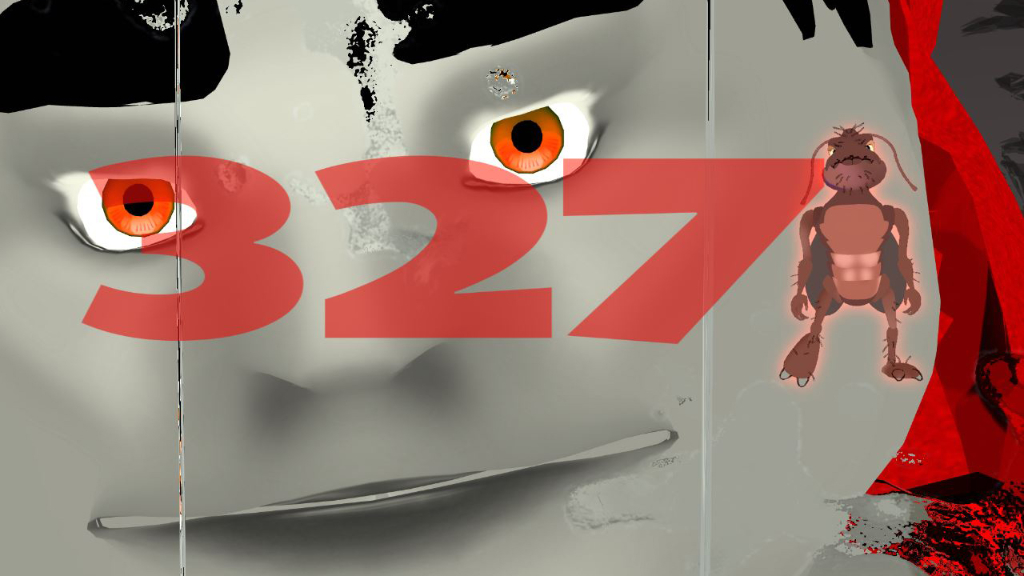
In 2023, I visited the exhibition Between Performance and Documentation: Contemporary Photography and Video from China [1], curated by Nancy Lin and Ellen Avril at Cornell’s Johnson Museum of Art in Ithaca, N.Y. Near the end of the exhibition, amongst photographs and videos documenting performance art in China from the 1980s and 90s, stood six monumental wooden structures, each holding a large portrait-oriented screen. The structures reminded me of wooden crates rearranged into obelisk-shaped pillars. The monitors on each pillar showed bright-coloured videos depicting what seemed like an environment straight out of a video game—snowy landscapes, underground mine shafts, and fantastical villages surrounded by mountain silhouettes and overflown by colourful dragons.
The installation was Miao Ying’s Pilgrimage into Walden XII Project, Chapter I: The Honor of Shepherds (2019–20) [2], which the label indicated was created through a program (then) called \Art. This was the first time I heard of Backslash at Cornell Tech [3]. I was intrigued. As someone who studies and writes about the complex, intertwined relationship among art, science, and technology, I was piqued by this. I had started my art history PhD at Cornell in 2021 and thought, we have an art-and-technology program?” “Why didn’t I know about this!
Backslash (or simply \) is Cornell Tech’s art funding program supporting artists and creatives whose practices are described as nonlinear, unconventional, unexpected, adventurous, intense, surprising, questionable, and primed for engagement with new technologies [4]. The program offers various financial structures (fellowships, grants, microgrants) to fund projects ranging from small student projects to major collaborative works involving visiting artists, Cornell faculty, and graduate students.
To date, Backslash Artists and fellows include Matthew Weinstein, Kate Gilmore, Mika Tajima, Miao Ying, Devin Kenny, Christie Neptune, Jen Liu, Mimi Ọnụọha, Chando Ao, Noah Feehan, Xin Liu, Lawrence Abu Hamdan, Niko Koppel, and Tianyi Sun. Since its inception in 2016, the program has undergone continuous transformation, shifting names, restructuring its funding mechanisms, expanding its focus, evolving, as technology does, through iteration and reiteration rather than stasis. No art initiative remains static, of course, but there is something fitting about a program embedded in a tech campus that treats transformation as a feature rather than a bug. Still, one throughline has persisted: the program’s commitment to pairing artists with technologists and its insistence on producing a realised artistic output; in other words, not a demo or a prototype, but something complete that can be presented to the public. Backslash is not about the experiment of partnering artists and engineers, but the receipts, the results that such a partnership can generate.

The program is the brainchild of founding fellow at Cornell Tech Greg Pass, then the campus’s Chief Entrepreneurial Officer and a former Chief Technology Officer at Twitter. The conception of Backslash, as Pass explained to me, must be understood within the context of Cornell Tech’s establishment in New York City and the school’s founding vision.
From the beginning, rather than limiting itself to traditional engineering education, Cornell Tech aimed to encompass the full spectrum of technology’s role in society, the economy, and culture at large, positioning itself not merely as a satellite extension of Cornell University in New York City, but as a distinct entity designed to leverage different resources and programs to fulfil this vision. The campus emphasises outputs and public outreach: since its founding in 2012, for example, Cornell Tech has implemented yearly open studio [5] events where students present their work to the general public to cultivate a sense of academic accountability and to ensure a continuing connection between scholarly research, technological innovation, and society.
Art and design, likewise, have been essential components of this vision and Backslash is one element of this, one branch of the tree. In 2017, Cornell Tech opened its permanent campus on the south end of Roosevelt Island in the former site of the Blackwell’s Island Penitentiary. The construction of the Emma and Georgina Bloomberg Center, one of the campus’s main buildings, stipulated the allocation of 1% of its budget towards art installations [6]. The building features five permanent installations created by Michael Riedel, Matthew Ritchie, Matthew Day Jackson, Ilya Bolotowsky, and Alison Elizabeth Taylor. Moreover, interinstitutional exchanges have been created to integrate design into Cornell Tech’s curriculum, including collaborations with students at Parsons School of Design. These collaborations were facilitated through connections with Parsons professor Justin Bakse and later expanded with the establishment of Cornell Tech’s M.S. in Design Technology [7].
Within this framework, Pass was interested in creating an initiative to further facilitate student engagement with the intersection of art and technology. The program drew inspiration from various precedents, including Rhizome’s Seven on Seven (7×7) program, in which seven artists are paired with technologists for a day-long collaboration to make something new [8]. (In fact, the 2025 Rhizome 7×7 [9] was hosted by Backslash at Cornell Tech.) Pass, however, who previously served as board chair of Rhizome for ten years until 2024, didn’t want to simply recreate 7×7 at Cornell Tech, so a new structure was devised. The new program’s initial designation was ArtFoo—foo being a term derived from computer science terminology to denote a placeholder or arbitrary variable, a stand-in for something yet to be defined. The name later changed to \Art, and then simply Backslash.
The move from ArtFoo to Backslash was due to multiple reasons. The backslash gave the endeavour a different meaning. In programming, the \ character functions as a so-called escape character [10], indicating that subsequent elements require a different interpretation. As Pass told me, this character can produce unexpected outputs and behaviours, not what they’re meant to be.
Kernighan and Ritchie’s seminal book on the C programming language, known simply as K&R and first published in 1978, explains that the \ character provides a general and extensible mechanism for representing hard-to-get or invisible characters. In layman’s terms, \ signals a change of interpretation to whatever is in front of it (what literary theory calls defamiliarisation, an operation that changes the way a word is read and interpreted to see it in a new light). This way, “\n” means the “n” is not really an “n” but a “new line.” Another example is “\a” which in C language triggers a small ring sound, the so-called bell character [11] and Pass’s favourite example of the use of \. (Curiously, a “\\” means the second “\” is not this special escape character but an actual “\”—it’s the world upside down, two negatives making a yes.)
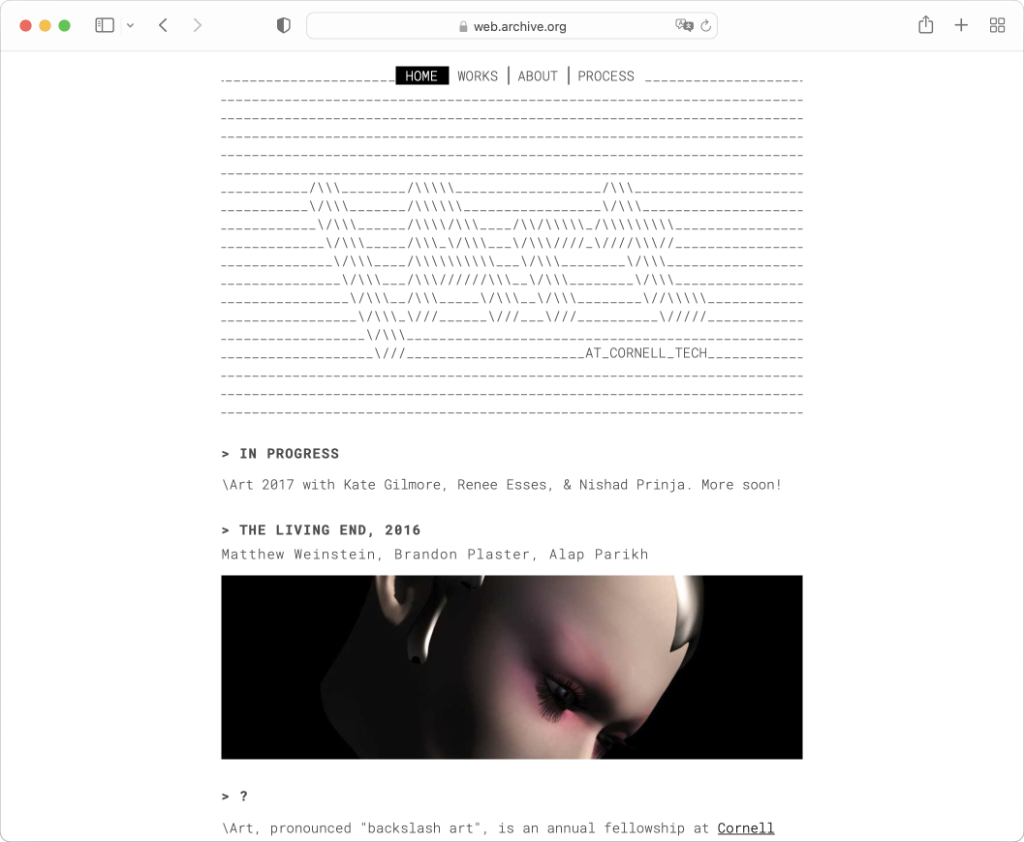
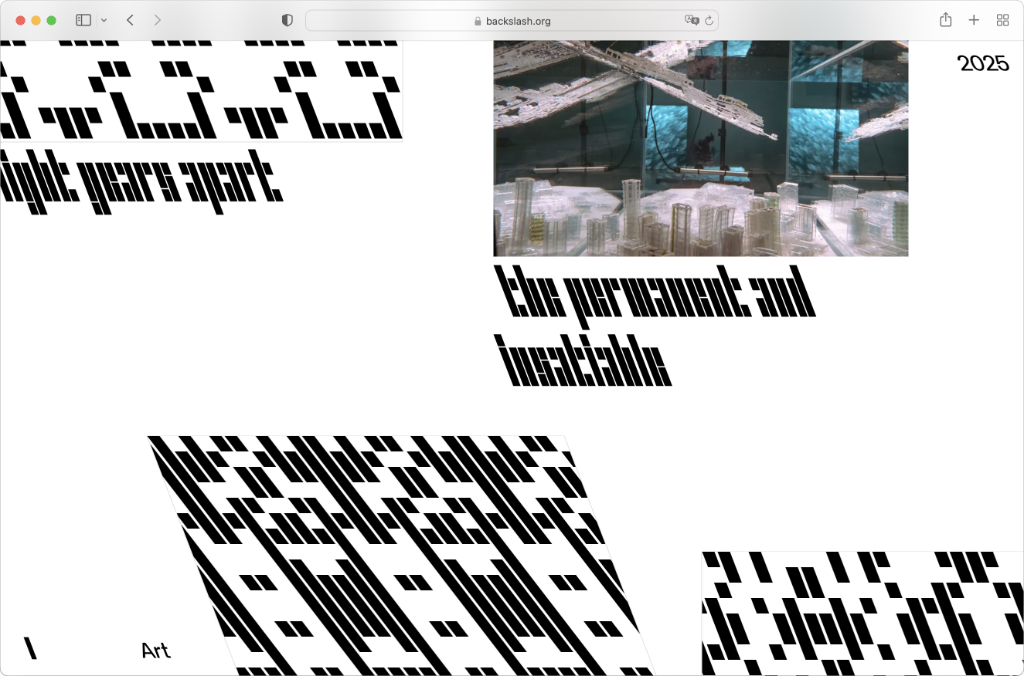
When one learns about Backslash at Cornell Tech, probably the first thing to note is its branding and visual identity. When I first discovered the program, an ASCII art \Art banner dominated the upper half of its website. Later, a custom-made font consisting entirely of backslashes was created by New York-based design studio Cotton [12]. But the name and its striking visuals (and, frankly, the discomfort it produces when you attempt to read the text on its website) are, I think, more than clever branding. It articulates a certain philosophy. I read the move from ArtFoo to \Art, and eventually to Backslash, as the consolidation of a more ontological shift in the way the program is conceived, a transition from open-ended potential to declared intervention.
Foo suggested tentativeness, an experiment still searching for its form, a placeholder. Backslash, by contrast, suggests an action to us: it interrupts, escapes, and transforms the meaning of what follows. It asks us to question what art might look like and compels us to be open to new art forms and new languages. With \, the program now had a theory of itself, a way of articulating what art might do when embedded within a true technology campus, as Pass often describes Cornell Tech—meaning, a place where technology is considered in all its dimensions, not only as an engineering problem but as a social force, economic engine, and cultural condition.
As its name suggests, the program has transformed and evolved through trials and new iterations. In its earliest incarnation, for example, Backslash functioned as a post-graduate fellowship through which recent Cornell Tech graduates were essentially hired to work and collaborate with artists. This is how artist Matthew Weinstein worked with Brandon Plaster and Alap Parikh (both 2016 M.S. in Information Science and Connective Media graduates), and Kate Gilmore with Renee Esses Wolfsdorf and Nishad Prinja (both 2017 Meng in Computer Science graduates).
The fellows would travel to the artist’s studio on a set schedule, working side by side to develop projects over the course of the fellowship, which lasted anywhere from six months to a year. (Plaster, for example, shared with me that one of his favourite memories of the program was riding his bike along the East River to Weinstein’s studio in Green Point.) This was, in effect, a job: a bridge between finishing a degree and entering the workforce, but one spent in the service of artistic production rather than a tech startup.
When I spoke to Plaster, Parikh, Wolfsdorf, and others, they all expressed gratitude for this arrangement. The fellowship gave them a paycheck and a purpose while they figured out their next steps, a rare luxury in the anxious limbo that often follows graduation. Today, the model has shifted. Artists work primarily with current students, and in some cases, faculty serve as advisors or collaborators. More graduate students from the Ithaca campus are also involved. Current Backslash fellow Lawrence Abu Hamdan, for instance, is working with Laura Cortés-Rico (PhD, Information Science, 2028).
Additionally, as the initiative has grown, Backslash Artists overlap. Currently, Tianyi Sun and Niko Koppel have been developing their projects simultaneously rather than in sequence. These are year-long collaborations, after which presentation timelines and contexts remain flexible, allowing works to be exhibited in ways that best align with each artist’s practice.
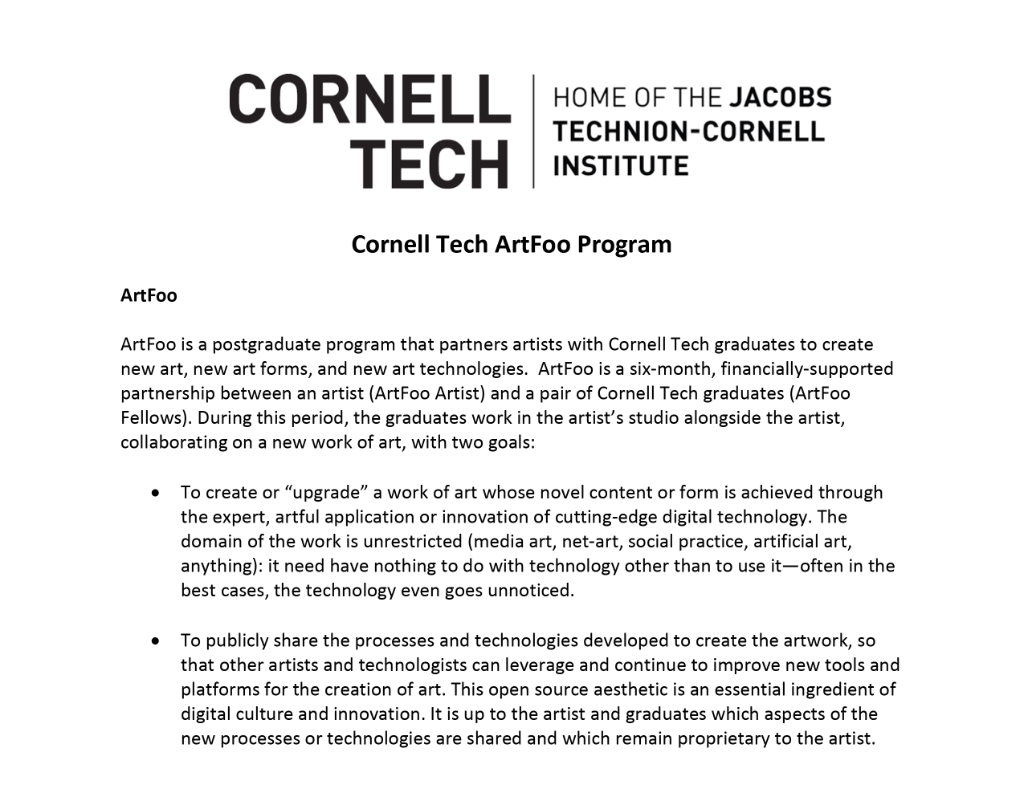
The ethos around working with technology has also shifted, if slightly. A 2017 pamphlet circulated among fellowship recipients emphasised the artful application or innovation of cutting-edge digital technology and described the program as aiming to create new art, new art forms, and new art technologies. Similarly, an older Cornell Tech Impact page from July 2019 [13] described \Art as a program that supports bleeding-edge technological interventions into artistic practice.
Today, the language around technology has softened. Backslash is interested in supporting artists and artworks that are unconventional and unexpected, as the new description reads, all adjectives that emphasise disposition rather than technical novelty; in other words, less foo and more \. The shift, in my opinion, suggests that Backslash has moved away from a preoccupation with newness and toward something harder to pin down: a certain sensibility, perhaps more conceptual than technical, in which the appropriate technology serves the artwork as opposed to the artwork matching the newest technology.
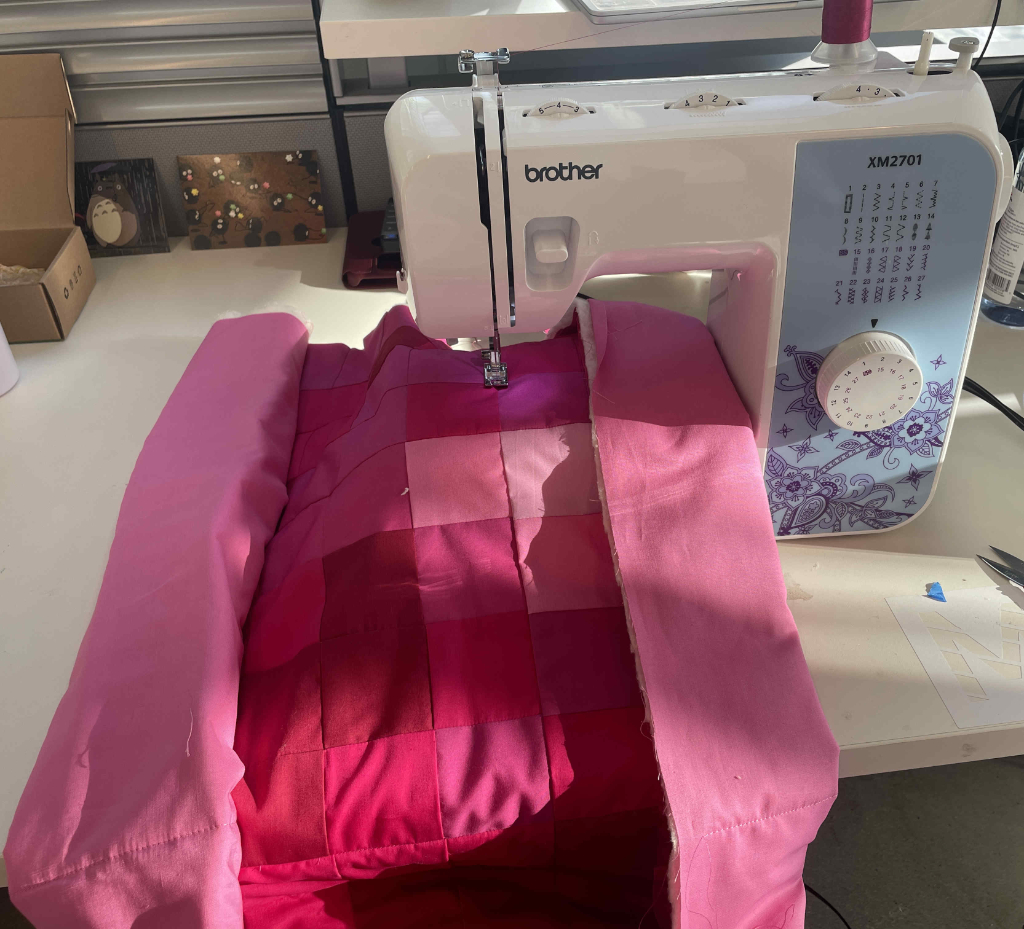
The emphasis on concepts rather than tools is evident across Backslash projects, including the student projects funded through microgrants [14]. For example, 2024 microgrant awardee Kara Myren created a Pink Noise Quilt [15], which translates a digital signal-processing concept into a handcrafted textile. Kara used software to visualise a pink noise filter, a type of random signal distribution commonly used in electronics and audio applications, then posterised and pixelated the image to reduce its 255 shades of grey to a manageable palette. The resulting grid was matched to pink fabrics sourced from a New York City fabric store and hand-sewn into a 30 x 30” quilt, now on permanent display at Cornell Tech’s MakerLAB. The project exemplifies how a technical idea can be executed into an artwork using more traditional media like textiles.
What these projects share, finally, is less a commitment to any particular technology than a willingness to let the work find its own form. In the second part of this article, I will explore some of the collaborations that have defined the program, situate Backslash within the longer history of art-and-technology initiatives, and ask what the program might still become as it enters its second decade.