Text by Iris Colomb
Mike McShane makes sculptures out of aluminium, silicone, prosthetics, kebab boxes and air. Benjamin Whateley is a developer and computer musician whose aesthetic and process are influenced by club music. Over the past five years, these two Essex and London-based artists have been working with artificial voices, separately, and in their own unique ways. While McShane builds machines capable of mechanically producing their own vocal sounds, Whateley uses voice synthesis to produce sound pieces and performances. By foregrounding materiality and humour, celebrating imperfection through technology, tirelessly challenging audience expectations and redefining the contours of empathy, these artists’ exploratory approaches push us to think about what makes a voice and what it can do.
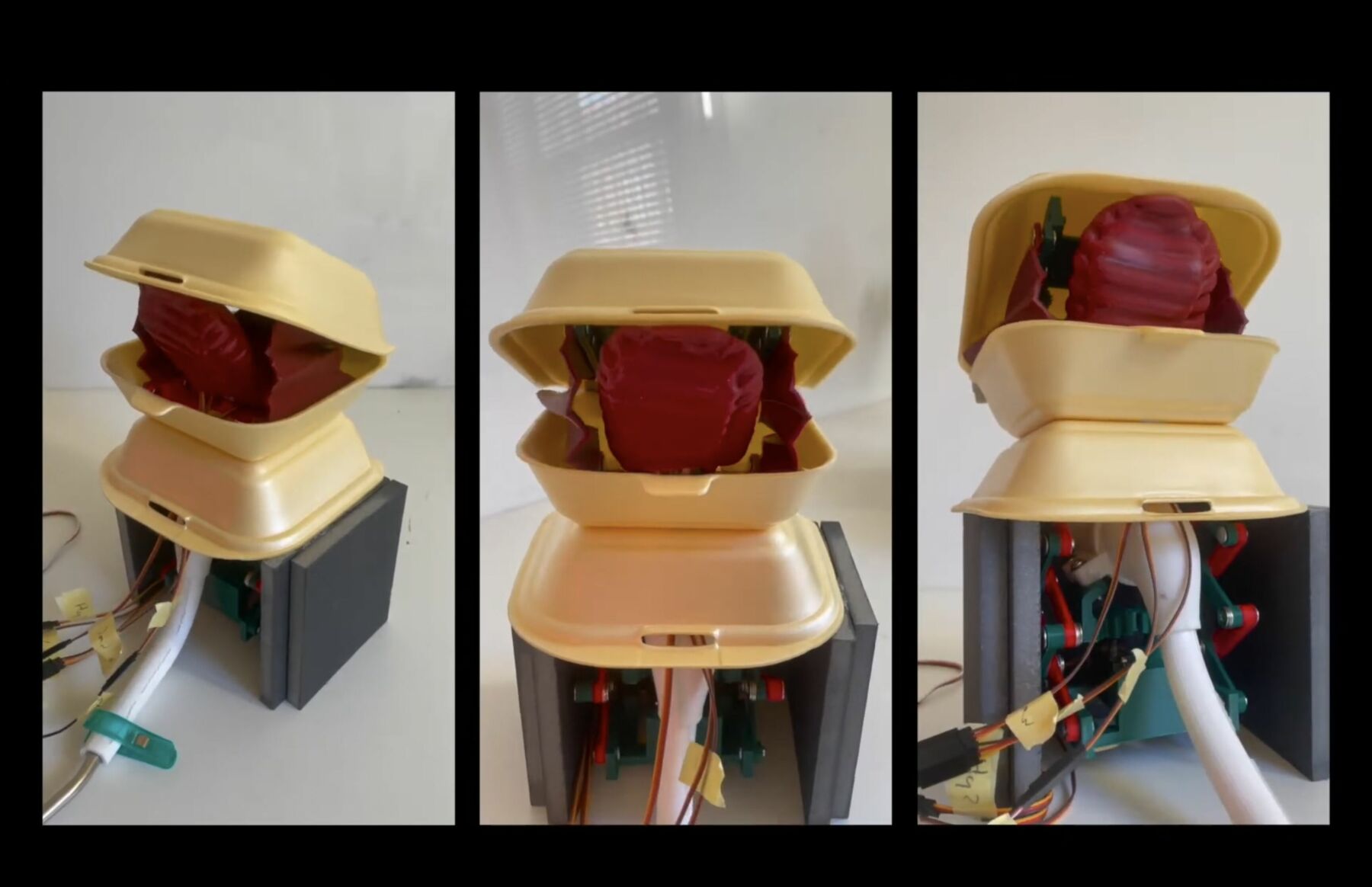
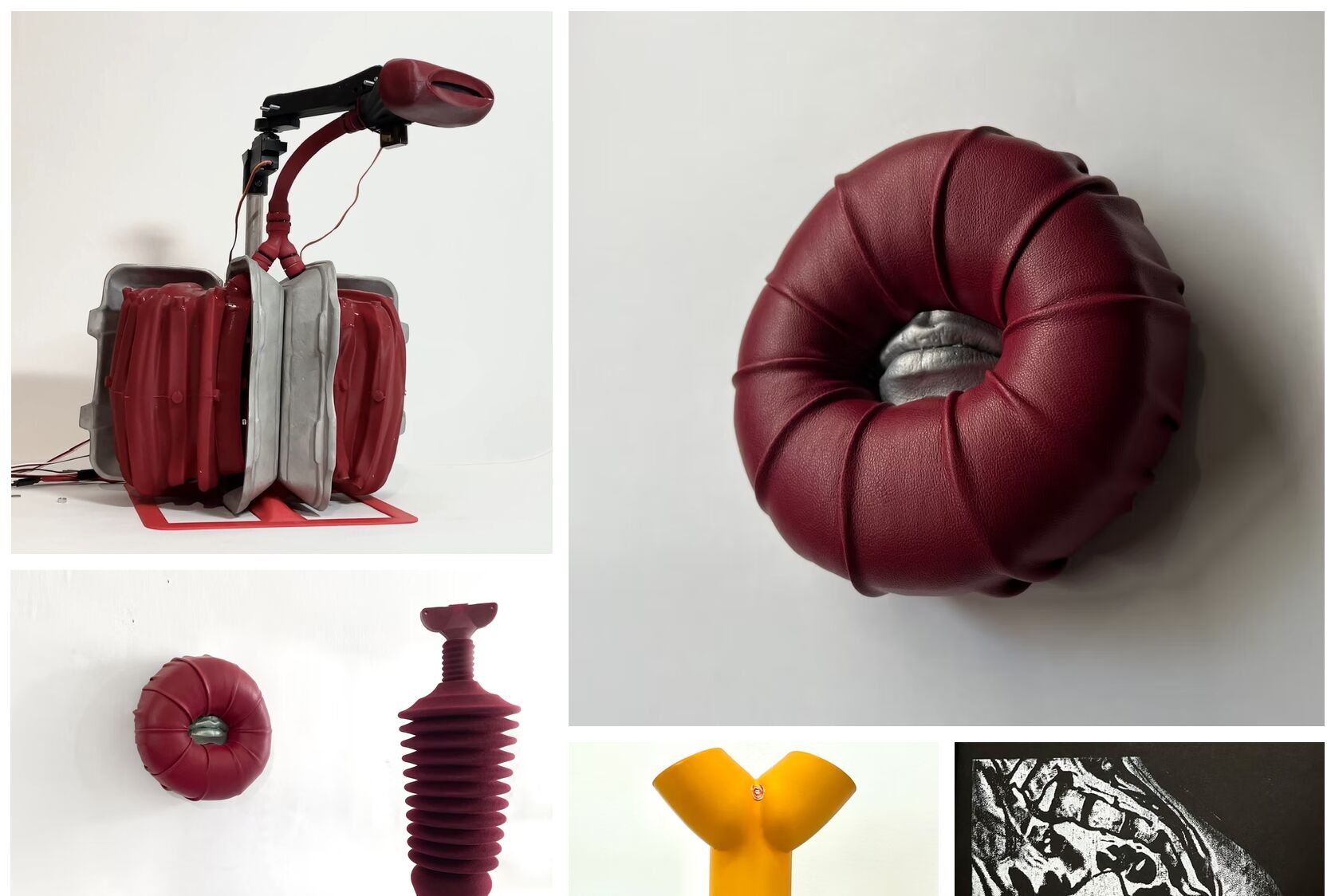
McShane’s interdisciplinary practice is informed by his visual arts background, and this is reflected in the sculptural lens through which he engages with the voice as a phenomenon. He is interested in the architecture of vocal sounds, the physical shapes through which they are produced. His work is full of references to gothic horror, fun-fairs, and meme culture, which he uses to subvert the elitism of the fine art world. In his exploration of the material thing that makes the sound, his aesthetic weaves between the anthropomorphic and the sculptural through a variety of modular parts, alternating between cast aluminium and dark red silicone, including tongues and larynxes as well as cast kebab boxes and a variety of bellows and valves. Each component is designed to draw the viewer’s attention to its function within the vocal apparatus, allowing them to see their gestures through their form.
Sound is at the core of Whateley’s practice, and he uses computational tools to digitally manipulate it. He approaches the sonic materials he works with as sound objects and his experiments have led him to think of the voice as a particularly malleable and sensitive material due to its monophonic nature and dynamic range. Whateley observes that there’s a lot of complexity in voice that we take for granted and is fascinated by the incredible range of possibilities it allows him to open up through a small change in a simple algorithm.
His making process is tentative, playful and iterative. Beyond computational tools his work is shaped by his aesthetic intuition I just put things together until I like how it feels. He is also drawn to the associative power of the voice, its emotional resonance and its ties to cultural signifiers, qualities which encourage him to play with context and create strange juxtapositions.
McShane’s interest in air-driven motion was sparked by his work with soft robotics, which started with the creation of U and I, a piece featuring two silicon letters that grow towards each other as they inflate. Through making this piece, McShane tells me, I became very interested in the kind of breath sound that they made as they vented. This fascination for sounds produced with the exhalation of air soon sparked an in-depth exploration of the vocal apparatus, with support from speech therapist Carol Glaister.
In 2022, using a servo motor and two pincers to inflate and deflate a silicon element built to emulate an embryonic chicken, McShane created his very first vocal machine, Baby Wakes, the vocal range of which is confined to a variety of expressive cries. While the work’s title, organic texture and elemental sonic qualities evoke a fledgling being, its basic mechanism and McShane’s own description of it as a vessel to contain anxieties brings it closer to a toy.
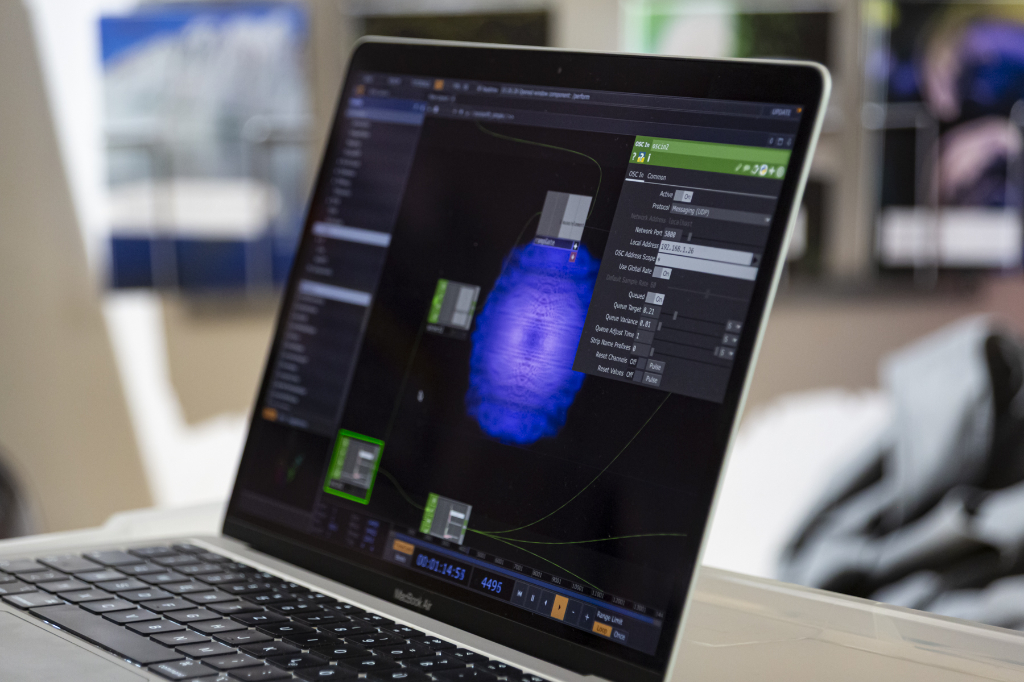
McShane’s reference to the origins of speech resonates with the limited sound palette of Whateley’s first experiments with vocal sounds. He started working with a set of vowel sounds found in his Max tutorial patch. After experimenting with interpolating them he changed the pitch of one of their waveforms with another waveform through a frequency modulation synthesis (fm synthesis) algorithm. Going from duller to brighter sounds by softening the input source with modulated filters led him to stumble upon a new sound, one that changes throughout its duration, like a squeal or a yelp.
These initial experiments allowed Whateley to start understanding the sonic properties of the voice and he was struck by its versatility, there was something about it that was really dynamic. The result is a synthetic sound poem, through which vowels seem to bounce back and forth through aural space at great speed. Whateley and McShane’s initial experiments with ways of making and manipulating voice both involve a return to the elemental components of language, a few cries and vowels. These sounds evoke a life before speech, allowing us to rediscover voice alongside them.
As Whateley’s syllables bounce against each other in that first experiment he simply calls voice, their movements start to suggest a kind of dialogue, an everchanging dynamic emerges as the machine appears to call, impress, irritate, pity and interrupt itself. Syllables stumble over each other, brimming with projected intention ‘oh’ becomes an awkward moan, ‘ee’ a tragic wail, ‘ah’ a clumsy gasp, ‘oh’ returns as a defiant yell, ‘ee’ a sheepish squeal, ‘ah’ a burst of triumph. The piece takes on a theatrical edge, and its ever-changing plot tumbles towards us at dizzying speed, exhilaratingly intense and impossible to follow. When infinite possibilities seem to emerge while nothing can be caught, laughter offers a kind of release. Whateley’s playful approach to ‘voice’ is reflected in this rare online specimen, aptly labelled as a work of ‘Comedy’ on SoundCloud.
McShane actively seeks ways for the machine to kind of mock itself. While the humorous side of his practice is made obvious by works such as Trash Talk Kebab Choir, a collection of singing kebab boxes with tongues, others, such as The Carynx, a recent and far more sophisticated piece named after the ‘larynx’ and the Celtic instrument ‘carnyx’, appear more menacing.
However, even when faced with this chimeric behemoth, a self-performing instrument capable of producing a variety of musical sounds from bassy drones to percussive plucks, McShane reports that people often laugh when they hear the voice, which is great. The audience’s reaction reminds us that laughter is a powerful response to art, which can carry multiple layers of meaning. Perhaps in a cultural climate beset by fears of technological replacement, laughing at failing machines can provide a welcome and timely sense of relief.
Throughout his practice, McShane enjoys combining a deliberately basic aesthetic with complex technological systems. However, despite his fascination for the mechanism of the voice, his goal isn’t to replicate the human vocal apparatus; he isn’t interested in reaching a high level of fidelity. Instead, his work deliberately sits in the vibrant interstice between trying, learning and failing.
He describes his vocal machines as simultaneously slightly aggressive, but also stupid, vulnerable. This combination of unease, humour, and empathy allows them to address some underlying complexities of our relationship with technology and automatism, such as the human urge to empathise with machines and the tendency to mechanise our relationships with one another.
Whateley enjoys using technology that defies the smooth, sealed polish of cutting-edge commercial products and often tinkers with imperfect or obsolete bits of software in which there are still things to be found. He is interested in the unexpected possibilities that their limitations and gaps make way for. The patch that first sparked his exploration of voice synthesis came from a modular toolkit that exposes individual components of machine learning and machine listening.
Bypassing blackboxed systems allows him to manipulate sounds with a flexibility and malleability which would never have been achievable in the 80s when FM synthesis was first developed. Something is compelling in Whateley’s excavations of older forms of technology and McShane’s deliberately flawed machines. By resisting mimetic realism and foregrounding process and limitation, their works become what McShane describes as more human than a perfect, replaceable voice.
When first encountering his works, despite the deliberate visibility of their sound-making mechanisms, people often ask McShane is there a speaker inside that?. This sentence immediately conjures stories of people running away from a train in their first encounters with film or accusing phonograph operators of being ventriloquists. Here, the traditional discrepancy between people’s expectations and the object that challenges them is reversed: their disbelief is sparked by seeing a body-like structure, when they expect the sound to be created by a discrete technological device.
Whateley’s performances often provoke similar misunderstandings, with audience members consistently assuming that the voice they hear is his; they sort of imagine me hunched over a microphone, making groaning noises, that’s hilarious because it doesn’t sound like me. Whateley shares that he often walks around making weird sounds with his own voice, but he never considers using them directly. Instead, he attempts to envision their shapes and imagines ways to resynthesize them. McShane and Whateley’s works speak to the strength of our assumptions when we hear voices and our drive to unveil their various sources. When we see a machine producing a voice, we look for hidden speakers, and when we hear a voice through speakers, we look for a human speaker.
From drums to organlike drones and remnants of altered pop songs, Whateley develops an attachment to sounds he works with, vocal or otherwise, as a result of the time he spends with them and of the dynamic and responsive nature of his process. He rarely exports the files in which he runs his sonic experiments. Instead of producing fixed compositions, his work usually remains within the program itself. Each project remains a site of experimentation, where the various elements and variables at play shape a field of compositional possibilities.
His performances function as a form of collaboration with the sonic environments he has created, unfolding in dialogue with the systems and sounds they carry. There is something lively, almost lifelike about the way these synthetic voices are interacted with, qualities that resonate with the agency we instinctively attribute to automata. Whateley’s sense of attachment to the sounds he works with extends to the tools he uses to the point of feeling a form of empathy towards them, I do treat them a little too much like they are alive, he admits.
Much like many artists who take an interest in robotics, McShane notes that the inception of his work with automata coincided with a period when his own body’s mobility was threatened by severe rheumatic arthritis. This experience allows him to identify with the kinds of moving sculptures he creates; the idea of myself as an imperfect machine resonates with me, he says. McShane used to refer to his vocal sculptures as ‘empathy machines’, an evocative term which gently points to these silly, slightly broken machines as mirrors through which to channel the compassion and warmth we struggle to direct towards ourselves.
Perhaps, by allowing us to rediscover what we take for granted, exposing our assumptions to make space for the unexpected, offering new ways of addressing our limitations through curiosity and comic release, McShane and Whateley’s vocal works could allow us to experience new forms of care and find new ways of growing towards each other.