Text by Mila Azimonti

I have learned and dismantled all the words in order to draw from them a single word: Home [1].
Fragments by Mahmoud Darwish punctuate Ecoes #8, Sonic Acts’ latest publication accompanying the 2026 Biennial. His writing on exile, loss, and belonging anchors this year’s curatorial strand, Melted for Love. As exhibition curator Angeliki Tzortzakaki recounts, the theme condensed through collective research and discussion in the midst of the ongoing genocide in Gaza: a condition that shaped how the works, and the world around them, were read. The theme crystallised gradually: at some point, someone said that what we were really circling around was love. Not in an ingenuous sense, but as something that connects grief, displacement, care, and relation. Love became a way to hold space for these elements to take place.
Across the programme, references to colonial afterlives, forced migration, and environmental collapse converge, binding ecological discourse to Palestinian struggle and other geographies of dispossession. To be melted for love suggests dissolution: a yielding into forms of care that resist the thickening logics of violence and extraction. As symposium assistant curator Hannah Pezzack notes, the question is how to leverage privileged positions and institutional resources to make certain things possible: by enabling artists who cannot easily travel to present their work, or making a performance possible for the first time. It’s not enough to write in a curatorial statement that you are for hospitality, or generosity, or love. These claims must be tested against their capacity to act.
In a European context marked by rising far-right politics, increasingly hostile anti-immigrant rhetoric, and the deplatforming of pro-Palestine voices in the Western art world (from Candice Breitz’s cancelled exhibition in Saarland to the firings at Artforum and the Berlinale’s silence on Gaza), this urgency is grounded in concrete cases. Sonic Acts operates within the same constraints it reflects on, navigating shrinking resources and an increasingly precarious cultural landscape. That such a programme can take place at all remains contingent. As Tzortzakaki notes, in other contexts the visibility of many of these works would be affected: either not exhibited at all, or presented in constrained ways due to high levels of censorship. Founded in the mid-1990s alongside the rise of digital technologies, Sonic Acts evolves from a focus on emerging tools to a broader engagement with ecological and sociological concerns. Its format now extends across installations, symposia, performances, and listening environments, arrayed over multiple venues in Amsterdam. What cuts across these three decades is the use of sound not simply as medium but as a mode of inquiry into political, ecological, and philosophical questions that exceed its own field.
For those arriving from elsewhere, like myself, the experience remains partial, compressed by the span of the so-called Festival Weekend. More fundamentally, Sonic Acts operates through multiple temporalities and many access points: workshops, talks, performative activations, among others. As ever, responsibility lies with the audience: it’s about what you choose to receive.
[EXHIBITION]
I find the exhibition, spread across W139, Arti et Amicitiae, and Rozenstraat within walking distance of each other, the Biennial’s most affectively charged strand. Structured as three distinct yet permeable exhibitions, it engages the theme Melted for Love from different angles through sculpture, video, drawing, and textile. Unlike most of the other curators, Tzortzakaki doesn’t come from sound studies. My background is mostly in visual arts and time-based media like video and performance. Within my curatorial practice, sound is thus more of a research thread. The exhibition doesn’t necessarily focus on sound artists, although works often connect to sound indirectly. She resists rigid distinctions between categories: sound and non-sound, advanced technologies and manual processes like embroidery. Sound doesn’t require technology to exist. Similarly, technology isn’t limited to digital systems. It is embedded in everyday life, in manual practices.
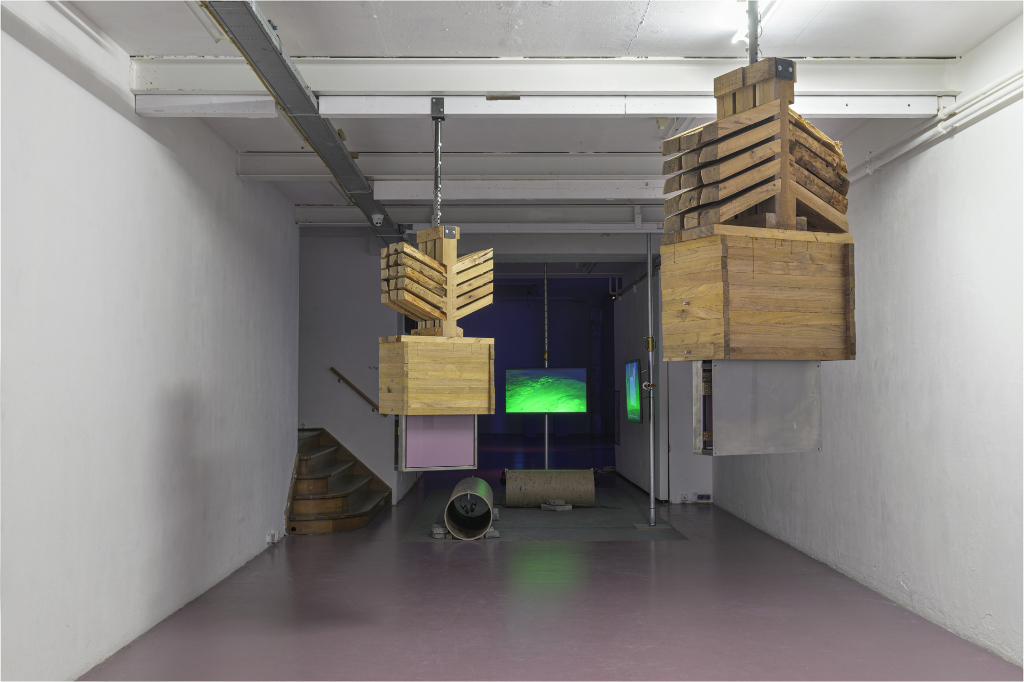
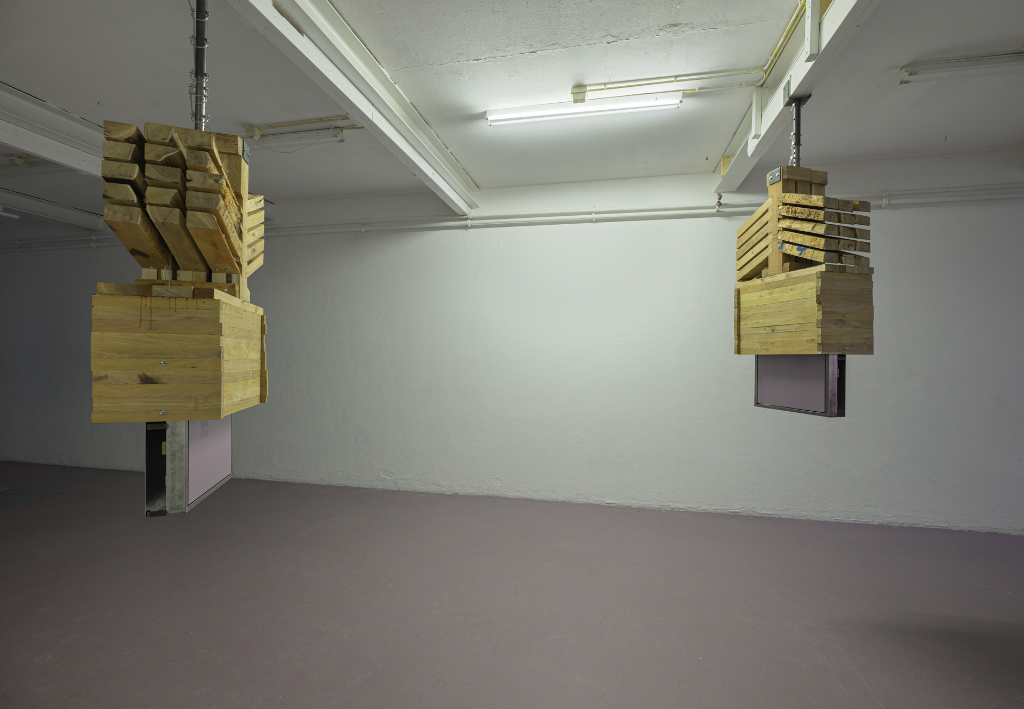
While the exhibition remains open to circulation, a possible trajectory begins at W139, where works probe the infrastructures of extraction, colonial occupation, and ecological transformation. Bad Luck to Every Magistrate and Bad Luck to Every Gamekeeper by Lower Levant Company and Olga Micińska articulate these conditions through two wooden resonant structures mimicking enlarged bat-house cavities. Operating as half-sculptural-object-half-acoustic-body, they emit interrupted sounds in which bat calls intersect with militarised radio transmissions and encrypted messages. Drawing on British colonial sonic legacies in Cyprus, including the propaganda radio Near East Arab Broadcasting Station, the work repurposes symbols of authority and resistance into speculative post-colonial futures. “Homes” for bats are recast as fragile architectures of refuge and interference: acoustic shelters and listening posts at once. As Tzortzakaki notes, there is a sense of circularity, almost of exhaustion; historical patterns repeat themselves, especially in geopolitical contexts.
At Arti et Amicitiae, the focus shifts to embodied mourning, loss, and repair, tracing human and non-human remnants of love. In a subdued, low-ceiling room stands a series of circular water containers functioning as both ritual instruments and irrigation channels, connected to a speaker. Ameneh Solati stages a silent, devotional encounter with the Euphrates as both river and wounded body, asking: Might Water Grieve? Operating at the intersection of planetary scale and bodily memory, the installation treats the Euphrates as a contested river-body shaped by extraction, conflict, and displacement, while also registering ecological and political violence. Through sonic and spatial cues, the work folds the mourning of those uprooted by war and environmental degradation into the river’s imagined affective register, staging a “hydro-lament” where human and more-than-human grief become entangled.
At Rozenstraat, the works turn to how loss is inhabited in real time, how to memorialise what persists, and how dispersed communities carry ancestral knowledge into collective forms of justice. Christian Nyampeta andKivu Ruhorahoza’s film Whispers functions as a hushed, ritual–like address to the un‑or‑half‑dead, reflecting on bonds that stretch across life, death, diaspora and the residues of colonial time. The piece combines listening‑driven footage from Dakar with readings of Birago Diop’s poem “Spirits”, where speech is a form of hospitality toward the dead. It’s a work that refuses monumental mourning in favour of a dispersed, domestic elegy, inviting the viewer to attune to the “aliveness” that persists in the margins and in the afterlives of catastrophe, staging the gallery as a chamber of unfinished conversations.
The exhibition’s tripartite structure choreographs an affective journey across scales, from systems to subjects. Moving from infrastructural analysis to embodied mourning and finally to dispersed, almost imperceptible fugitive memory, it guides how we inhabit complicity, loss, and resistance. Sound attunement carries across the burden of engagement, making listening the connective mesh. Many works are newly commissioned, with residencies and mentorships enabling Sonic Acts to sustain long-term relationships with artists and support projects as they develop over time. This continuity allows for deeper development and sustained exchange. As Tzortzakaki puts it: Curating is not just about selecting works, but about building relationships and developing projects together over time.
[SYMPOSIUM]
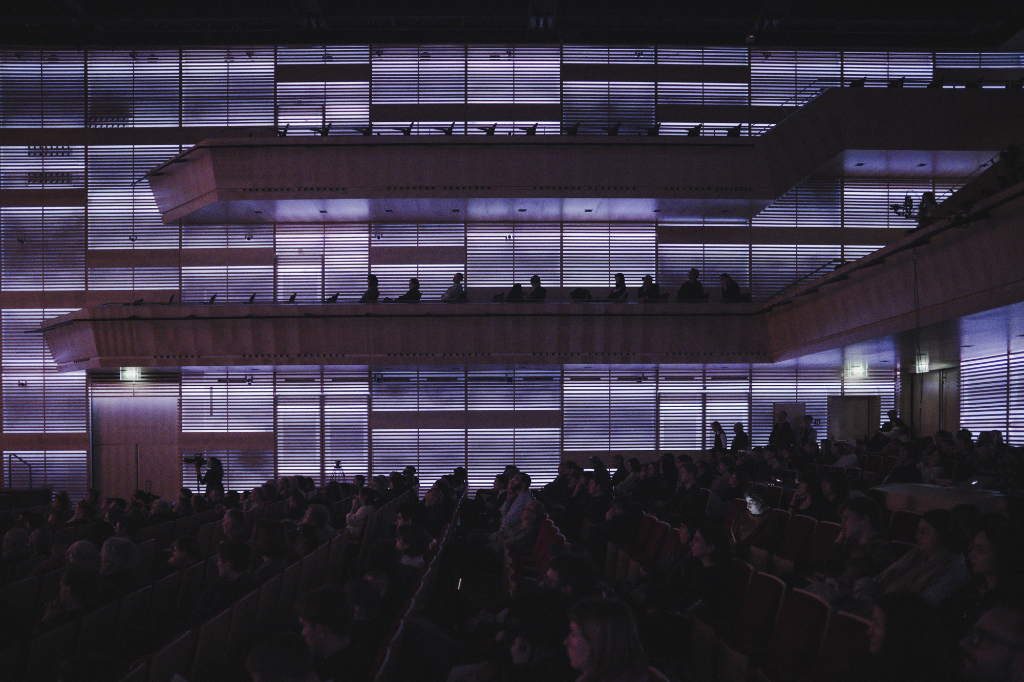
The symposium forms Sonic Acts’ most pressured, discursively dense arena, where the Biennial’s conceptual architecture is unpacked and its ambitions tested. Lectures and performances complicate Melted for Love, staging contradictory sonic politics: sound as weapon, surveillance, and warfare versus sound as resistance, memory, and community. Sound is a conceptual tool for navigating contemporary conditions of be/longing.
At its strongest, the symposium unsettles its own premise. Flavia Dzodan’s Affective Logistics maps how platforms capture emotion as cargo, treating mood, attention, and desire as extractable data through behavioural targeting and algorithmic optimisation. Her emphasis on affect as harvested resource shows how intimacy becomes folded into speculative profit zones (the same infrastructures that govern climate-driven displacement and colonial-style control), so that tenderness and affability are no longer spontaneous relational forms but zones of infrastructural entanglement and governability. Here, love’s traces become battlegrounds where intimacy risks co-optation.
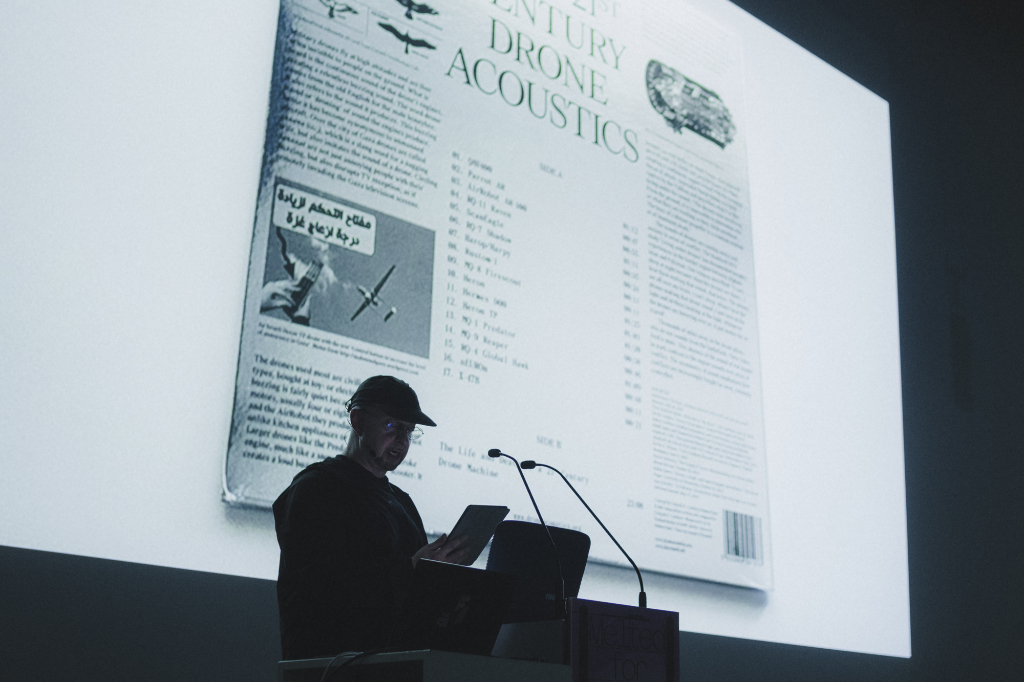
Lawrence Abu Hamdan’s lecture-performance Zifzafa uses a video game simulation to expose wind turbines in Israel’s occupied Golan Heights as acoustic weapons masquerading as green energy. While their infrasonic hum doesn’t harm individual ears, it isolates communities by severing networks of communication: people, animals, and everyday sounds become inaudible across distances, rendering Bedouin lifeworlds acoustically illegible and controlling audibility itself. Noise law, focused on cochlear damage, treats pollution as an individual issue rather than communal violence, and is thus ineffective here. Forensic listening becomes a counter-affect, revealing sonic architectures’ dual capacity to produce both solidarity and erasure. The work is performed live in its intended form for the first time, bringing together saxophonist Amr Mdah and sound artist Busher Kanj Abu Saleh from the occupied Golan Heights, alongside Earshot audio investigator Fabio Cervi.
Eleni Ikoniadou’s intervention exposes an impasse in contemporary sonic art. Confronting authoritarianism, ecological ruin, and live-streamed genocide, she declares fiction, speculation, and sonic practices, once framed as escapes from anthropocentric and colonial logics, are now exhausted within institutions complicit in capitalist violence. Citing Ailton Krenak’s critique of biennials as art-commodity recyclers, she situates aesthetic practice within political entanglement. Her contribution exposes a central tension: whether sonic practices can produce political intervention within frameworks already implicated in domination. Rather than assuming sound and performance emancipate, she foregrounds the complicity of the platforms that host them. When asked by the audience whether her position is self-contradictory, Ikoniadou calls it a contradiction “worth accepting.” The words of Eva Illouz resonate in my mind: I’m embarrassed by how much I criticise from a distance while remaining complicit. Perhaps being critical today means accepting this complicity.
Sonic warfare, affective capture, and care coexist in the symposium’s discursive field, staging tension between fear (warfare, surveillance, control) and resistance (radio, collective listening, community-making). The most generative moments emerge in the cracks. Salomé Voegelin challenging Yuk Hui’s “outsider critique” from the audience with feminist perspectives, or Steve Goodman’s Sonic Warfare confession: his once speculative theory emerging retrospectively as a way to justify his tinnitus, hyperstitionally birthing an entirely new, and more relevant than ever, research field. Fissures generate reflection that outshines parallel thematics.
[PERFORMANCES]
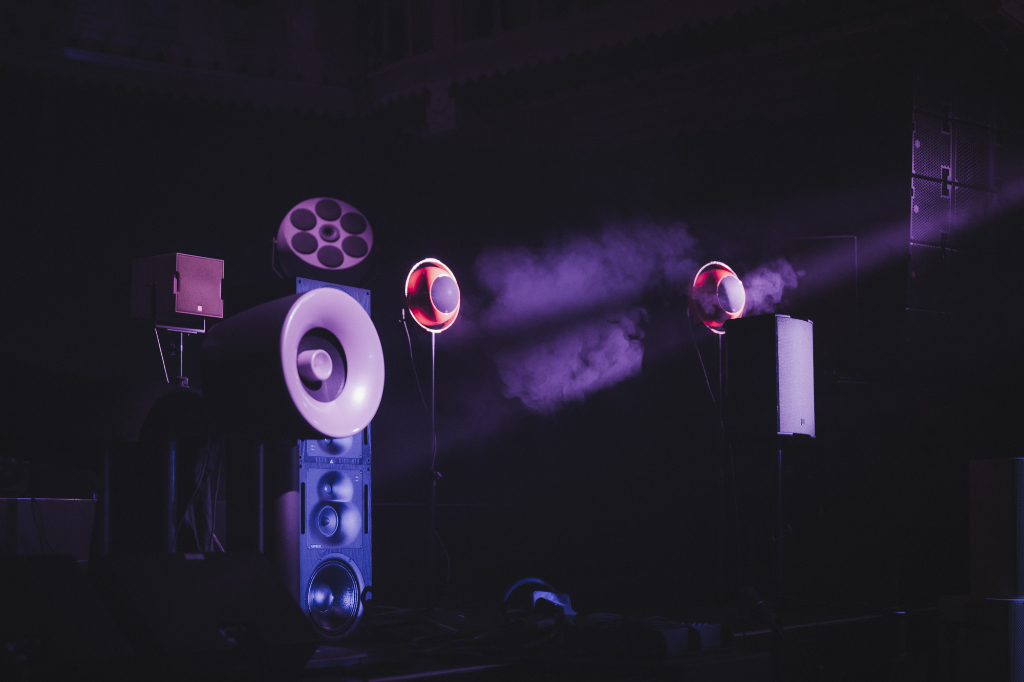
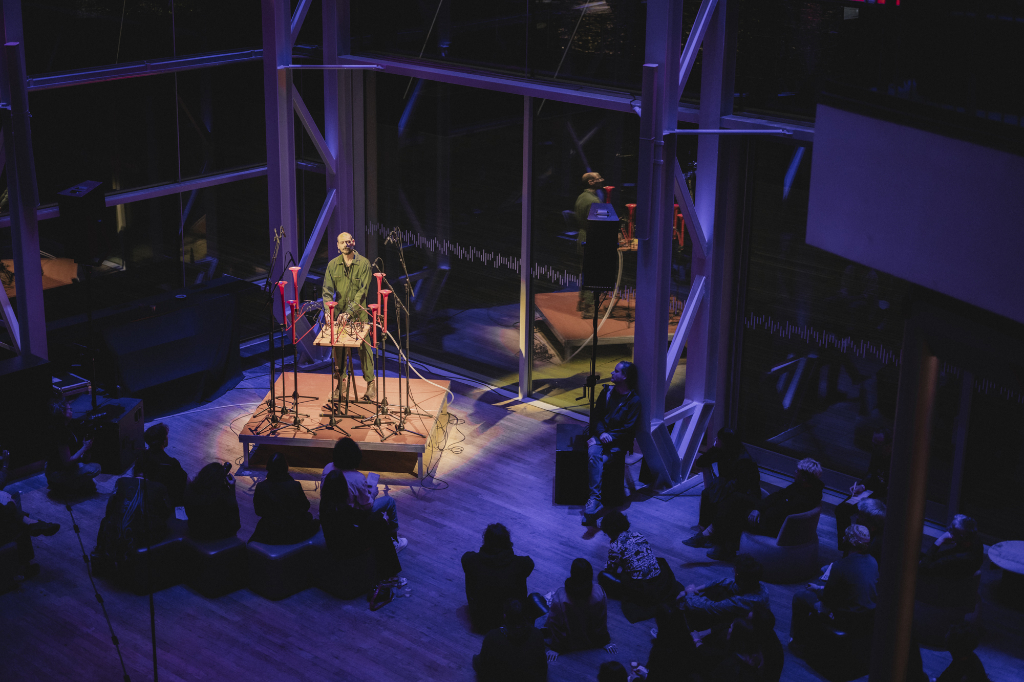
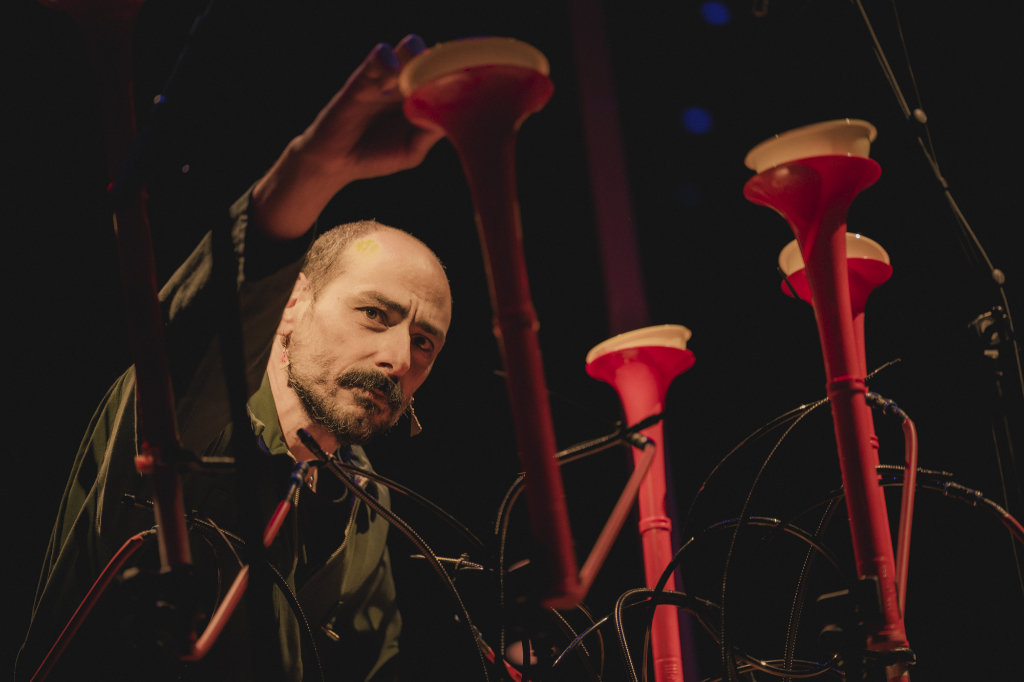
The performances and concerts operate in a different register, where affect is produced through conditions of listening. Across the Expanded Experience programme and the Acousmonium evenings, sound is encountered as duration, proximity, and spatial immersion. This is most evident in works where the relation between sound and body becomes unavoidable. Mazen Kerbaj’s Lungless, performed on the mechanically driven “Horns of Putin,” an air compressor-driven array of prepared trumpets, sustains a continuous, abrasive sonic field that evokes endurance and exhaustion. A sonic memorial to his childhood in East Beirut during the Lebanese Civil War, the title operates on dual registers: literally lungless (mechanically produced sound, no human breath), and figuratively evoking war’s suffocation. Drawing from shared acoustic memories that bridged Beirut’s East-West divide, Kerbaj transforms bombing echoes into a composition of painful nostalgia, where mechanical exhalation becomes a prosthesis for breath stolen by conflict. Within Melted for Love, it registers as a form of raw, bodily refusal, produced through the physical and temporal demands placed on the listener.
Similarly, Éliane Radigue’s Occam Océan – Occam Delta X, performed live by Zinc & Copper, accretes through extended duration and minute variation, demanding attention that is durational and embodied. Hearing her droning compositions realised through analogue brass instruments is as moving as it is exacting. The work reveals something about curation: by arranging works in time and space without overdetermining them, curators create conditions in which meaning can emerge. Radigue’s passing, days before the performance, infused the experience with a collective emotional charge no framing could anticipate.
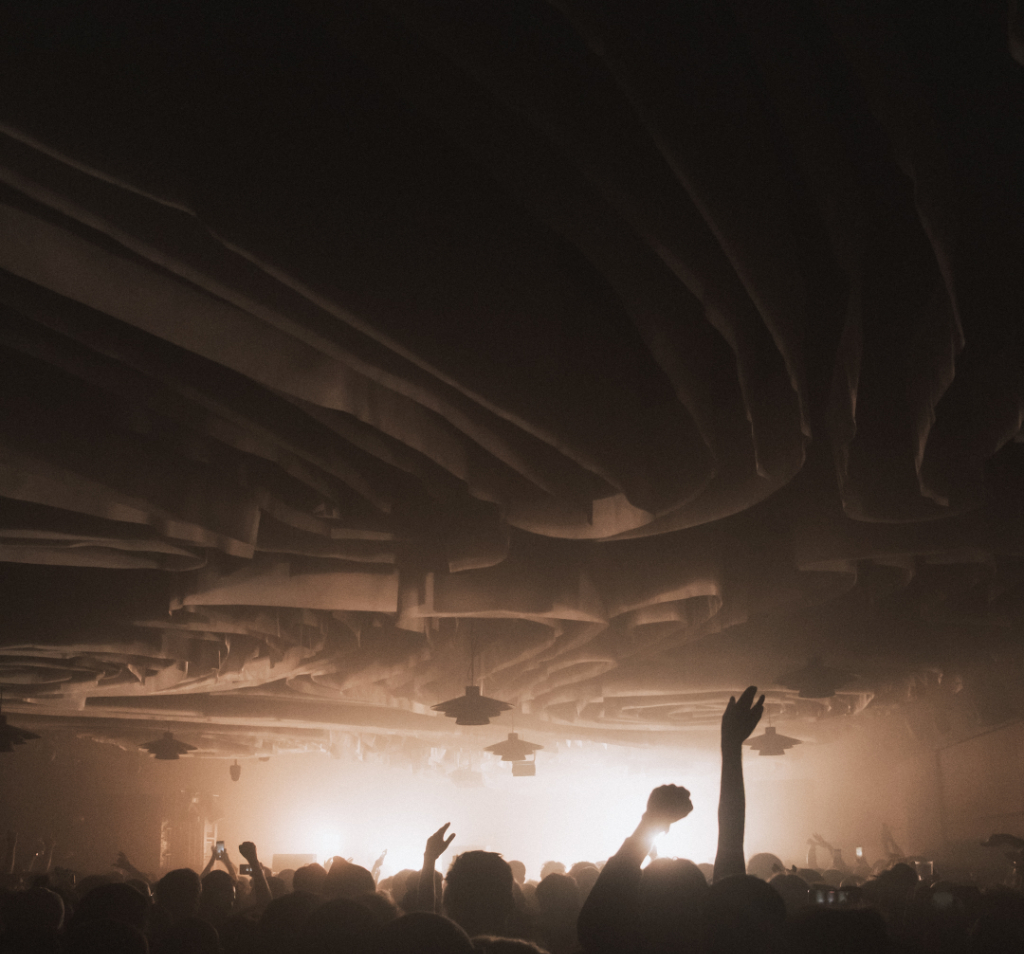
The Acousmonium evenings rest on the obvious yet often overlooked premise that music is experienced differently depending on the space and its acoustic properties. While diffusion truly is the final step of the creative act, the moment sound is shared with listeners in a given environment, it has long been marginalised within experimental music, its role being subsumed into standardised formats and technological devices. Conceived in the 1970s by François Bayle for the INA-GRM’s acousmatic repertoire, the Acousmonium is a cyclopean, 360° orchestra of more than eighty loudspeakers of varying sizes and tonalities, to be played like an organ. Distributed across Paradiso’s concert hall, it turns the space into a responsive topography. François Bonnet describes this as creating “the conditions for music to emerge”,[2] enabling hyper-focused listening and altered temporal perception. Ironically, the most futuristic-sounding work is Bernard Parmegiani’s De Natura Sonorum, composed in 1975. Innovation in sound doesn’t follow a linear timeline.
[CONCLUSION]
Sound has a particular capacity to move through bodies and spaces. It is difficult to fully control or shield oneself from it, which gives it a different kind of relational potential compared to other media. Yet this potential isn’t inherently emancipatory: sound can also be instrumentalised: politically, economically, technologically. At Sonic Acts, it operates as a connective yet ambiguous tissue across its strands, where a more complex understanding of listening is enacted, as a way of thinking about how we relate to one another and to the environments we inhabit.
There is no illusion about the limits of either art or the institutional frameworks that sustain it. Institutions remain entangled in the systems they critique; funding structures, geopolitical contexts, and power relations shape what can be made visible or audible. Art can create space, raise awareness, and facilitate encounters, but it cannot resolve the conditions it addresses. The work is to navigate these contradictions: to make space where possible, to use existing platforms without disavowing their complicity, to bring people together without resolving the tensions that structure that coming together.
At Sonic Acts, art and culture are not treated as separate from politics, nor as neutral spaces of experience. What the programme makes possible instead is a space where difficult questions can be asked and sustained without closure: what is the point of making art now? What is the role of the artist and the curator? What responsibilities persist? What kinds of relations might still be possible? After all,
We suffer from an incurable malady: hope [3].