Interview by Daniela Silva
Deep beneath Porto’s streets, in Roman mines and ancient aqueducts, sound encounters a different measure of time. Echoes stretch through stone, frequencies return altered, and seemingly inert spaces reveal their own acoustic presence. For Portuguese composer, visual artist and stage director Jonathan Uliel Saldanha, this dialogue between sound and architecture is central to an artistic practice that treats physical environments as active participants in composition. His work explores the thresholds between the organic and the mechanical, the visible and the invisible, investigating how sound can transform our perception of space, time and the body.
Active in Portugal’s experimental scene since the late 1990s, Saldanha founded the sound-art collective SOOPA in 1998 and has since developed a multidisciplinary practice spanning experimental music, installation, sculpture and speculative theatre. His early immersion in Hindustani classical music and tabla rhythms established an enduring interest in cyclical structures, repetition and collective experience.
From the subterranean acoustic investigations of Tunnel Vision to the theatrical environments of Red Mercury, Lithium Faust and Libidinal Lake, his work draws on ritual, speculative philosophy and technological systems to construct immersive sensory environments. More recently, his exhibition Surface Disorder extended these investigations into the gallery space, exploring the unstable relationships between matter, signal and perception.
Collaboration has become another defining aspect of Aldan’s practice. Through ensembles such as HHY & The Macumbas, HHY & The Kampala Unit and Arsenal Mikebe, he investigates improvisation, rhythmic density and the visceral intensity of collective sound. His long-standing relationship with Nyege Nyege collective has opened further possibilities for sonic experimentation, including collaborations with Fulu Miziki and Kingdom Molongi. Across these different contexts, rhythm, repetition and sonic pressure become tools for organising collective experiences, where sound is felt as much through the body as through the ear.
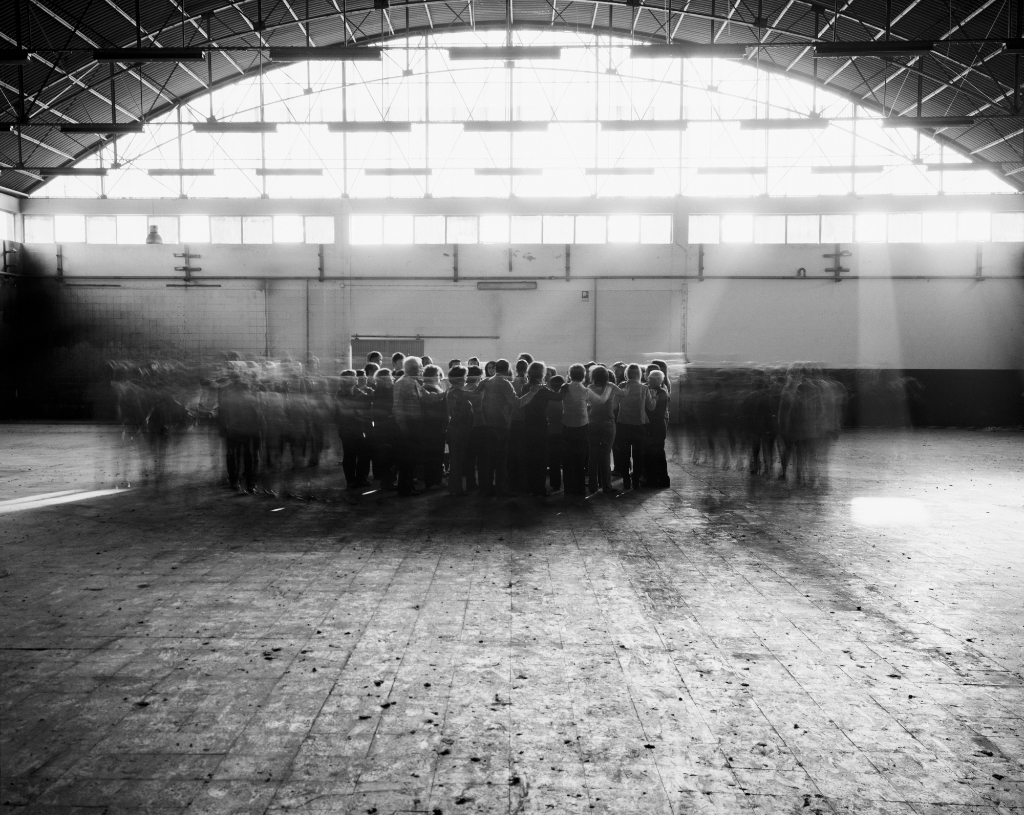
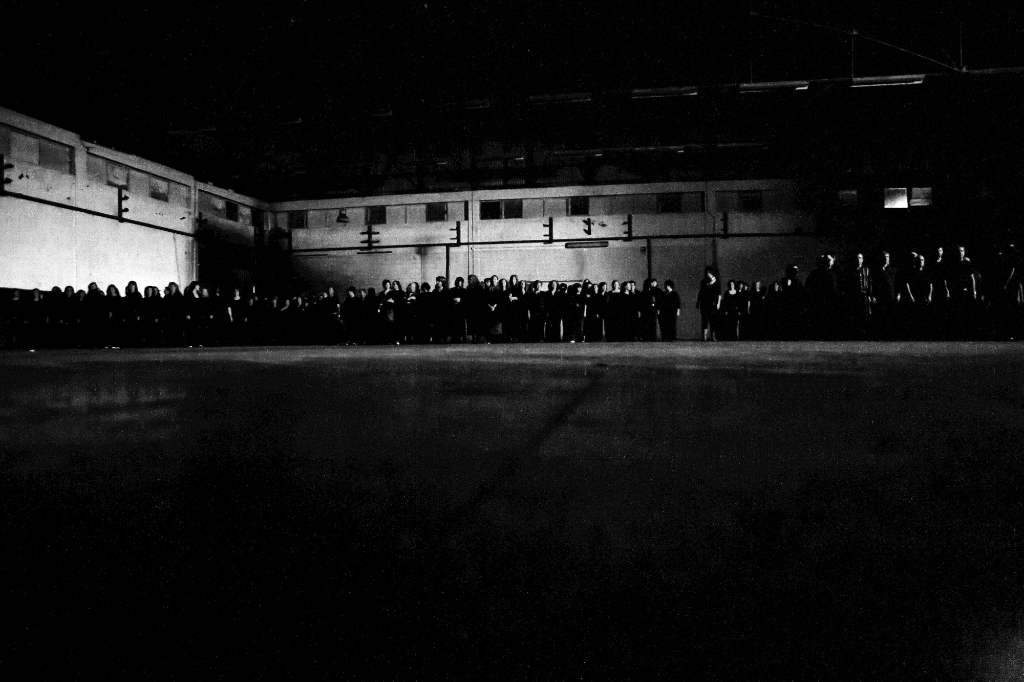
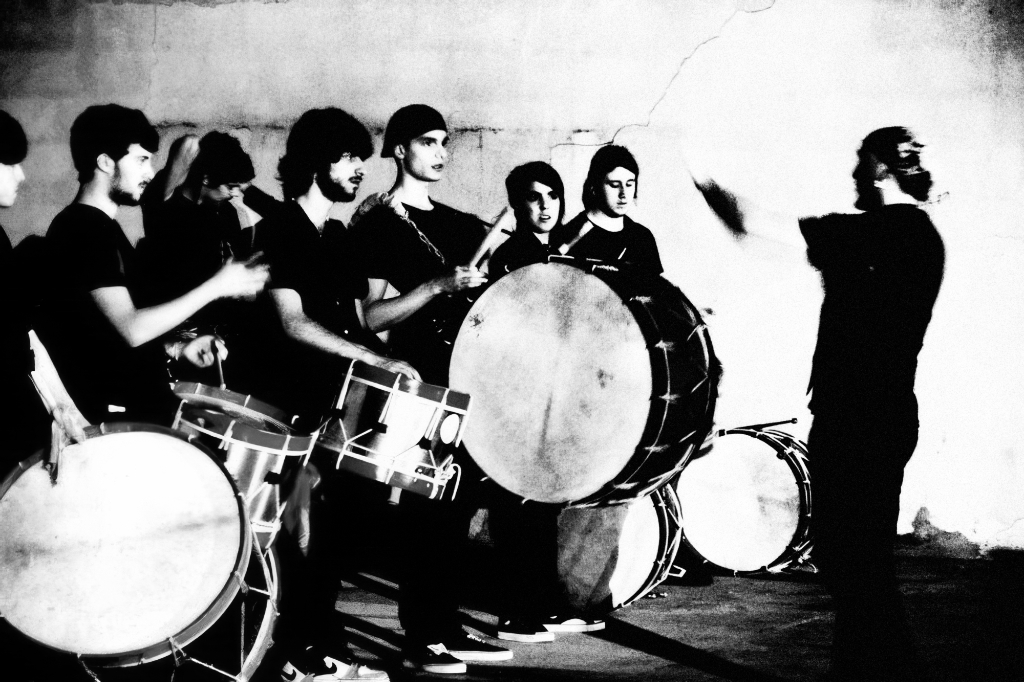
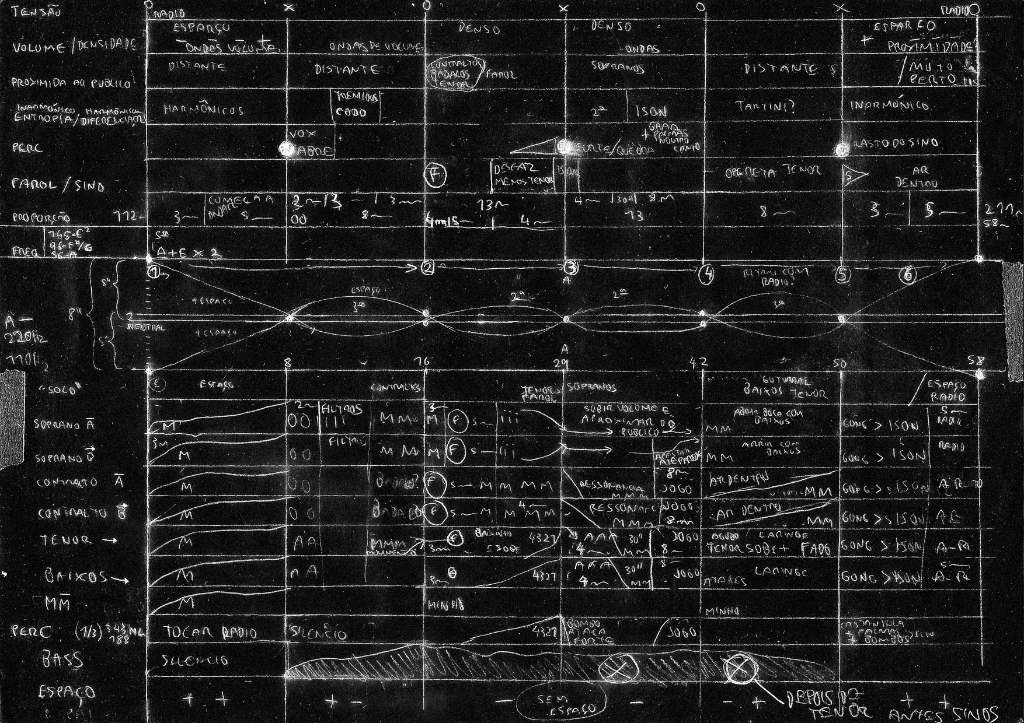
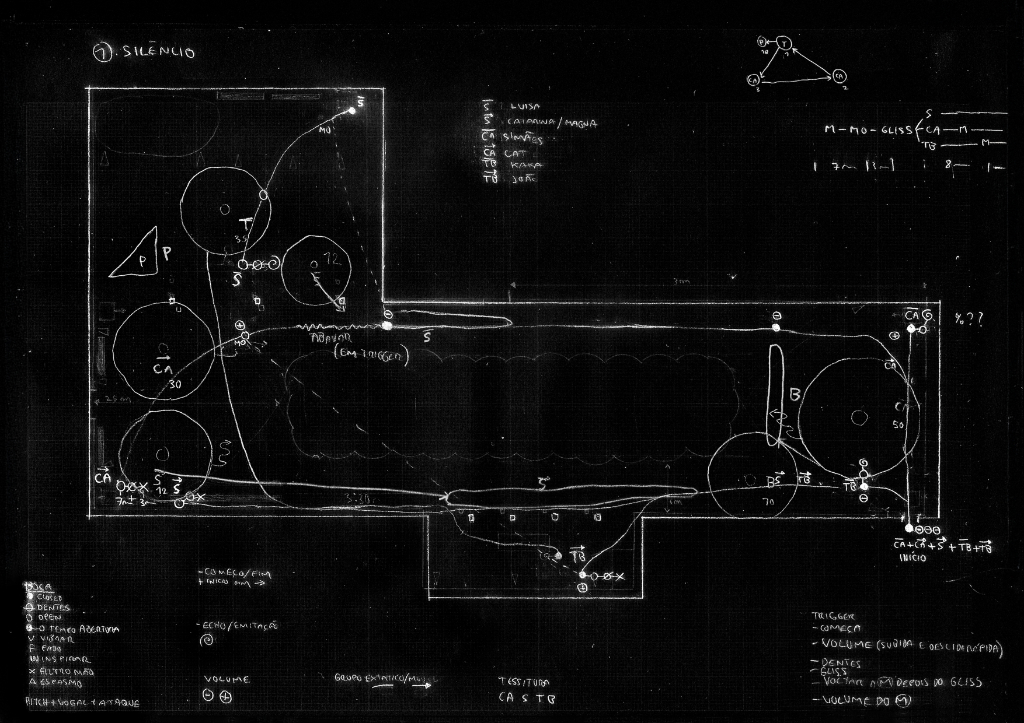
This November, the release of KHÔRUS ANIMA as a recording revisits a singular performance originally staged in 2012 inside the abandoned Fábrica ASA in Guimarães, Portugal. Conceived with the community choir Outra Voz, the work brought together around 100 voices, the percussion ensemble Allcateia and eight subwoofers within the vast industrial space. Guided by gestures, movement and attentive listening rather than conventional musical notation, the performers transformed the factory into an enormous resonant instrument, where human breath, architectural acoustics and low-frequency vibrations became part of a self-organising sonic environment. Performed only once, KHÔRUS ANIMA now takes on another existence through its recording, which Saldanha describes as a re-versioning of the original event, translating a collective spatial experience into a new form of intimate listening.
Saldanha reflects on the influence of architecture, biological rhythms, and ritual on his creative processes; the physical and psychological dimensions of sound; and his fascination with the moment when individual voices dissolve into collective sonic landscapes. Through his reflections, listening emerges as a way to explore the complex relationships between bodies, environments, and the invisible forces that connect them.
You’ve had a long-standing relationship with a hidden Porto, the underground. You’ve recorded in Roman mines and explored ancient aqueducts. When you are deep in those spaces, how does that physical environment edit your creative process?
Spending time below the threshold of civilisation creates a detachment from human time and a glimpse into a stillness indifferent to us. But that indifference still has physics, and in my work physics feels like a second performer. In Roman mines, the space isn’t empty; it’s an active acoustic filter. Time becomes dense, and the space begins to “talk” through its own resonances. We aren’t just making sound in a space; the acoustic body of those cavities is contaminating us. It’s a dialogue with a hole where the environment edits the signal back.
You began studying the tabla at 15. How did that early immersion in the mathematical discipline of Hindustani music shape the biological rhythms we hear in your ensembles today?
My obsession with Indian classical music stayed with me as a rhythmic virus. It taught me how to trust long, cyclical structures that hold a specific purpose while hosting chaos. Even in dense clusters, I think about time as architecture—cycles that slowly shift the listener’s sense of duration. It’s the point where the rigid math of tala meets the unpredictable pulse of the body.
You often describe the city as a “stone organism.” In Tunnel Vision, you focused on tight, subterranean spaces, but for Khorus Anima, you moved into a massive 4,500-square-metre factory. How does your “organism” behave when it has that much room to vibrate?
It’s the same organism, but a different metabolism. Tight spaces provide immediate friction, a claustrophobic time that presses sound against the body. A factory behaves like a navigable field: it offers longer decay and distributed phase relationships that you can physically walk into. I’m fascinated by structures that appear inert but reveal complex, lifelike behaviours once you excite them. The factory becomes a massive, distributed resonant instrument, a hidden sound system where the architecture itself is the primary instrument.
You use the term “phantom” to describe the way sound bounces off architecture. Tell me about your relationship with this “ghost.”
The “ghost” is a spectrum, a voice without a body that becomes flesh through contact with surfaces. In certain conditions, especially with sustained excitation or feedback, the room’s resonant modes can dominate the perceived source. It’s like Ovid’s Echo: the body is lost, and only the resonance remains. I’m interested in the moment when the space’s mechanics reshape the signal so strongly that the original “ping” feels secondary to the environment’s response, when the ghost becomes more present than the source. I’m not claiming the space has intentions, though sometimes it can feel that way; only that its constraints become audible enough to feel like another actor.
In Khorus Anima, the contrast between human breath and low-frequency mechanical pressure is striking. What was the systemic intention there?
The goal was a self-organising, autopoietic system. In biology, autopoiesis refers to a system that can reproduce and maintain itself. I applied this to the factory: a set of simple rules where voices and room modes stabilise their own patterns over time. The human voices are the variable element: they feed into the room and each other, guided by choreographies of timing. We then use subwoofers placed at key resonance points to stimulate the building’s cavity modes, bridging the vibration of the human chest with the vibration of the concrete. It’s a single ecology where breath, stone, and low frequency circulate.
You coined the term “intracranial-dub.” How has that concept evolved from your early recordings in caves to your recent work?
In my earlier work, I used the “outside” cavity of a cave to double the “inner” cavity of the listener’s skull. Recently, it moved from the architectural to the visceral. “Intracranial-dub” is about composing perception itself: attention thresholds, micro-delays, and signal routing as choreography. It’s no longer just about the sound material and where you record; it’s about how sound reorganises memory and affection through pressure and repetition. The skull is the first cave.
What fascinates you about working with a mass of 100 voices, such as the Outra Voz ensemble?
There is a threshold where the human voice mutates into a landscape. It stops being about individual expression and becomes a murmur, a weather system, or a swarm. It creates a collective mind-effect that you feel as physical mass rather than a linguistic message.
In Santa Viscera Tua, you deal with religious structures. Are you drawn to the “sacred,” or are you more interested in the mechanics of ritual?
I’m interested in belief as a technology. Ritual is a human strategy for relating to otherness — to the unknown or the uncontrollable. Sonically, ritual is a precision instrument: it synchronises bodies, compresses time, and produces altered states through constraint and repetition. It’s a way of depositing intention into a space that has no immediate, measurable return.
You often prioritise timbre and guttural sounds over lyrics. Why?
Timbre is less accountable to social grammar. It feels more exposed. Pre-language, the sounds of the throat before they become words, is a register that connects the child with the dying. It’s the body speaking at the margins of language. It isn’t a salvation from language, but it carries a different kind of raw, direct intensity that language often masks.
Projects like KIK or your work with Nyege Nyege Tapes feel more confrontational and percussive. How do you bridge that with your choral work?
The form changes, but the function is identical: to lure the listener’s body into negotiating pressure. In my work with João Pais Filipe in KIK and with HHY & The Macumbas, we engage in a high-tension dialogue where static rhythm is transformed into landscape. And through Nyege Nyege Tapes and its wider ecosystem, projects like Arsenal Mikebe and HHY & The Kampala Unit push that same research through different machinery: density, repetition, and engineered pressure that can tip into stasis. Whether it’s that percussive machine or a 100-person choir, the strategy remains the same: using pressure and duration to make sound behave like environment.
As an artist who moves between sculpture, stage direction, and sound, do you feel these media are all saying the same thing?
Ideas migrate. There is a “virality” where a sound comes from an image, or a word becomes an object. I wouldn’t say they say the same thing, but rather that they resonate inside one another. They are different optics onto the same obsession: pressure, time, otherness.
Now that Khorus Anima is finally being released as a recording, what are you handing over to the listener?
Khorus Anima was radically site-specific, so the recording is a re-versioning, a dub version of the event. You can’t capture 100 voices moving through a factory in a simple stereo field, so we extracted the skeleton. The recording is a new object that retains the logic of the swarm and the pressure, but it’s composed for a different mode of listening, one that happens inside the listener’s own private space.
What’s your chief enemy of creativity?
Projecting desires and the temptation to turn language into a costume. The work dies the moment the concept starts performing itself.
You couldn’t live without…
Time. Not as an abstract concept, but as a material. It is the only real studio I have.