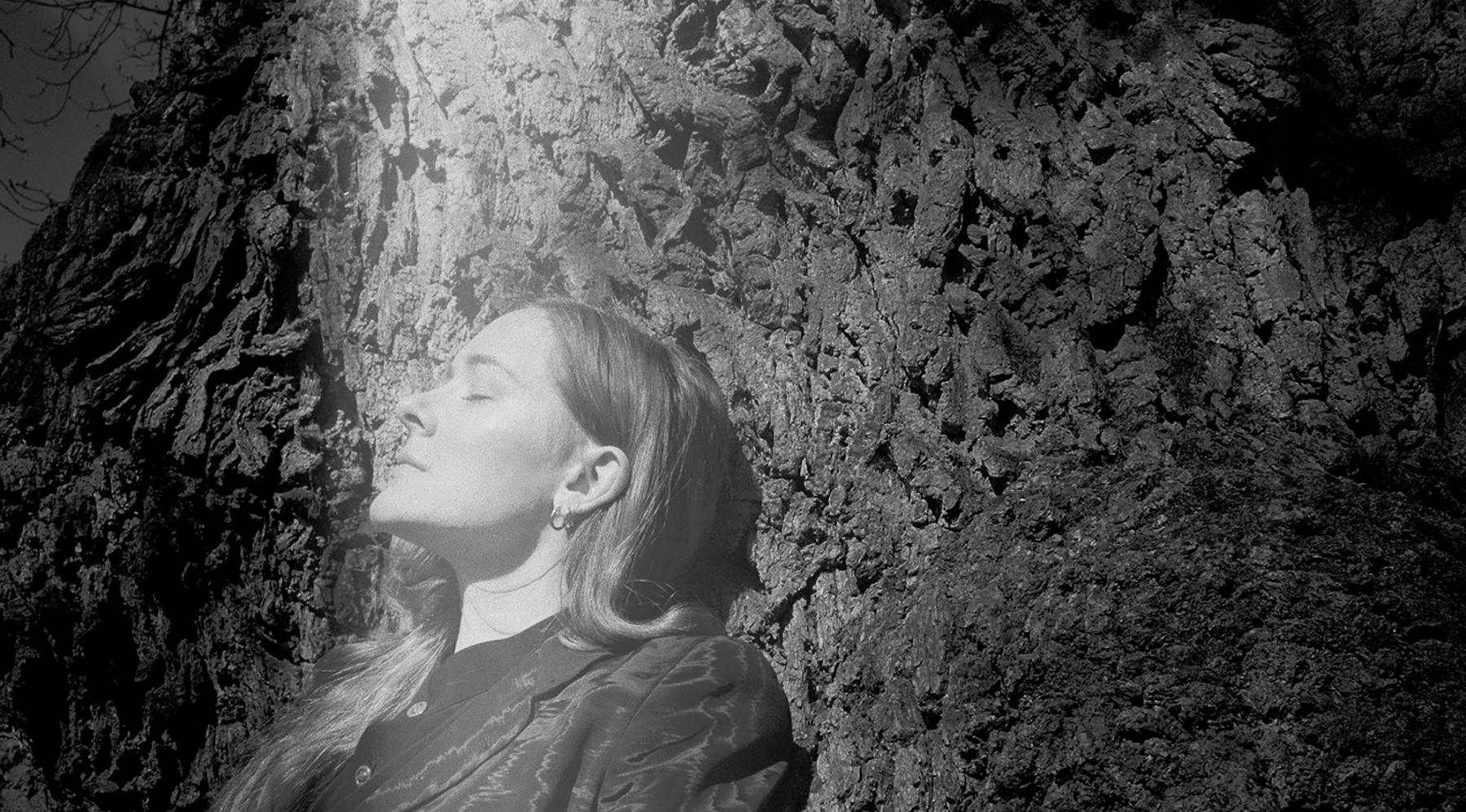
Text by Dom Stevenson
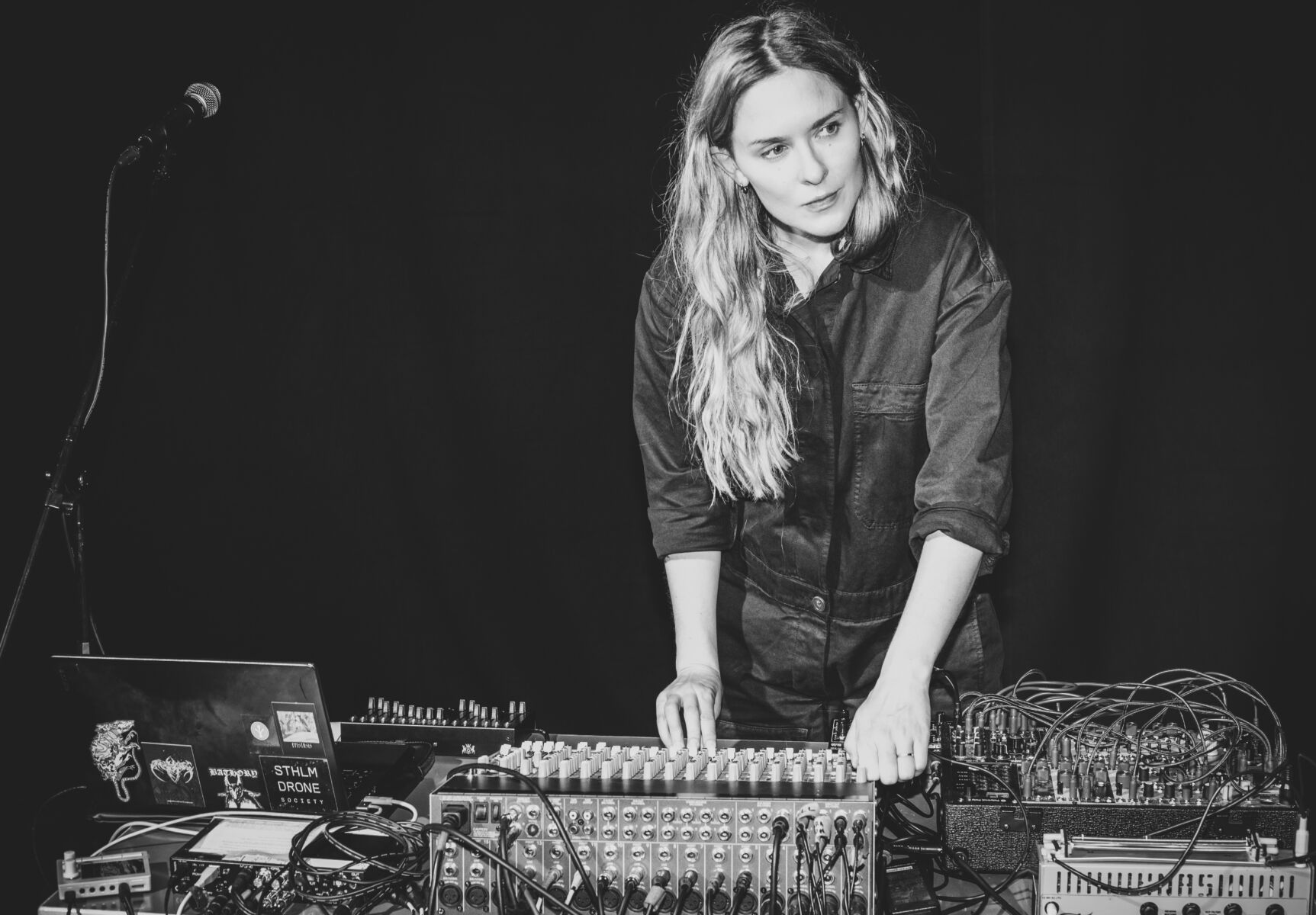
The next mixtape instalment comes from Maria W Horn, the Swedish composer whose diverse and intricately constructed works explore the physical and psychological dimensions of sound through electroacoustic experimentation.
A co-founder of the Stockholm-based experimental music imprint XKatedral, Horn draws on a diverse musical background spanning folk music, punk and black metal, bringing these influences into conversation with contemporary composition.
Her latest album, Melting Pillars of Snow, released via XKatedral, is a deeply immersive work, at once delicate and visceral. Intricate acoustic textures hover above doom-laden drones, interspersed with fleeting passages of spoken word. At times, the record evokes the creaking of a house slowly succumbing to time, revealing memories embedded within its foundations.
At the heart of these compositions is an unusual interplay between contrabass recorder, shō, percussion and guitar, alongside Horn’s electronics and spoken word. The opening piece, Scythe of Saturn, features narration from Michael Gira of Swans, whose distinctive voice adds another dimension to the composition.
Drawing inspiration from W.G. Sebald’s The Rings of Saturn, the album explores themes of memory, mortality and the passage of time. The gradual transformations and contrasting physicalities of sound weave a narrative throughout the compositions, inviting the listener into a space where time itself becomes an object of contemplation.
Accompanying her mixtape, A breeze becomes a storm, we speak with Horn about the intuitive nature of her compositional process, the relationship between listening and mortality and the literary and sonic worlds that inform her work.
There’s something both delicate and visceral about Melting Pillars of Snow. Moving between intricate acoustic instrumentation and walls of noise and distortion, a sense of narrative seems to emerge through these contrasts. What interests you about working with such sonic extremes, and how did they inform the compositional process behind the album?
The compositional process behind Melting Pillars of Snow took its slow course during the last couple of years, in savoured moments in between other projects and deadlines when I had time to work on music for the fun of it. I think because of the absence of any outside dictation or pressure to move the music forward, it could unfold organically in an intuitive way. I merely followed the inherent impulses of the material, taking the role of facilitator while also allowing the synchronicity and peculiarities of daily life to inform its direction. Structuring these contrasting sound sources and their respective physicalities felt like a delicate sculptural challenge, like directing a drama unfolding between an odd cast of characters, each with their own presence and flow.
Melting Pillars of Snow seems to centre around the passage of time and our relationship with mortality. I’m curious whether you see sound as a particularly interesting medium for exploring these ideas, given its inherently temporary nature, existing only for as long as it is heard.
I like to think of music as time ornaments, something that illuminates the passage of time.
In coping with my own mortality, learning to access a focused state of listening has been very helpful, as it can give access to an ego-dissolving place of no-mind. As listeners, we learn to direct our attention and lose ourselves to the beauty and brutality of existence.
W.G. Sebald’s The Rings of Saturn was an important inspiration for the album. What was it about the book that resonated with you, and how did you approach translating its ideas into a musical language?
When I first read it, I was struck by the language: a stream of consciousness made up of sensory impressions, where historical flashbacks blend with memories and fleeting snapshots. From one perspective, the book is a meditation on a landscape that once flourished, yet now lies in ruins. There’s an inherent oblivion in the landscape that reminds me strongly of my home region of Västernorrland.
As the pilgrimage along Suffolk’s coast progresses, the past, present and future of the author’s stories increasingly clash against each other. There is something about these overlapping temporal perspectives that I associate with the creative process, where different parallel flows and developments can unfold at once, and one needs to let go of all intellectual constructs and simply submit to the material’s inner logic. There is something quite brutal about this creative drive, which—through the new forms it takes— fades earlier preconceptions from memory.
The album brings together an unusual combination of instruments and musicians, alongside your own electronics and processing. How much room do you leave for experimentation and unexpected discoveries when working with an ensemble?
For the album recordings, I worked with each one of the musicians separately. Starting with the percussionist Magdalena Meitzner, we experimented with finding special timbral techniques to apply on a range of percussion instruments – bowed bowls and cymbals, an overtone triangle, gongs and resonant drumheads. For each of these modes of playing, I came up with a short SuperCollider patch intended to expand the spectral palette, and by improvising on these modes we arrived at a number of sparse sonic environments that came to act as the fundamental scenery for the music.
Populating these environments are arrangements for Paetzold contrabass recorder and shō, two wind instruments occupying opposite ends of the frequency spectrum. Played by Anna Petrini, the Paetzold contrabass recorder is a massive instrument defined by its rich, woody timbre. In contrast, the shō—a Japanese mouth organ resembling a miniature bamboo pipe organ, performed by Mattias Hållsten—cuts through with a distinctive, piercing high-frequency sound. The recordings also feature electric guitar by Mats Erlandsson, alongside spoken excerpts from The Rings of Saturn read by me.
The rehearsals leading up to the live premiere of the music was the first time I had the whole ensemble gathered in the same room, and as we are starting to perform the material live I feel like this adventure is only beginning. In a sense, the record is just the initial form of the music; I already had to adapt and make changes on the go, but I like the transformational aspect of performance.
For your CLOT mixtape, could you tell us a little about the selection you’ve put together? Are there particular sounds, artists or ideas that have been occupying your attention recently, and how have they found their way into the mix?
I had a lot of fun with this mix! It’s a selection of compositions that, in their various ways, centre thematically around wind instruments, in a broad sense, including pipe organ and voice. Old and new material, with some exceptions the selection is centered around the Stockholm experimental music scene, friends and people I’ve encountered in recent years that are exploring woodwinds and brass in unexpected and captivating ways. The name “A breeze becomes a storm” is from a Sebald quote that appears in the last track of the album, A handful of Dust.
Tracklist:
> Vallåt Från Mockfjärd Efter Anders Frisell, Lockrop & Vallåtar – Ancient Swedish Pastoral Music, Caprice Records 1995
> Yoshi Wada – Earth Horns with Electronic Drone (Part 3), EM Records/Edition Omega Point, 2009
> Smote – The Cottar, Songs from the Free House, Rocket Recordings 2025
> RAGE THORMBONES – side B [3], Carrier Records 2020
> Brìghde Chaimbeul – She Went Astray, Glitterbeat Records 2025
> Malin Bang, Anna Petrini – Split Rudder, DB Productions 2012
> Timothy Archambault – Inversions, Onimikìg, Ideologic Organ 2024
> Abigail Toll – Matrices of Vision, Shelter Press 2023
> Philip Glass – Music in the Shape of a Square, Piece in the Shape of a Square, Stradivarius 2001
> Goat – Impermanence & Death, Medicine, Rocket Recordings 2023
> Vilhelm Bromander – DLM, Aurora II, Warm Winters Ltd. 2026
> Anna von Hausswolff – Dolore di Orsini, All Thoughts Fly, Southern Lord 2020
> Theatre of Eternal Music – Early Tuesday Morning Blues, Velvet Underground Appreciation Society, 1964
> Opeth – §4 (Feat Ian Anderson), The Last Will and Testament, Reigning Phoenix Music 2024
> Isak Hedtjärn – Piom, Kvarpan, Fönstret 2024
> Colin Stetson – The love it took to leave you, Invada Records UK & Envision Records 2024
> Dror Feiler – Clarinets & Bells, MAAVAK, Ideal Recordings 2023
> Microtub – Andersabo Part 3, Thin Peaks, Thanatosis 2024
> Maria W Horn – A handful of Dust, Melting Pillars of Snow, XKatedral 2026
Website: https://mariawhorn.bandcamp.com/album/melting-pillars-of-snow
(Media courtesy of the artist)