Text by Eddy Gibb
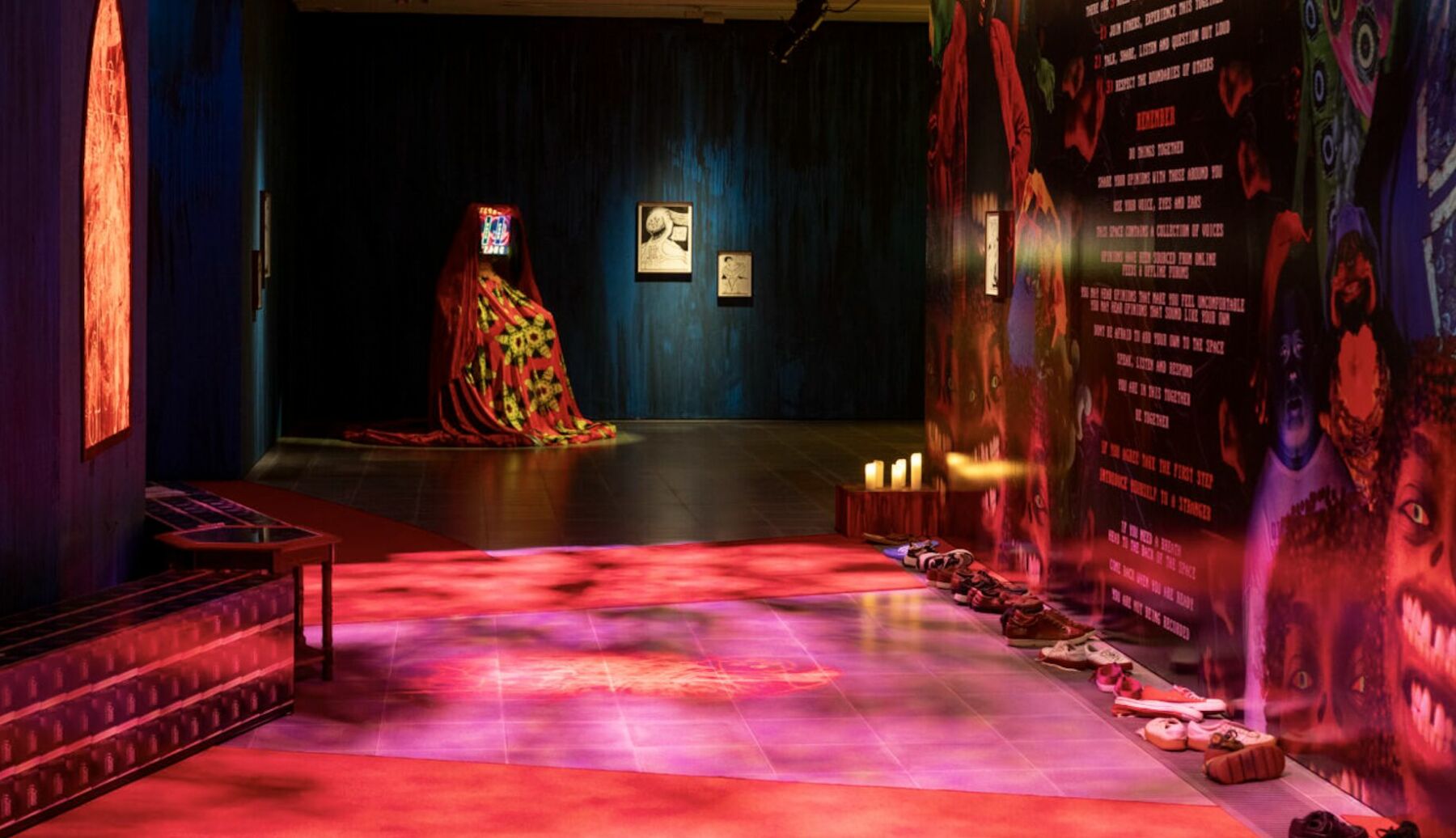
I’m a woke bitch–the artwork said so. The whining voice on the other side of the door hated democracy, so I shut it out. The game character berated me, but I ‘unlocked a chance for change.’ Why they would try to enter this space, devoid of natural light and asylum-like with eerie voices, wasn’t immediately obvious. Serpentine North Gallery became a corrupted version of the usual ‘white cube’: the digital opium den of today, somewhere between haunted house and gamer’s lair.
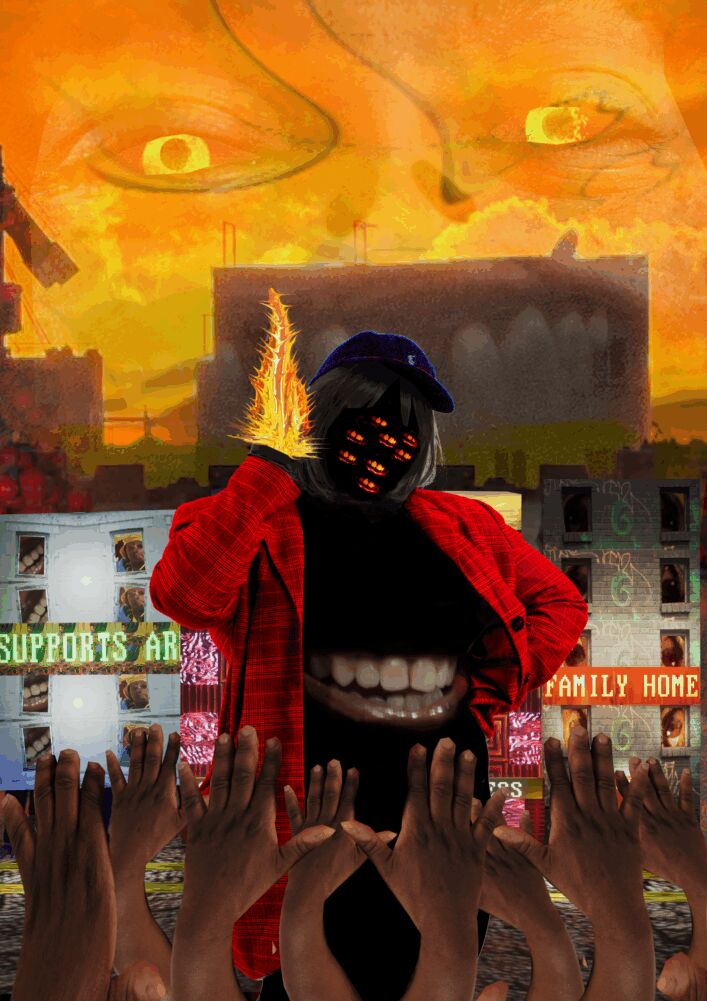
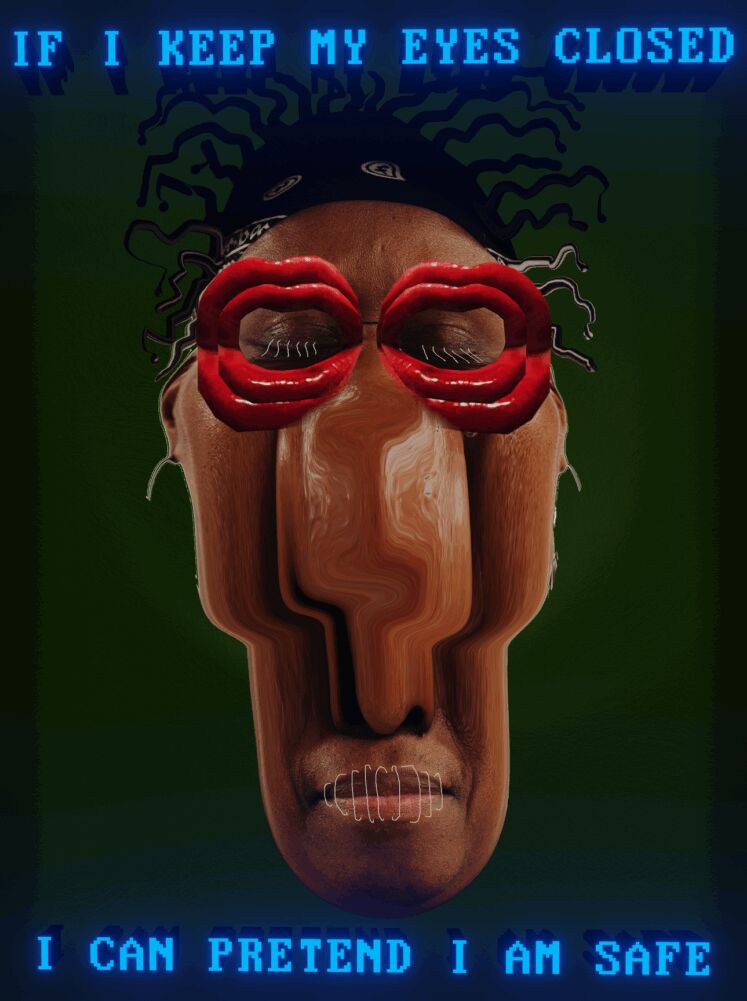
Alongside ink drawings depicting sharp-toothed, multi-eyed monsters screaming perverse catchphrases (I PRETEND TO CARE IF IT MAKES ME LOOK GOOD), it was inhabited primarily by the strange voices and devices of Danielle Brathwaite-Shirley’s video game-based artworks. Stepping into the London exhibition recalled the pixellated words in one of the Fictional Video game Stills (1991-92) of Suzanne Treister, an early explorer of video games in art: NOW ENTER A VIRTUAL WILDERNESS.
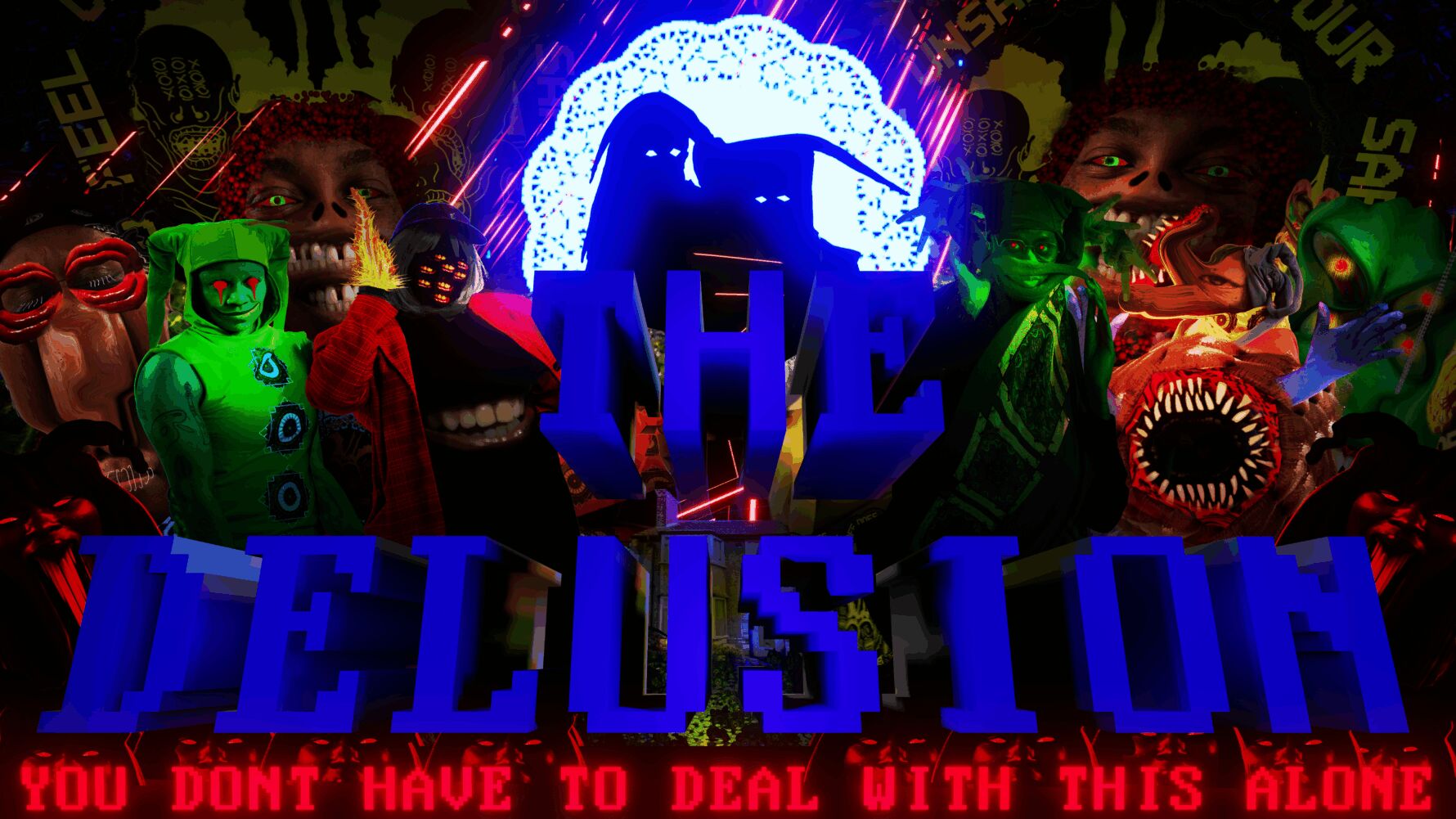
In THE DELUSION (Sep 2025-Jan 2026), Danielle Brathwaite-Shirley built an exhibition around three co-op video games with communal controllers. The London- and Berlin-based artist inherits the traditions of social activist games and games of complicity [1]–games which often challenge the verb ‘play’. By bringing them into art world contexts, private, solo experiences open up to public audiences and group dynamics. In Brathwaite-Shirley’s GET HOME SAFE (2022), for example, players decide how to guide a Black Trans character safely home through a late-night cityscape; in YOU CAN’T HIDE ANYTHING (2024), players are revolutionaries who’ve just overthrown a global slave trade and vote on how to proceed. Here at Serpentine North, Brathwaite-Shirley aims to encourage ‘difficult conversations’ [2] about delicate topics including race, religion and censorship.
But the creepy space isn’t exactly ideal for human connection. It’s a patchy experience largely dictated by whoever happens to join you; if they’re unengaged, it’s awkward silence among visually and technologically average games. However, sometimes the games come alive, part social experiment, part performance art. That’s when THE DELUSION reminds us of the difficulty of playing life’s original multiplayer mode–when we’re never NPCs, but we sometimes act like it.
I DIDNT REALISE YOU THOUGHT LIKE THAT (2025) is the first artwork we encounter. After introductory audio (‘the hate is pungent–who will you tolerate?’), various characters appear on a screen behind the transparent door and present their views; visitors decide whether to close the door, accepting or excluding them. One character says we should stop using fossil fuels completely. Someone steps out of the crowd and confidently closes the door on their green dreams. It’s not the answer I expected–I imagined more of a Just Stop Oil crowd. There’s no discussion, just a strained silence as we wait for the countdown bar to finish.
One character wants to legally mandate gender fluidity. People shout to open the door, nuances unmentioned. Another character says we need religion to help us where science cannot. Someone disagrees, shouting that science is enough; the door is closed uneasily, without debate. The groupthink feels totalitarian–there are no dissenting voices. The tyranny of the noisy rules all: the most vocal (usually Americans) are generally at the back, far from the door and responsibility. Those of us near the door are quieter, feeling the pressure–and sometimes guilt.
The game characters’ word choices, voiceovers and avatars evoke online forum users, sometimes troll-like, sometimes holier-than-thou, often bizarre. It’s a chance to detox online impatience and extremity via face-to-face interaction. But the game provides no antidote to toxic digital forces–it unleashes them in person. Whoever acts quickest and loudest, wins. I’m brave enough to make an independent contribution only once, when a character urgently needs a dump: naturally, I open the door without hesitation. It’s not lost on me that the moral stakes are so low that it’s an ethically empty gesture–comedy covering moral cowardice.
It’s desperately frustrating (and sometimes scary) when the will of the group oversimplifies or brushes over nuanced issues, when you realise the herd mentality you’ve succumbed to. The artwork toys with the concept of the ‘magic circle’ outlined by Johan Huizinga, a Dutch historian and cultural theorist of games and play: games as separate, permissive, unselfconscious spaces with different rules and consequences from the outside, everyday world [3]. Blending games with tangible, real-world social judgement (or fear of it), the digital work brings out the worst in the analogue space. Brathwaite-Shirley’s desire for people to connect and converse seems extremely distant–textbook trolling, IRL.
Though now wary of honesty and suspicious about the artist’s goals, the next game is a more wholesome experience: six of us sit down with our hands on a tilting table, which we manipulate to guide an on-screen ball through a maze-like landscape. The game is titled I CANT MOVE WITH YOU (2025)–but we can’t move at all. There’s so much lag between moving the table and the on-screen result that it’s impossible to control the ball. It becomes a six-way Chuckle Brothers to-me-to-you. The most human connection I’ve felt so far is through the exhibition’s technological dysfunction, the awkward laughs, and our shared frustration at the Sisyphean task.
The game seems self-defeating: using technology as a tool for human connection becomes a laughable endeavour. It’s a far happier result than the previous game, though not exactly via any expected championing of technology. By now, however, we might guess that Brathwaite-Shirley runs an experiment that’s open-ended enough to embrace this. What happens is reminiscent of the audience participation central to the Fluxus performance art of the 1960s and ‘70s, where chance spectator interactions were key to rule-based, game-like ‘events’ [4].
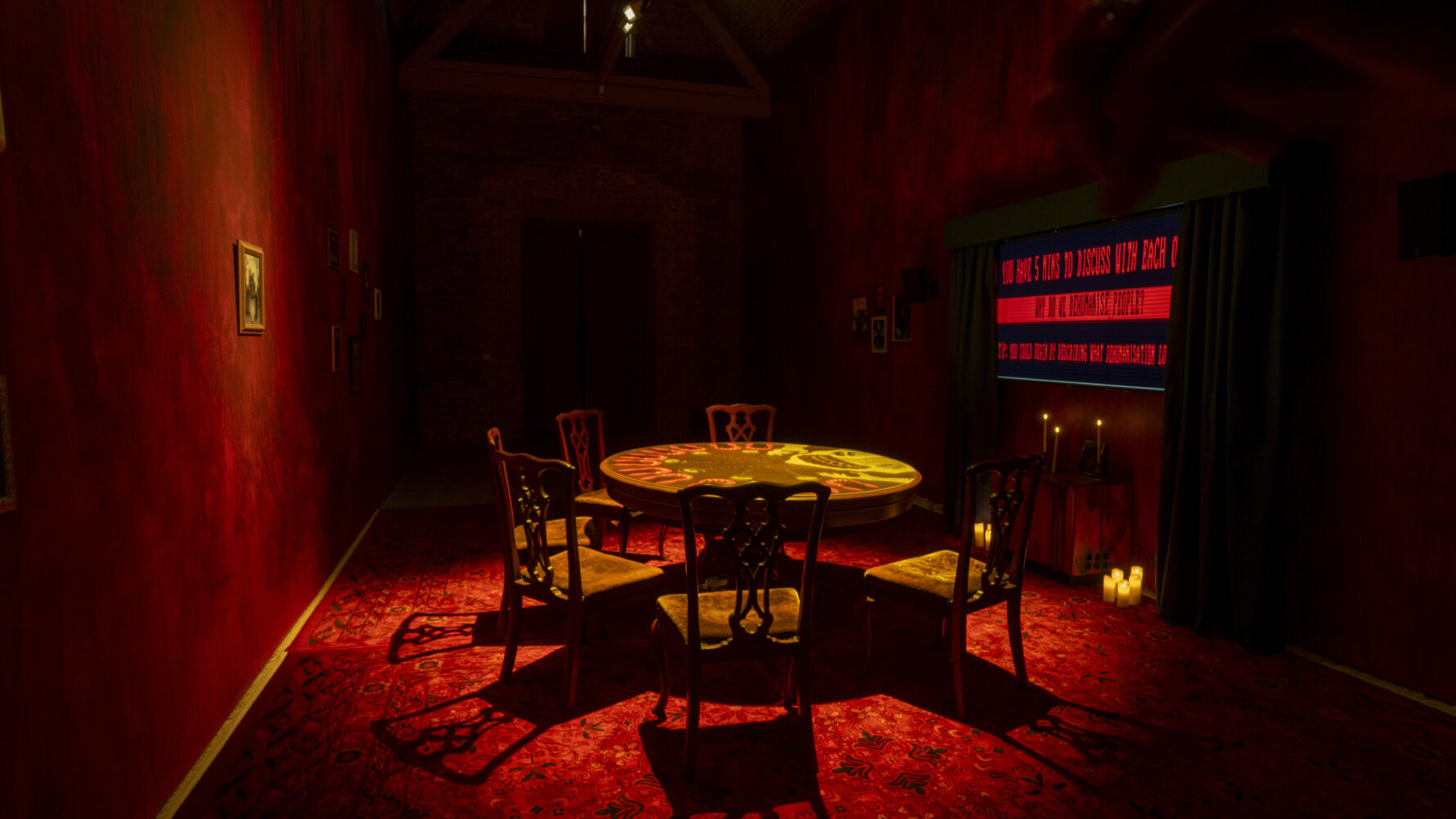

Eventually, we manage to move the ball enough that a pop-up asks us to introduce ourselves to a stranger. There are friendly handshakes and light-hearted chats about work, art and London. The game asks us to discuss where hope comes from. Someone says that hope usually grows from something negative, then someone instead gently suggests that hope, for them, is independent, free-standing. We seem to differentiate reactive and spontaneous hope, and someone expresses amazement that hope might be one of the few things that’s truly self-sufficient. Not exactly a Socratic dialogue, but a surprisingly deep and diplomatic discussion among strangers.
Finally, we’re asked to place our hands on our stomachs, close our eyes, and hum. It’s vulnerable in a gloomy roomful of strangers, but (with much nervous laughter) it happens. When we’re asked to hum louder, surprisingly, we buy into it. It’s like a group meditation at a yoga retreat. What might be the exhibition’s first victory for optimism is underscored by irony: technology’s failure brought people together in ways that its success couldn’t. But the technology of Brathwaite-Shirley’s game can fail, and the overall artwork, in its social probing, can still succeed.
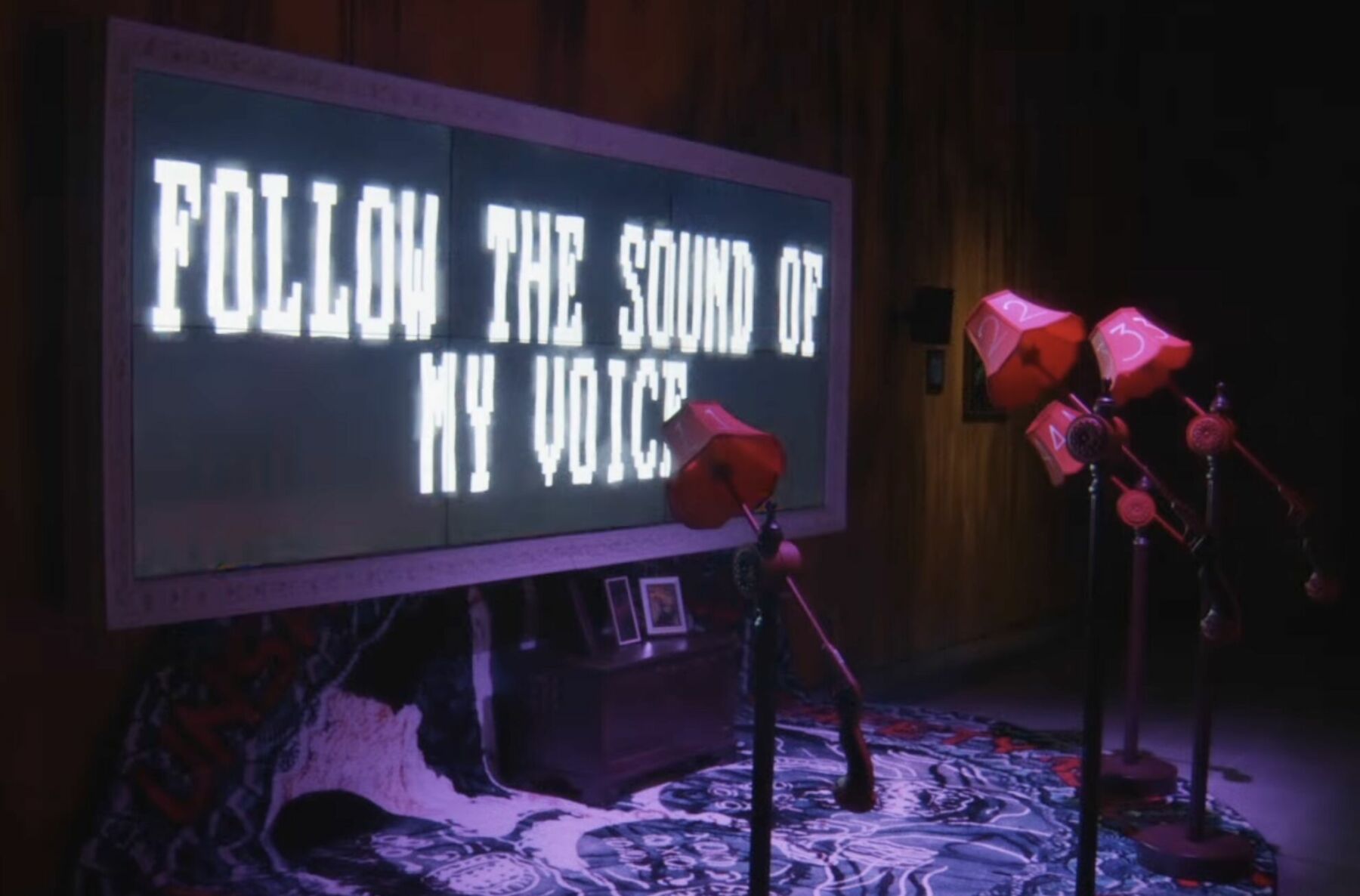
The third game (I DONT KNOW IF I CAN BE HONEST IN FRONT OF YOU [2025]) has four lamp-gun controllers, triggers at one end, lampshades at the other. Visitors fire them at a screen to vote for various options as they whizz through a strange building. Often, the game feels a bit obvious: when asked to select propaganda posters that resonate with us, I select one that says ‘FUCK TERRORISTS.’ The game’s optimism seems shallow, as if highlighting that quickfire digital decision-making makes it easier to be mean online, but also easier to be meaninglessly nice.
Elsewhere, the game suggests that all hope is lost–do we ‘wait for hope’ or ‘fabricate hope’? Surely it depends on whether we view ‘fabrication’ as positive or negative? We need more nuance and discussion, but we’re forced to make superficial decisions by fast-paced shoot-voting. And much of the game passes in a blur because I worry that everyone thinks I’m having a moral breakdown–I can’t aim my digital crosshairs accurately. I suppose that’s the ethical ambiguity expected when you vote by shooting. The format, lampshade firing squad with fingers on triggers, isn’t conducive to conversation.
Towards the game’s end, some people engage more. We answer questions with a show of hands. ‘Are you lonely?’ Lots of people raise their hands, young and old. ‘Are you addicted to anything?’ Some perfectly dressed, perfectly innocent-looking young professionals put their hands up and I’m instantly curious, but I don’t trust that the exhibition’s supposed openness would protect my questioning. Nevertheless, it’s touching to see in person a vulnerability among strangers which usually you might only find in the anonymity of online forums or games.
Finally, the game attempts another yoga festival moment: we’re asked to chant ‘MY VOICE HAS POWER’, to stamp, louder and louder, and to move around the space–which eventually resembles a madly marching army. It’s faintly culty, and I’m reassured to see that many people don’t follow the instructions. Yes, technology can troll us, but we can also resist. This isn’t easy art. Don’t expect Brathwaite-Shirley’s artworks to make you feel good about yourself or the state of humanity. They reveal how digital culture can either enhance or corrupt our humanity and interconnection–we have to be brave enough to choose.
Sometimes THE DELUSION succeeds in its mission of tech- and game-based artworks stimulating connection and conversation; they’ve been called an ‘anti-echo chamber’ [5], which occasionally rings true. Yes, the artworks can do what social activist games usually do–‘not […] find appropriate solutions, but […] trigger discussions’ [6] to quote video game designer and theorist Gonzalo Frasca.
But often they’re less predictable and more concerning. THE DELUSION’s games are most thought-provoking as triggers of discussion about the lack of discussion triggered. When the exhibition betrays itself, when noisy voices and quickfire decisions dominate and silence surrenders, the games seem to corrupt in-person interactions with the superficiality and polarisation of online spaces: it becomes a toxic uber-echo chamber, flipping from empathetic New Age group counselling session to extremist rally, marginalising nuanced opinions.
Breaking open the hermetic game seal via face-to-face social dynamics, the works introduce a porosity to the ‘magic circle’, bleeding together digital and analogue, game and everyday. To borrow a line from Rilke, these threads cannot be untangled. Brathwaite-Shirley’s art acts as an ethical, socio-political playground, which sometimes reveals how our complex, hybrid world can foster feeble political participation and cloud-based moral courage. The real delusion in mind is perhaps that it would ever be possible for technology to simply be a force for good.
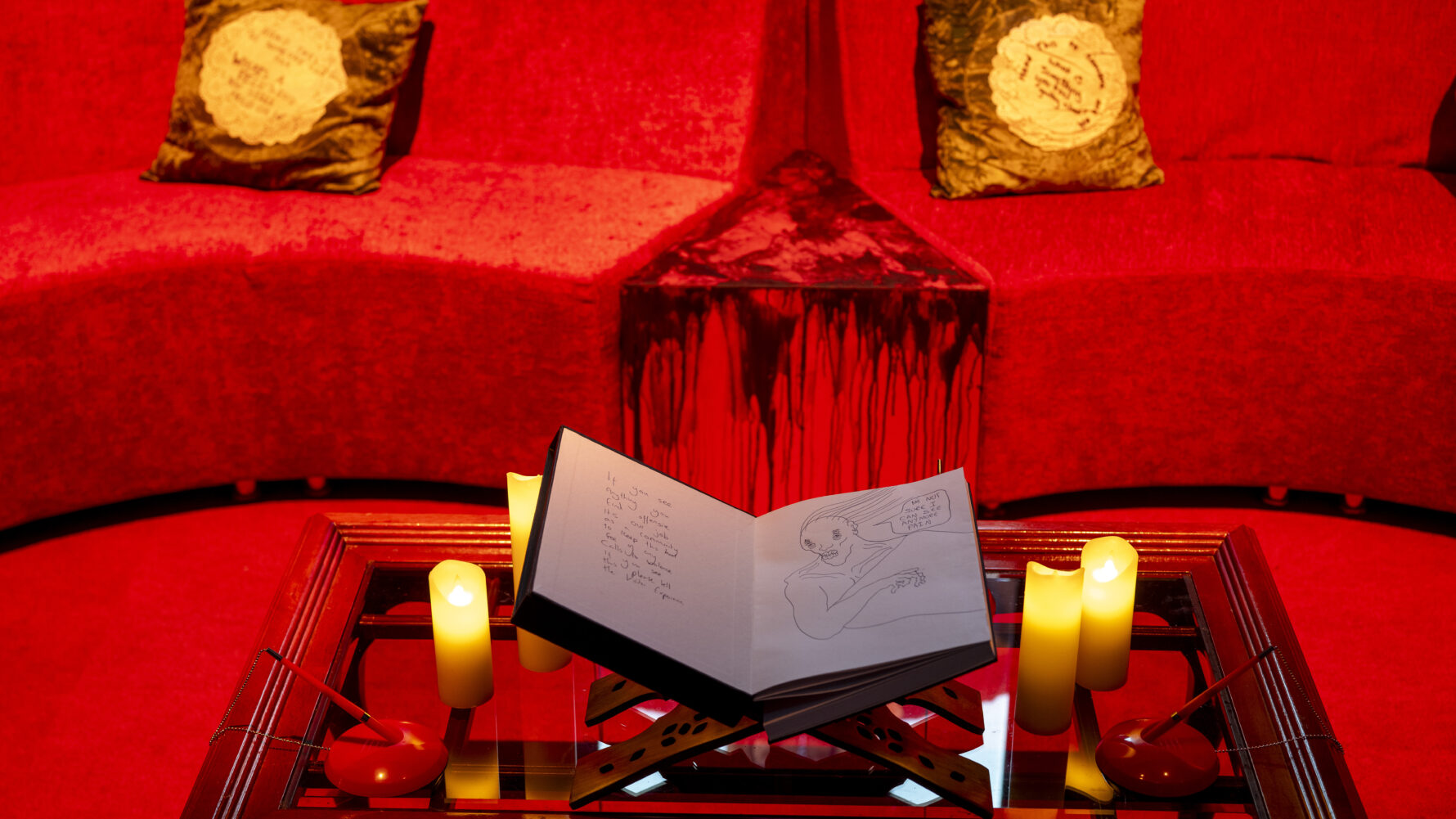
At other times, the exhibition isn’t really pro- or anti-digital, but agnostic: sometimes technology fails altogether, presenting an offline option. It’s a relief to find that the fourth and final game, TO REMEMBER YOU BY (2025), isn’t digital and isn’t really a game. We’re asked to record how we feel in a book, and it’s full of delightful doodles. Here, the sofas and well-stocked bookshelves finally present an antidote to the games, something informed and unhurried. The doodlers and I, reunited from the table-tilting game, claim (only half jokingly) that our drawings are the best artworks here. But we’re laughing with people we met through the game-artworks, so maybe Brathwaite-Shirley is the real winner.
That said, I’ve never felt so relieved to step out of the gallery into the fresh air of the surrounding park, where a nearby Henry Moore sculpture offers its comforting presence. But when I try to strike up a conversation with a passerby whose canine is also sculpture-curious, I’m flatly ignored–somehow Brathwaite-Shirley made that dark, airless space friendlier than the lovely park beyond Serpentine North.