Text by Six Minutes Past Nine

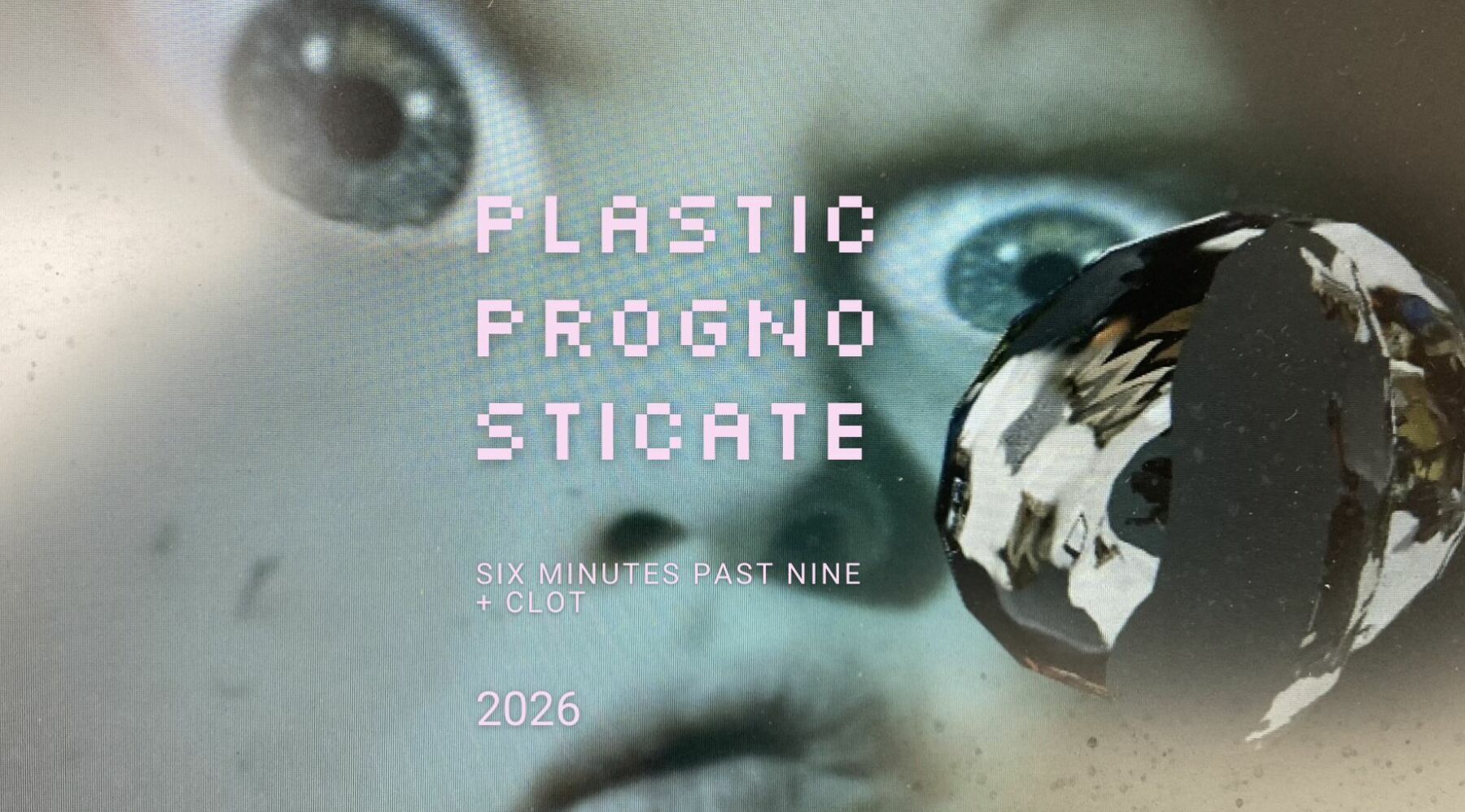
This article launches a collaboration between Six Minutes Past Nine and CLOT Magazine: a series of research-driven texts within the Plastic Pronosticate project that bring together artists, writers, and researchers working across contemporary technological culture.*
Founded as a digital-first platform for experimental art practice and theory, Six Minutes Past Nine operates as a distributed cultural project spanning publishing, studio-based work, and research. Led by Daniel Hawley-Lingham alongside Christopher Michael, Mathieu Buchler and Lynn Klemmer, it has developed a model of temporary “surfaces” that support experimental and time-limited forms of artistic and critical production. Within this context, writing operates alongside artistic practice as a mode of inquiry rather than documentation.
This collaboration unfolds within the editorial context of CLOT Magazine, founded and directed by Lula Criado and Meritxell Rosell. Drawing on backgrounds in science and cultural research, CLOT has established an international platform dedicated to exploring art/science/technology interactions and experimental art forms, through interviews, essays, and thematic series. Its work situates artistic practices within broader cultural and technological contexts, engaging a wide network of contributors and institutions.
While artificial intelligence forms part of the backdrop to Plastic Prognosticate, the texts collected here are less concerned with AI as an isolated subject than with the broader conditions it reveals. Technology appears not simply as a tool, but as an infrastructure shaping perception, behaviour… and the limits of what can be imagined.
The project begins from a provocation: that contemporary culture is saturated with futures that arrive pre-formed – framed through narratives of inevitability, optimisation, and progress. Rather than opening possibilities, these narratives often narrow them, establishing a horizon that feels both expansive and already decided.
The works gathered here respond to that condition in different ways. Some trace the systems that underpin technological life – supply chains, data infrastructures, and platform economies. Others move through more speculative or poetic registers, exploring authorship, embodiment, memory and belief. Taken together, they form not a unified position, but an assembled field of inquiry. CLOT Magazine provides a context in which these perspectives can be brought into dialogue with a wider field of thought and production.
At the same time, Six Minutes Past Nine’s commissioning approach establishes the conditions through which these texts emerge – selecting and supporting a body of work drawn from an open call. What emerges is a series that does not seek to resolve the present, but to complicate it – reopening questions that have too quickly been closed, and creating space for alternative ways of thinking, writing, and making to take shape.