Interview by Irem Erkin
For Marcus Maeder, sound offers a way to explore the relationships that shape the world around us, including those beyond the limits of human perception. The Swiss artist, electronic music composer, and researcher has developed a practice at the intersection of experimental music, philosophical inquiry, and environmental science, exploring how these fields inform one another.
His work is grounded in an interest in systems and their connections, from the networks that shape musical and philosophical thought to the complex interactions that sustain ecological life. Rather than approaching sound simply as a means of representing the world, Maeder explores how listening might expand our understanding of it, bringing us closer to processes that exist independently of our ability to perceive them.
Music has been central to Maeder’s practice since its beginnings. Alongside his long-standing collaboration with fellow musician Bernd Schurer, with whom he co-founded the independent label domizil in Zurich in 1996, he has explored electronic music as a space for experimentation across disciplines.
Philosophy has also played an important role in his practice, particularly the work of Gilles Deleuze and Félix Guattari, whose ideas found their way into his music in Die Wunschmaschinen, a surround-sound radio play based on Anti-Oedipus. His own trajectory followed a similarly interconnected path: after studying fine arts and philosophy, Maeder turned to Environmental Systems Science and eventually completed a PhD at ETH Zürich.
His scientific training and collaborations with researchers have since become integral to his artistic practice, allowing him to investigate ecological processes through both empirical research and sonic experimentation.
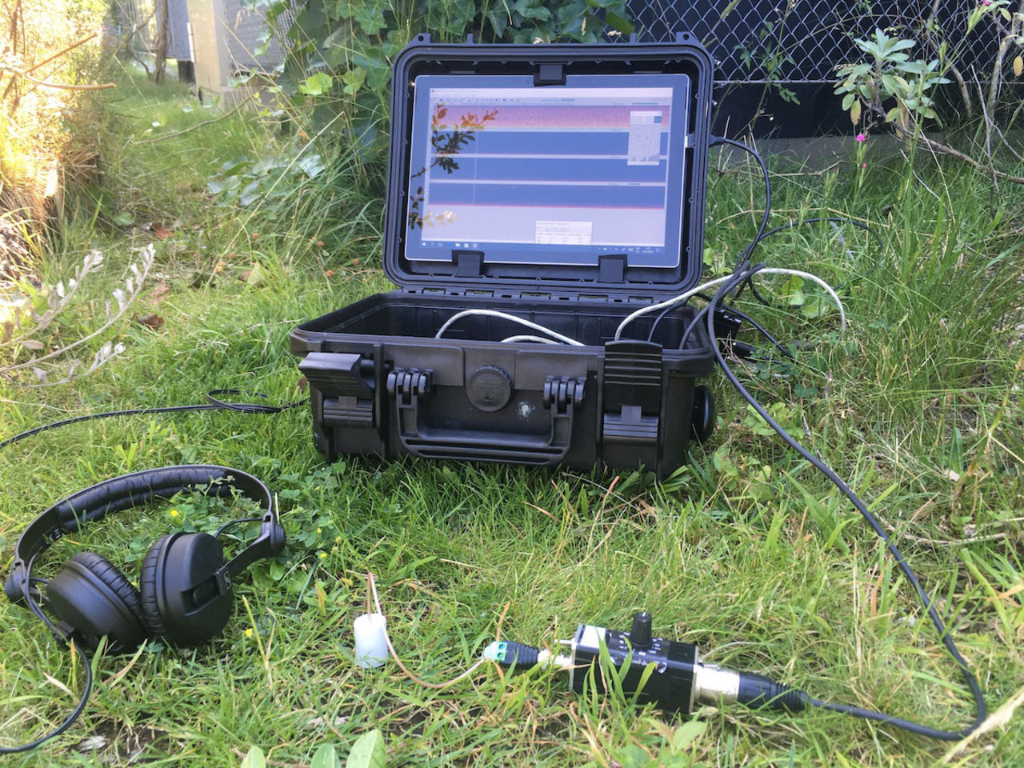
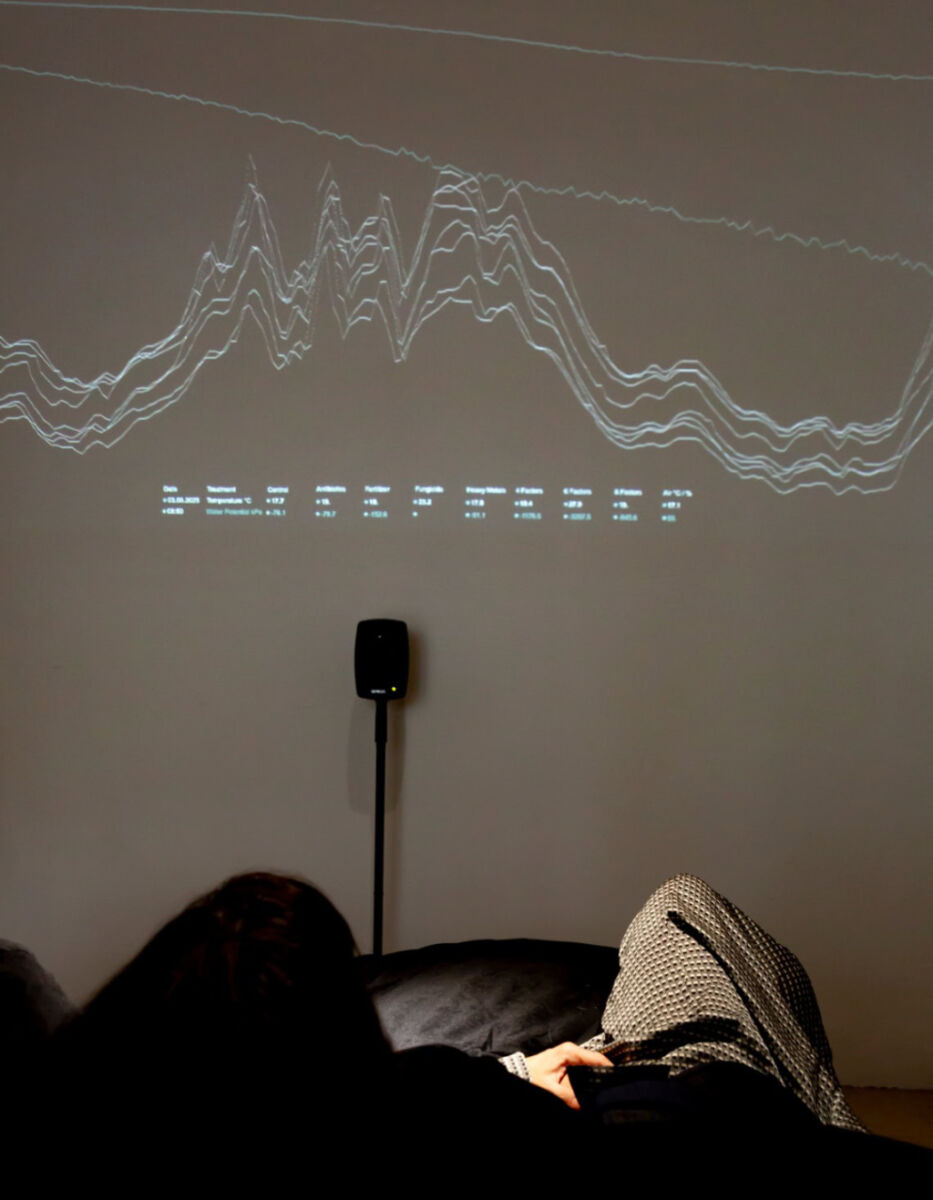
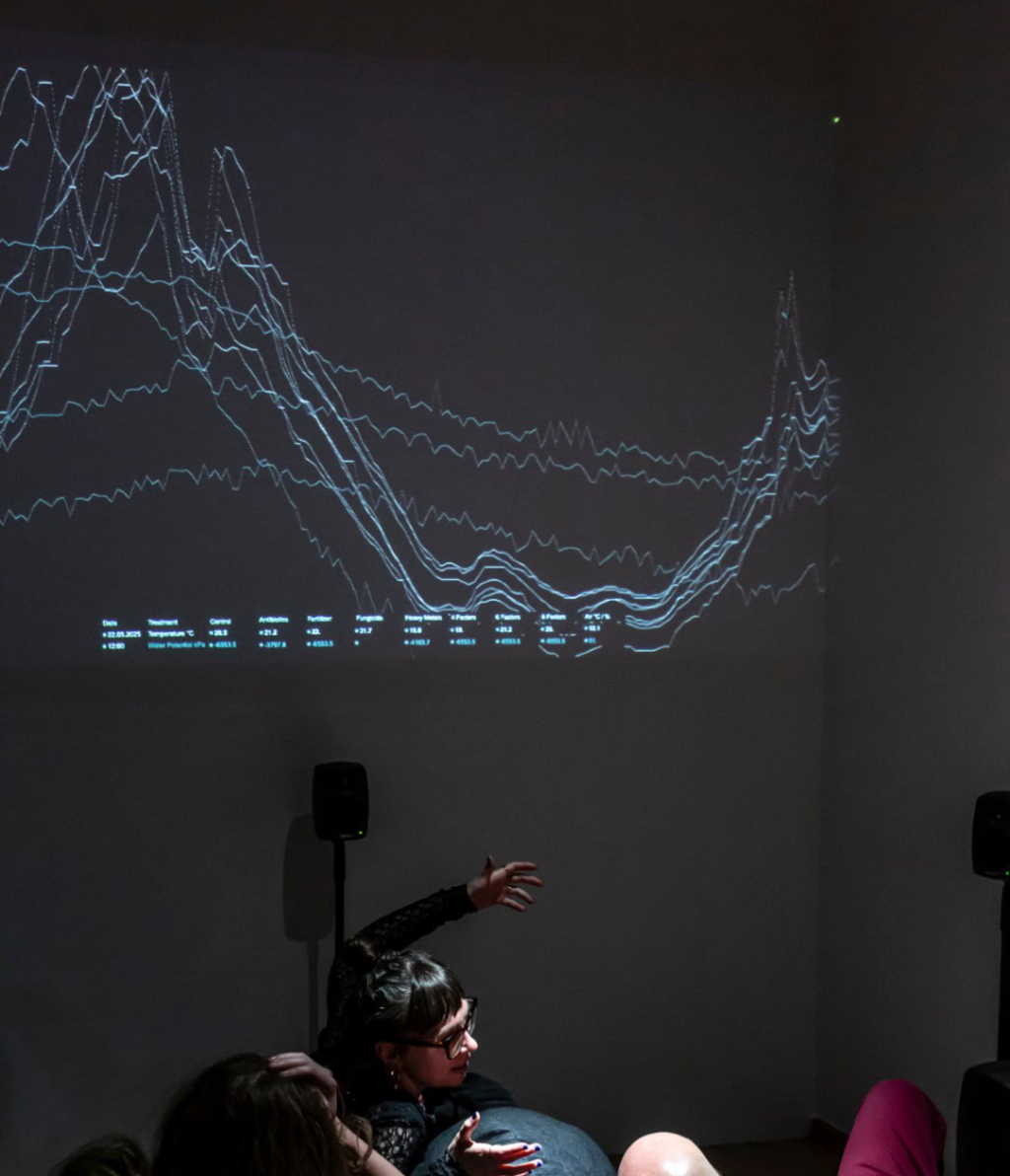
In Sounding Soil, Maeder explores the acoustic activity of soil ecosystems, placing microphones in the ground to investigate forms of life and interactions that usually go unnoticed. In Change Factors, he approaches ecological processes through data sonification, translating temperature and humidity measurements into sound. Developed through the CHRYSALIS. ARTISTS IN LABS research programme at Art Laboratory Berlin, in collaboration with Matthias Rillig’s research group at Freie Universität Berlin, the installation emerges from research into how environmental change affects soil ecosystems.
Currently on view as part of the CHRYSALIS. ARTISTS IN LABS exhibition (open until November 29, 2026, at Art Laboratory Berlin), the work continues Maeder’s investigation into the relationships between sound, technology and the living world. His approach challenges the assumption that nature must be translated into familiar human terms to become meaningful. Instead, listening extends our perceptual capacities, letting us approach ecological systems on their own terms while acknowledging that much of their complexity will always exceed our understanding.
You studied fine arts, then philosophy, and later environmental systems science. Was there a moment when you realised these paths weren’t separate after all?
I never felt these were abrupt shifts; one flowed organically into the next. I started as an electronic musician and sound artist, and at some point I became interested in what the sounds I heard outdoors might mean. But there was also a very formative moment in the 1990s, when philosophy began to influence electronic music. There were labels such as Mille Plateaux, and we saw much of what we were doing at the time reflected theoretically in poststructuralism.
During my philosophy studies, though, I soon became interested in systems theory, ecosemiotics and aesthetics. By the time I had finished, I knew that, if at all possible, I wanted to do my PhD in Environmental Systems Science. In the meantime, I had already collaborated with natural scientists on various occasions. My stays and projects at the Swiss Federal Institute for Forest, Snow and Landscape Research WSL were particularly important during this period. That’s also where I began collaborating with ecophysiologist Roman Zweifel.
Before your academic and artistic career fully took shape, you worked as an editor and producer for Swiss radio, even heading live productions for a period. What did that world teach you about storytelling, timing, and the politics of what gets aired? Who has influenced the way you listen most?
Yes, that was my first leadership role. Sometimes, travelling in the outside broadcast van, I felt like the captain of a spaceship. The live broadcasts, working with sound engineers and meeting the artists, were the enjoyable parts of the job. I also learnt how to put programmes together and schedule them, as well as journalism practice and ethics. The less enjoyable, political side was that, even around 2000, the Swiss media landscape was coming under increasing pressure from right-wing populist politics. Suddenly, ‘Swissness’ was supposed to define the programming: local bands, Swiss German dialect, and so on.
The station was also becoming increasingly ‘formatted’: no more challenging music. In fact, Swiss radio is still afraid of its own audience and of politics to this day. Eventually, that prompted me to move on. Afterwards, I made several radio plays for Swiss and Austrian radio.
An incredible number of people have shaped the way I listen, as has, of course, my research as an ecoacoustician. But I think my friends have always mattered most: friends who introduced me to music they liked. Music they made themselves. Jolanda Gsponer, for example, from the underground record shop Karbon in Zurich.
That was our real musical education back then: hanging out there for entire afternoons, soaking up new music like sponges, all the way to Japanese noise… No music conservatory could have offered that kind of education. Nor would I be who I am without my friend and labelmate Bernd Schurer. We both somehow feel that we have conversations about music with each other that we couldn’t have in quite the same way with anyone else. We’ve been working together for 30 years now. I would describe what we do as a merging of music, art, philosophy, the environment and computers.
You turned Deleuze and Guattari’s Anti-Oedipus into the surround-sound radiplay Die Wunschmaschinen. What made you feel that these ideas belonged in sound?
I felt that way all the time with Deleuze and Guattari. That this philosophy is a kind of poetry. At first, I think I listened to the texts more than I understood them line by line. And I probably wasn’t the only one. When we premiered Die Wunschmaschinen in Frankfurt to mark the fortieth anniversary of the 1968 movement, Achim Szepanski was in the audience and was visibly taken with what he heard.
I think the two volumes, Capitalism and Schizophrenia, Anti-Oedipus and A Thousand Plateaus, contained the seeds of much that profoundly shaped me and those around me in philosophy, music, and art, and, not least, my own philosophy of life: connectivism, network theory, immanence, ecosystems of thought. In how I live: I see my life as an experiment in which everything is somehow connected.
Having co-founded domizil in 1996, what would you say the label has allowed you to do that exhibitions or academic contexts haven’t?
I think almost everything I do comes out of my practice in electronic music. It shapes how I listen, act, experiment and interact with the world. In that sense, domizil is our real home: a platform for engaging with other people’s music, and a place where we follow only our own rules. We release strictly what interests us, and that isn’t much—our own music too, of course.
I first got into electronic music right after art school. Back in the mid-1990s, the electronic music scene was simply a much more appealing context for us than the art market or academia. We could invent ourselves, our music and our own context. We built our own instruments on our computers and started streaming music before platforms such as Spotify existed, when MP3 was still an experimental format developed by the Fraunhofer Institute.
The emerging internet and the subculture we were part of allowed us to think differently about how we presented and distributed our art. This had its counterparts in the analogue world too: we were involved in independent spaces between art and music, and co-founded the media lab k3000 in Zurich.
On a deeper level, did listening to sounds produced inside trees change how you experienced forests or plants in everyday life?
Yes, definitely. My relationship with plants changed a great deal. Later, this extended to ecosystems: whenever I listen to field recordings, I become aware of how deeply everything is interconnected. Roman and I first investigated plant sounds, then moved on to electrical signals in plants, because we became increasingly fascinated by plants as intelligent systems.
From what I understand, the sound in your work results from data being shaped by movements in nature. How do you decide which sounds correspond to which processes or variables?
I’m not sure I understand the question correctly. It is less about movements than about relationships and processes that I investigate through sound. If you record sound in an ecosystem while also measuring other parameters, relationships emerge that other scientific disciplines may have already explained and that also have sound counterparts.
No sound exists without a physical or biological cause. You can then investigate relationships between sounds or sound sources, and these can tell you something about processes and conditions within ecosystems. The world sounds.
How do you translate this kind of ecological complexity into sound without turning it into a simple illustration of scientific data?
By often doing basic research through sound. For example, by acoustically investigating biodiversity in soil ecosystems, exploring acoustic signals of drought stress in trees, and so on. My artistic work always emerges from my scientific research and cannot be separated from it. There are simply two kinds of output: artworks and papers. Often, neither comes before the other, and it’s never a simple matter.
With Sounding Soil, you literally put microphones into the ground and revealed an entire acoustic world beneath our feet. With Change Factors, you are working from temperature and humidity data instead of direct recordings. How has that shift changed your relationship to the idea of “listening to nature”?
Listening to nature does not, of course, have to consist only of ‘nature’ experiences or recordings. Data sonification can make the otherwise inaudible audible, bringing them into the realm of sound. It can offer an entirely different perspective on complex phenomena, for example, or let us recognise patterns that elude our sight. We live in a world in which the artificial and the natural are inextricably intertwined.
Even a field recording does not simply represent nature; strictly speaking, it is a technological artefact. Our reality is constituted through experiences that emerge from both technological and natural elements. What fascinates me about data sonification is the kinds of sonic worlds that can emerge when you let data sound. It generates so much new, previously unheard material for composition. In that sense, it is simply an expanded way of listening to the world.
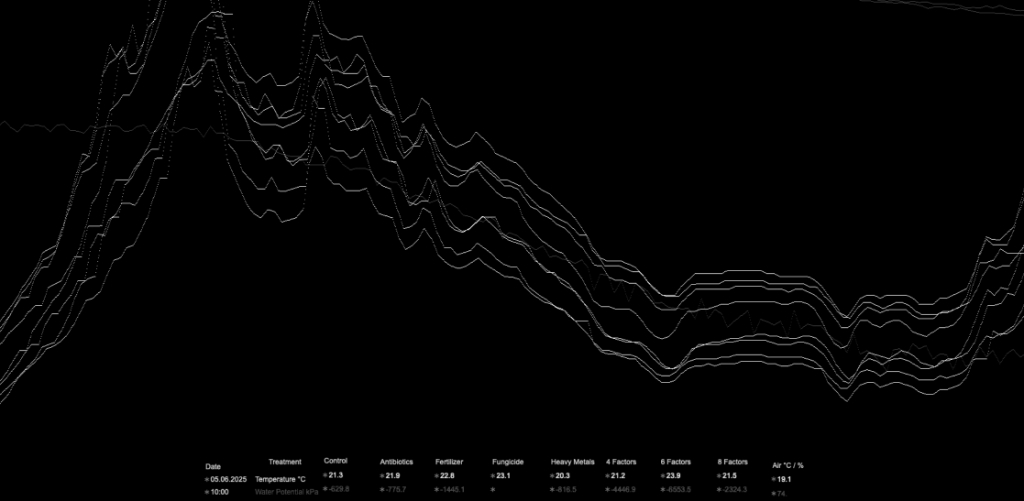
In the Rillig Lab’s Global Change experiment, the differences between treatments become especially audible as the soil dries and water potential declines. What interests you about that particular threshold, where environmental stress becomes perceptible?
I think we often have no real sense of what happens when climate change hits unless it becomes visible everywhere, as it did this summer with low water levels and relentless heat across Europe. By ‘no real sense’, I mean we lack an immediate sensory experience of, for example, drought and heat in soil already under pressure from human use. And then there is always this ambiguity, this lack of clear-cut results in the measurements, what scientists call scatter.
Nothing corresponds exactly to the models you hope to see confirmed in an experiment. Scatter, or random, inexplicable results, is of course also an excellent source of new artistic material. But it also shows that science can only approximate what is actually there, statistically. In my installation, this becomes perceptible as pulsations, modulations and beatings, rather than clearly distinguishable tones.
For me, ambiguity in science then becomes ambiguity in art, asking us to form our own views, reflect on our impressions and question them. The closer you listen, the more complex the sound field becomes, or, indeed, the world.
People often say artists “give nature a voice.” Does that language sit comfortably with you, or does it risk placing the artist too centrally in the encounter?
Yes, to me that is simply anthropocentric, anthropomorphic bullshit. I find nature so much more fascinating when I take its fundamental otherness as my starting point, rather than making it wear, as Emerson puts it, the colours of the human mind. Of course, we cannot escape perceiving the world through the cognitive abilities and categories available to us.
But that certainly does not mean that what surrounds us is merely a reflection of how we communicate or, more generally, of our social behaviour. What interests me is finding a way to approach that otherness within the communicative situation of an artwork. And I find it all the more exciting when much remains incomprehensible and eludes our habit of ‘hearing voices’.
You developed Change Factors through the CHRYSALIS residency, embedded in a scientific lab rather than just visiting it. What has being part of this allowed you to explore that would not have been possible within your usual artistic practice?
Since the two are intertwined in my work anyway, the question does not really arise for me. I was invited to the lab primarily as a researcher and worked there as a Humboldt Fellow. The outcomes were both scientific and artistic. But in any lab, the exchange of ideas and connections with people matter a great deal to me. Matthias Rillig’s lab has become one of my centres of gravity because I find an exceptionally inspiring atmosphere there, one that is equally important to my research and my art.
What’s your chief enemy of creativity?
Predetermination.
You couldn’t live without…
Freedom.