Text by Àngels Miralda
Kunstverein Arnsberg’s exterior space is distinctly removed from a traditional gallery setting. This hybrid indoor-outdoor venue is situated in a medieval church courtyard, where steps have echoed across stones for centuries. Approaching Louis Braddock Clarke‘s solo exhibition, visitors first encounter what appears to be a neutral blank wall. But this is no ordinary barrier—it’s the reverse side of a screen, and the experience is not visual but visceral. Sound enters the body through vibrations: the thuds and rumbles of explosions and other mining-related recordings pulse from speakers, as if emanating from the beating heart of our geological environment.
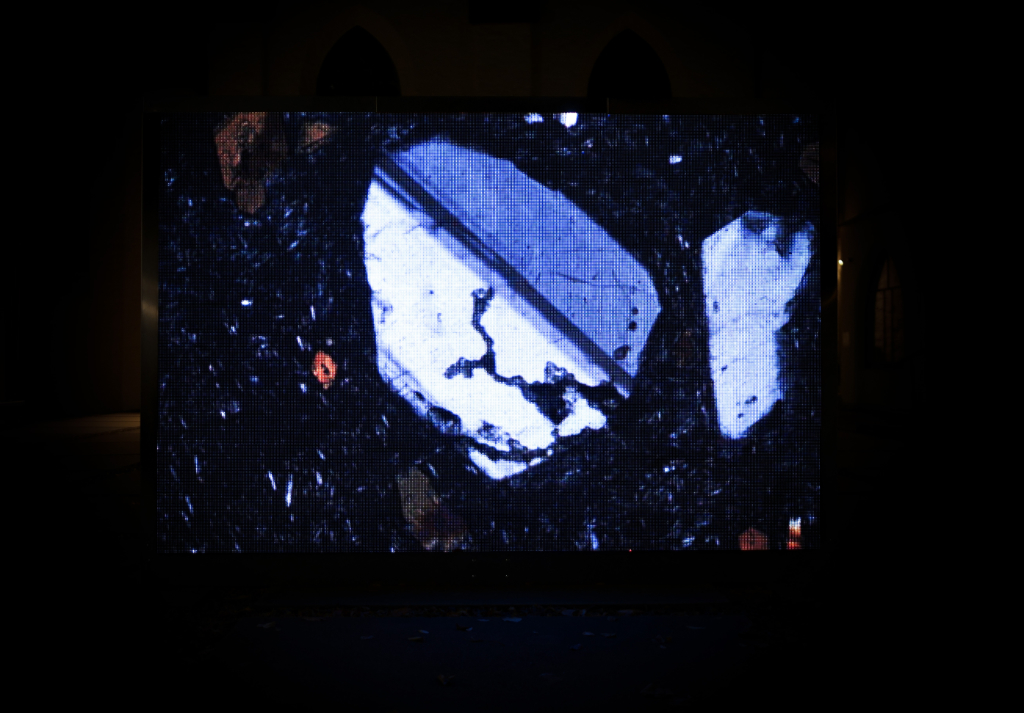
On the screen’s other side, algorithmic loops dance across ultra-thin slices of rock, scanning the earth’s insides in mesmerising patterns. Braddock Clarke presents stone as a living entity—one that speaks and communicates through its colours, sounds, and history, split open like a book to address our alienated relationship with deep earth, despite our contemporary dependence on its rare elements.
In the exhibition text, curator Yannik Güldner creates a poetic relation between mined landscapes. The earth surrounding Arnsberg is riddled with ancient mines, and the extracted hills of the Sauerland mountains gradually give way to the more industrially-prone Ruhr region. This tunnelled and blasted earth reads like an endless open surgery. The extractive drive that fueled colonial ventures and the advent of capitalism floated to the surface through deep-earth excavations that punctured the planet’s seal. And while Braddock Clarke uses the instruments of geologists and surveyors in his work, Güldner writes that it represents a counter-method that uses extraction instruments without repeating its hunger. It reverses their intentions, repeating their movements to increase understanding and empathy, rather than increasing numerical profit values. Braddock Clarke practices mineral attunement, a process whereby listening awakens a sense of stone thinking that emanates from the earth. This non-extractive approach is rooted in the artist’s personal relationship to mined landscapes and shapes his entire artistic practice.
In an interview with director Pauline Doutreluingne, the artist details his upbringing in Cornwall, where local mining history is intertwined with mythological stories and auditory hallucinations experienced in tunnels—phenomena that produced local folktales of imagined creatures beneath the earth. This lore informs how Braddock Clarke sees minerals: as living beings rather than inert resources. He reflects on the beauty that workers characterised geology and its ores as living creatures. That’s where I started—the minerals becoming conscious agents in my works. This perspective connects to his method of sonic-listening, in which “silent” collaborators—the rocks themselves—have their speech translated into understandable formats for the human ear. From his relation to mined landscapes to his approach toward scientists as horizontal collaborators, a recognition of what has occurred feeds into empathy toward a wounded planetary core.
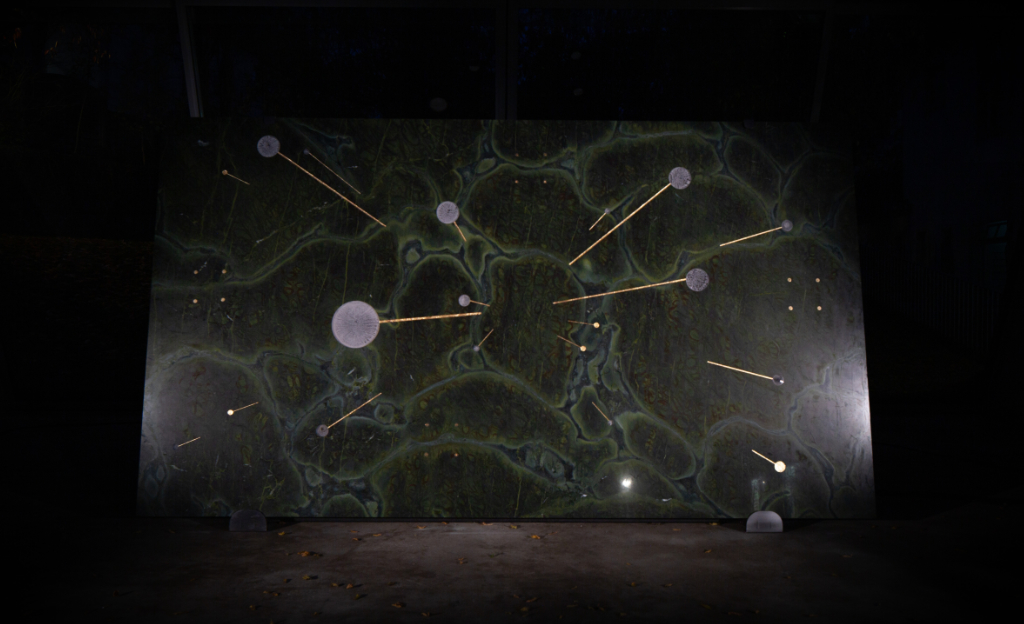
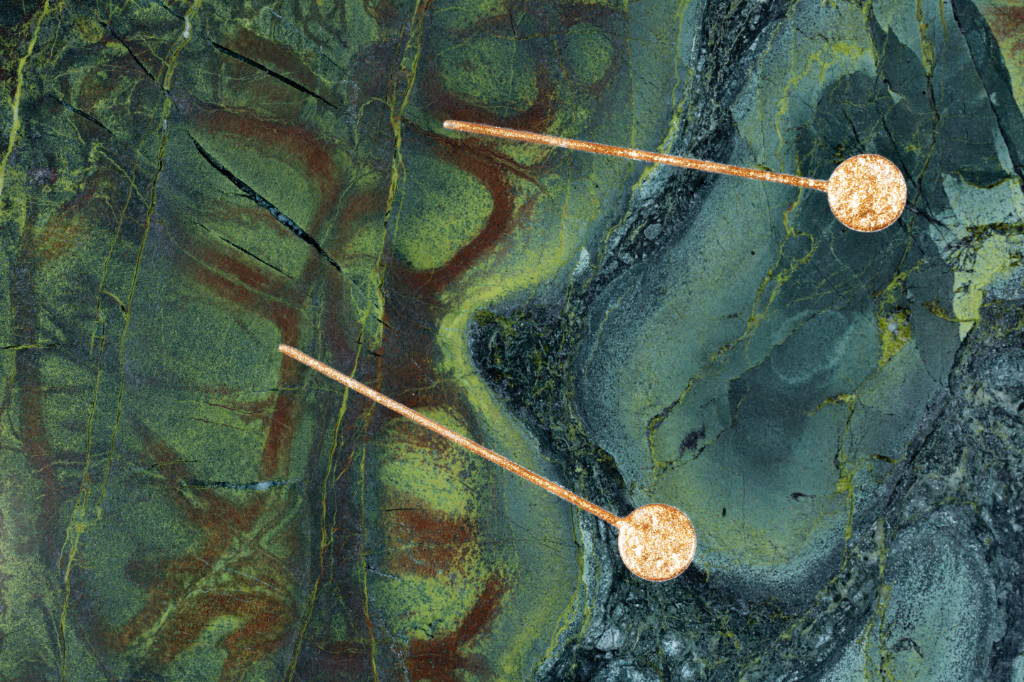
FACE 001 transforms the stone itself into an instrument. Laden with transducers, this marbled, swirling stone, named Vitoria Regia, plays a soundtrack of archival mining explosions and rockfalls, transmitting vibrations to the audience through its fragile, thin-sliced surface. The work actively translates low frequencies into infrasound—a detection technique developed during the Cold War in which barometric microphones were used to detect nuclear explosions. These microphones detected changes in air pressure caused by explosions anywhere on Earth.
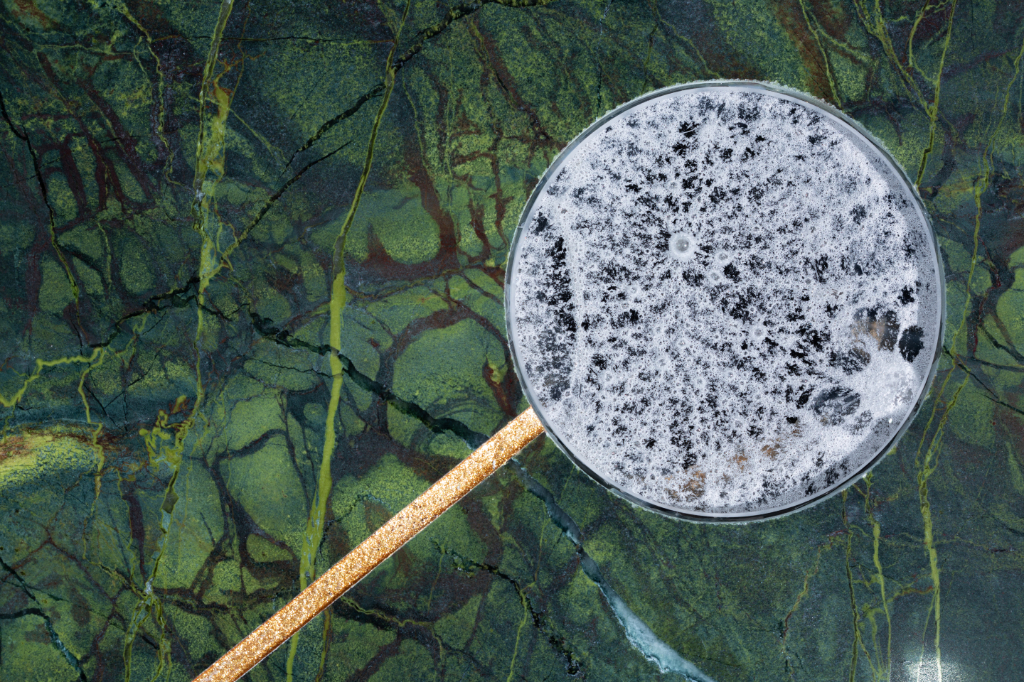
On this shaking stone surface, holes are drilled into locations selected by geologist Annique van der Boon, who collaborated on the project, pointing out which areas would need inspection to learn more about the stone’s composition. These were filled in with petrified whale bones and golden lines, creating a deep-time divination map for deciphering the language of minerals. The stone, on the other hand, was selected by Braddock Clarke, though he wonders if it wasn’t the stone itself that chose to participate, I had an immediate magnetism to the stone Vitoria Regia, Rock nr: 6314, Slice: 56 – it spoke of worlds within worlds, had a geology of circular compression, and bacterial arms as if it was still growing. The choice was through divination – a type of dowsing through the post-mine landscape and finding the source signal. Maybe it was its magnetic lava particles magnetising me – Maybe its active hallucinations kept circling my unconscious – or Maybe Vitoria Regia chose itself to join our infrasonic pirate ship at Kunstverien Arnsberg.
Turning around, the video of FACE 002 is visible. It plays an algorithmic sequence of ultra-thin rock cuts sourced from laboratories in the Netherlands. Composed by creative coder Arran Lyon, the algorithm jumps between hues and cuts sourced from the world over to be studied in Dutch laboratories. The camera moves slowly across the elegant colours and patterns of a vast collection of stones, each telling a story of the planet’s continental and subterranean evolution over geological time. These delicate, translucent slices also reveal the frenzied contemporary desire for rare earth minerals—a hunger in which we all participate through the unmeasured, obligatory consumption patterns of Western life.
Visitors are invited to touch FACE 001, to feel the deep pulses of geological time vibrating through their fingertips—a direct, haptic connection to an ancient earth from which we all were born. This tactile encounter transforms passive viewing into an embodied listening experience, where the body itself becomes a receiver for the stone’s transmitted frequencies. The two works, facing each other, create a layered environment both inside and outside, reflecting on the openings and closures left behind by tunnels bored into fragile landscapes. They are linked through post-extractivist traces—acknowledging what has been taken while refusing to repeat the violence. Tellurian underground pulses push into the night air, escaping like a thousand sound-waves freed from their millennial subterranean prison.
The beating heart of rock that lies beneath our feet and moves economies sits in geological solidarity with the ruined landscapes of the global south, from where many of these samples came. It connects to the philosophy of Édouard Glissant’s tout-monde, whose volcanic solidarities reach out from Martinique through deep underground lava chambers that connect the world.