Interview by Neshy Denton
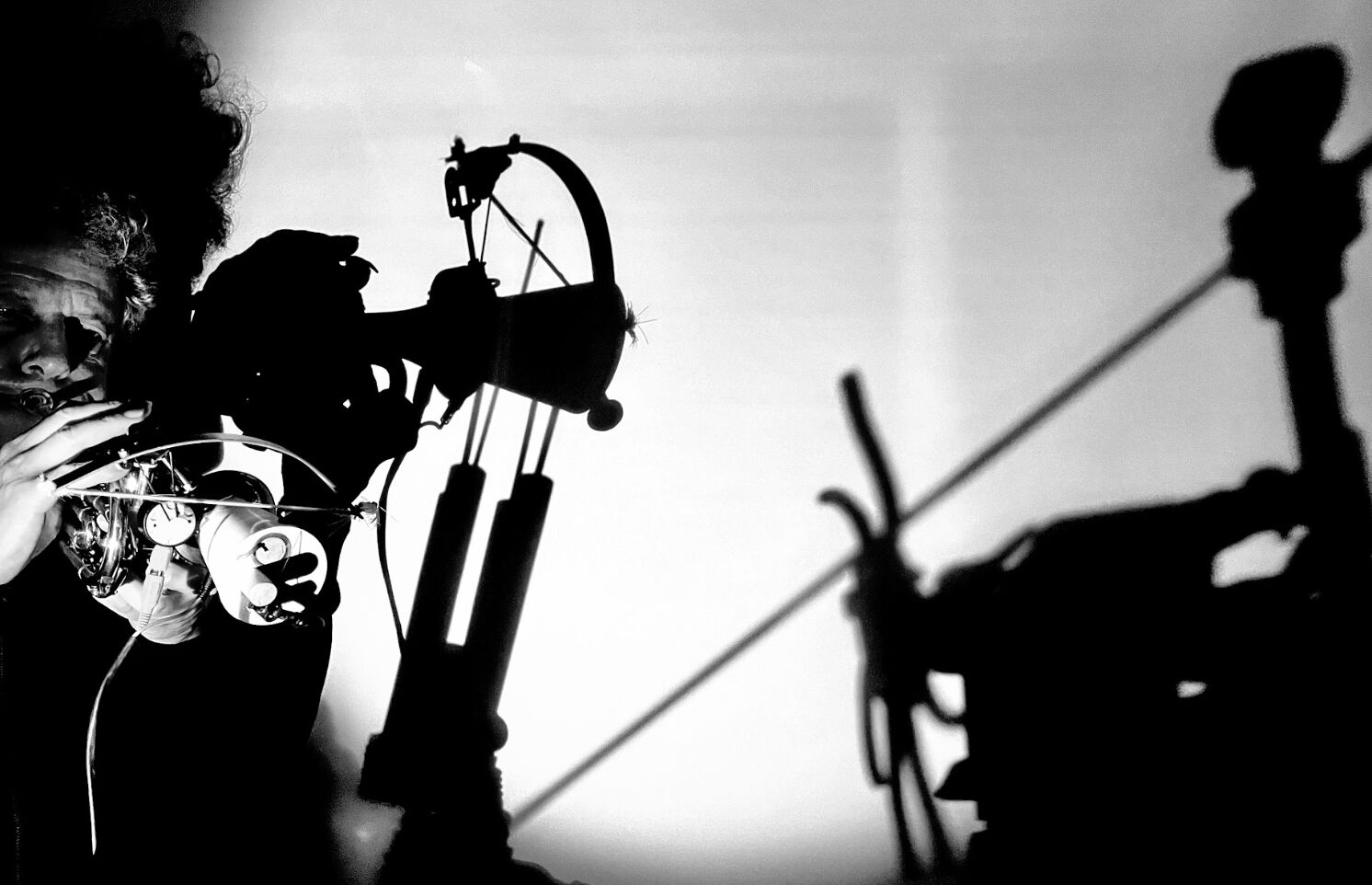
If there were to be a bridge between the random spontaneity of jazz and the metronomic precision of a clock, we’d be getting somewhere close to understanding the initial specs of Pierre Bastien’s music. Built around the musical realm where experimental is the first accurate word that comes to mind, the French artiste, or sound whisperer at most, and a mechanical engineer at best, carries a beckoning eye for composition.
It is nothing short of fascinating how the fruit of one’s own revolution can be built from mere boredom, or the extraneous need to bring two pans together around a metronome to uncover one’s real passions. Precisely, we may think there’s a correct way to awaken said creativity, and confirming the latter as Bastien’s introduction to the endless world of autonomous music through robot mechanics and electricity, we stand corrected.
Following his encounter with Raymond Roussel’s Impressions d’Afrique, a book describing machines capable of shifting movement through changes in temperature, Bastien’s interests expanded beyond performance alone. He became invested in the act of construction, developing mechanical devices that respond to electricity in order to generate motion. From these looping, semi-random consequences of chance emerged a form of rhythm untethered from the human body, a melody so far removed from natural that the Parisian artist hadn’t yet realised he was stepping into an entirely new musical language. Possibly a large piece of the subsiding time for the detonation of semi-autonomous experimental music, visibly influencing a bunch of artists emerging today.
I don’t even know whether it’s the idea of breaking loose from what tradition expects, or the fact that when one interacts with music exceedingly often, the notion of meaning in sound gets completely lost into the ether. But, what I find the experimental camarades have in close kindred is relief in releasing the strange, the jarring, basically the so-called anomalous of what was decided for us. It’s a treachery which concludes in something much more cavernous than meets the, I guess, ear. Something which calls out to me when I stumble across artists like Pierre Bastien.
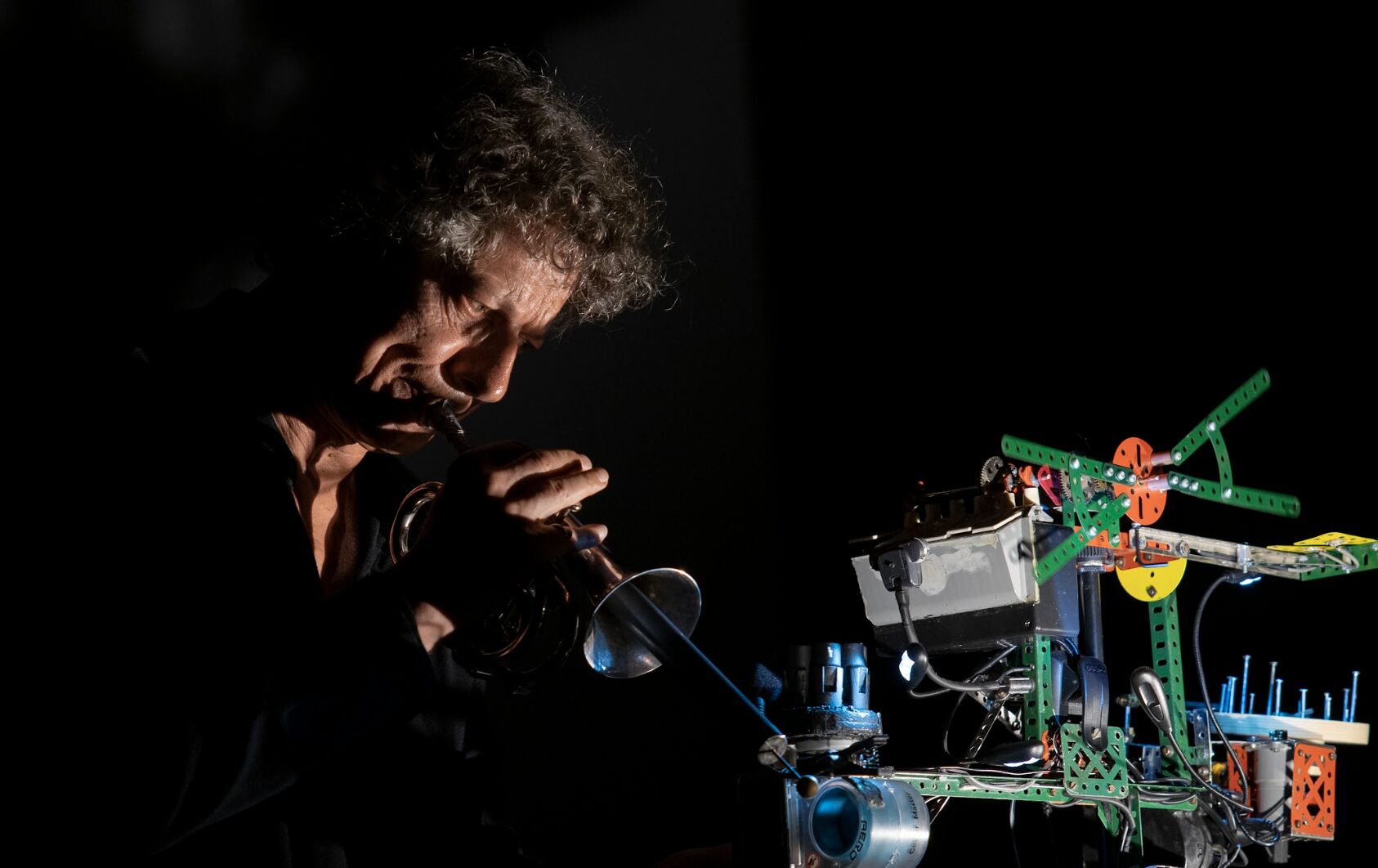
You’ve probably listened to Bastien’s Mecanium, his first piece made from the mechanical orchestra he fathered so sophisticatedly. What follows in his catalogue progresses into a sort of deepening, a tinkering widening of the same idea. Having built over 60 of his “mecanoids” – the autonomous individual robots crafted to create rhythm, music, and now considered close companions to the musician – he explicitly rehearsed their behaviour to curate a version of their own music. So much so that his sense of time and rhythm has fallen into place with them, influencing how he now makes music.
From a blind (ish) eye, it may seem like his outreach was to rush to some futuristic drone, where autonomy was bound to take over. But after speaking to Bastien in the following interview, it becomes clear the relationship with machinery is tentatively meditative rather than, say, futuristic. He recalls building his first musical machine at fifteen, during the unrest of the 60’s, as a way to dismantle the authority of the metronome and reclaim rhythm on his own terms.
Operating within the experimental music scene of the time, often marginalised and dismissed by mainstream institutions, what followed was not quite a rejection of musicianship, but a suddenly revolutionary way to expand it. Perhaps what makes Bastien resonate now is not this said futurism, but his refusal of it, focusing on a commitment to slowness, error, and care in this world of ours that rarely allows for any of the three. At least nowadays. I encourage you to listen to his sound, because, at a time when music is increasingly dematerialised, Bastien’s work reminds us that even in a digital era, rhythm can still be something you touch and patiently negotiate with.
You first made your mechanical musicians at the age of 15. What was going through your mind then?
What was going through my mind was similar to what was going through the French society of the time. I turned 15 in May 1968, right at the moment when students from all over the country started a long strike that would soon become a revolution, when workers joined the rebellion. Protest and subversion were in the air. My school had been occupied and then closed after the headmaster had fled. The guitar lessons continued, though, lines and chords ruled by the anti-musical ticking of the metronome. Times were changing around me: my timekeeper had to change as well. One afternoon, I took two pans from the kitchen and placed them on either side of the metronome, whose dull ticking turned into an inspiring bing-booong. Half consciously, I had made my own private revolution, and my first musical machine.
It took a few years before I thought about following up on this first experience. The next trigger came from literature, when Raymond Roussel’s novel Impressions d’Afrique was published in paperback. The book describes several imaginary inventions, among them a thermodynamic orchestra that plays on its own and works through sudden temperature changes. Roussel’s description of the robots is so detailed that it made me want to build something similar: musical automata that react not to thermal conditions, but simply to electricity.
I love the fact that the Mecanium was essentially the first “robot” or “machine” as we could call it, to ever go on a musical tour. Correct me if I’m wrong. Tell us about that time.
I don’t know whether Conlon Nancarrow toured with his player piano or not, but I do know that Joe Jones -the Fluxus artist, not Count Basie’s drummer- performed with his automaton-like music machines already in the sixties. As part of the second generation of sound artists, I never felt like a pioneer. That said, it is true that Joe Jones switched from playing drums to shaping mechanical sound devices, without ever mixing the two activities. His robots replaced his arms, legs, and lungs: they were a substitute for him, while in my case, they are an extension of myself.
In 1976, when I brought a self-built machine on stage for the first time, I was unaware of any similar experience in the field of « free music », as it was called back then. But I knew the existence of Mauricio Kagel’s Zwei Mann Orchester, with its two performers activating a huge sound installation, and I was a great fan of Heinz Holliger’s Cardiophonie, a solo piece for oboist playing along with the sound of his own heart rate.
The idea behind the construction of my little robots was more an attempt to play several parts at once, rather than to enter the world of mechanical music. It was a way to bring the popular one-man band into the experimental scene, through new techniques and inventions.
It’s fascinating how futuristic and ancient your sound feels. What influenced this sound? And could you detail the process for selecting which instruments, such as a Javanese saron or a Moroccan bendir, are paired with which mechanical action?
Collecting acoustic instruments from different musical traditions is my way of determining a personal range of sounds that inform my music. My studio is filled with instruments from all over the world: percussion, string, and wind instruments. Each one has its own timbre, distinct from the others. I like playing them privately, often not according to the tradition they belong to, more instinctively: just to make them sound as good as possible.
Meanwhile, I study how my body works to produce the sound, and I slowly find out how a future machine will work in order to reproduce my Action. As you say, the combination of a machine and an ancient instrument leads to a paradoxical object. Even if the mechanism’s technology is rudimentary, it creates a strong contrast that is amplified by the musical result.
Unlike most mechanical instruments, mines offer fewer possibilities than a human player. My robots play a few notes and simple lines. They are not meant to compete with humans, even less to overpower them. They are serving musical ideas that are not based on virtuosity.
You have questioned your work before; I read somewhere that it was maybe old-fashioned. So, what artistic value did you conclude the Mecanium offered that modern electronic music could not?
At the time I started building robots, you could not easily buy sequencers or rhythm machines in music shops. Over the years, electronics developed and become affordable. Why then going on with my little contraptions, with their limitations and imperfections? Limitations and imperfections are probably the qualities I don’t find in modern electronic devices. Limitations help me focus on a specific aesthetic rather than get lost among millions of possibilities. Imperfections give a sort of humanity to the robots; they make them charming machines – my « motherless daughters », as Francis Picabia named his mechanomorphic drawings. On stage, my contraptions offer an even greater artistic value. They don’t hide inside a cold metal box. You can see how they work. You perceive the sound through your ears and your eyes at the same time, then you understand it and enjoy it better.
Safe to say you are greatly influential within the experimental music realm, do you have some sort of reflection about how this scene has progressed throughout the years, parting from when you first started up until now?
Back in the 60’s, when I was a music fan, and in the 70’s, when I started playing for an audience, the expression « experimental music » was used exclusively to describe academic or institutional research. A young musician and self-taught composer would not claim to belong to the experimental music scene, a designation reserved solely for the likes of Edgar Varèse, Pierre Henry, John Cage, Pierre Schaeffer… At the time, all of us were put in the same pot, melting pop, folk, jazz and rock music. There was a beauty to it, with events like the Amougies festival presenting all those categories to open-minded audiences. But those festivals were exceptions: it was generally difficult for us to express our ideas beyond the mainstream music; few clubs, few festivals would accept us, and often reluctantly. Then came personal computers and other electronics, allowing non-trained musicians to play with sounds rather than just sing over three chords on a guitar. I loved that moment! Suddenly, we were no longer a bunch of isolated crazy idealists: we were hundreds, thousands of music makers dealing with new sounds. The supremacy of love songs decreased; a huge radical movement changed the parameters. Definitely for the better. I realise I answered your question only on the social level. There have been aesthetic changes as well, though not as much as we could expect. Noise music, for instance, had been a revolution in 1913, more than a century ago. Our times made the avant-garde more widely known and shared. The biggest changes had been initiated by our elders.
You’ve collaborated with a diverse range of artists, from free-jazz icon Jaki Liebezeit to electronic acts like Aphex Twin (on the Rephlex label) and experimental musicians like Michel Anabila. How does the presence of a human collaborator, whose decisions are not mechanical or programmed, change the behaviour or voice of your music? Do you approach composition differently when the robots are sharing the stage or a recording with a person?
First, two points: Aphex Twin invited me to join his label, but we never performed together -even if he exclaimed he would have loved to literally play (like children are playing) with my contraptions, right after my set at a Rephlex night in Rome. Jaki Liebezeit played some free jazz in the sixties, but he is mostly known as a member of the krautrock band Can. I need to say that because I remember how he brusquely turned down Jac Berrocal’s suggestion to cover Ornette Coleman’s “Lonely Woman” when we were recording Oblique Sessions. I would like to focus on two artists among those who have played with my little robots over the years. When I had the chance to collaborate with Tomaga, I remember how Valentina Magaletti’s drumming would melt into the mechanical beat with ease. Instead of being an obstacle, each imperfection, each slight hesitation of the robots seemed to inspire her and to enrich her own part. You can hear that throughout our Bandiera di Carta LP. Another unique moment was the collaboration with DJ Low, aka Tom Deweerdt. Tom is the only artist who physically took the commands of my machines. After a short concert we had played together in Ostende, he djayed for two hours with the robots as the only sound source. A similar session was recorded not long after: the last two tracks of Swing Low (Modern Obscure Music MOM057) feature Tom conducting the mechanical orchestra in his own way, quite different from mine.
You often incorporate projections of the Mecanium’s moving parts, such as in your Silent Motors project, which uses overhead projectors. Could you elaborate on the visual dimension of your work?
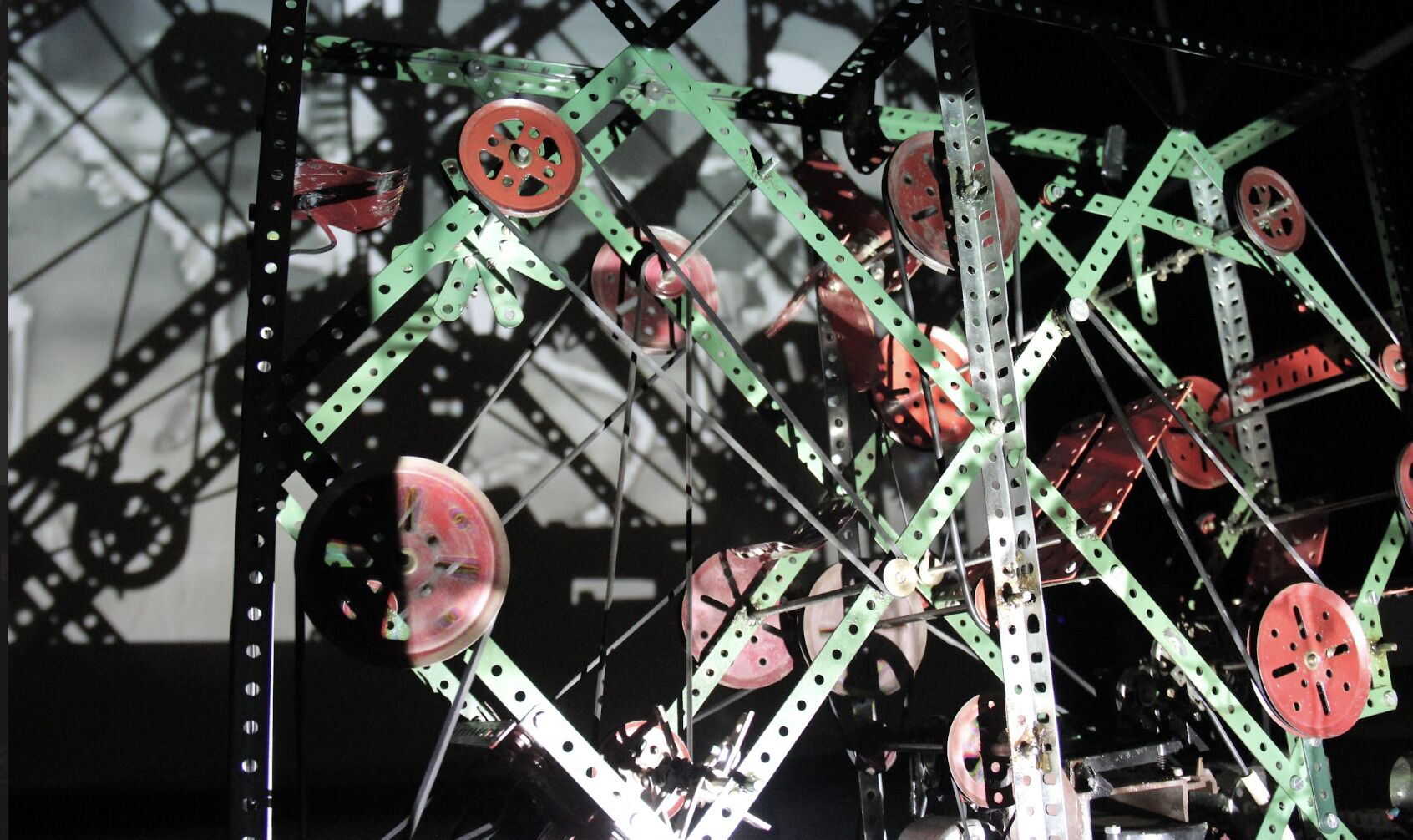
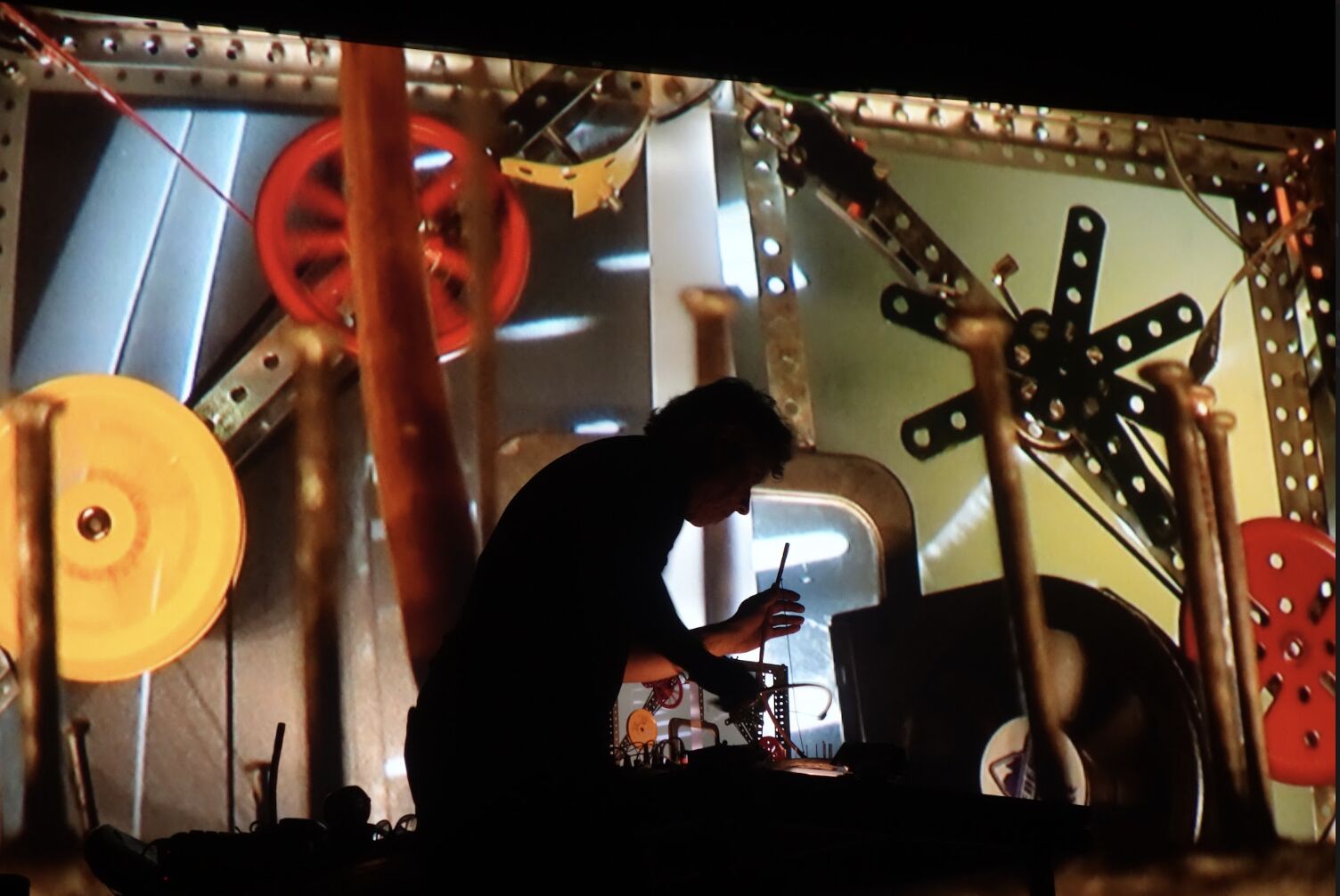
In the studio, when planning a new live set, I am always imagining the image and the sound simultaneously. Difficult to say which comes first. I love the magic of the stage: not the pop/rock stage with scaffolding around it, where heavy speakers and flashy spotlights are hung; rather, the dark stage of a theatre or a club, where you can change perceptions through lights and scale through projections. Besides that, the robots I am performing with have a kinetic quality. They move, turn wheels, flap paper, pluck and rub strings, hit percussions, shake rattles… A simple light bulb in front of them, and there is a shadow theatre behind me on stage. A beamer and a tiny surveillance camera pointing at them, and you see a huge close-up of the mechanism if I have the chance to play in a room equipped with a screen. Then my visual is more than an ornament added to the sound: it’s the sound itself, captured through a sort of Cinéma-vérité.
For listeners new to your work, which one album, perhaps a lesser-known one or one that represents a specific phase, do you feel offers the most complete snapshot of your world?
My third and last album on Rephlex, Machinations, includes a DVD with several videos of the robots playing exclusively mechanical compositions. There is another album, this time a vinyl, that features seven mechanical orchestras: Impressions de Meccano on the Dutch label Des Astres d’Or is a limited edition of 40 copies, each copy presented in a unique handmade sleeve. The recordings were done during the last decade of the 20th century. Some fans think this album is my best, a compliment that shows how much they appreciate me as an instrumentalist. I hope this opus will find a wider diffusion in the near Future.
What upcoming projects do you have in the books that we can look out for?
A second CNT album with the wonderful cornet player Louis Laurain; a first album on Sub Rosa, with the great eRikM; two nearly ready albums, one with David Fenech, another one with Klimperei; a score for a short animation film by Éric Montchaud; another score for another short animation film by Lucia Malerba and Niccolò Manzolini, and an installation including virtual reality with the same artists; some live improvised gigs with Michel Banabila that would result as a new collaborative record, somehow different from our previous studio albums.
If you had to picture your music as an animal, which one would it be and why?
Because I work on different levels -sound and visual, serious and ludic, ancient and futuristic,… – I like to picture my art as an onion with its multiple skins that you can peel indefinitely, every time revealing a new aspect of it. Never thought of an animal before, since I would not like peeling any… Maybe a squid that changes colours, still keeping its strong identity.
What’s your chief enemy of creativity?
Laziness, disease.
You couldn’t live without…
Love, friendship, art… and also tinkering, probably.