Text by Daniela Silva

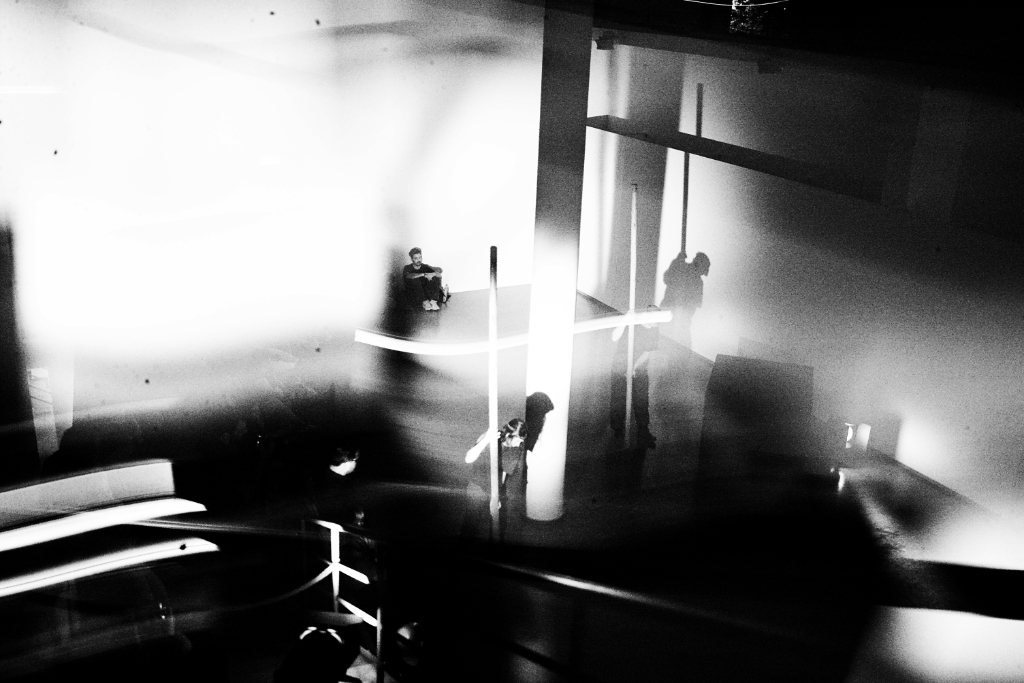
Who is really in control when a machine tells us what to do? In Situational Compliance, artist Matthew Biederman turns the familiar game of Simon Says into an encounter with automated authority. Using computer vision and pose detection, the interactive installation asks participants to raise their arms, show their hands or kneel, while a machine evaluates each body as compliant or threatening. Exposed cables, cameras and a live skeleton view deliberately reveal the apparatus behind the interaction. The work does not simply observe: it gives orders.
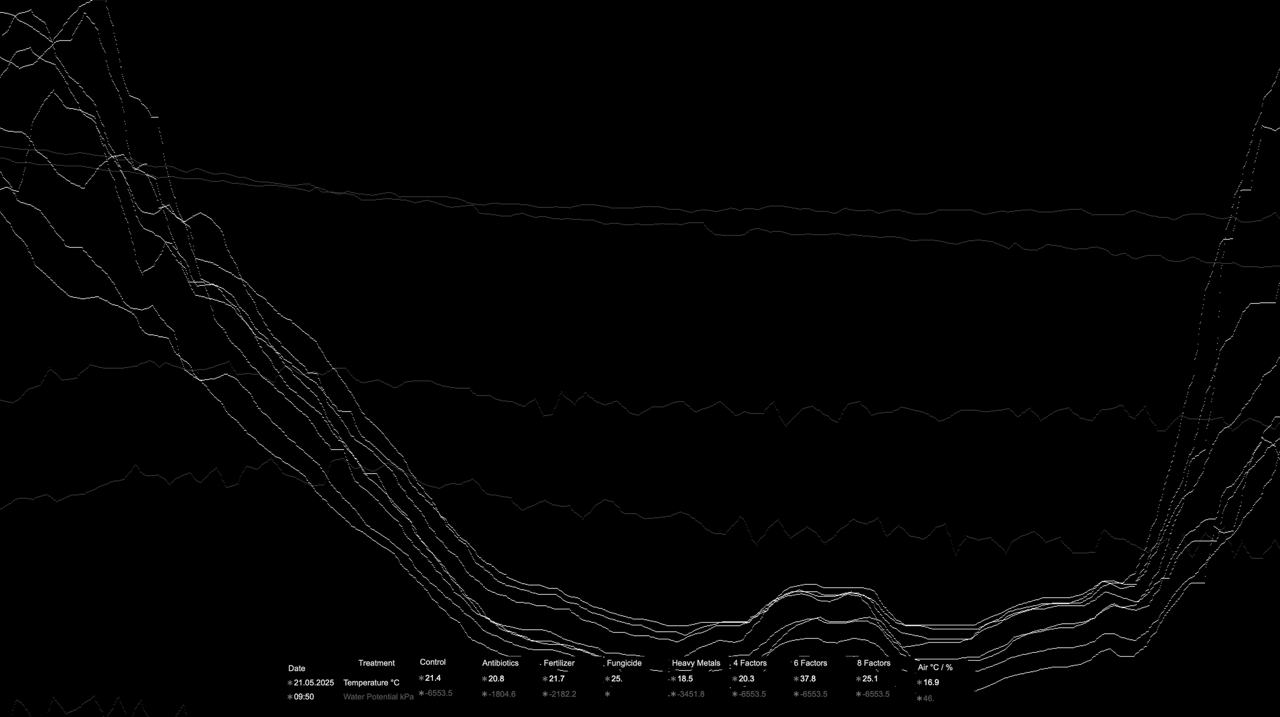
The project has been awarded the EDIGMA SEMIBREVE Award 2026, recognising a trajectory that, since the mid-1990s, has investigated the technological infrastructures operating beneath everyday experience. From electromagnetic frequencies and communication networks to surveillance and machine learning, Biederman’s practice makes visible systems that often remain abstract, unnoticed or deliberately concealed.
The apparent simplicity of Situational Compliance is central to its tension. Simon Says is a game most people learn as children, but it is also, as Biederman describes it, one of our first experiments with authority: staying in the game depends on following instructions. What begins playfully gradually becomes uncomfortable as the commands come not from another person, but from a computational system.
Biederman initially imagined participants becoming frustrated, walking away or deliberately losing. Yet some remain determined to complete the game and become, paradoxically, its most compliant players. For the artist, the real moment of winning lies elsewhere: in understanding that the machine doesn’t care about you.
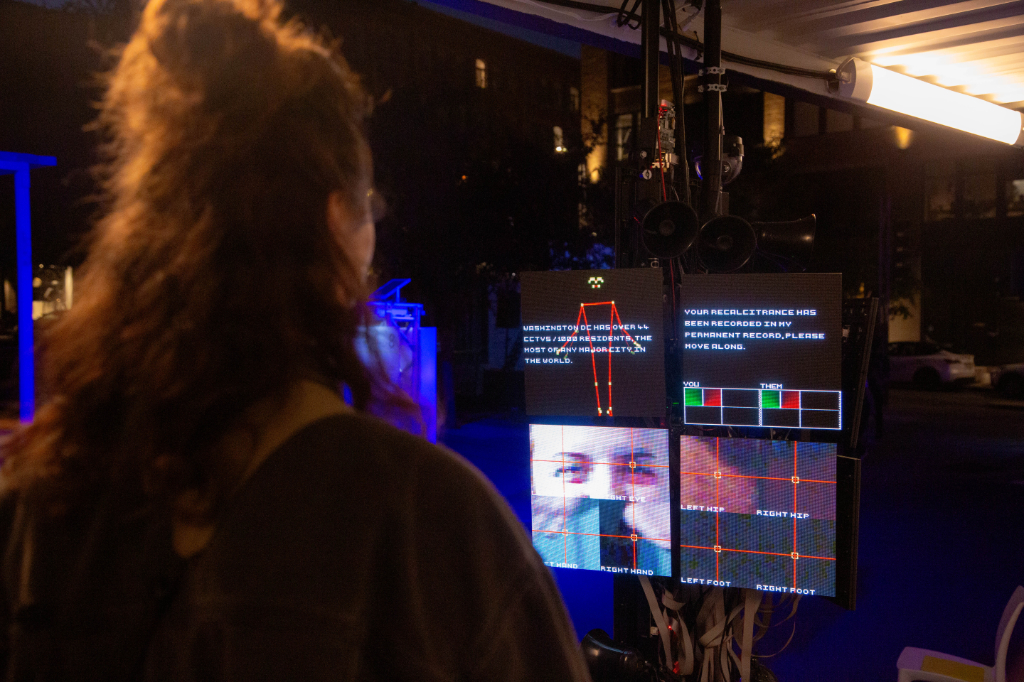

This shift from body to datapoint extends beyond the installation. Computer vision systems increasingly mediate public space, translating bodies and behaviours into information that can be classified and evaluated. Their apparent objectivity is precisely what Biederman questions. We have been led to believe a machine makes decisions without bias, he says, despite models being trained on datasets that carry existing social biases. Automated judgement can consequently appear detached from human responsibility.
Making these mechanisms perceptible has long been part of Biederman’s practice. He describes art as a way of reflecting the world back to us through things that are unseen or overlooked. Electromagnetic spectra, networks and surveillance cameras become artistic material precisely because their invisibility allows them to operate quietly as structures of control.
There is also, for Biederman, a need to be honest with your material. Technologies used to produce interactive and immersive artworks are entangled with military and surveillance infrastructures. Artists working with them therefore encounter a choice: reproduce the seamlessness of these technologies or expose their histories, mechanisms and alternative possibilities.
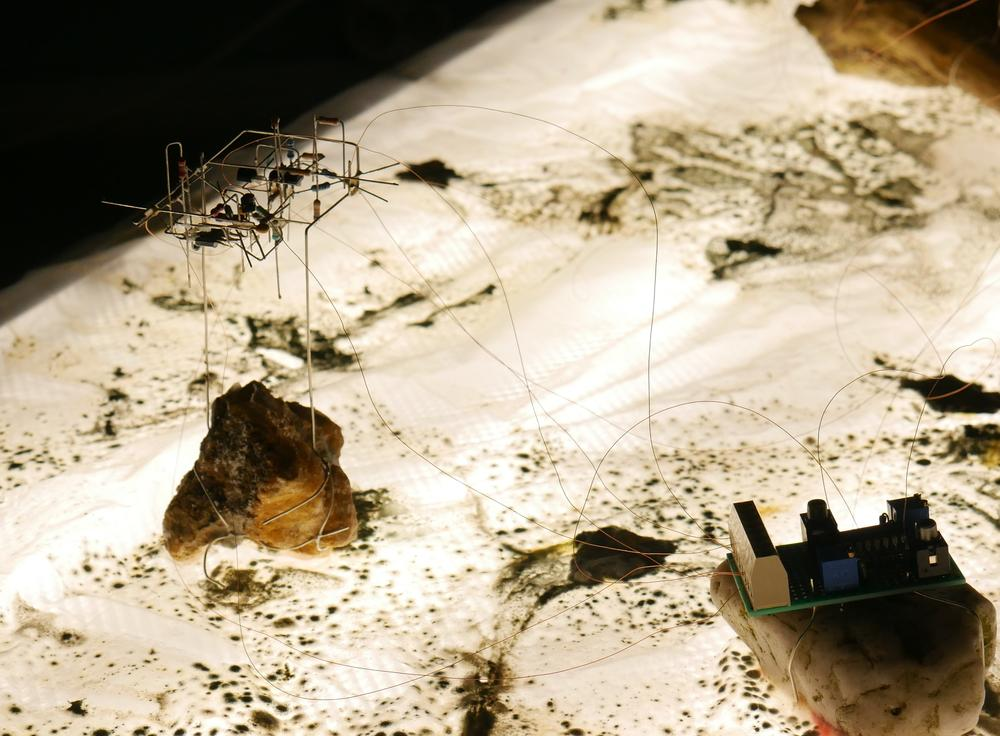
His recent experiments with ‘torch-bending’, developed through exchanges with researchers at IRCAM and his long-term collaborator Pierce Warnecke, push this approach inside AI itself. Inspired by circuit-bending, the process intervenes in model weights rather than treating artificial intelligence as a finished tool. Creative misuse of technology has always been something that I’ve found fruitful, Biederman explains. Turn a knob farther than it should go, and see what happens.
Getting inside these systems removes some of their mythology. Once AI models can be manipulated and disrupted, he argues, they stop appearing as magical black boxes containing some form of ‘super intelligence’ and become readable as layered statistical systems.
This process is also inherently collaborative. The torch-bending experiments emerged through Warnecke’s work with IRCAM, exchanges with researcher Axel Chemla-Romeu-Santos and published research that could be accessed, shared and transformed. For Biederman, technological and artistic development cannot be separated from this circulation of knowledge: Nothing is made in a vacuum. Rather than protecting individual territories, he sees cross-pollination as fundamental to richer creative and research environments.
That question of sharing becomes more politically charged when considering contemporary AI. Who owns these tools, who benefits from them, and who has a stake in the knowledge used to construct them? Biederman is increasingly interested in the possibility of computation as a commons. Today’s models, he argues, have been built from a collective intelligence accumulated over millennia, yet that knowledge is increasingly mediated and sold back, through privately owned computational systems.
What comes next in a world where the knowledge of mankind is sold back to us? he asks.
It is a question that shifts the discussion beyond what AI can generate towards the infrastructures through which knowledge itself is becoming organised. And there remains, for Biederman, an important distinction between statistical generation and imagining what does not yet exist: The one thing AI can’t do is have an imagination.
That possibility of imagining otherwise will inform his next collaboration with Warnecke: a series of interactive works exploring possible technological futures, developed during an upcoming residency at Interstices in Caen and due to begin appearing publicly in 2027. Their experiments will extend ‘bent’ AI across VAEs, GANs and, more recently, LLMs. In Situational Compliance, however, the proposition remains disarmingly immediate. A machine watches. It evaluates. It tells us what to do. The question is how long we continue playing.
Situational Compliance is on view during SEMIBREVE Festival from 22 to 25 October in Braga, Portugal.