Text by Meritxell Rosell

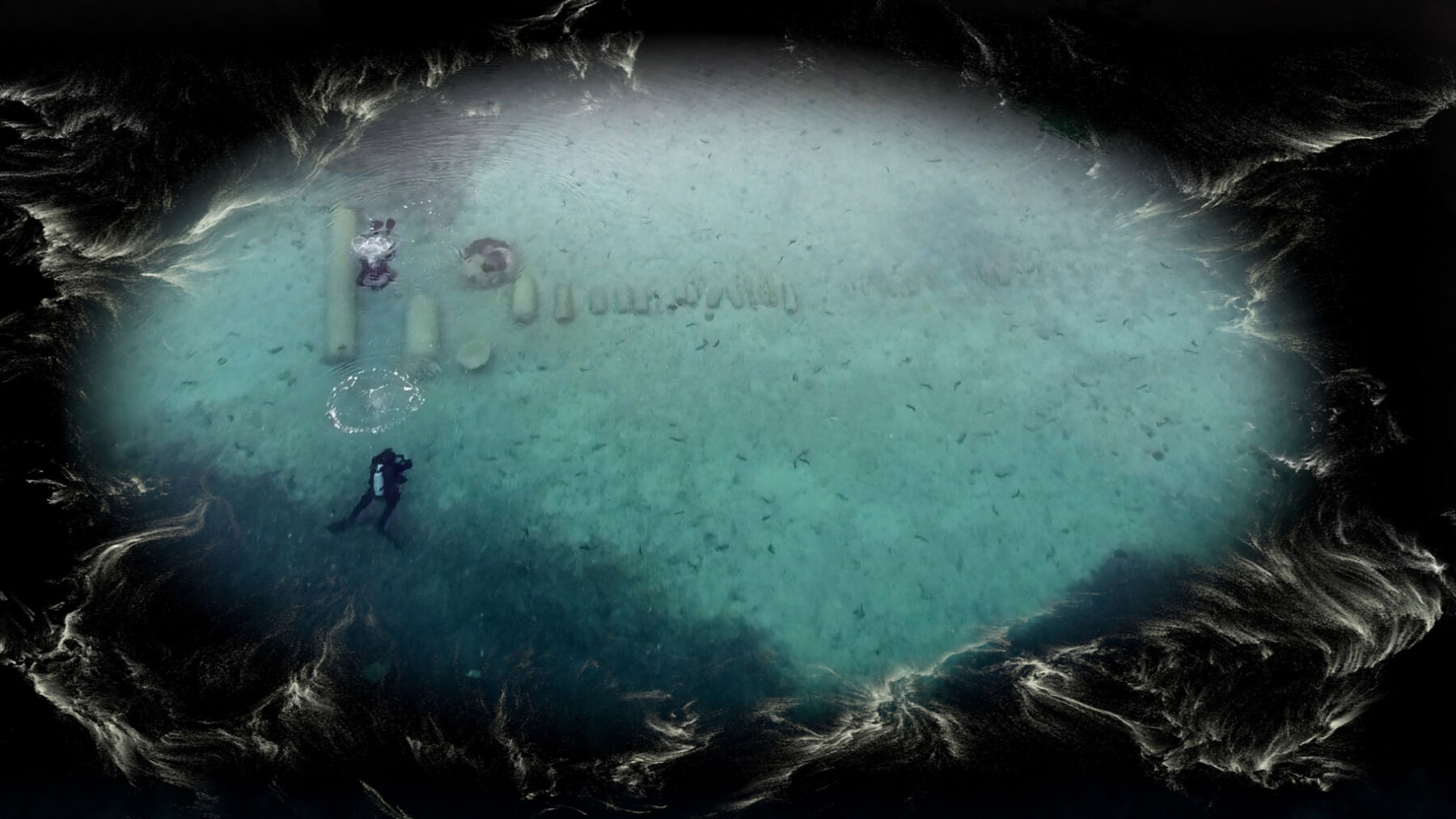
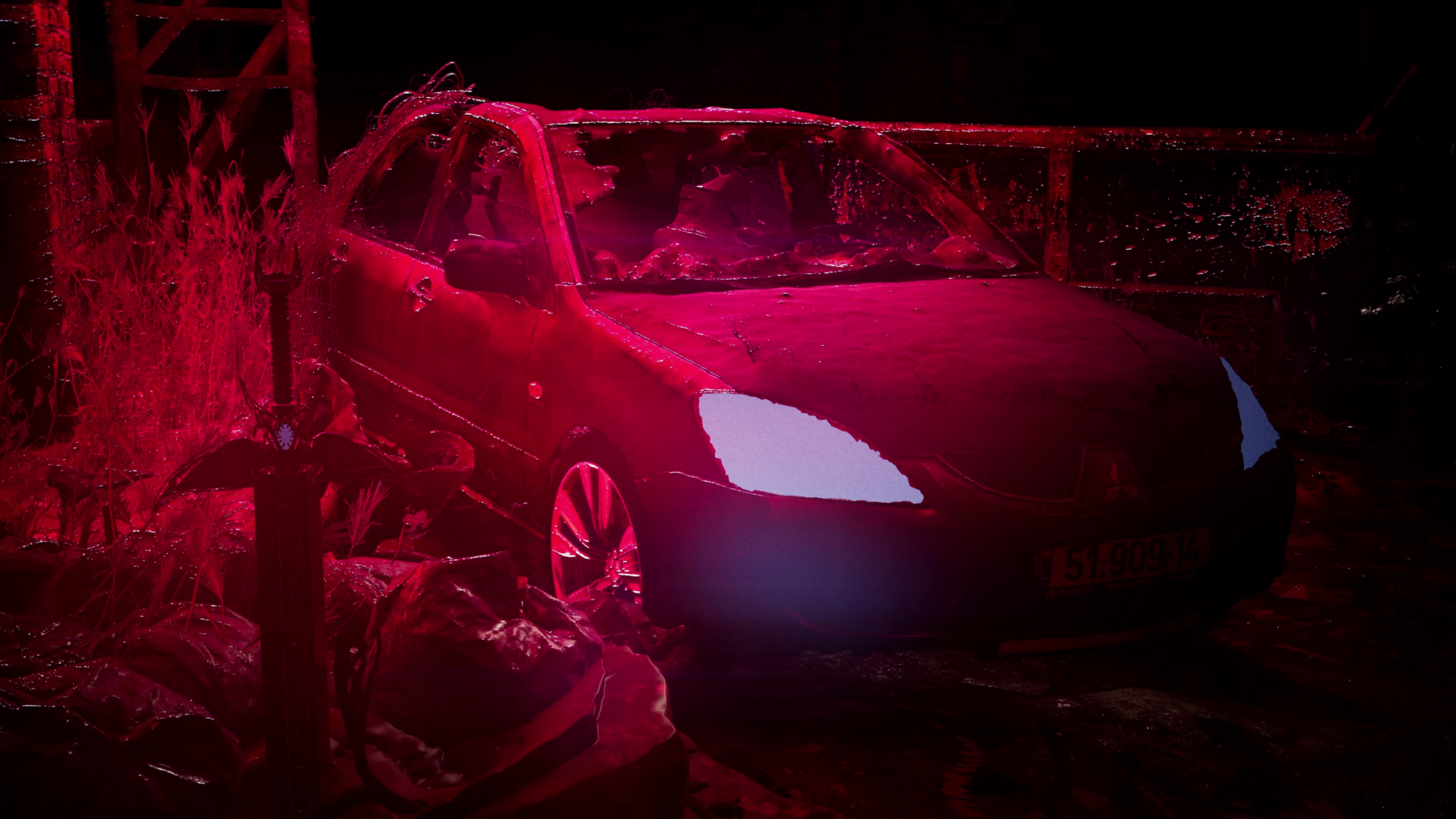
A camera moves through a dark, derelict space, sterile, untouched by any type of existence, gleaming pink, as everything is bathed in neon light. It zooms in on an abandoned, battered car, its windows shattered, weeds creeping inside. The car’s front lights are on, beaming like a pair of insect eyes, a remnant of an ancient existence. Metal and glass glimmer beneath the artificial light; everything appears polished, accelerated, strangely frictionless, despite the lack of motion. A strange white light seems to travel through the weeds and the metal structure of the car, the stone walls too; everything feels connected through an eerie pulsating energy, almost a heartbeat.
This is Mitsubishi, the latest audiovisual work by London-based artist, DJ and educator Chris Speed Visuals (CSV). A dark, crunchy neo-grime production that has already travelled through sound systems around the world. The track moves through grime and glitch with an abrasive energy. The video borrows the satirical language of car commercials but turns it inside out, using it to explore our unconscious death drives and the degradation of urban environments. Inspired by the writing of J. G. Ballard, Mitsubishi inhabits the uneasy space between the seduction of power, desire, and destruction and a meditation on consumption, urban degradation, and the unconscious drives beneath our fascination with machines, speed, and violence. As a form of guerrilla marketing to build up hype for the release, the video was shown on Tokyo’s Shibuya Crossing billboards as part of NEO SHIBUYA TV
The choice of Mitsubishi as a title feels particularly fitting. Beyond the automotive corporation, the name carries another cultural residue, recalling the Mitsubishi-branded ecstasy pills that became part of rave culture’s mythology. This collision between rave culture, digital imagery and Ballardian dystopia sits naturally within CSV’s wider practice. Working across music, CGI, motion capture, VR and immersive installation, he explores real-time technologies by pushing them to their limits—and occasionally beyond.
With Mitsubishi, CSV turns the fantasy of the car commercial into something darker, revealing the uneasy relationship between desire for consumption, acceleration, and the destruction that lies beneath some of our urban landscapes.
Mitsubishi borrows the visual language of the car commercial only to subvert it, turning aspiration into something more uncanny. What drew you to that particular aesthetic as a vehicle for exploring our collective fascination with speed, consumption and destruction?
As a child, one of my early hyperfixations was automobiles and the whole culture surrounding them. I remember collecting toys and curating an encyclopaedic knowledge (which I have since forgotten). In my teenage years, I started to fear cars after a recurring nightmare of being in a crash, and as an artist I tend to listen to my subconscious.
It wasn’t until earlier this year that I finally conquered my fear of driving, so I thought this was the perfect time to put this song out into the world. In terms of the car commercial aesthetic, I basically always found them hilarious in the way they are super overdramatised and alienated from being a commodity. Can advertisements be art? is a larger question, but with this music video I just wanted to play with the semiotics of consumerism.
J. G. Ballard’s writing often reveals the psychological landscapes hidden beneath modern architecture and technology. Which aspects of his work resonated most as you developed Mitsubishi, and how did they find their way into both the music and visuals?
A big part of overcoming my fear of driving was reading J. G. Ballard’s novel Crash as well as watching the David Cronenberg movie adaptation. A lot of my earlier audiovisual work dealt with body horror and how technology can accelerate these notions, so tracing Cronenberg’s influences inevitably lead me to Ballard.
For whatever reason, his earlier climate apocalypse trilogy didn’t capture my full attention, but it was reading the trio of Crash, Concrete Island and Atrocity Exhibition when I realised he was a prophet of our times. Fellow seer Jean Baudrillard once called Crash ‘the first great novel of the universe of simulation’ in how it turned away from science fiction, which looked to the stars, and instead interrogated how the future will affect our minds.
Decaying urban environments go beyond being a result of socio-economic factors and can be seen as an extension of the 21st-century mindset that Ballard tapped into. It’s clear to see the Freudian influences within these texts as psychoanalysis draws many connections between the death drive and libidinal desire. With my tune, I wanted to simulate the feeling of crashing into a wall of bass frequencies and tap into the primaeval desire for jouissance.
Your practice moves fluidly between music, CGI, live audiovisual performance and immersive environments. Do you see these as separate mediums, or are they all manifestations of a single artistic language?
The contemporary artist must wear many hats, and I have recently started to see these mediums as containers for larger worlds I am constructing. Whether this chooses to manifest itself as an album, film, game, sculpture or live performance, fundamentally it’s all coming from the same primordial soup. Even though the worlds may be separate, it somehow all connects as if seeing the same ideas explored through quantum multiverses.
A decade of working within the field of new media art has naturally resulted in repeating themes and topics within my work, but only now am I starting to become more aware of them. For instance, the live motion capture set I’m currently touring builds upon previous investigations into digital avatars and the phenomenological body but now wears the skin of RPG character customisation screens. I am constantly adapting the tools and knowledge I cultivated from previous projects onto new ones which eventually start to form its own artistic language I suppose.
Sonically, Mitsubishi feels rooted in grime while simultaneously stretching beyond its conventions. How do you approach genre today—as a framework, a material to manipulate, or something to actively dissolve?
Grime as a genre originates from the same brutalist council estates Ballard wrote about but channels class consciousness into something productive and, dare I say, empowering. Growing up near East London, the aggressive sound of it became absorbed into my subconscious as I was constantly hearing tunes blasted from the back of the school bus on Nokia mobile phones.
It’s all too easy to make beats that recreate an old sound, but as a producer I’m always trying to experiment and hopefully stumble on something innovative. As with my literary influences, I wear them on my sleeve sonically, as my sound consistently pays homage to the wave music community. Evolving beyond the witch house and cloud rap textures, a newer incarnation of this continuum entitled neo grime was a big influence on Mitsubishi. I wanted to bridge the gap between the nostalgic bass music of my youth and something more forward-thinking. Similarly to my visual work, I’m slowly trying to achieve a signature sound which is recognisable no matter which drum pattern is used.
In Mitsubishi, the symbolism of the automobile intersects with one of rave culture’s most enduring icons: the Mitsubishi ecstasy pill. It feels like a collision between acceleration, pleasure, capitalism and self-destruction, a set of themes that also echo Ballard’s fiction. Was this overlap central to the work from the outset, or did it emerge during the process?
It’s great that you picked up on that! My track titles always come later in the process, but I did consider those parallels between car manufacturing and the mass production of ecstasy pills. Originally the music video was going to be more overt by flashing the MDMA chemical compound onscreen (but I decided against this). It’s interesting how drug subcultures end up reterritorializing the same branding used by huge conglomerates to also sell escapism in a Brave New World soma kind of way. Again, it all ties into psychoanalysis and the Dionysian drive for excess under capitalism.
The video is currently being shown on the billboards of Tokyo’s Shibuya Crossing, a space traditionally associated with advertising and spectacle. How does it feel to insert a work that critiques those very visual economies into one of their most iconic sites?
That’s all thanks to NEO SHIBUYA TV for allowing me the opportunity to present my art to the citizens of Tokyo. I wanted to work with them because we both share a DIY hacker ethos and love of underground street culture, so it just made sense that the Mitsubishi music video should be presented near its headquarters in Japan. As I mentioned previously, it was more of a playful critique than anything, but it was definitely a highlight of my career seeing my work recontextualised within such a futuristic city.
Across your work, there is an ongoing dialogue between real-time technologies and human perception, often pushing digital systems beyond their intended function. What questions are you currently asking of technology, and where do you think that conversation is leading your practice next?
Somehow I have purposely been avoiding AI even though that appears to be the existential topic of today. My last few projects have been more interested in nostalgia, psychogeography and English heritage. This includes my video essay Continuum FM, which investigates urban spaces haunted by the death of rave, or my ongoing worldbuilding project Magical Materialism, which uses medieval history to comment on the rampant worker exploitation we still see today.
Like a lot of people online right now, I have also become fascinated by liminal spaces and what their popularity can reveal to us about the current moment. I think the next large artistic project I undertake will continue this trend: technology’s effect on the subconscious and the urge to escape into simulated worlds.