Text by Leoni Fischer
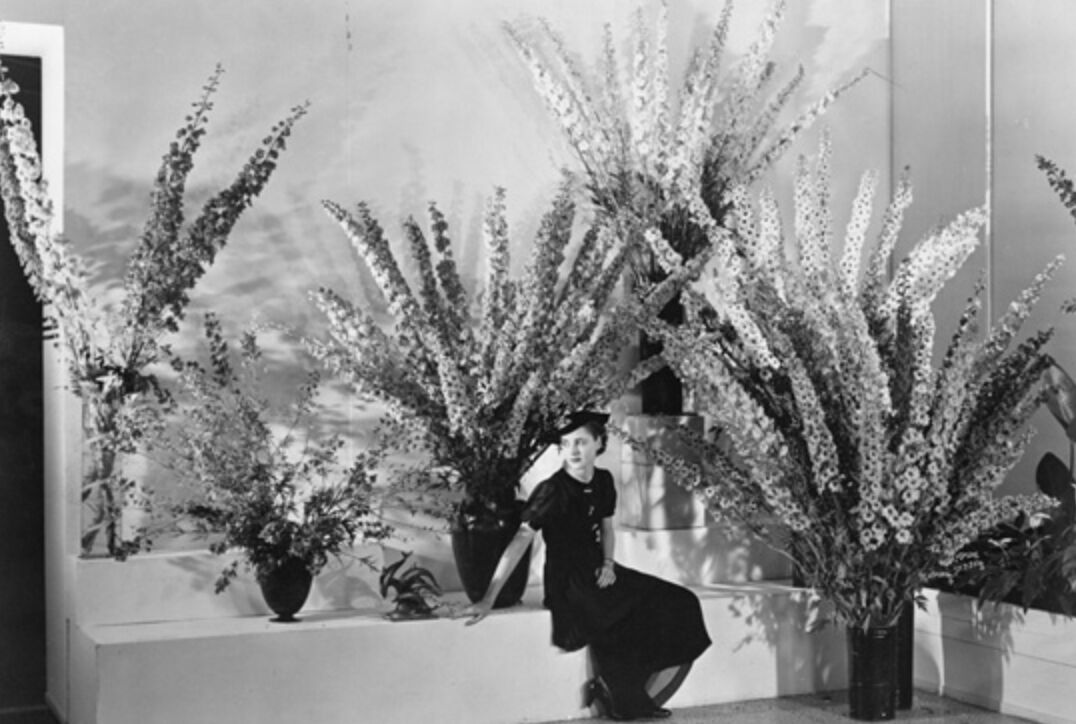
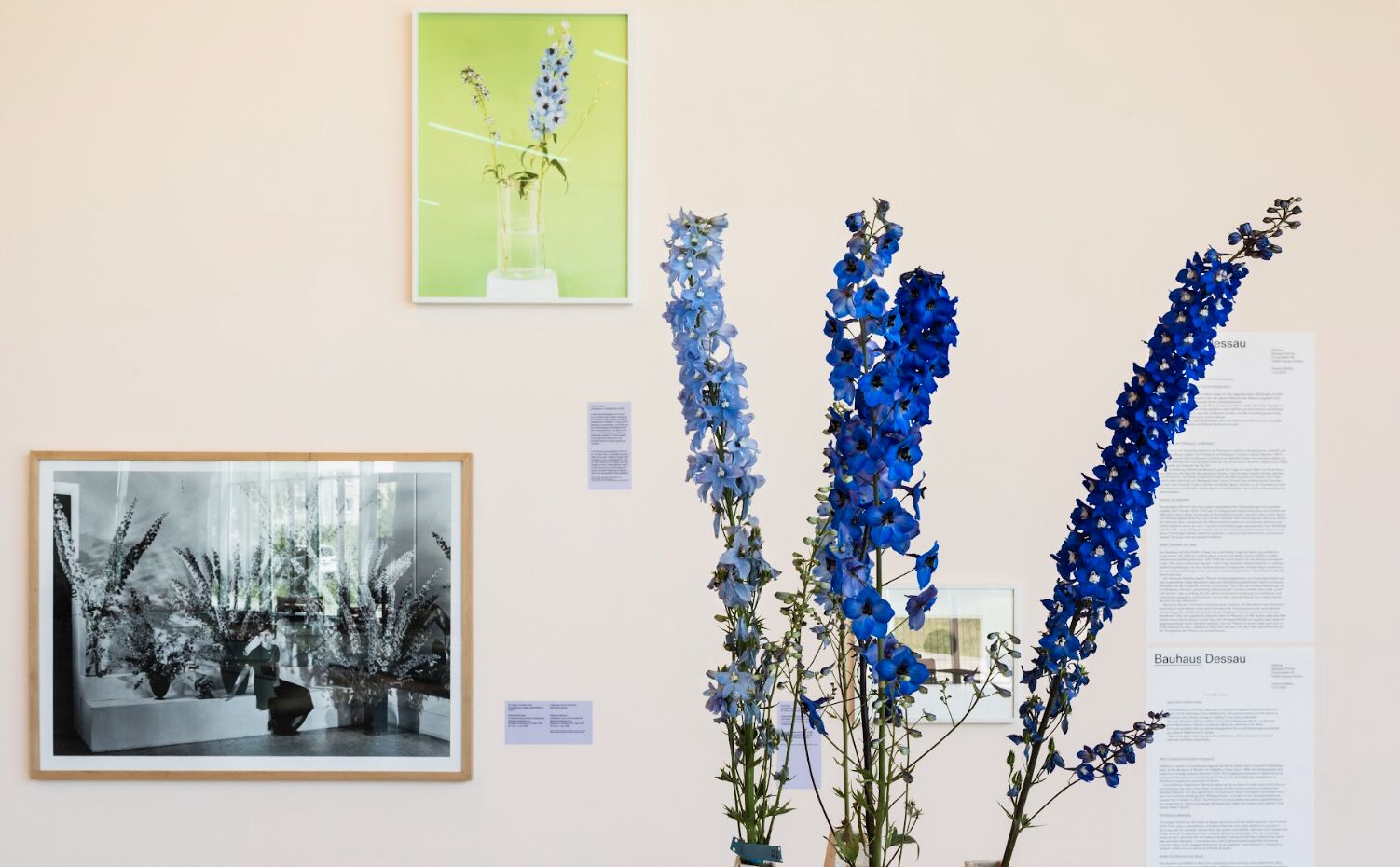
A lady dressed in elegant black poses on a white pedestal amid a fantastical nature. Tall flower spikes rise from large vases, each spike densely packed with thick pale blossoms, whose throats enclose a dark eye. In contrast to this floral explosion unfolding around her, the young woman appears all the more delicate. My gaze follows her sideways glance towards a group of small bronze dolphins that seem to dart playfully between two vases. Like a magic key in a fairy tale, these happy sea mammals point to the Latin name of the perennials whose exuberant splendour is here on display: Delphinium.
This scene is captured in a black and white photograph of Steichen Delphiniums, an exhibition by the photographer and curator Edward Steichen, an extraordinary one-week flower show, that took place at New York’s Museum of Modern Art in 1936. It marks the first time in the history of the then still young institution, where plants were exhibited as art and can today be counted as a forerunner of Bio Art.
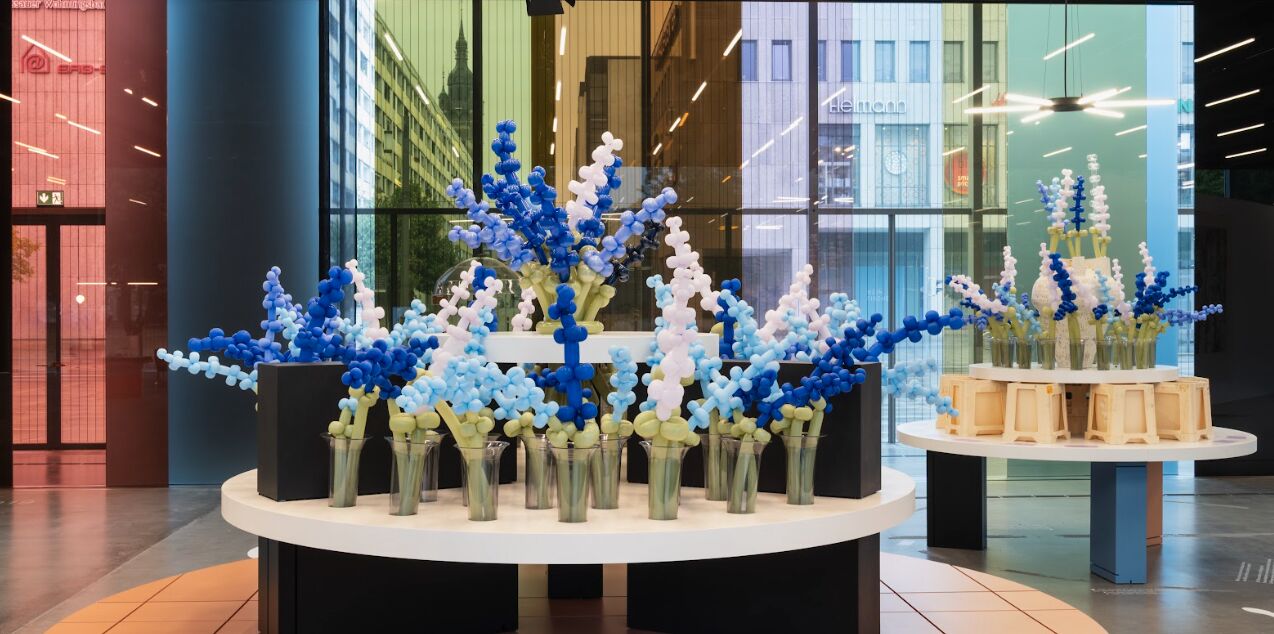
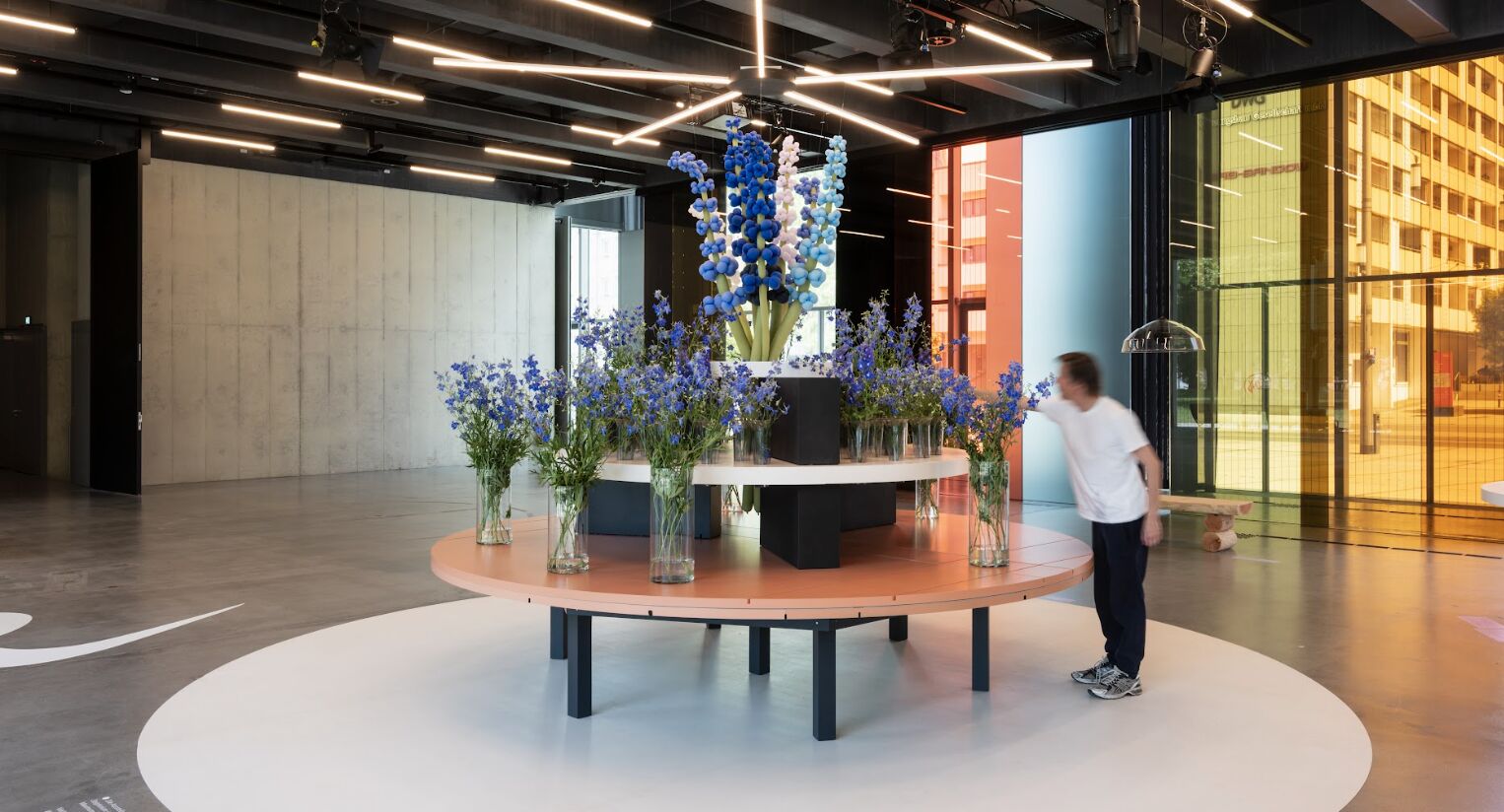
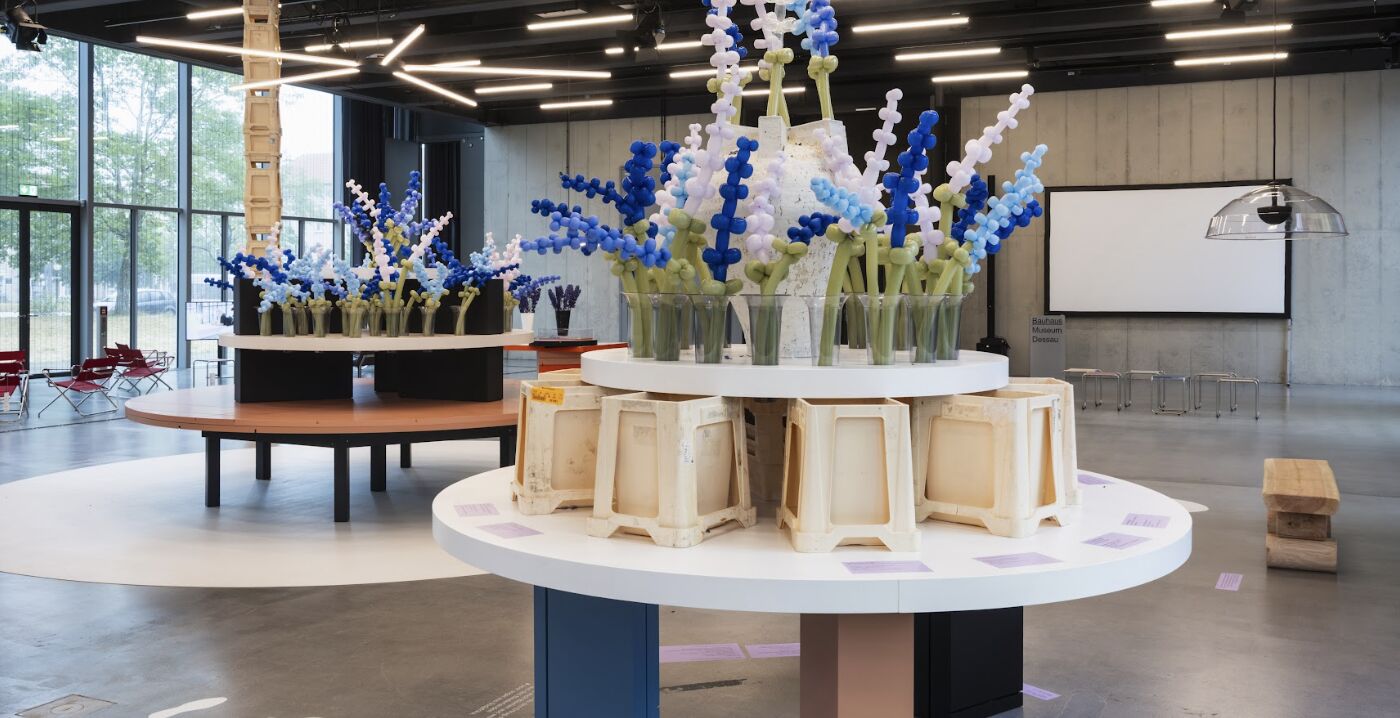
Eighty-nine years later, I am sitting on a wooden blockhouse bench inside the large entrance hall of the Bauhaus Museum Dessau. Since the delphinium’s spring bloom in May, this space called “Raumbühne” (Spatial Stage) has become the stage for a long-term experiment by the museums Curatorial Workshop: The exhibition Delphinium Maximum* (opened on May 18th 2025) set out to bring the Delphinium back into the museum and to once more strike its visitors with the outstanding beauty of its blossoms, that radiate vibrant shades of blue.
From my scenic viewpoint, I let my eyes wander through the exhibition space. But instead of being struck by the sheer size and volume of a display made up of hundreds of delphiniums, I see: A modest amount of flowers, half-dried with drooping heads, fallen petals and stems protruding from yellowish water. In one of the vases, I spot a fat black fly drifting atop. Compared to the stately display of Steichens Delphiniums, the flowers in Delphinium Maximum ironically present themselves in a far more minimal arrangement.
When it comes to exhibitions and their historical reception, it’s always a matter of what gets shown and what, in turn, remains hidden from the viewer’s eye. During its eight-day run, Steichen Delphiniums went through several rounds of refreshment, meaning that tired flowers were replaced with fresh ones. It comes as no surprise that there is neither documentation of the in-between states of decay, nor of the labour required to maintain such a constant level of healthiness in the show: exchanging water, throwing away wilted flowers, collecting dropped petals off the floor, cutting the stems and leaves of the new batch.
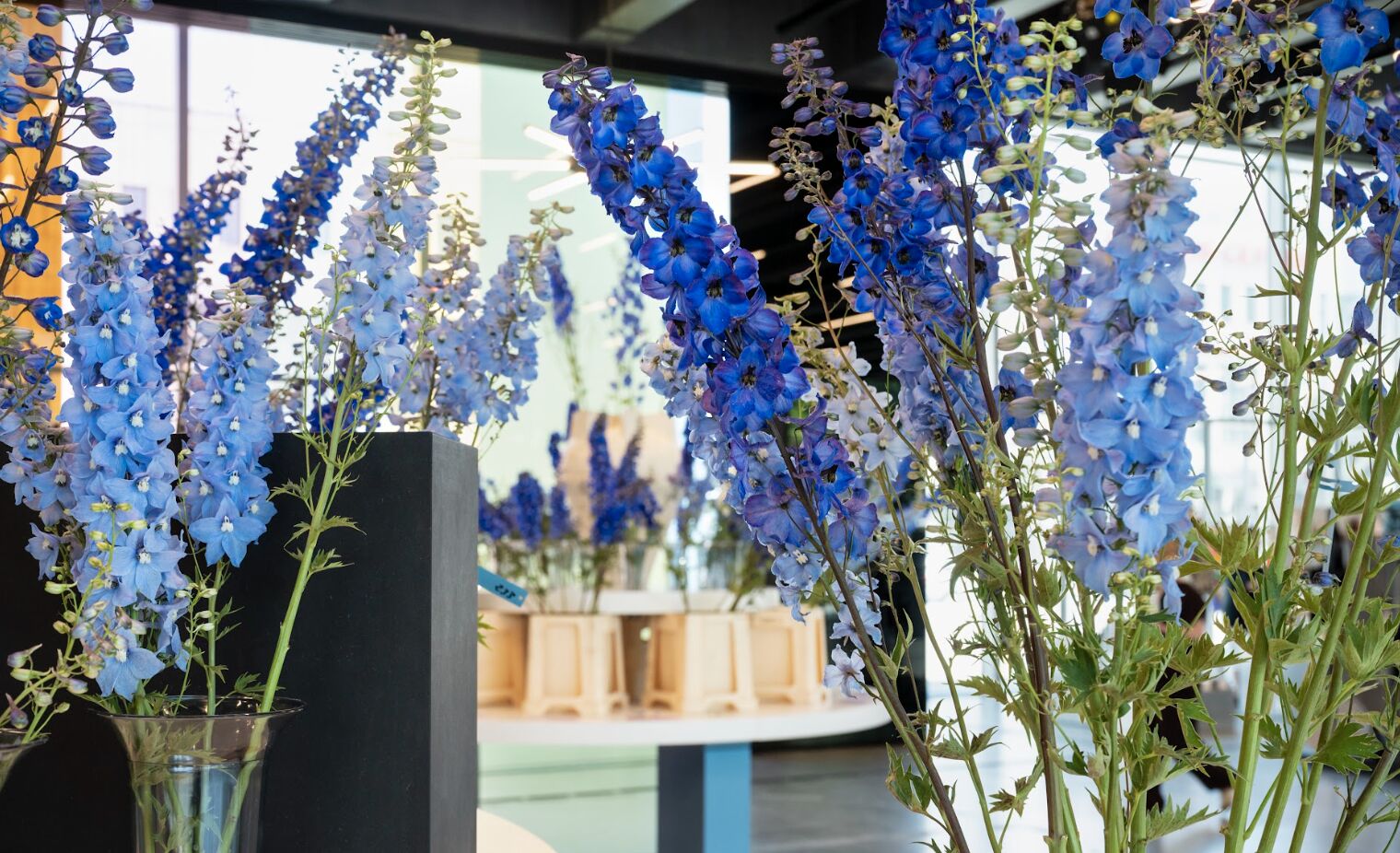
I could dismiss the flower-panorama presented at the Bauhaus Museum as a less-than-ideal version of what might have been – or I could see it as an invitation to witness the slow process of decay that is the obvious fate of a cut flower and, more broadly, the shared condition of every organic being on earth. Still, as a curator reflecting on my own exhibition, I cannot do without some self-critical introspection. If we set out to re-create the floral splendour of Steichens Delphiniums, then what went wrong? And if that was never truly the goal, what can be learnt from doing things differently?
Perhaps a small story of failures might be just the right form to reflect on an exhibition centred around such an inherently fleeting subject. Failure, after all, can be defined as the disappointment of expectations, the inability to fulfil a task, or a series of minor shortcomings that lead to collapse. Yet, despite its negative connotations, failure can also be understood as something true to the process, that eludes forcing and instead makes space for surprises.
Even though no project can ever be perfect, what I am suggesting here is that an exhibition dealing with live substances like plants and flowers has a more intricate relationship to failure —one that reveals a great deal about humans, museums, the objects they safeguard, and the belief systems associated with them. How can one make a two-year plan with something that grows uncontrollably, or not at all, gets eaten by slugs or killed by one of the various pests circulating in a modern flower nursery? Something that might bloom too early or too late, and retains its beauty too briefly, once cut from its root? By taking these questions into account, Delphinium Maximum becomes not only a contemporary re-enactment of Steichen’s Delphiniums but a critical examination of the idea (how) to show flowers in a museum as art. The exhibition thus challenges the temporal and structural relationships of nature and the museum’s institutional logic.
Off to a Promising Start
In early April of 2023, the Bauhaus Dessau Foundation purchased 202 delphinium seedlings from the gardener Wolfgang Kautz in Potsdam, a student of the influential delphinium breeder Karl Foerster. They carry names such as Finsterahorn, Morgentau, Nachtwandler, Völkerfrieden, or Augenweide, and are planted at the Weinreich nursery in Wolmirstedt, less than two hours’ drive from the museum. It’s the beginning of Delphinium Maximum. Delphiniums bloom twice a year, and after two cycles, the flowers will be shown at the Bauhaus Museum in 2025. At the nursery in Wolmirstedt ,the plants are cared for by Nina Busse and Jan Weinreich, whose uncle Alfred Weinreich once bred his own delphinium variety “Piccolo”.
In May, we visit our flower patch at the nursery. No bloom yet. In June, we were able to get hold of the first delicate blue flower. Following an old archival reflex, we press it in between sheets of newspaper and thick books. The second bloom in August is already more successful. In spring 2024, the field is packed with large delphinium spikes in various shades of blue.
The experiment seems to be working! We pick a few and dry them in a material from the conservationist’s tool box: Silica gel absorbs water and is usually placed in museum vitrines to control the level of humidity and protect the artwork.
The results are life-like. Under the glass hood we exhibit them in, they look noble like Snow White in their coffin.
One singular flower being the late summer bloom of 2024, crushes our hopes. Most of our initial plants have not survived the summer. Waves of record-breaking temperatures put stress on the delphiniums that are, in their wild form, at home at alpine heights and mild climates. Already weakened, they become an easy prey. Did you know that a sick plant smells better to slugs than a healthy one?
Failure to Launch
As the exhibition opening approaches in spring 2025, we are in regular exchange with the gardeners. After saving everything they could, they filled the gaps with new seedlings. Other varieties are introduced into our living collection, since many from our “original” batch had been old varieties that are difficult to find and purchase. A few weeks before the opening, we face an even bigger problem: as a result of a cold spring, the flowers won’t come into bloom in time!
In the following days, we discuss various options for dealing with this worst-case scenario. While we choose to gamble, the press release of Steichens Delphiniums had been headed with “weather permitting” to avoid being restricted to a specific opening day. The administrative structures and planning processes of the museum, however, make this option seem virtually out of reach for us – impossible to be implemented on short notice. To take the bull by its conceptual horns and open the exhibition without the presence of any fresh flowers feels intriguing only in theory. Perhaps the contemporary way to solve the issue would be to buy a bunch of nameless delphiniums from the wholesale market? This idea is the antithesis of the super-localised approach we have been following thus far. But that’s precisely what we decide to do.
When Worlds Collide and Terms Collapse
This change poses not only pragmatic questions, but also reveals the terms in which we think about the plants from inside a museum.
Plan A had been to show the flowers of a precise set of plants which not only grew in synchronicity with the exhibition’s conception, but also connected to a specific, almost genealogical line of local breeders. This portrayed the breeders as individual authors building a kind of bio-artistic practice driven by aesthetic, formal or philosophical ideas. The emergency plan instead featured flowers with various provenances and led to the imagination of two groups: the fast and reliable consumer products and the original art pieces that are, for complicated reasons, not present.
Substantially different from the delphinium plants in Wolmirstedt, the flowers of the first group we show were most likely traded in the Netherlands (annual sales made by the biggest trader, FloraHolland, can total 2.5 billion euros) and grown in South Africa, Kenya, Ethiopia or South America, often under questionable conditions for the workers and the environment.
On the other hand, this altered situation makes it even more obvious that Delphinium Maximum is discussing not only Steichen’s Delphiniums as a key moment in modern exhibition history, but also a whole set of Modernist ideas which had been the engines behind experimental artistic activities at the historical Bauhaus.
In his horticultural practice, Steichen, like many avantgardists of his time, shared a Modernist belief in technological progress and its potential to infinitely expand the human domain in the service of a better society. “Higher! Lighter! More efficient!” are keywords of an industrial modernism, which also resonated with the sensible yet occasionally megalomaniac breeding goals pursued by Steichen and his colleagues. At the historic Bauhaus and beyond, such ambitions went hand in hand with a new understanding of living matter, driven by technological innovations, but far from being disenchanted in the process.
For Steichen, a flower was not merely a botanical object shaped according to his will, but an expressive being of its own. His statement: A Delphinium is not alive unless it laughs at you aloud when you look at it or presents so sinister an appearance that it gives you goose flesh, suggests a modern idea of nature imbued with agency and affect. A similar fascination with plants can be found in the works of Bauhaus students like Fritz Kuhr, or Reinhold Rossig, and masters, most notably plant-lover Paul Klee. Delphinium Maximum exhibits reproductions of his paintings A flower Performs (Eine Blume tritt auf) from 1934 and Dying Plants (Sterbende Pflanzen) from 1922.
Steichen’s desire to democratise art within the framework of industrial mass culture seems equally modernist. Just as he had argued for photography to be accepted as a legitimate art form, he sought to elevate flower breeding to the same status. While he had referred to the flowers in his 1936 exhibition as “works in progress,” his delphinium variety Connecticut Yankee was commercially released in 1965 for just 95 cents a packet. Now, anyone could grow a piece of Steichen’s art on their own balcony. Perhaps Steichen imagined the museum as the ideal space to cement this reclassification of the flower as art. Meanwhile, the exhibition also celebrated Steichen’s new appointment as president of the American Delphinium Society, revealing institutional ambition as well as the intention to build an artistic as well as botanical legacy.
Growing together
Today, artistic genres such as Bio Art have become established, and through ongoing discourses around sustainability and ecology, ephemeral materials in exhibitions are no longer unheard of. Nevertheless, the museum retains conventions that often clash with the nature of such living exhibits. Potential health risks for visitors, unpleasant smells from decaying or fermenting substances, the regulated climate control of gallery spaces, and an unfamiliarity with caring for these special exhibits continue to make it difficult to present plants within institutional frameworks as art.
Archival documents compiled by artist Inge Meijer for her publications The Plant Collection and The MoMA Plant Collection reveal that, historically, museums have employed individuals whose sole responsibility was to care for in-house potted plants. Today, few museums include plants in their inventories, yet signs continue to emerge that the relationship between institutions and their natural surroundings is evolving. At the Fondation Beyeler in Basel, for example, a recent job posting sought a curator with botanical expertise to oversee the museum’s garden, and in Dessau, the once uniformly manicured lawns in front of the Bauhaus building have been transformed into insect-friendly wildflower meadows.
During the five months of Delphinium Maximum, we developed a watering schedule that distributed the labour of care across multiple shoulders; an opportunity for collaborative work beyond individual disciplines. At the same time, these long watering sessions within the exhibition space became moments of spontaneous connection, sparking conversations with visitors about their own gardens, their relationship to nature, and the ideas explored in the show. Thus, in attempting to bring the fleeting beauty of the delphinium into the museum, Delphinium Maximum reveals more than just the fragility of flowers.
It exposes the delicate balance between control and care, as well as the colliding dualisms of inside and outside, nature and culture, and human and non-human. Rather than recreating a historic exhibition, the exhibition becomes a living inquiry into failure, adaptation, and collaboration. In doing so, it suggests that the true undertaking of such a project lies not in permanence or perfection, but in the shared experience of tending, witnessing, and letting go.
Delphinium Maximum runs until 8 September 2025.