Text by Guillermo Justicia
Some days after the lights went down in Matadero Madrid’s naves, the eighth edition of L.E.V. Matadero still lingers as a question: in a landscape increasingly populated by synthetic voices, what forms of relation remain available to us? Curated once again by L.E.V. in partnership with Centro Danza Matadero, Cineteca Madrid and Central de Diseño, this year’s programme was built around memory, perception and the increasingly blurred border between the human and the artificial. Live music, performance, immersive installation and extended reality all pointed, from different angles, at the same ache: a hunger for connection in an era that keeps finding new ways to keep us apart.
Archives, Memory and Reconstruction
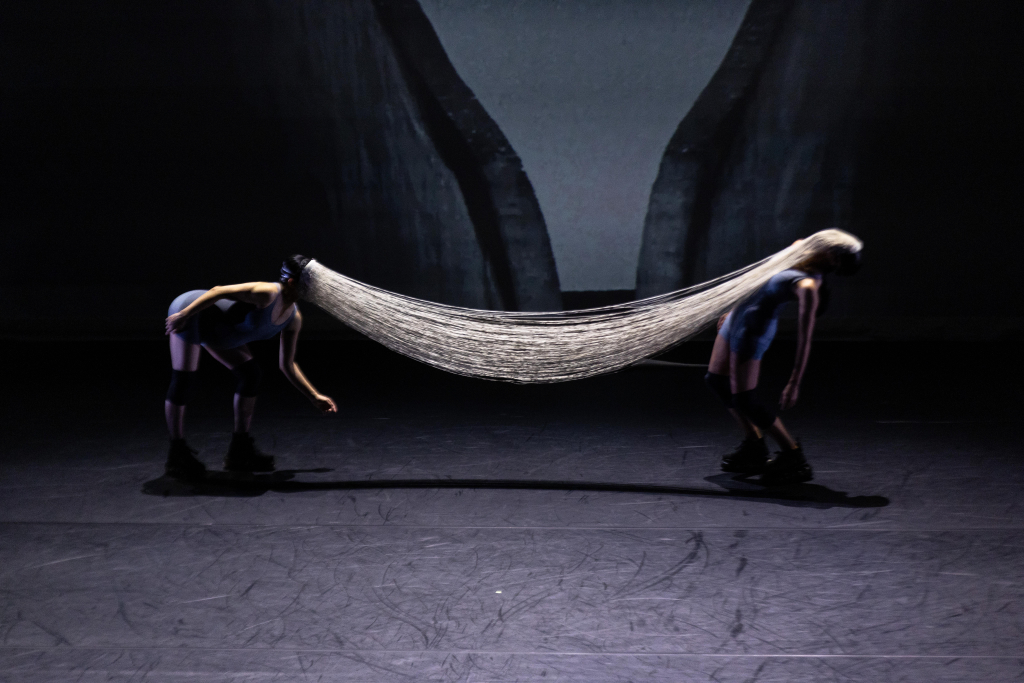
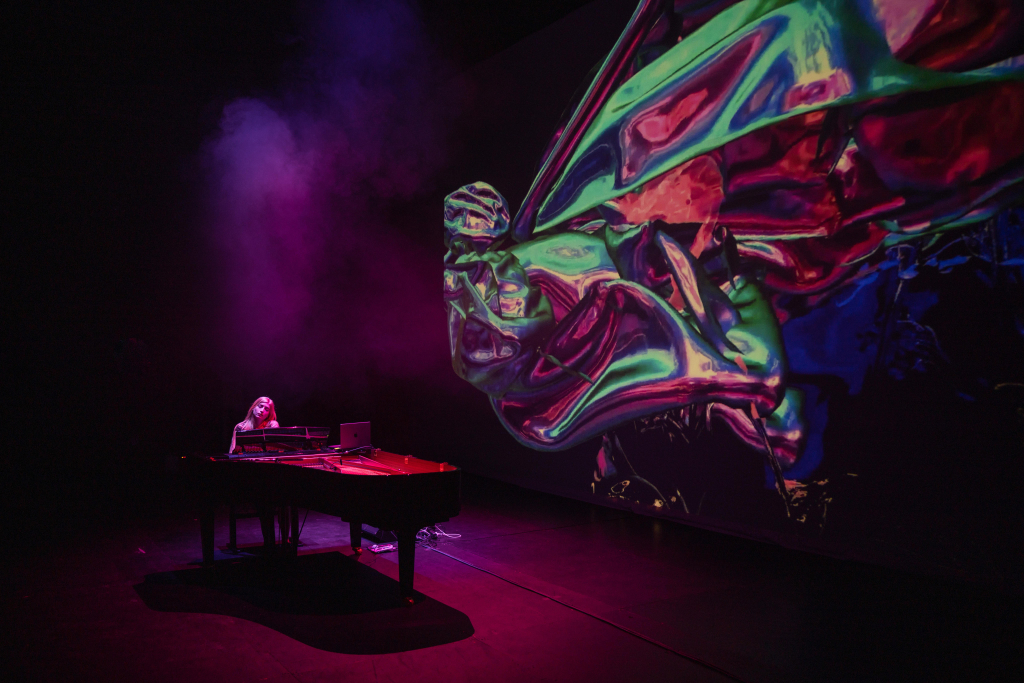
The festival opened on September 17 with Neon Dance’s Last and First Men, a stage adaptation built around Jóhann Jóhannsson’s score, co-composed with Yair Elazar Glotman, and narrated by Tilda Swinton. Hearing Jóhannsson’s music live again was reason enough to sit in Nave 11 and let it wash over the room.
The choreography treated the body as a fluid medium: liquid, hypnotic phrases that dissolved and reformed, less a narrative danced out than a nervous system rendered visible. Underneath the sci-fi, climate-crisis-aware premise, the piece repeatedly returned to the fragility of human connection, treating it less as a certainty than as something contingent, negotiated and easily lost.
The question of reconstruction extended into VORTEX, the festival’s dedicated space for extended realities, where memory became something to navigate rather than simply remember. Carles Castaño’s [“Á”1653 “gora” 23035] offered something closer to a jolt than a caress. Built as an interactive mixed-reality experience, it casts the visitor as an unwitting archivist, tasked with helping a distant future civilisation reconstruct our species by declassifying present-day events.
Funny, unruly and chaotic by design, it plays like a cry for help disguised as a game, using its own interactivity -the visitor’s hand on the VR controls- to open a door onto rebellion, and serves as a reminder of how grim the logic of postcapitalism can look from just far enough away.
A Long Goodbye was perhaps the festival’s most delicate moment. A virtual reality piece centred on Ida, a 72-year-old pianist whose memories are slipping away, it reads like an honest love letter to life, framed through a distinctly European tradition of introspective, human-centred storytelling.
Watercolour illustrations set the scenes, guiding a narrative threaded through cassette recordings of Ida and her partner. It feels written as a refuge, a way to find comfort amid the disorientation of no longer recognising one’s place in the world.
Rituals and Shared Grammars
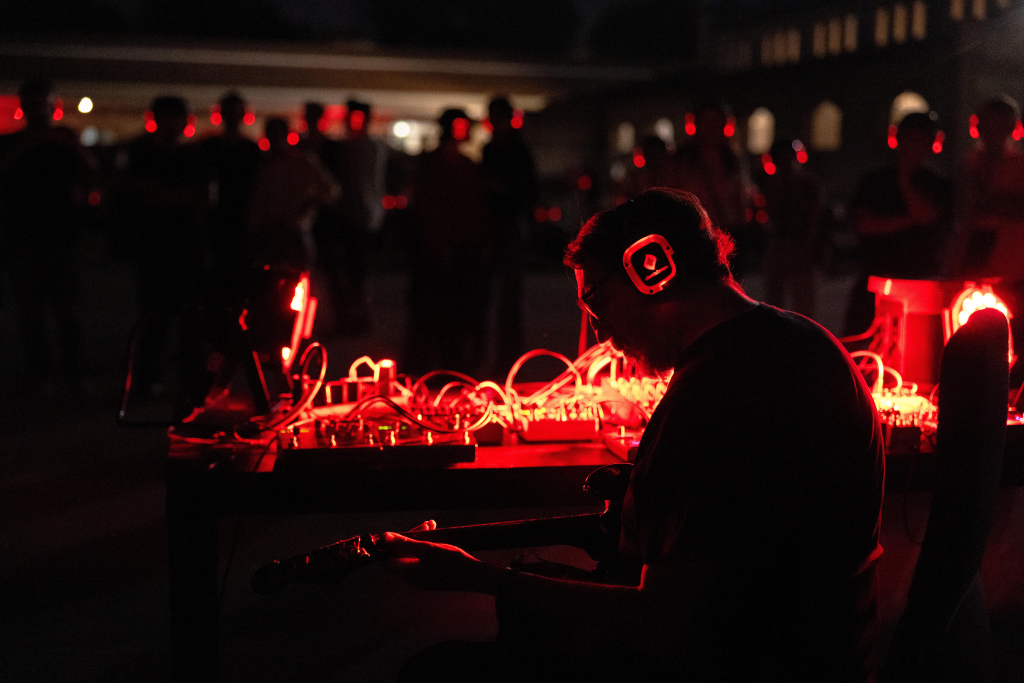
At dusk, Plaza Matadero hosted Suso Saiz as part of L.E.V.’s Silent Sound Sessions, where every attendee is handed a pair of headphones and left to drift. Saiz’s guitar textures, processed into long, patient passages, unfolded as ambient music seductive enough to close your eyes to.
The set then moved to Centro Danza Matadero, where Kyria Libia premiered El arrobamiento, a work developed during the artist’s residency at Matadero Madrid. Her organ-based sacred music turned the room inward, introducing a distinctly mystical register to a festival otherwise preoccupied with outward-facing technologies.
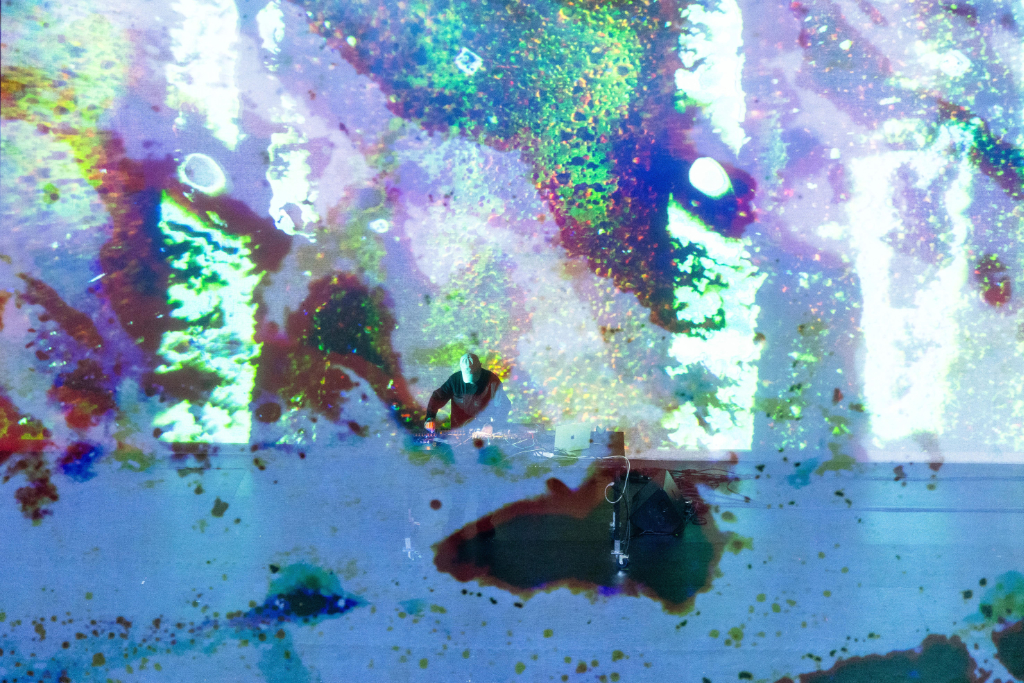
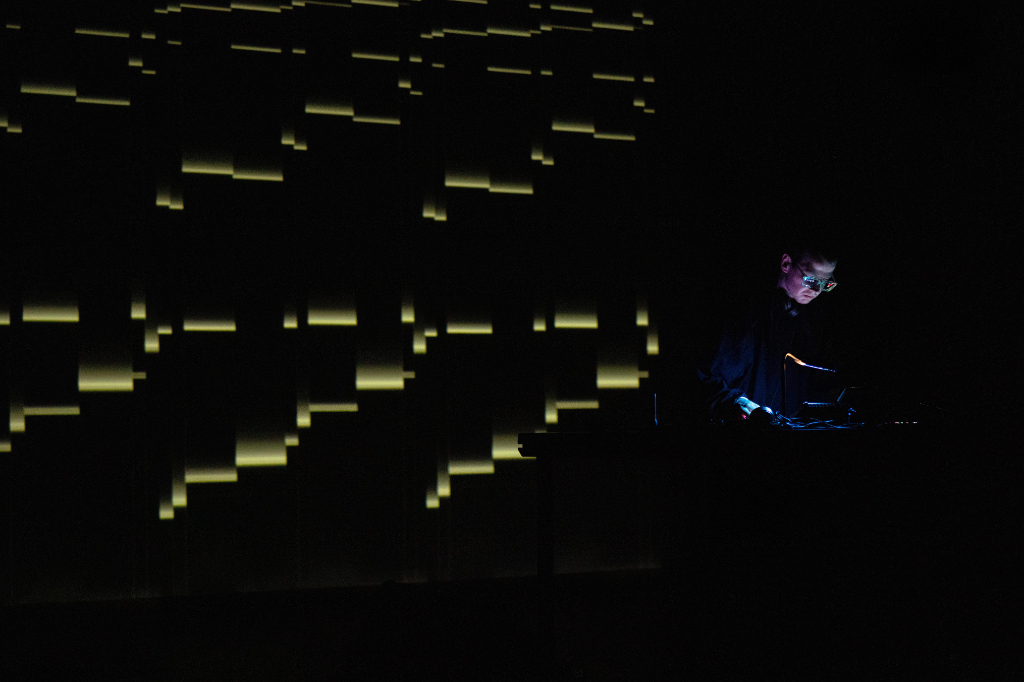
Drew McDowall, a former member of industrial band Coil, now a collaborator with the likes of Kali Malone and Caterina Barbieri, performed an A/V concert alongside filmmaker Pedro Maia that pulled the evening into an even more ritualistic register. Strings led the set through what felt like a cathartic rite.
A thrilling spectacle of soft motifs gently evolving over time, while Maia’s visuals folded McDowall between layers of projection, collapsing performer and footage into a single fabric and quietly dissolving the usual distance between stage and screen.
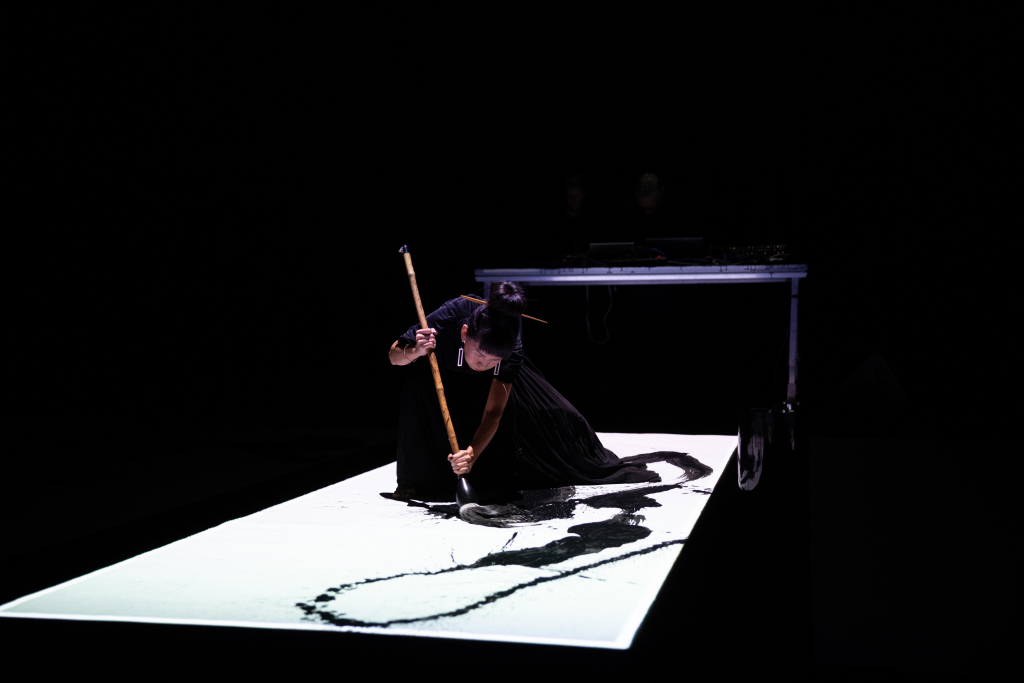
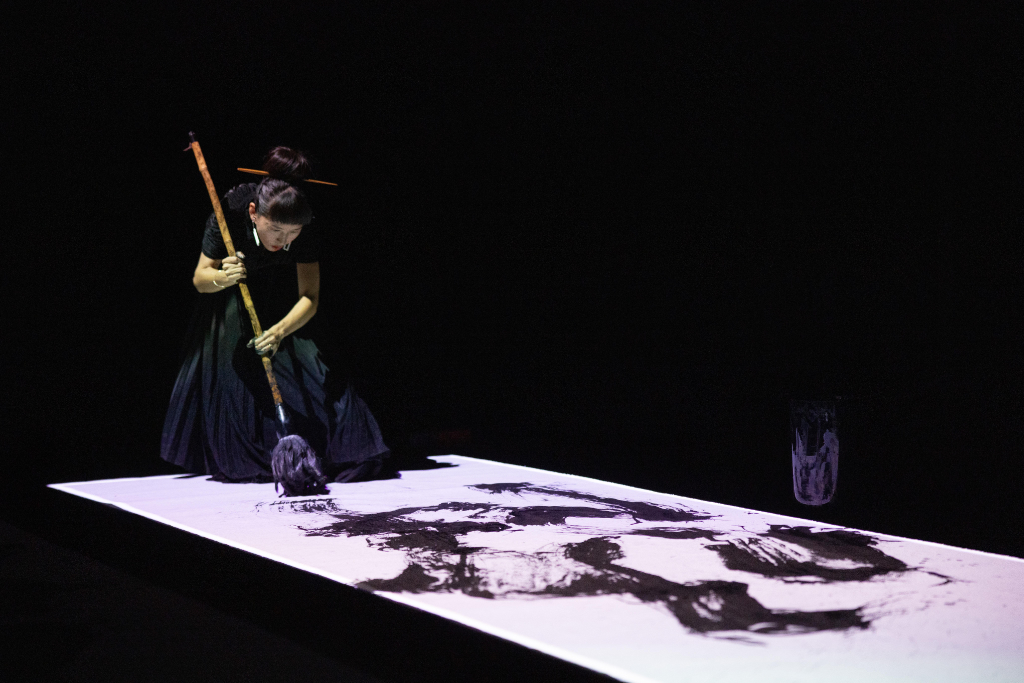
If the first two nights were about the ache for connection, the third turned toward language itself. Calligraton paired Japanese calligrapher Aoi Yamaguchi with the sound duo Schnitt in a piece that treats brushwork as percussion and percussion as brushwork. It is hard not to think of the Gutai group’s conception of painting as bodily action, here extended into audio.
Schnitt’s sound design was sharp, almost pointed, and Yamaguchi’s ink strokes seemed to trigger it rather than accompany it. Trembling snare rolls landed in time with each gesture, and the result functioned less like accompaniment than like two notational systems converging on a shared grammar in real time. By the end, five white canvases had been violently inked, the score left behind as a visible residue.
Milian Mori extended this idea with a set of electronic music that breathed and convulsed on its own terms: hard-hitting, deconstructed beats over a deep, abrasive bass. The patterns were built from a deliberately narrow palette yet still carried a complete arc from tension through release, turning repetition, texture and rupture into an internal system of their own.
Interfaces of Play
Elsewhere, interaction became a form of play. INITI Playground offered a long, pressure-responsive wall for visitors to pelt with small rubber balls, tracking each impact and turning play into pattern. A similar logic ran through Puppet, a collaboration between 1024 Architecture and French producer Vitalic staged in the workshop space: an Xbox controller wired to drive the limbs of a physical puppet, each button mapped to a distinct element of the track, resulting in a fun collaboration through rearrangement.
Intimacies with Machines
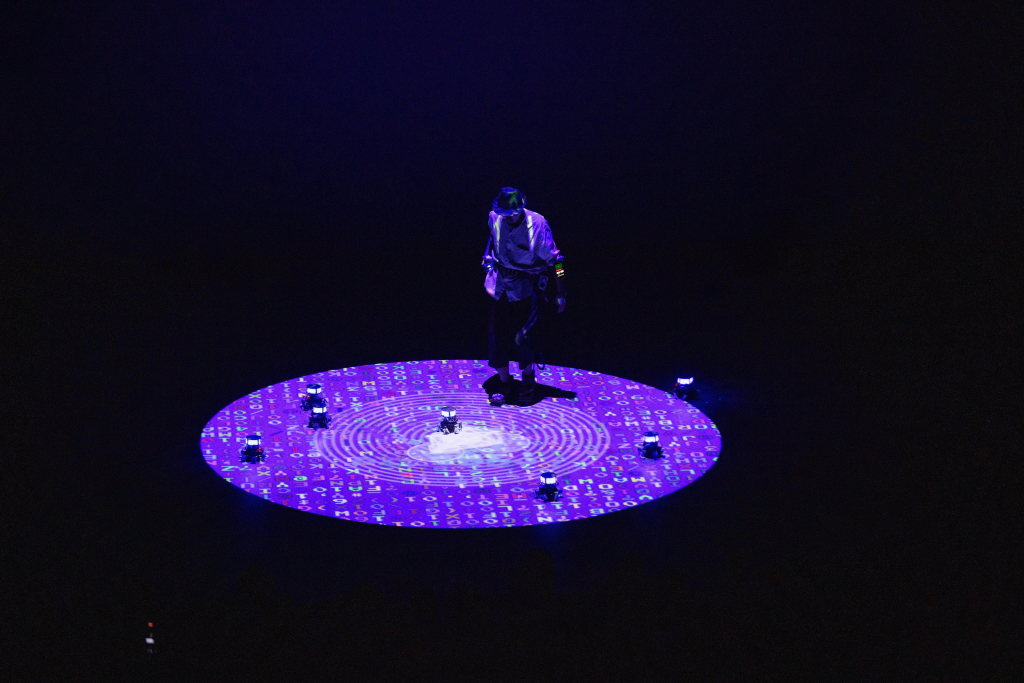
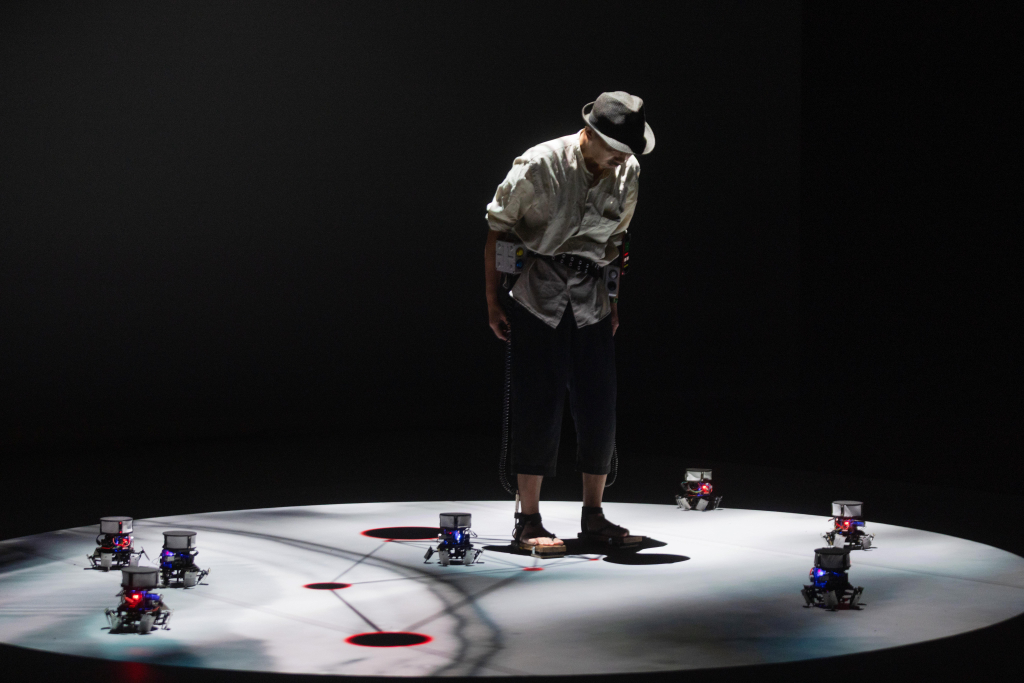
The festival’s closing day belonged to illusions and dreams. THE CLUSTERs turned Nave 11 into a joyful collision of species and objects: eight robots, programmed, stimulated and observed by Naoyuki Tanaka (NAO), dancing around him like a company of their own.
Dressed in traditional Japanese costume against a sound design built from noise and frantic, machine-like impulses, the piece plays that contrast for both comedy and tenderness, and manages something rare: a genuinely sweet love story between a human and his robots.
Kelly Moran took the last slot, approaching the machine from the opposite direction. Her piano lines layered with ease and elegance, an unhurried dance held up by light, organic rhythms, each phrase leaping over the previous one in grace.
Beneath the technique, what came through her hands was something more human than technical: a search for knowledge, a reaching toward inner reflection, carried by an instrument that has done that job long before any of this year’s screens existed.
Learning to speak again, in this context, does not necessarily mean recovering a lost language. It means finding new ways to establish contact. Whether staged through a mesmerising synth sequence, a puppet wired to a game controller or a commanded robot, certain concerns continue to resurface: how do we reach another being when the channel between us keeps getting more mediated? None of the answers on offer was simple, and the festival never pretended otherwise. But something quietly hopeful lay in watching so many different systems strain toward the same end.
What remains a few days later is not the novelty of the interfaces themselves, but the ways they revealed communication as a process that is never fixed: always fragile, incomplete and still capable of generating unexpected forms of proximity.