Interview by Son Hyerim
To listen underwater is to enter a world never organised around the eye or, indeed, the human. Below 200 metres, where the twilight zone starts, and after 1000 m, where sunlight no longer reaches, life communicates, navigates, and perceives primarily through sound, shaping a world attuned to listening long before any human ear arrived to record it.
In the dim, pressurised strata of the ocean, vision gives way to vibration, and listening becomes less a capacity we command than something the sea itself teaches. Within this sonic dimension of aquatic worlds, Robertina Šebjanič‘s practice unfolds. Based in Ljubljana, Šebjanič is an artist and researcher whose work drifts through the fluid thresholds of ecology, (geo)politics and art.
For more than a decade, she has investigated the chemical, biological and political dimensions of aquatic environments through installations, performances and situated listening sessions. To describe the human impact on underwater ecosystems, she has coined the term aquatocene, a conceptual lens through which her projects register the Anthropocene as it sinks below the waterline.
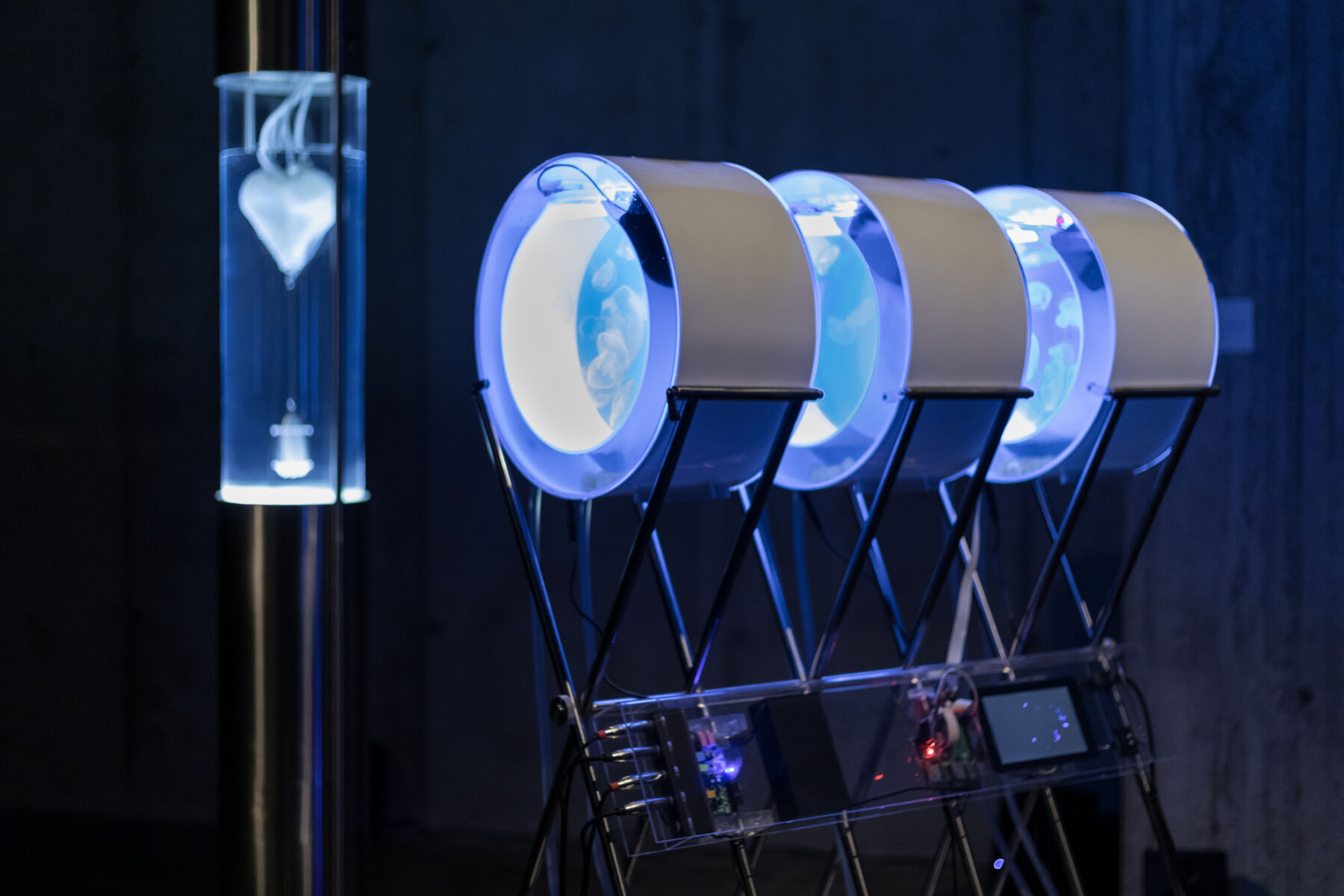
Several long-term projects anchor this inquiry. Aurelia 1+Hz / proto viva generator, later developed into the performance Aurelia 1+Hz / Proto Viva Sonification, draws on the bio-signals of moon jellyfish to stage an encounter of interspecies communication in which listening becomes relational rather than extractive.
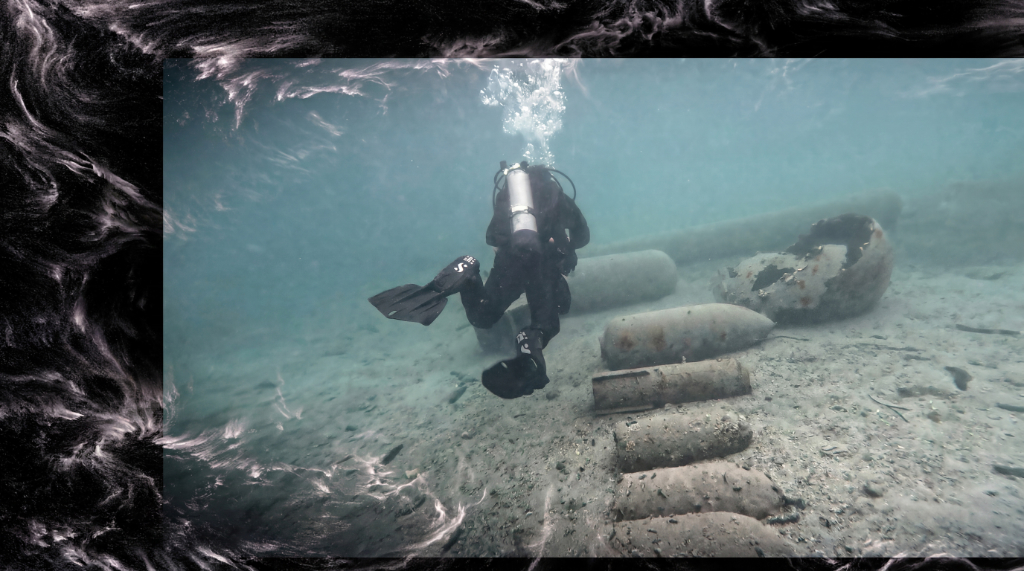
Aquatocene / Subaquatic quest for serenity, an ongoing series of hydrophone recordings gathered from oceans and seas across the globe, makes audible the anthropogenic noise pollution from shipping, sonar, and extraction that disrupts the acoustic networks marine species depend upon for survival. Echoes of the Abyss, recently distinguished at the Prix Ars Electronica [1][2], turns to the submerged military legacies of the 20th century: unexploded ordnance and chemical munitions slowly leaking on the floors of the Baltic and Adriatic seas, recorded during residencies aboard the research vessel TARA and with the MADE IN platform.
Shadows Above My Window_Mislinja 238 km², co-produced by Koroška Gallery and Ocean Archive/TBA21, brings together hydroacoustic recordings, ecological data, archival materials, local knowledge, and Slavic mythology to listen to the Mislinja Basin as a living, memory-bearing hydrocommons shaped by human and more-than-human relations. And as we finish this interview, she is an Artist at Sea aboard the research vessel R/V Falkor (too), operated by the Schmidt Ocean Institute [3], sharing the vessel with the scientific team conducting the expedition Surveying Salt Fingers in the Caribbean, led by Dr Joseph Gradone and Dr Corday Selden.
Šebjanič’s approach resonates with a lineage of listening practices, from Pauline Oliveros’s deep listening to Jana Winderen’s hydrophone fieldwork. At the same time, her attention to watery entanglement finds a philosophical echo in Astrida Neimanis’s hydrofeminist figure of bodies of water.
Yet what distinguishes Šebjanič’s position is the proposal of listening as witnessing: an understanding of listening not as the acquisition of information but as a state of awareness that refuses separation from the environmental and historical conditions through which a sound has come into being. Listening emerges as precisely such an act: political, ethical and profoundly embodied.
Your practice has drifted through the fluid thresholds of ecology, (geo)politics and art for over a decade, with a particular attunement to aquatic worlds. To begin with, what first drew you to water and to sound as sites of artistic research? What interests, influences and inspirations have shaped your practice along the way?
I think my attraction to the underwater world and sound emerged from a desire to move beyond the limits of the human perspective and to enter into a different mode of sensing. Water is not only a subject matter for me; it is a medium, a living archive, and a connective flow that reveals the entanglements between species, geological processes, geopolitics, histories, and human interventions.
My background is in sculpture, and perhaps this is where my sensitivity to materiality began. Over time, I became increasingly interested in materials that are not static but constantly transforming: water, sound, living systems, chemical processes, and atmospheric conditions.
Sound became an extension of this research because underwater worlds are primarily acoustic environments for marine life. Listening through hydrophones opened a way to encounter aquatic life without relying on vision, allowing me to perceive the ocean and rivers as active participants rather than passive landscapes.
Many influences have shaped my practice: scientific research, collaborations with marine biologists and oceanographers, the work of artists exploring sound and ecology, and philosophical approaches that question the separation between humans and the more-than-human world. But perhaps my strongest inspiration comes from direct encounters with the oceans, rivers, and the many forms of life that live there.
For me, listening is not only an artistic technique; it is an ethical position. It asks me to slow down, become attentive, and recognise that the world is constantly communicating beyond the frequencies we are accustomed to hearing.
Unlike urban field recordings filled with familiar mechanical or human sounds, your work focuses on the sonically unfamiliar realm of deep-sea environments. Do you see this very condition of listening to the unheard as inherently political? What particular challenges do you face when presenting these unfamiliar sonic environments to audiences?
Yes, listening to the unheard, particularly underwater ecologies, is inherently geopolitical because it disrupts dominant modes of perception and control. The deep sea is often framed as distant, mute, or passive, yet it teems with sound and is shaped by human activities like shipping, wind turbine construction, oil pumping, and fishing; we also use sonar and other sonic tools to navigate the waters.
Presenting these soundscapes makes the violence of anthropogenic noise pollution and the vulnerability of marine species audible. One challenge is the strangeness of the sonic material; it’s often abstract or alien to audiences, which I approach as an opportunity to unsettle habitual listening and create space for new auditory sensibilities.
In projects like Aquatocene and Echoes of the Abyss, you translate underwater ecologies into sound. How do you understand and work with the materiality of sound in these projects, particularly in relation to discourses such as sonic new materialism?
In my practice, sound is not just a medium; I would say it’s a material with agency. In Aquatocene, hydrophone recordings capture the layered, dynamic nature of aquatic environments, revealing how sound reflects ecological tensions and vibrancies. Sonic new materialism resonates with my approach, as it challenges human-centred frameworks and emphasises matter’s vibrational and affective qualities. I see underwater sound not only as representational but as performative: it enacts relationships, histories and disruptions that are felt viscerally, not just intellectually.
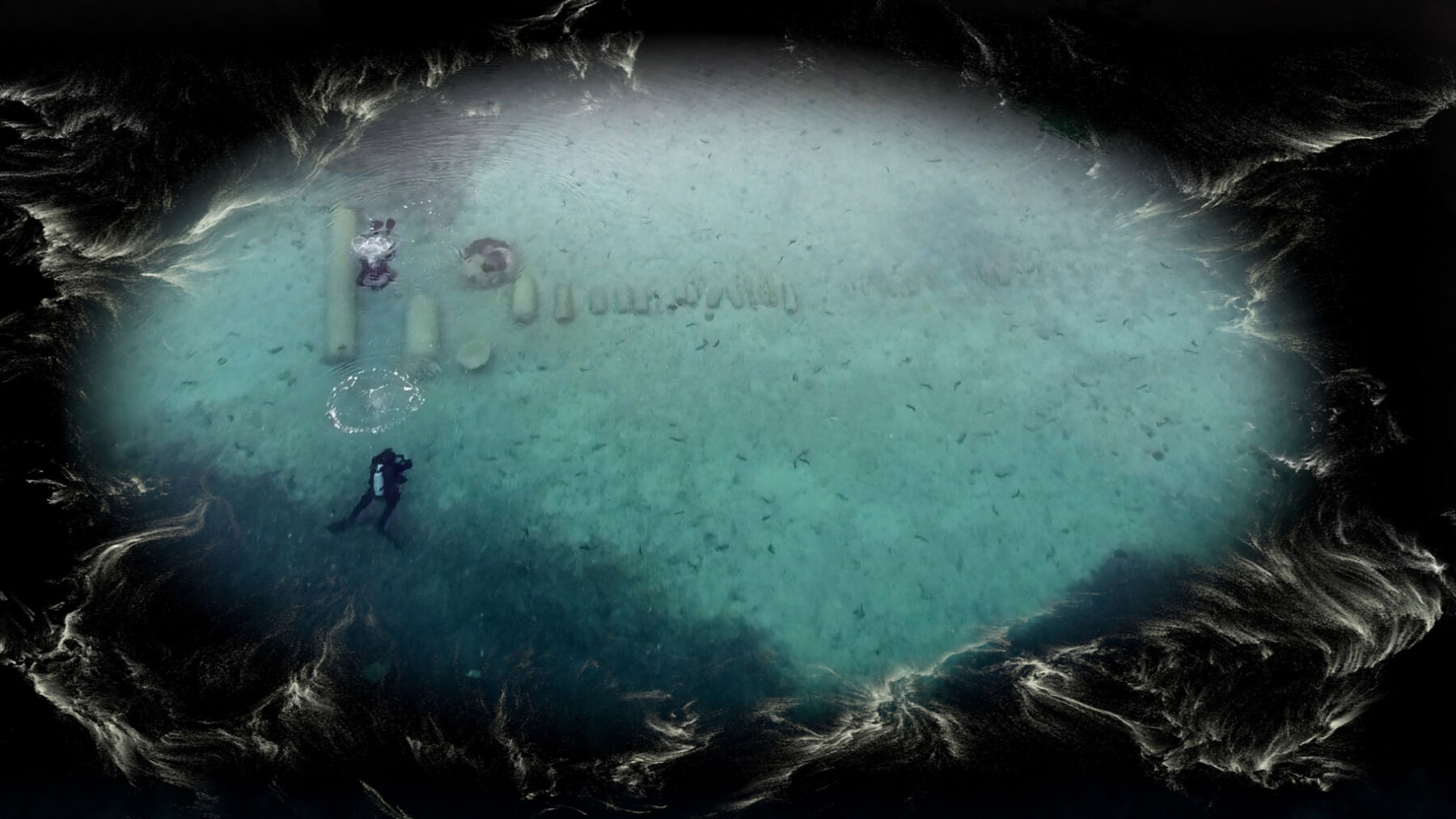
Echoes of the Abyss emerges from an ongoing investigation into the ecological imprint of submerged military legacies, specifically the leakage of toxins out of discarded munitions and chemical weapons that lie dormant yet threatening on the seafloor. The project began during my artist residency aboard the scientific research vessel TARA in the Baltic Sea, where I conducted initial hydrophone recordings above underwater unexploded ordnance (UXO) from the Second World War.
These recordings revealed a haunting sonic memory – some sounds of metallic structure – presenting an absence that is, in itself, sonically charged, hinting at the invisible yet persistent violence embedded in these marine environments. Continuing the research in the Adriatic Sea during the MADE IN Platform residency, I deepened the exploration of these toxic seabeds, focusing on how such anthropogenic interventions disrupt marine life.
Echoes of the Abyss invites audiences to uncover layers of geopolitical and environmental trauma that linger beneath the surface through two video essays that, for now, focus on two locations: the Adriatic Sea and the Baltic Sea. The toxic remnants, mostly munitions on the sea floor leaking chemicals into the environment, are often overlooked or ignored, yet they pose significant threats to marine ecosystems and human health.
In Echinoidea Future – Adriatic Sensing, you worked with sea urchins not as bioindicators but as active participants in an ecological dialogue. How did this shift your understanding of interspecies communication and environmental sensing?
Coastal communities were a key focus of the project, especially in the Adriatic context around Dubrovnik, where seasonal tourism growth and human pressures increasingly affect marine ecosystems. Echinoidea Future – Adriatic Sensing brought another perspective into my practice, where sea urchins became not only bioindicators but participants in an ecological dialogue.
The installation combines underwater recordings of the multispecies environment, including fish, crabs, and traces of human activity such as ships, with visualisations based on long-term environmental data, inviting audiences to sense ecological change through sound and perception.
In recent situated listening sessions, such as at the online course TBA21 Sound Ecologies (2026) or the new artwork you made for MOMENTUM Biennale (Moss 2025), you engaged audiences in open and non-traditional spaces. What are your specific considerations when curating listening sessions outside conventional white-cube contexts? Do you approach listening sessions in such site-specific settings with a spatial ethics of listening?
Absolutely. For instance, at the MOMENTUM Biennale in Moss, Norway – the first edition of the biennale dedicated to sound and sonic practices – I participated in a newly commissioned collaborative work with colleague artist Lena Ortega.
The piece was developed specifically for the site, exploring the liminal space between sea and coast, inspired by the materiality and chemistry of sea foam and its ephemeral, transitional nature. What I find especially valuable in initiatives like this is that they do not end with the exhibition itself. Together with curator Morten Søndergaard and the community of artists he brought together, we continue to meet and exchange in different locations, allowing the conversations and collaborations around sound, listening, and place to continue evolving beyond the biennale framework.
As the artistic lead of TBA21–Academy’s Sound Ecologies (2026), where I developed the listening framework together with invited artists, researchers, and participants, spatial sound ethics became central. In these sessions and events, I focus on how we listen, where we listen, and who is included or excluded from the process of listening. The site’s acoustic properties, its historical and ecological context, and its relationship to water all shape how I design the experience.
I aim to create environments where listening is slow, intentional, and reciprocal, where hearing becomes deeply connected to place and presence. I also consider sound accessibility and how collective listening can foster shared attentiveness to the world around us.
At the Media Mediterranea Festival 2025 (Pula), you presented CO_SONIC 1884 km² as part of the H2O Interfacing programme. A year earlier, you also presented the work as part of UCLA SciArt PST.ART (Los Angeles), while its expanded variation, CO_SONIC 38,144 km², was included in the official programme of Tribeca Immersive (New York City). How did the practical frameworks surrounding water ecologies influence your approach to these different presentations? Were there particular challenges or potentials when presenting sound-based ecological works in outdoor and non-traditional exhibition contexts?
Working in H2O Interfacing, curated by Darko Fritz, meant aligning artistic intent with ecological specificity. CO_SONIC 1884 km² was part of an outdoor video screening, where the public could watch and listen to the videos in an old Roman theatre dating back 2,000 years —now a venue where music and other events still happen—so these kinds of spaces have a special energy, for sure.
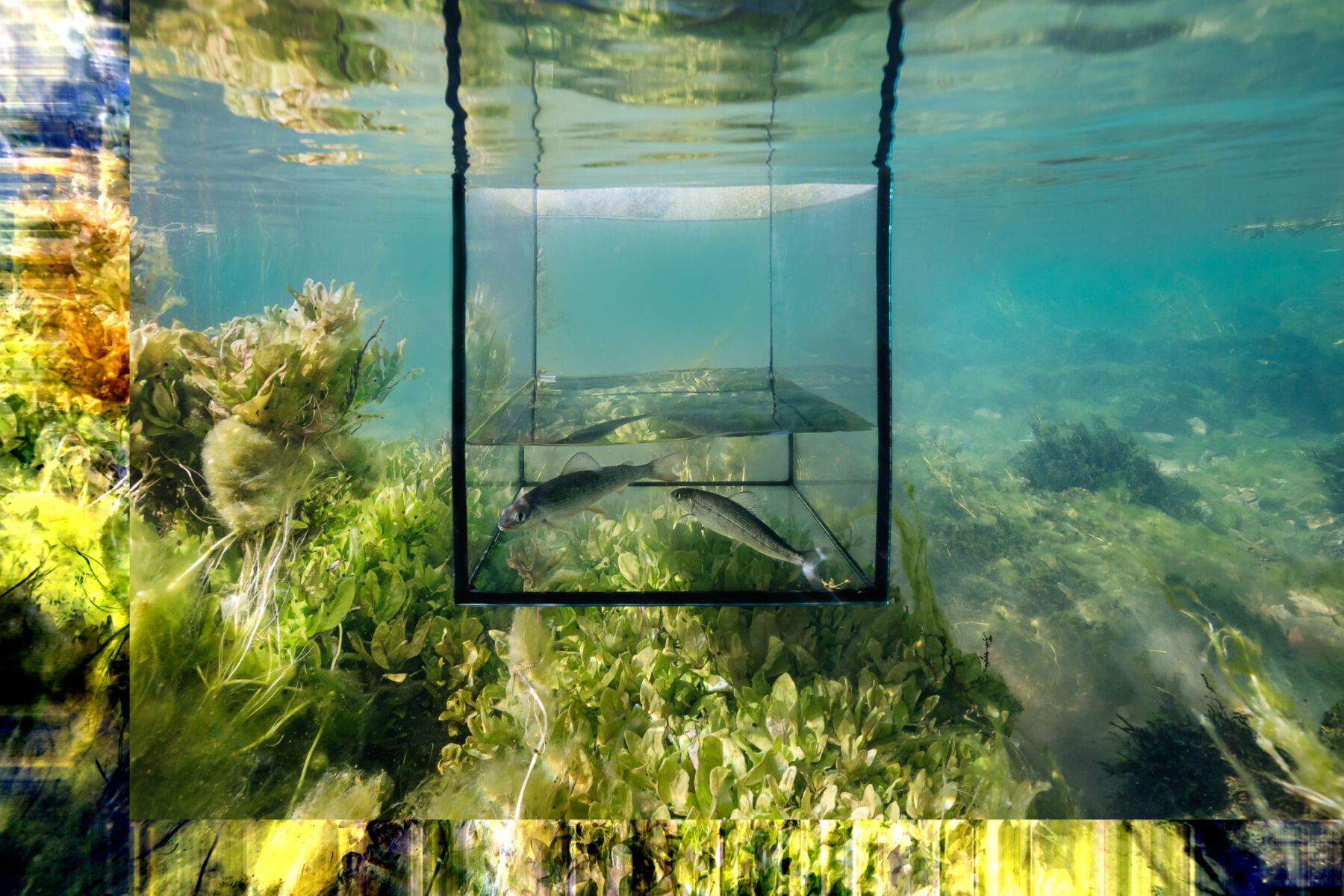
CO_SONIC 1884 km² is an audio-visual work that presents both the environment of the river Ljubljanica and its basin, which covers an area of 1,884 km². When I was commissioned by Cukrarna Gallery in Ljubljana to create it, I wanted to explore how to bring the presence of the river and its surrounding life, human and more-than-human, closer to the public in a way that resonates beyond visual representation.
The work is an audio-visual and poetic reflection, grounded in field recordings- in this case, AI-generated soundscapes that support and amplify the fish that live in this water- that speaks to the deep entanglement between river systems and the communities, biological, ecological and cultural, that inhabit them.
The Ljubljanica River has a unique character: throughout history, as it flows both above and underground, different parts have been given different names, as if they were separate rivers. With CO_SONIC 1884 km², I wanted to restore a sense of the river’s wholeness, its continuity as a living body shaped by time, geology and human interaction. Sonically, the work documents the river’s current state – its ecological stress, its layered memory, its resilience – offering a space to reflect on the increasing vulnerability of freshwater systems in the Anthropocene. At its core, it calls us to listen to the river not just as landscape, but as a sonic entity, a storyteller, and a witness to environmental change.
I also explored a slightly different approach in a special setting at the Serra Madre Festival in Bologna, where I created the composition in binaural sound. The audience experienced the audio part of the CO_SONIC 1884 km² through spatial headphones while moving freely through an open garden exhibition space, encountering vertically arranged aquariums with fish, textile forms, and projected imagery.
This combination of movement, space, and sound created another layer of immersion, allowing visitors to enter the sonic landscape more embodied. At the same time, the experience remained intimate and individual, while still enabling moments of shared presence without disturbing others using the park space.
I’ve realised larger immersive audiovisual presentations of the work in several contexts. One of my favourites was for sure UCLA. When I was invited to participate in Atmosphere of Sound at the UCLA Art | Sci Center, I initially planned to explore the sonic landscapes of Los Angeles waters. Due to the 2020 lockdown, the residency shifted online. Together with curators Victoria Vesna and Anuradha Vikram, we expanded the research into my ongoing work, CO_SONIC 1884 km² of the Ljubljanica River basin, a unique water system where seven rivers disappear underground, flow through extensive cave networks, and re-emerge, gaining different names along the way.
In 2024, the project was presented at UCLA as a solo exhibition and audiovisual performance, followed by a discussion with local experts, including Lauren Bon, creating a dialogue between the Ljubljanica and the Los Angeles River and the ways their communities perceive and relate to these living water systems.
The work can also exist as a standalone sound piece. For Tribeca Immersive, that year curated by Ana Brzezińska, we developed this adaptation together with the team of MONOM Studio, creating CO_SONIC 38,144 km², an expanded version of CO_SONIC 1884 km², with an added sonic scape of the Hudson River and Lake Tear. Presented in a dedicated 4DSOUND space, the immersive multichannel sound work invited audiences to listen to the river not simply as a landscape, but as a sonic entity, a storyteller, and a witness to environmental change.
In the early stages, you transformed jellyfish biological signals into sonic material, and later emphasised audience participation and embodied listening. How do you conceptualise relational listening and the process of building auditory relationships between human and non-human entities in your work?
For me, relational listening is about creating a multispecies sonic dialogue that challenges anthropocentric perception. In Aurelia 1+Hz and other sound-related works like Aquatocene, I aim to reveal the presence and agency of aquatic life through sound, inviting audiences to listen with more than just ears, to feel, sense and interpret the soundscape as an entangled experience.
The idea is not to decode the jellyfish or the ocean as data, but to build beyond that: a more empathic relationship that respects their sonic expressions as meaningful in their own right. In doing so, I hope to foster empathy and awareness towards the more-than-human world.
The marine world is inherently sonic and tactile. Below 200 metres, where sunlight fades, vision gives way to other sensory modalities. In this dim, pressurised environment, life communicates, navigates and perceives primarily through vibrations, sounds and physical interactions, shaping a world that is deeply attuned to touch and listening.
Aurelia 1+Hz initially started as an installation and later developed into a performative piece. This transformation seems to reveal not just a formal expansion but also the performativity of listening itself. Could you share what motivated this shift and what intentions guided you in merging installation and performance?
The shift from the installation Aurelia 1+Hz / proto viva generator to the performance Aurelia 1+Hz / Proto Viva Sonification emerged from a desire to emphasise the liveness of interspecies communication and the performative agency of listening to/hearing the other. Initially, the work examined the sonic interaction between jellyfish and technological systems in a contained environment.
Over time, I realised that listening, from both human and more-than-human perspectives, had an embodied quality that the static installation Aurelia 1+Hz / proto viva generator could not fully capture, as the focus shifted more to the relationship between the animal and the machine. The performative format let me foreground the temporal and situational nature of the encounter with the beauty of the jellyfish, and invite audiences into a shared sonic moment where listening becomes both relational and responsive.
Have there been particular instances where the jellyfish soundscape or other elements of your work — like the river-related pieces — created especially immersive, created especially immersive or affective experiences for the audience? Could you share examples where you felt audiences were deeply engaged?
One memorable instance was during a performance of Aurelia 1+Hz in a darkened space, where the jellyfish’s bio-signals created subtle sonic pulses. The quiet intensity of the sounds encouraged a stillness and focus among the audience that felt deeply communal.
Similarly, during listening sessions for Aquatocene, I’ve witnessed people physically react, leaning in, closing their eyes, even becoming emotional, when confronted with the alien yet intimate voices of the ocean. These moments reveal sound’s power to reach beyond language and provoke visceral, empathic responses.
When working with different multispeaker systems, I noticed that CO_SONIC 1884 km², especially in immersive presentations at Tribeca Immersive, UCLA, or through 3D sound systems, creates powerful engagement. The combination of field recordings and AI-generated sonic elements evokes the feeling of resting beside a river on a warm summer day, a space between external surroundings and inner landscapes.
The work allows audiences to enter their own memories and emotions while sensing the river’s ecological dimension. For me, the most meaningful moments are when their personal responses resonate with the work’s intention while also opening new perspectives.
Your recent works increasingly explore military legacies, polluted marine ecosystems and power structures through sound. Do you consider listening itself to be a political act? What kind of ethical or behavioural reflections do you hope to provoke in your audiences through these sonic experiences?
Yes, I see listening as a deeply political act, especially in contexts where silence has been imposed or where voices (human or non-human) are erased. By amplifying underwater ecologies, I invite audiences to reconsider their position within extractive systems and to recognise the sonic traces of violence, whether sonar, noise pollution, or climate disruption.
I hope to foster not only awareness but a sense of accountability. Listening becomes an entry point into rethinking how we inhabit and affect the world, and how we might develop more respectful, coexistent practices.
Among your body of work, which piece do you feel has been most effective in conveying such political listening to audiences, and why?
It’s difficult to single out one work, but Echoes of the Abyss has been particularly effective in communicating the geopolitical dimensions of listening and attention to slow violence.
Through its visual and sonic engagement with the topic of toxic legacies of submerged military waste and their long-term ecological consequences, it brings attention to invisible forms of slow violence that continue to shape marine environments and their life and their bodies.
The piece doesn’t dramatise these threats; instead, it invites audiences to view and listen attentively to disruptions that speak volumes. In that space of listening, the geopolitical becomes present not through spectacle, but through the uneasy awareness that what we fail to hear or see does still affect us, and others, profoundly. The work asks: what does it mean to coexist with these buried histories, and what responsibilities emerge when we choose to truly listen?
With Echoes of the Abyss, I invite the audience to consider listening as an act of geopolitical and ethical engagement – a way of confronting what lies beneath the surface, both literally and metaphorically – listening as an act of witnessing, of acknowledging submerged histories and ecologies.
What are you currently reading, listening to or looking at? Which artists, musicians or thinkers accompany your research at the moment?
At this moment, I would mention the books that are present in my reading corner and the films that have recently resonated with me and stimulating me. They are not necessarily a fixed list of references, but rather the materials, images, and thoughts that accompany me in this period of my research of new upcoming work that I develop this summer in 2026 and Shadows Above My Window – Mislinja was premiering 11 september 2026 at the KGLU – Koroška Gallery in Slovenia and in October at TBa21 – Ochen Archive – online.
Books at my booktable: The Slavic Myths by Noah Charney, Svetlana Slapšak; A Book of Waves by Stefan Helmreich; Through the Scope of Life, Art and (Bio)Technologies Philosophically Revisited by María Antonia González Valerio, Polona Tratnik; Living as a Bird by Vinciane Despret; There Are Rivers in the Sky by Elif Shafak.
Films to watch: Fiume o morte! (2025) ‧ director Igor Bezinovic; Silent Friend (2025) ‧ director Ildikó Enyedi.
What’s your chief enemy of creativity?
Geopolitical tensions/conflicts/wars and the restrictions they impose are making the longitude and latitude of where we live increasingly determine our possibilities. They open some territories while closing others, turning parts of our common planet into inaccessible or “no-go zones.” This gradual fragmentation undermines the idea of a shared world and erodes our sense of living on one common planet.
You couldn’t live without…
/ocean /stories /rivers /coffee… Their order shifts with the day, and the geography of where I find myself.