Text by CLOT Magazine

The School of the Art Institute of Chicago (SAIC) is one of the USA’s oldest accredited independent art and design schools. Founded as the Chicago Academy of Design in 1866, it has since provided students with a challenging education in the studio arts, as well as exhibition opportunities.
At SAIC, students have the unique opportunity to pioneer future-facing works in a dynamic learning environment. The AT/SP faculty are visionary artists with national and international reputations who take an inclusive and critical approach to the technological and sonic arts. They encourage rigorous practice informed by robust research, iterative hands-on experimentation, and the interrogation of diverse histories, theories, and strategies.
Artists’ explorations of the complex social, historical, cultural, and global dynamics involving our bodies, our senses, and technology are constantly evolving, and this is reflected in the wide range of topics that AT/SP embraces. Students can focus on any of these areas or explore their hybrid, interdisciplinary possibilities.
SAIC’s ever-evolving range of courses is designed to provide students with an immersive, thorough, and critically engaged course of study from a global perspective, connecting them to the international art community. Entering graduate students take introductory seminars on technology and/or sound that form a critical and inclusive foundation for their studies and a cohesive community among their peers.
The faculty’s ongoing research and evolving practices lead them to conduct an ever-changing range of contemporary seminar topics. Recent topics include Anxious Media Ecologies, Art & Biotechnology, Out-Voicing, Philosophy of Technology, and Ears for Cinema. Graduates of the program are well-prepared for careers in various fields, including fine arts, media arts, sound design, and technology-based art practices.
ART on THE MART is one of the world’s largest digital art platforms, transforming an architectural landmark into a permanent, larger-than-life canvas and bringing video mapping techniques to Chicago’s Riverwalk. The program has commissioned work by names like Derrick Adams, Charles Atlas, Nick Cave, and Barbara Kruger, alongside projections by Chicago-based artists.
ART on THE MART’s Spring 2026 season spotlighted emerging talent from the School of the Art Institute of Chicago (SAIC) through their project Synthesis, a newly commissioned program created by SAIC graduate and undergraduate students who paired up to produce 14 original works. Synthesis challenged students to consider the monumental scale and architectural specificity of THE MART, exploring how visual projection and sound can converge seamlessly within its façade and surrounding urban environment. Each student pair (one leading the visual component and the other the audio composition) brings their expertise to develop a moving image work projected for 9 months on the façade of THE MART building, visible from Wacker Drive and along the Riverwalk.

Additionally, since 2018, the department has participated continuously in the international Ars Electronica festival in Linz, Austria.
Each year, an external curator works with the department to select graduate students for this opportunity. In 2024, SAIC presented (re)understanding media: Extension of agency in the global village, an exhibition that reexamines the relationship between men and machines. The exhibition encouraged visitors to rethink and reimagine how media arts rebalance and restore the benevolent aspect of technology in society and culture, fostering a more equitable and hopeful future through technology. Sam Anthem, Benjamin Glass, Patrick Glennon, Yuwen Huang, and Liang He created an immersive space where visitors relearned media tools to build a better, more hopeful world.
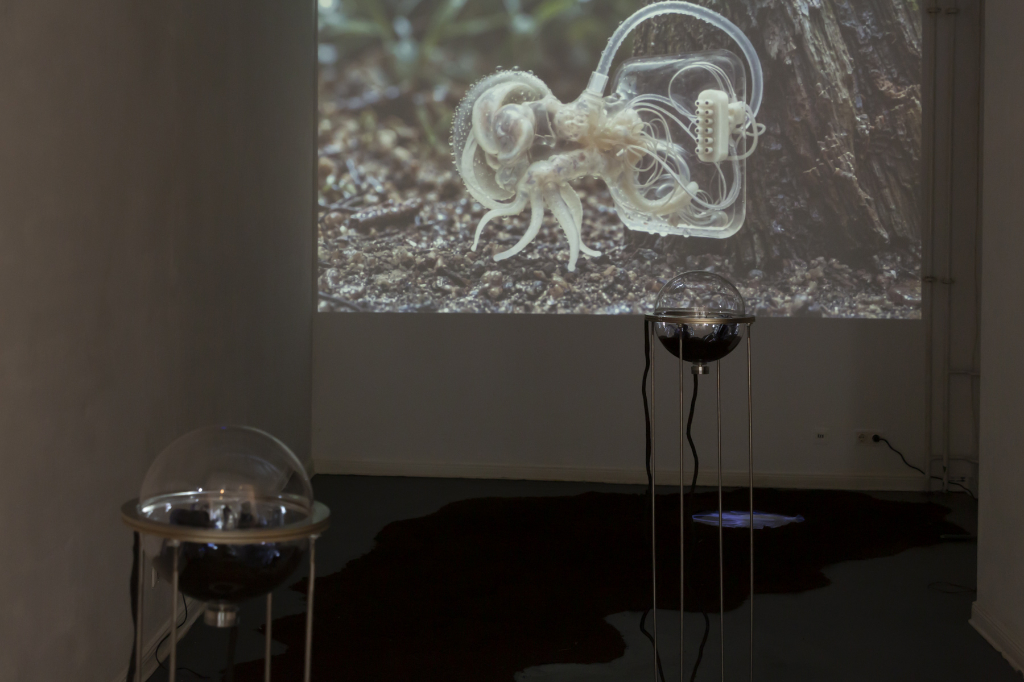
Students have access to a wealth of digital and analog resources, purpose-built labs and studios, and expert support staff. These facilitate a wide range of practices, including creative coding, sound practices such as synthesis, multi-channel installation, sound sculpture, electronic instrument building or programming sound, olfactory art, bio art, experimental music, acoustic ecology, installation, performance, AR, VR, games, kinetics, neon, holography, electronics, robotics and more.
This DIY and hacking philosophy is embodied throughout the curriculum, and works produced are often interactive, immersive, multisensory or hybrids of retro and cutting-edge technologies. This global perspective enables students to explore a wide-ranging, interdisciplinary path or take a focused approach to specific media, disciplines, or topics within the AT/SP ecosystem, fostering rigorous experimentation, skills-based learning, and conceptual investigation to prepare students to be creative and productive cultural citizens.
SAIC’s graduate program offers a priority application deadline of December 1, 2026, with a reduced application fee. The final deadline is January 10, 2027. Learn more and apply at saic.edu/atsp.