Text by Agostino Quaranta
The South of Italy and the dilemma of the future
In response to the theme Mutating Tradition of the third edition of the tekhnē journal (curated by CTM) and stemming from a collaboration with CLOT Magazine, I decided to investigate and map relationships with technology that have intersected with Southern Italian popular sonic traditions. The idea behind this article follows a series of considerations that I began last spring, when I casually stumbled upon a sentence within a publication of vernacular Ostunese poetry while browsing in the library in Ostuni, my family town in Puglia, in the South East of Italy. The book contained a page with the author’s note, written in standard Italian, which began with the statement: The Ostunese dialect has no future.
Such a premise felt curious for an introduction anticipating a collection of poetry dedicated to that very idiom, and I later noticed that similar titles circulate widely online. Across local news outlets, blogs, as well as TikTok, Facebook and Instagram accounts, based in different parts of the Mezzogiorno, one can encounter a variety of opinions speculating on how Neapolitan and Sicilian, along with other Southern Italian regional languages and dialects, aren’t syntactically capable of expressing futurity, unlike standard Italian.
Still widely spoken today, Southern Italy’s regional languages generally convey future time through the present tense, often with the addition of temporal adverbials or auxiliary verbs, rather than through a dedicated synthetic future tense, as Italian does. Nevertheless, this apparent linguistic paradox seems to serve a broader conjecture: that regional cultures of the Mezzogiorno are stuck in an immutable and eternal present, unable to conceptualise or articulate futurity.
Regardless of these colloquial speculations, I believe it is relevant to analyse the relationship between perceptions of time and processes of change in the Italian South. According to Sofia Rudi Kent, whose research examines infrastructure and governance, the tension between the two is situated within a broader global geography of speculative and suspended infrastructures. Her argument suggests that this perception of time is not exceptional to Southern Italy and its apparent incomplete modernity; it’s rather an example of how the state-industrial complex manipulates infrastructural myth and its temporalities to create a framework in which the feeling of suspension becomes a condition imposed upon people of the Mezzogiorno.
At the same time, ‘future’ and ‘technology’ are obviously not interchangeable terms, though the two have often been closely associated within musical discourse. As the Egyptian, Berlin-based producer Abadir argues in his critique of futurism within the western electronic music scene, the juxtaposition of future and technology has been linked to pushing forward the boundaries of music, with technology playing a major role in imagining a future full of new aesthetic and conceptual potentials.
In this essay, I therefore attempt to trace — through the cracks of history — the connections between these themes, examining how they intersect within regional music genres in a territory long cast in opposition to the economic, industrial and technological development associated with northern Italy and, more widely, northern Europe.
This mapping does not seek to promote either a futurist imaginary or technological advancement in Southern Italy. Rather, it aims to investigate a series of unexpected, albeit marginal or overlooked, historical relationships between these regional cultures — heavily associated with a mythological sense of immobility and historical fatalism — and the technologies of their respective historical presents.
Lu Marzianu de lu Salentu [An Alien in Salento]
The earliest finding in my research led me to Domenico Modugno, the Grammy-winning artist internationally renowned for the Italian hit ‘Nel blu dipinto di blu’ (‘Volare’). Before unfolding my observations, however, it is necessary to contextualise some broader events in the artist’s life and career.
Modugno was born in Polignano a Mare, in Puglia. At a young age, he relocated with his family deeper south to the small village of San Pietro Vernotico, in Salento, where he spent most of his adolescence. The town’s rural cultural context, and Southern Italy more broadly, became a major source of inspiration in his early and lesser-known career, which consisted of an extensive collection of popular songs in Southern Italy’s regional languages.
During those years, he built a sonic imagery that I consider a work of Southern Italian interregional speculative imagination, intertwining various ´meridionali´ sonic and linguistic traits. Curiously, the artist was notoriously presented as Sicilian, despite being Apulian, and despite Salento and Sicily being around 600 km apart. As Modugno recalled in many interviews, the controversy around his ambiguous identity was seemingly caused partly by pressures from film and record executives, who demanded that the artist conceal his real background in order to sell a more marketable character, and partly by people simply mistaking him for Sicilian.
Despite these contentions, the artistic journey of the Apulian artist — by occupying such a liminal place — evolved into an inventive and long-standing musical production that bridged the pre-existing shared cultural history of these territories. After all, his town’s idiom, Salentino, spoken across the Salento peninsula in Southern Puglia, belongs to the same linguistic group as the more widely recognised Sicilian and Calabrian languages, with which it shares numerous lexical and phonetic similarities.
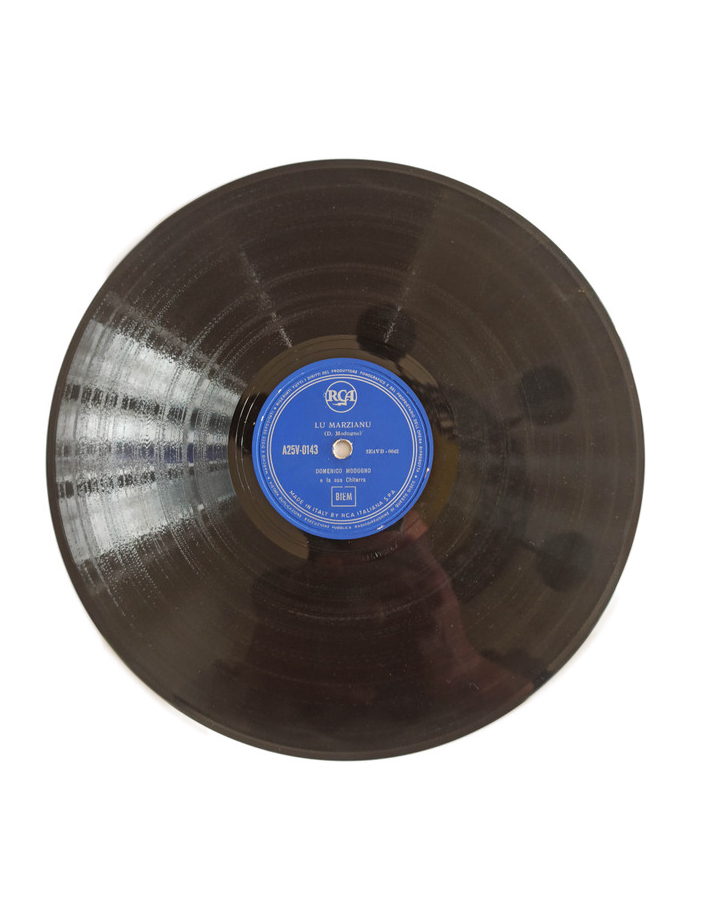
One could argue that Modugno’s in-between condition becomes exacerbated in one of his most bizarre songs: a little-known release from 1955 titled ‘Lu Marzianu’ (‘The alien’). Resembling a typical Southern Italian ballad for voice and acoustic guitar, the unconventional song evokes the tradition of the storyteller with an interplanetary twist. Rather than addressing contemporary events or political themes through the lens of realism, as cantastorie commonly did at the time, Modugno chose to impersonate the tragicomic experience of a helpless farmer, astonished by the godlike arrival of a shiny silver UFO crashing into his cultivated land.
The piece lies almost entirely outside any conceivable canon of the time for an Italian pop artist, especially for a composition written in Salentino or Sicilian, and more broadly in Southern Italy’s regional languages. This is especially evident considering his use of the expression “discu vulante”, a vernacular gimmick for “flying object”, at a time when the word UFO had been coined just a few years earlier, in 1947. The alien, described as a giant creature stinking of oil, resembles either a divine or demonic apparition, perhaps hinting at a subtle tease of dogmatic Catholic faith at a time when religious censorship in Italy was particularly strict.
Within a broader picture, the science-fiction theme of ‘Lu Marzianu’ seems to function as a plot device rescuing into absurdity to depict the condition of subalternity of Southern Italian peasants. The UFO can be considered an allegory of the imminent and drastic transformation of Italian society as it transitioned from rurality to urban mass culture. Hence, the song expresses the paradoxical tensions between the technological advancements of the 20th century, magic and the divine in post-war rural Southern Italy, and the peasant’s broader sense of subjugation.
However, I would argue that the fatalistic and somewhat comic imagery reproduced by Modugno in this particular song, as captivating and unexpectedly humorous as it may be — and despite its underlying solidarity with the peasant — risks reiterating a paternalistic and atavistic view of peasant culture, rather than recognising an intellectual dignity in its complex relationship with magic.
Il Banditore: a planetary town crier against the empire
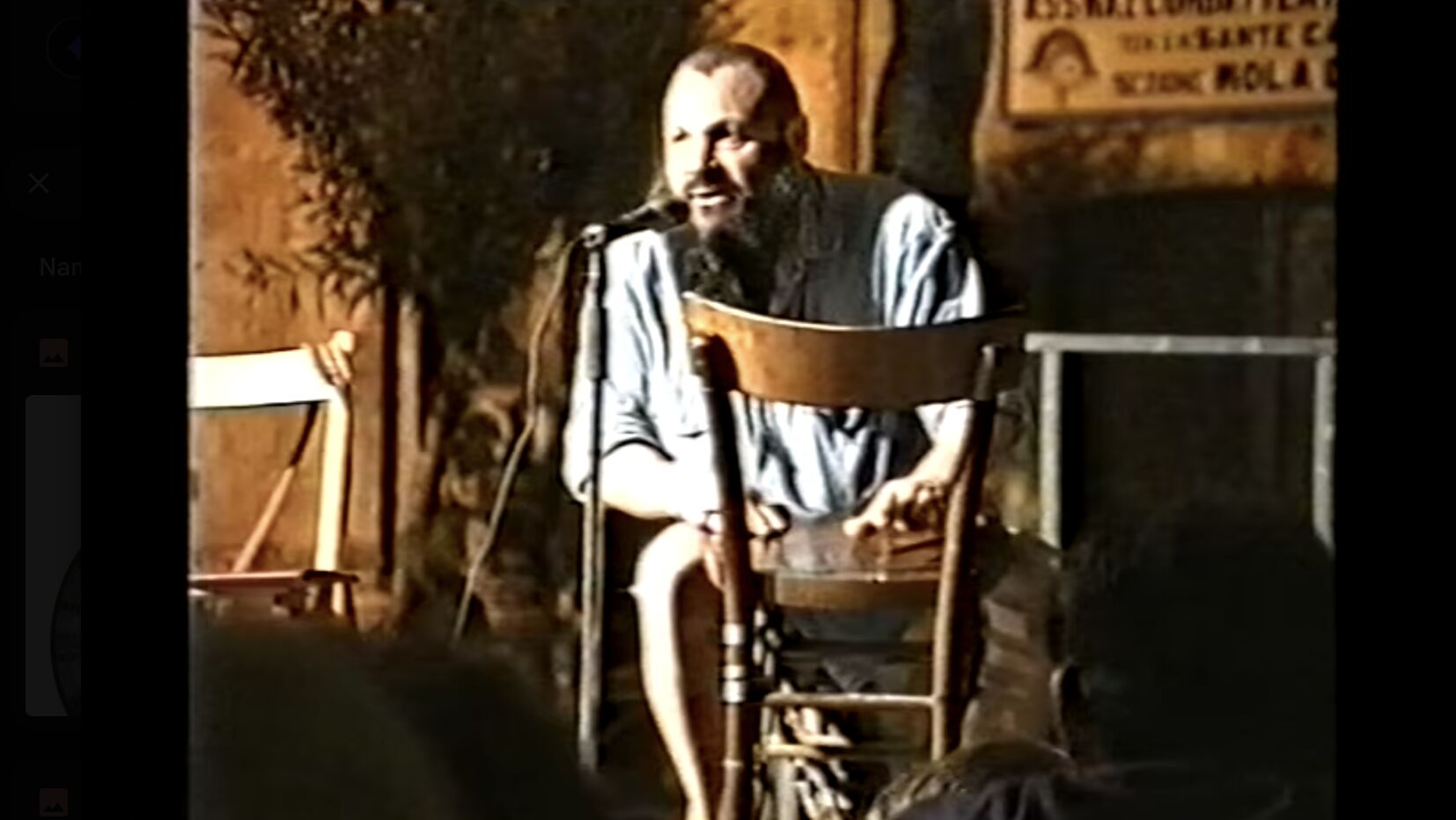
The United States killed the anarchists Sacco and Vanzetti with the electric chair back in the day, so I decided to redeem this poor peasant object, the [wicker] chair, and make it my means of expression, my favourite instrument, while also taking a stand against the inhumanity of the death penalty.
Enzo Del Re was an Apulian singer-songwriter known for his political and social protest songs in the Molese dialect (the vernacular language of the tiny fishing town of Mola di Bari) and, at times, in Italian. His performances were characterised by the use of a wicker chair played as a percussion instrument, often accompanied by additional sounds produced through palatal clicks. Both sound sources were generally amplified through the use of microphones.
What often stands out immediately in Del Re’s music is how his unwavering political songs tie together an intergenerational knowledge of traditional repertoires from the Mola di Bari area with a bold advocacy for a great variety of causes: from the abolition of mental institutions and prisons, to the critique of Western neoliberal ideas of progress, to raising awareness of the conditions of alienation under capitalist society.
His approach to sound-making was as multifaceted and revolutionary as his ideals. On the one hand, the Molese author’s discography is studded with songs that intertwine traditional microtonal melodies with a poetic sensibility toward the rural world of his birthplace. On the other hand, his quirkiness shines through in the way these references intersect with a subversive expertise in creating sounds, using almost exclusively his own body, a household object and the ingenious techniques employed to amplify them.
The song that probably best sums up all these considerations is the title track of his album ‘Il Banditore’, which I would define as an early electronic music production. The composition begins abruptly with a groove made from the sound of a chair and his voice exclaiming in Italian, People of the planet, be careful!, followed by a succession of onomatopoeic expressions reminiscent of dialect words deconstructed to the point of losing all semantic value. At the same time, the beat is embellished with a rhythmic pattern, probably made of tongue clicks, that functions simultaneously as a melodic line and as another layer of drums.
Completing this already unpredictable sonic landscape are two electronic effects, a series of reverberated tongue clicks and the loud electronic sound of an air-raid siren. The overall atmosphere seems bizarrely to allude to a techno production, despite the track being published in 1976. ‘Il Banditore’ seems to share with the genre not only a sense of rhythmic circularity, but also a prophetic affinity — despite the geographical distance and the inherently different historical context — with the militantly political and countercultural guiding beliefs later articulated through science-fiction aesthetics by the pioneering Detroit collective and label Underground Resistance in the early 1990s.
As suggested by the title, the song recalls the figure of those who delivered political and municipal announcements throughout the public spaces in Southern Italian towns, who were actually called ‘banditori’. Ultimately, the track seems to stage a fictional planetary town crier confronted with the geopolitical tensions of his times: the Cold War, the war in Vietnam and an increasingly aggressive Western capitalist society, which in Italy was violently shaped by the Strategy of Tension throughout the so-called Years of Lead.
From Tecnopizzica to Lento Violento
What is it really all about when we discuss the rhythmic and sonic history of South Italy? And what about its electronic counterpart? The music tradition of South Italy usually refers to dances and sound styles categorised under the umbrella of Tarantella. Nowadays mostly associated with folklore or revival enactments, these regional repertoires of rhythmic and melodic patterns only sporadically overlapped with the realm of electronic music. The micro-history of experiments is therefore devoid of much documentation and is often restricted to a number of very few and isolated songs which may be forgotten or slighted even by the people who produced them. According to my personal experience, there is only one historical instance of this musical overlap: the experiments informally coined tecnopizzica, techno-pizzica, or elettro-pizzica.
It may be simply a romantic intuition, but I strongly believe in the concept of the ripple effect: the possibility that one tiny event can lead to unintended consequences in a later state or context, and that this process can influence, through sound, the formation of sociocultural meanings. Indeed, I enjoy the idea of following some of these ripples that spread across seemingly different sonic realms, connecting Tecnopizzica (rare electronic music experiments that took place with the traditional Salento genre Pizzica Pizzica), Lento Violento (an enigmatic Italian hard slow-style club genre), and, more generally, the musical languages derived from the sonic traditions of Southern Italy.
In 2021, I wrote an article for Norient aiming to reconstruct a series of circumstances in which the rhythmic and melodic patterns of Southern Italy, mostly confined to the realm of ‘folk revival’, overlapped with the world of electronic music. The essay focused on Tecnopizzica, which I believed to be an isolated case in Southern Italy, if not the only micro-history of systematic and collective electronic music experiments focused specifically on forming new meanings around Southern Italian traditional rhythms. Looking back from today’s perspective, however, I would no longer describe Tecnopizzica as an isolated case. Compared to what I believed in 2021, I now see at least one other comparable instance, which I will explore later on in this essay.
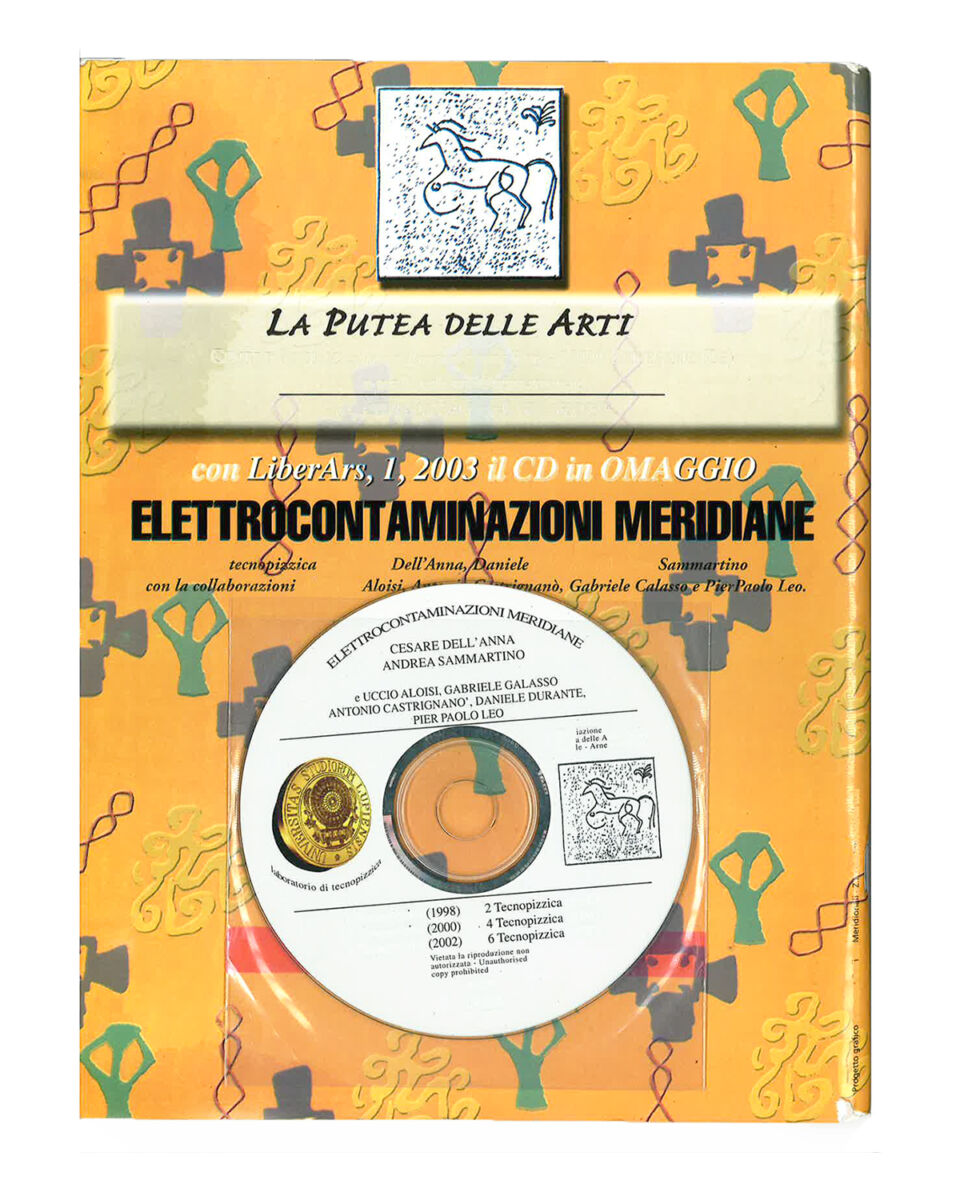
The epicentre of Tecnopizzica developed as a sporadic proto-genre in Lecce between the beginning of the 1990s and the early 2000s, propagating through episodes in the city’s hinterland, the broader territory of rural Salento, and sometimes even beyond this geographical area. One of my favourite memorabilia on this topic is an article published to promote the launch of a Tecnopizzica CD by Cesare Dell’Anna and Andrea Sammartino, sold together with LiberArs, a local cultural newspaper in Arnesano, a village near Lecce, which claims these experiments were attempts to produce and build a new imaginary around what they defined through the album title as ‘Elettrocontaminazioni Meridiane’. The feature describes this concept-EP as the Southern musical spirit, through contamination with new electronic technologies, within the space of a youthful and metropolitan musical taste.
According to my investigations at the time, Tecnopizzica was heavily driven by various ideas theorised by two scholars from the University of Lecce, Piero Fumarola, a sociologist of religion and the author of the aforementioned article, and the ethnographer George Lapassade. These two were invested in encouraging, through workshops, recording sessions, lectures and even informal acts of persuasion, local artists who were generally either electronic music producers or musicians with a background in regional popular music styles, to embrace the making of those experiments.
These sporadic experiments generally computerised some of the modular structures of Pizzica Pizzica, forming new meanings oriented towards club music. For example, one of my favourite traits of Tecnopizzica tracks was the sampling of the circular, hectic percussive patterns of traditional songs, generally played on frame drums. At the same time, the rhythm was often accompanied by synths, noises, FX, and sometimes loops of deconstructed melodies and vocals from local vernacular music repertoires with influences from sounds such as noise, dub, drum and bass and acid techno.
One of the central hotspots at the dawn of this experience was a Tecnopizzica lab, which was informally set up by Piero Fumarola and Daniele Durante (from the now internationally renowned group Canzoniere Grecanico Salentino), with a DIY instinct and very few resources at the University of Lecce, followed by a series of concerts around the country that were documented in some rare essays and video recordings. At the same time, between 1997 and 1998, experiments by various artists, including Cesare Dell’Anna, Nidi D’Arac, and Canzoniere Grecanico Salentino, among others, were performed live in squatted social centres around Italy. Ultimately, towards the mid-2000s, after a few other examples of isolated experiments by artists such as DJ Bellezza, Mascarimirì, Alpha Bass and Roberto Chiga featuring Dj Gruff, this experience slowly died out.
Since I wrote about this topic five years ago, I’ve had the opportunity to delve deeper into it beyond the sole focus on Tecnopizzica, not only from a research perspective, but empirically, in my practice as a DJ, experimenting with ways to incorporate these traditional rhythms into sets that combine them with music with similar BPMs. I immediately noticed a certain similarity between the rhythmic patterns typical of Southern Italian percussive beats and some of Gigi D’Agostino’s songs from his infamous Lento Violento repertoire.
For those unfamiliar with Lento Violento, it’s a style of electronic dance music developed by Gigi D’Agostino. Its name means ‘slow and violent’, and its tempo often ranges around 100 BPM, similarly to Pizzica. According to Discogs, this genre consists of a hard kick, like those found in Hardcore or Hardstyle, but played at a very slow tempo, with vocal samples and dark acid sounds on loop. One of the main channels used to promote the Slow Style was Gigi D’Agostino’s very well-received radio show on the Italian radio broadcast m2o. The sound was also advocated by several other producers such as Elena Tanz, Luca Noise, DJ Maxwell, Daniele Mondello and Express Viviana.
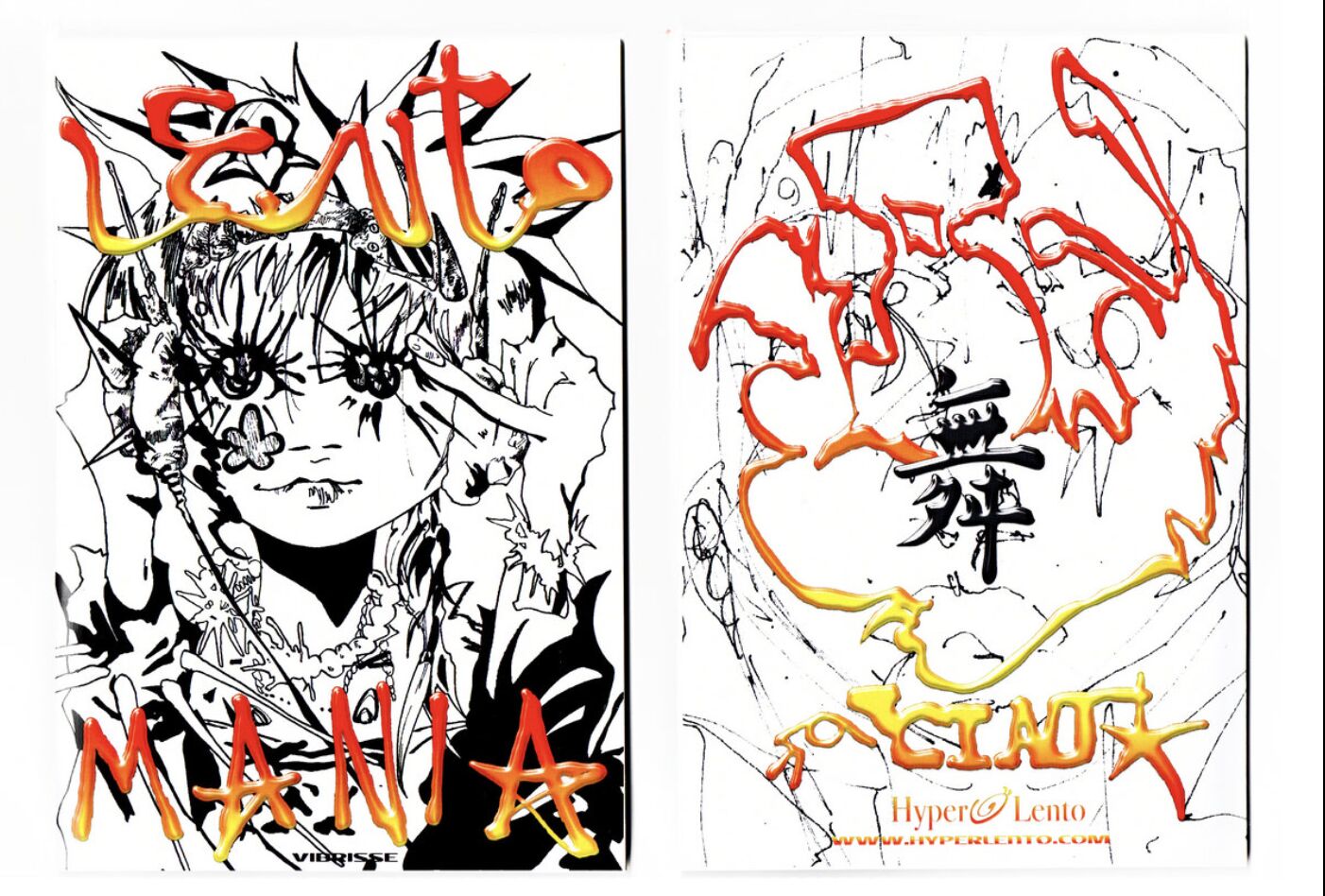
In the past decade, “Lento” has begun to gain traction again; some Italian artists have revived the genre and reintroduced it in contemporary contexts. Some of the most remarkable examples are Musica Jao by Vipra Sativa, released on Presto?! in 2017, a mix for NAAFI by Nahshi titled Violentamente, published in 2019, and Our Riches (Aspirapolvere mix), a release by Vibrisse from 2022. Vipra Sativa recently decided to even found Hyperlento, a Rome-based electronic music hub focused on experimental slowstyle music. And only a few months ago, the label published a fanzine titled Lentomania by Vibrisse that explores the history of this sound while also dissecting both semantically and semiotically the philosophy behind the genre.
However, it seems to me that the interlinks between this sound and the musical languages of Southern Italy still need to be entirely mapped. One of the most obvious traces from such a context is that the landmark triplet and jumpy rhythm of this genre are regularly constructed according to the same patterns as a tarantella. While this could be said to be a common rhythm used in hardcore techno and hardstyle, the presence of sonic elements, vernacular Southern Italian expressions in track titles, or overt references to traditional dance music traditions such as tarantella and tammurriata make the references very evident. This is the case in several tracks, including Tarantella Dell’Orso (2006), Capatosta (2007), and Fisafonica (2006), Paese in Festa (2008), and also an unverified release by Gigi D’Agostino uploaded by an unofficial account under the title Tammurriata Balbettata.
Thus, I find it relevant to understand the historical context of the city where Gigi D’Agostino was born and raised. Turin is a crucial North Italian hub for post-war migration from Southern Italy. Diego Novelli, mayor of Turin between 1975 and 1985, famously stated that the city is the third most populous southern city in Italy after Naples and Palermo. The enormous transformations brought about in this city by migration from the South, largely documented in an extensive filmography including the documentary ‘I meridionali a Torino’, are presumably latent even in Lento Violento.
Between 1958 and 1963, more than 1,300,000 southerners left their homes to move to central and northern Italy; among them, more than 800,000 headed for the large cities of the industrial triangle, first and foremost Turin. This connection between Southern Italy and Turin is traceable in many Southern Italian family histories, including mine. My parents moved to Piedmont immediately after university and lived in the province of Turin for many years, and both my brothers were born in the region.
Indeed, Gigi D’Agostino’s family is from Salerno, and his upbringing in Turin was, in his own words, shaped by the city’s industrial context, by the fact that his parents had come from the South, and by his birth in Mirafiori, the well-known suburb of Turin, where the FIAT plant was located. In an interview he gave to La Stampa in 2019, he discussed his connection to Southern Italian music. Gigi D’Agostino explicitly reiterates the influences he perceived in his music, linked to southern folk music and his father’s passion for playing the accordion: I grew up in a folk context. Unfortunately, he [his dad] didn’t have the opportunity to become a professional musician; he started out as a factory worker and then did other jobs. But I also owe my ear to him, and the fact that I live off music is a kind of sign of destiny.
Whether Gigi D’Agostino ever encountered Tecnopizzica is ultimately impossible to establish. Yet I cannot help but wonder whether he or anyone in his circles had crossed paths with it before Lento Violento became a reality. One episode I keep returning to took place on 10 October 1998, when Turin’s El Paso Social Centre hosted a Tecnopizzica performance. I can’t currently confirm if Gigi D’Agostino or any of his friends attended that event. It seems unlikely, considering he was then frequenting large techno clubs, worlds very distant from El Paso, a militant social squat largely associated with the punk scene. Perhaps, though, that is not even the important question.
What I find more relevant to observe, instead, is the possibility that musical languages rooted in Southern Italy continued to circulate, generating unpredictable processes of osmosis that gave rise to new sonic forms. If Tecnopizzica emerged in close proximity to the rural landscape of Salento from which those rhythmic traditions originated, Lento Violento seems to reconfigure a series of Southern Italian sonic codes, redeploying them into the gritty sounds of the post-industrial and fog-covered landscape of Mirafiori. They are pretty different worlds, yet they still look like cousins. To borrow a quote from one of Gigi D’Agostino’s eccentric songs, all we can do is solely to follow such a chain of echoes of Southern Italian sounds by relying on the study of causes and the succession of phenomena.