Interview by Neshy Denton
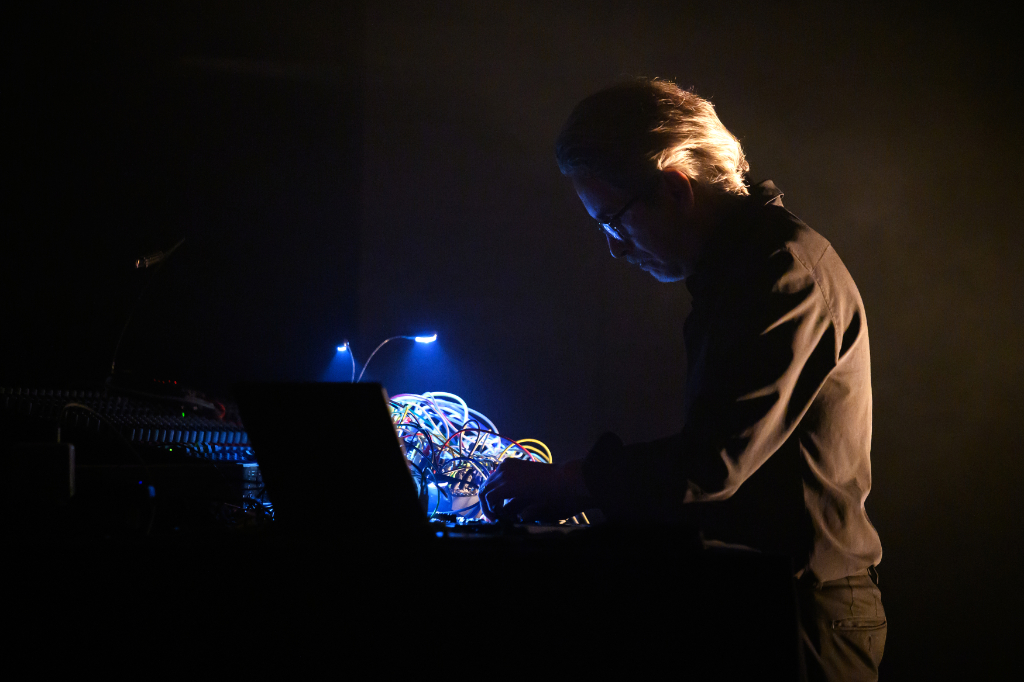
Even as Abul Mogard has gradually drifted from the protective fiction that once defined his musical arena, it feels like that presence still lingers nearby, as if the persona itself hasn’t fully come to terms with his departure as Guido Zen’s alter ego. The retired Serbian factory worker we’ve all come to know quite well now feels less like a character and more like residue. A conduit that opened a portal into Mogard’s liminal sonic world, tracing its gentle coarseness into one of the most visceral discographies in contemporary ambient and experimental music. Further down the line, the Italian producer’s music decrypted the archival memories of that persona, a figure through whom the sound found its first fortune, if not fate, before Abul migrated to the forefront of his own creative confidence.
Go back to his earlier pieces like Drifted Haven or Half Light of Dawn, and they’ll now suggest a distant memory. And, listening back, I struggled to escape from inhabiting someone else’s nostalgia, flicking through fragments that felt quite dissonant, which, eventually, casts a small hint of hope if you carry on climbing through the rest of his catalogue. Whether that’s correlated with Mogard’s later possession of his own work is perhaps open to interpretation. Either way, there’s a strange contradiction in the way one can perceive these all-encompassing pieces of sonic art. Even from a place far removed from what that industrial world represented in his sound, the emotional weight remains legible.
Speaking as someone who’s grown up in Spain – in other words, on a completely different spectrum from the context at hand – I can nevertheless taste a peaceful dread settling the groundwork, the music being powerful enough for you to understand something you’ve never actually experienced. Scroll through the early responses to his work, and you’ll find listeners drawn to that very idea, captivated by this mysterious, and supposedly real, figure resurfacing through sound. If anything, this is cyberpunk at its finest.
As far as embracing creative journeys goes, I admire how respectfully Abul Mogard engages with the idea of time, leaning into what feels like an art of lingering in sonic space. His work tends to unfold through extended tones and blurred, slowly shifting textures, held in a suspended state that resists any fixed sense of direction. It doesn’t feel like music that resolves conventionally, but something you enter and stay within for a while – it feels too immersive to be music for consumption; the interaction just feels much deeper than that.
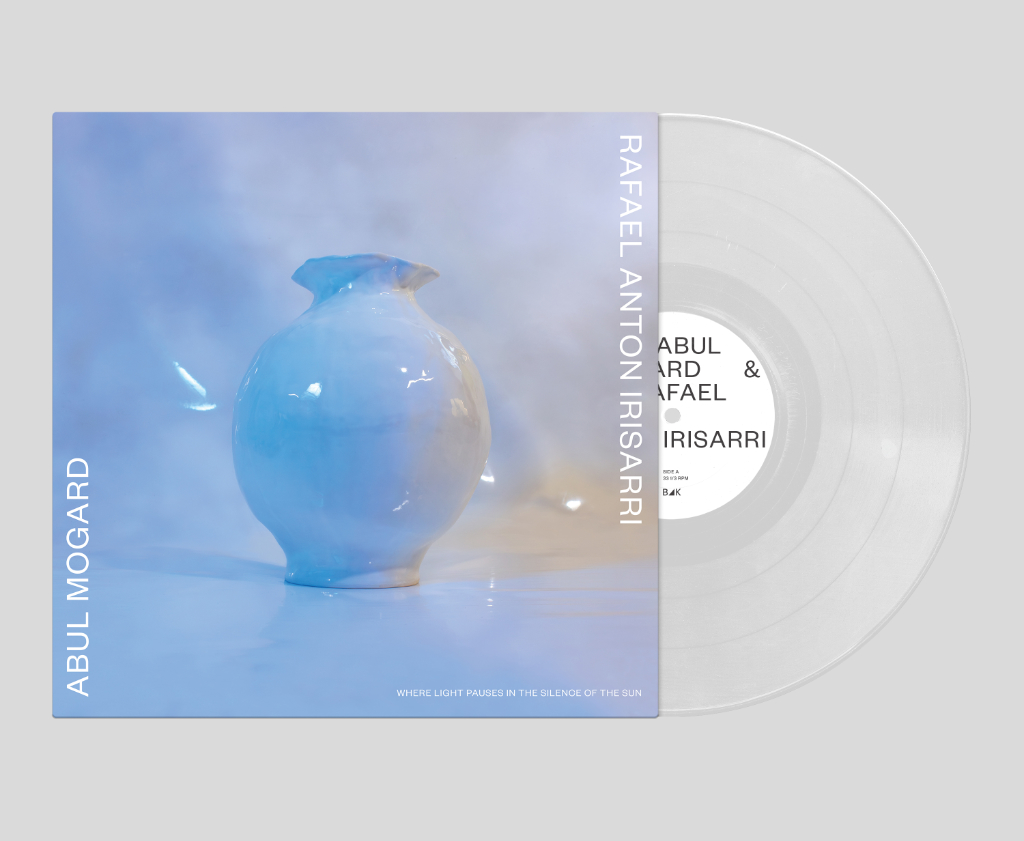
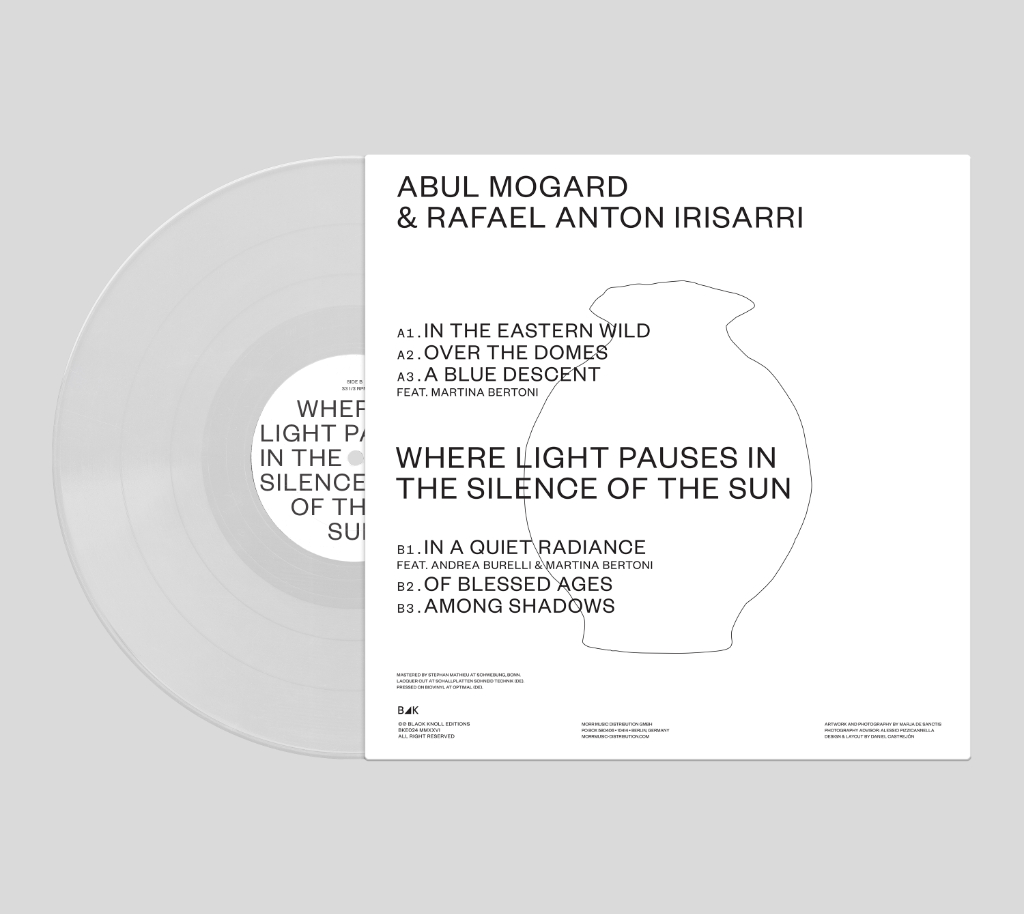
The composition in collaboration with Rafael Anton Irisarri on Where Light Pauses in the Silence of the Sun takes that viscerality to another level. Finding its form as a consecutive album to their earlier work, Impossibly Distant, Impossibly Close, improvisation here was allowed to drift before being reshaped into something more permanent in the studio. Recorded during a short residency at Morphine Raum in Berlin, the material was crafted into a deeply resonant LP, set to be dropped into your favourite streaming platforms on the 26th June, 2026. And maybe your postbox too if you’re smart enough to preorder the record (in no means is this supposed to be a marketing blurb, just my honest recommendation).
The finished vessel, as rendered by Marja de Sanctis, now appears glazed, a subtle shift from the raw fragility of the previous record that mirrors the music’s own movement toward something more held, more resolved. Where fragments were stretched, passages reassembled, and drones left to hover somewhere between ambient, classical, experimental, or whatever else that feels too reductive to try and name. That same sense of unfolding extends beyond the record itself. As Mogard continues to bring his work into live contexts across Europe, including upcoming appearances at L.E.V. Festival, the question of how that intimacy translates into space becomes increasingly central and, I’m sure, a clear draw for those curious to witness in person.
Landing on the 1st May at LEV in Gijón, the set will unwrap within the vast architecture of the Teatro de la Laboral, where Mogard will present his live performance Quiet Pieces. A work that moves even further inward and is designed to only roll out as a quiet undoing of perception. Ahead of his upcoming shows in Spain, we spoke to the artist to unpack the nuances running through his work.
You’ve spoken about the short-circuiting of the senses in Quiet Pieces. Given the project’s origins, do you feel like a medium translating the memories of a persona, or has the line between your own history and Abul’s archival memories completely dissolved by now?
The line between me and the original Abul persona has largely dissolved. I used to feel that Abul was a separate character, and I would make sure that the music I made as Abul Mogard would fit that identity. Over time, I realised that this approach was limiting my creativity and my ability to change, so I moved away from it. Now I feel more like someone translating my own memories and feelings into music, and I’ve come to see that this can still resonate with others’ memories and emotions.
You have compared the tangibility of your sound to sea spray or smog, suggesting it affects the olfactory senses as much as the auditory. At L.E.V., performing in the massive, historic Teatro de la Laboral, how do you scale that intimacy?
I should say that I didn’t write those words, Conor Thomas did, but I really liked the comparison and felt it was fitting. I haven’t been to the Teatro de la Laboral yet, but from the photos, it looks very beautiful. In general, I enjoy playing in old theatres like that, as I find the acoustics very warm and the sound tends to retain a certain closeness, which can make it feel more intimate than, for example, an old factory or another highly reverberant space.
It’s been an absolute pleasure listening to your upcoming release, Where Light Pauses in the Silence of the Sun, recorded, if I’m not mistaken, in a residency at Morphine Raum, where there was no stage. How did you manage to pour such depth into a shared sonic space, and did that lack of physical hierarchy influence the way you and Rafael Anton Irisarri communicated?
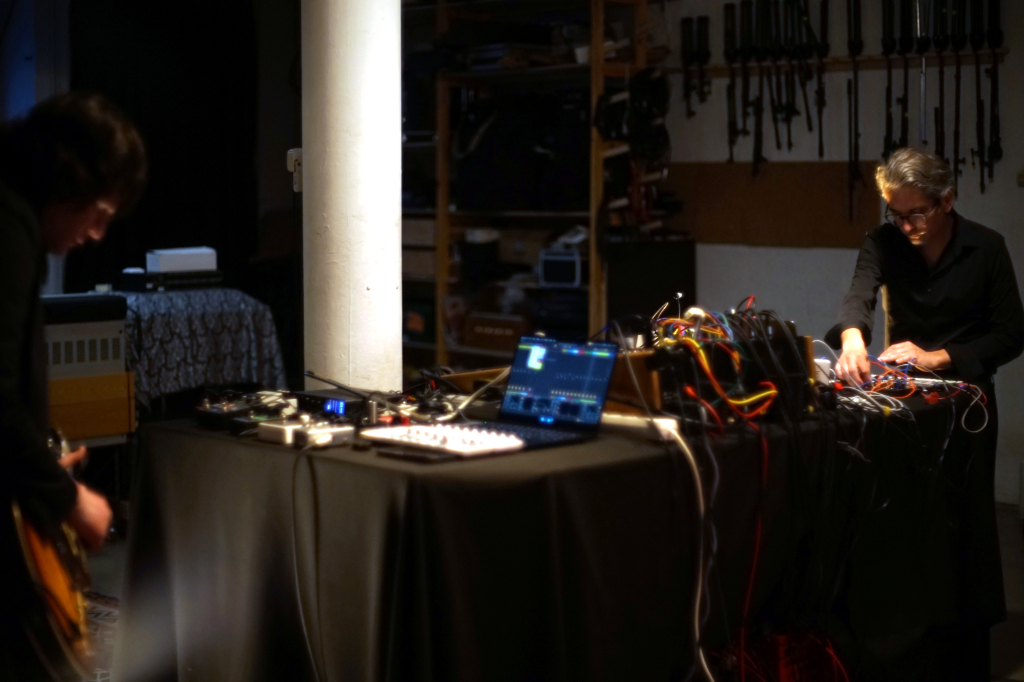
Thank you, I’m very pleased to hear that you enjoyed the new record with Rafael. Yes, the source material was recorded during those three shows and some rehearsals. There’s no stage and the space is very small; it fits around 60 people. The interesting thing with this album is that we played those shows with our usual set, but as it’s quite improvised, it never sounds the same.
When we listened back to the multitrack recordings, we realised there was material that was very different from the original pieces we performed, and that, once reshaped and reworked, could become the starting point for a new album. I think the proximity to the audience might have made us play differently. It felt almost like a house concert, with very little tension. Rafael and I generally don’t need much communication during the concerts; we mostly listen to each other and to how the music as a whole is unfolding. Sometimes we just write quick notes on the mixing desk.
What fascinated me the most was when Rafael mentioned that during your sessions, it felt more like being “inside a system moving on its own” rather than two individuals making choices. How did you negotiate your individual signatures to reach that state of ego-less synchronicity, even to the point of not knowing who was playing what? Would you describe it as a kind of collective flow state?
One of the most important things when making music is to work towards the piece as a whole, rather than becoming too attached to a detail one might like a lot. Within a collaboration, whether live or in the studio, this becomes even more relevant. You have to distance yourself slightly and listen, and listening allows you to make choices that serve the music. Sometimes that also means not doing anything, just waiting, or shaping what is already there while listening to the other person.
Although we use different instruments, Rafael mostly uses a guitar and I use synthesisers, we tend to work similarly, building loops and processing sounds with similar effects. Because of this, it can become difficult to tell who is doing what, whether it’s a guitar, a synth, or a loop already unfolding in the background, and you simply have to navigate that moment. I suppose that when things work well, it can feel like that, less like making decisions and more like being inside something that is moving on its own.
I was struck by Marja de Sanctis’ description of the vessel on your album covers—how it evolved from raw, unfired clay on the first record to a finished, glazed object on the new one. Does this reflect a shift in your own creative process—moving from a state of fragile improvisation toward something more permanent, maybe?
Marja’s cover really fits the music on this album. The fragility of the improvisation becomes something more permanent through the process of assembling and shaping the album. It’s that fragility that can be very interesting when listened back to and isolated, and it feels very precious as it might happen only once in the performance. Our creative process hasn’t changed much; it’s an evolution of the previous work.
In a genre often associated with escapism, you frequently lean into uncomfortable dissonance and tonal pressure. What does that specific friction reveal about the human experience that a pure harmony might miss?
I particularly like working on the edge. The edge of distortion is something I’ve been exploring since the beginning of this project. I’m interested in the contrast between the melody and harmony of tonal music and the harmonics introduced by distortion. When heavily amplified, these harmonics begin to add layers to the music, and I find that space more interesting. It creates a kind of suspended tension.
The same applies to the low end. When bass frequencies are pushed, they create a kind of physical pressure that allows the listener to detach slightly and become immersed in the sound. I think this is where that friction might reveal something: it might trigger an emotional response, draw on personal memories, or even alter perceptions of time.
It’s funny because your music feels like an oscillation between something almost hopeful and a core heaviness, which I believe stems from an “industrial melancholy” you’ve mentioned before. Could you elaborate on how you process your feelings (if feelings is the right term) into this fascinating depth of sound?
I don’t really process my feelings consciously. I try to make music instinctively, following the sounds. What matters to me is finding an emotional connection to what I’m making. If it feels too distant, I tend to leave it on the hard drive until I find a way to make it work. Sometimes this process is very quick, sometimes it takes years. I’m glad to hear that you find a sense of hope in the music.
Your recent work integrates live acoustic contributions from Martina Bertoni and Andrea Burelli. How has the introduction of these breathing human gestures changed your relationship with your synthesisers?
It doesn’t really change my relationship with the machines. While working on the drafts, we felt there was space for acoustic strings and vocals. The music itself seemed to call for it, so we approached Martina and Andrea, whose sensibility we really appreciate. I’ve always liked combining human sounds with my music. Some of the works I’m most attached to move in that direction, where acoustic elements and electronic sounds coexist and blend. That’s also one of the reasons I enjoy remixing songs.
From the project’s solitary origins and the early narrative of the retired factory worker seeking the industrial sounds of his youth, to now performing in monumental institutions like the Centre Pompidou, how do you protect that sense of interiority? Is it a challenge to keep the music sounding the way you originally intended?
When I created that alter ego, I was going through a difficult personal time and had also lost confidence in making music on my own. Having that persona made me feel protected and allowed me to maintain a certain freedom. I should also mention Marja de Sanctis, as she developed the story of the retired factory worker when I asked for her help, feeling that the older man I had imagined needed a narrative. Over time, I regained enough confidence to work on my own again, and that also helped me to embrace collaborations with a new sense of tranquillity.
Playing in the kinds of venues I’ve had the fortune to perform in hasn’t altered that sense of interiority. If anything, it has given me more experience, which I try to bring into the music. I don’t try to keep the music sounding the way it did in 2010, because I’m not the same person anymore, and much has changed since then. There would be no point in recreating it in the same way. What I try to do instead is maintain a thread of continuity between the works, so that the original idea evolves as it shifts from one album to the next. In a way, I see my discography like some of my pieces, something that unfolds slowly and takes you from one place to another, while still retaining a connection from beginning to end.
What’s your chief enemy of creativity?
The biggest enemy is a kind of flatness, not doing anything, not listening to new music, not going out and seeing things, not speaking to people. I love being in the studio and getting absorbed in making sounds, but I’ve realised that to do that interestingly, I need input from outside.
You couldn’t live without…
My family and close friends. In terms of material things, there are a few pieces of equipment I would take with me if I had to leave quickly, but at the same time, I tend to make similar sounds with whatever tools I come across, so I suppose any of them could be replaced.