Text by Dom Stevenson

At a moment when music videos often chase algorithmic circulation, Iljal moves slower, more structurally attentive. The work is a moving-image piece by composer and contemporary artist Tyler Friedman, created in ongoing collaboration with Aron Sanchez-Baranda. Together, they operate in an expanded field where sound, image, and ecological research co-constitute one another.
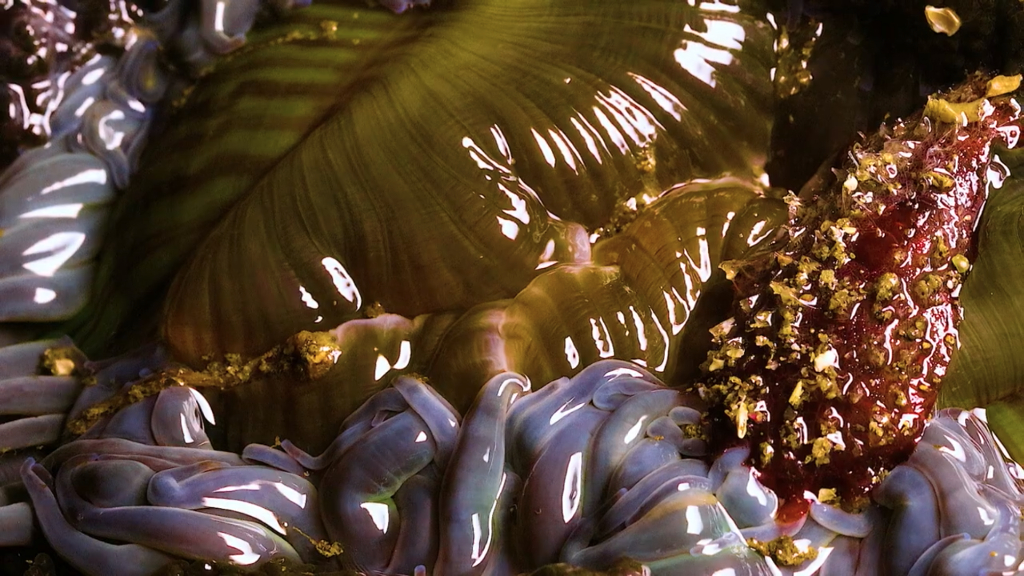
The video turns composition into inquiry: tidal flows, marine organisms, and microtonal improvisation fold into a shared temporal architecture. Vibrantly coloured, the imagery sees sea anemones mirroring the currents of pitched percussion, creating a sense of being enveloped by tentacular melodics. Sanchez-Baranda’s work treats biological life as a subtle intelligence, blurring distinctions between the natural, the alien, and the synthetic.
Improvisation, Friedman notes, unfolds within defined parameters, much like ecosystems shape biological forms. Alternative tunings carry their own logics and limits, echoing patterns of life that defy anthropocentric norms. METLASR, his latest record, released March 27 via Radicant Editions, aligns diverse sounds to a single invisible pulse – immersive, subtle, and quietly utopian – opening a visual and sonic chapter that unfolds across listening situations, performances, and exhibition contexts in New York, Berlin, and London.
Nature unfolds with an element of contingency and unpredictability. Do you see a connection between improvisation and the flow of ecological systems? And how does microtonal composition – often resonant and complex yet beyond standard tonal norms – sit within that relationship?
Insofar as improvisations are possible outcomes of enclosed systems of defined parameters, there is certainly a parallel. I wouldn’t frame nature in terms of unpredictability; improvisation certainly involves spontaneity, but that’s something else. Tuning is a single aspect of a larger network of conditions – although, insofar as microtuning can be related to Sanchez-Baranda’s video work specifically, it’s perhaps interesting to compare the great variety of possible biological forms that are wholly incompatible with our anthropocentric notions of sensorial embodiment (in this case: boneless, sessile, many-limbed, limited to exclusively tactile sensory input) with the way 12TET tuning has been treated as a musical default. Alternative tunings also have their own internal logic and tendencies, as well as their own limitations and refusals, much like specific ecosystems encourage certain biological patterns.
Aron Sanchez-Baranda’s imagery is immersive and radiant – how did that sense of visual space or movement shape your approach to composing for METLASR?
Sanchez-Baranda’s music video for ILJAL does a few interesting things. The fluid motions of the sea anemones visualise the underlying flows of voltage that are pointillistically articulated by the pitched percussion. His work, in general, blurs the real and the unreal, the biological and the synthetic, the natural and the alien, and the beautiful and the strange in ways that resonate strongly with the music. The point about immersion is interesting – as I certainly strove for a sense of being enveloped by tentacular melodics while designing the soundstage.
Musically, the composition progresses with momentum while retaining a sense of vibrational neutrality. How do you hope viewers and listeners engage with that balance? And what kind of listening experience are you aiming for?
METLASR is very explicitly an expression of a series of confluences. Timbrally, almost all of the sounds have compatible and relatively pure overtone spectra, despite their diverse material, cultural, and geographic origins. The record is very interested in being multiple things at once. It’s also a model of synchronisation focusing on articulations and variations of a single central, yet invisible, flow — although of course all of the patterns are aligned to a shared pulse. As such, maybe you could say that METLASR is in departure from synchronisation rather than actively attempting to enact it. As I designed the system used for the album, I was holding in mind a kind of utopian fantasy and reaching for a kind of dialectical sonics. Although I can’t necessarily claim that these ideas are legibly embedded in the music, I would like to imagine that the experience of the record bears some traces of this.