Text by Mila Azimonti
There’s hardly anything neutral about adding visuals to a music performance. Images never merely “adorn sound” — research shows as much. Once sight enters the equation, the eye takes over judgment, steering how we make sense of what we hear. Sometimes subtly, other times entirely, visuals reorganise perception itself, often in ways the listener is only half aware of.
The promise of audiovisual work lies precisely in that reorganisation. At best, it opens a new sensorium where sound and image meet, expand, or challenge each other. At worst, it turns listening into watching. That tension ran like an invisible thread through an evening at the ICA London, curated by Oblique Futures and Diagonal Records on 4th October. Three world A/V premieres — Powell’s We Do Recover, Concrete Fence (Regis × Russell Haswell), and Florian Hecker & Marcin Pietruszewski’s NORMIFICATION — each tested the limits of what happens when sound meets image.
In a way, the night could be read as a study in audiovisual practice: a cross-section ranging from dry conceptualism to sensory deluge. What unfolded revealed how differently the eye and ear can relate: visuals that opened new interpretive dimensions, generated the music, or consumed it entirely.
Concrete Fence: The framing Mode
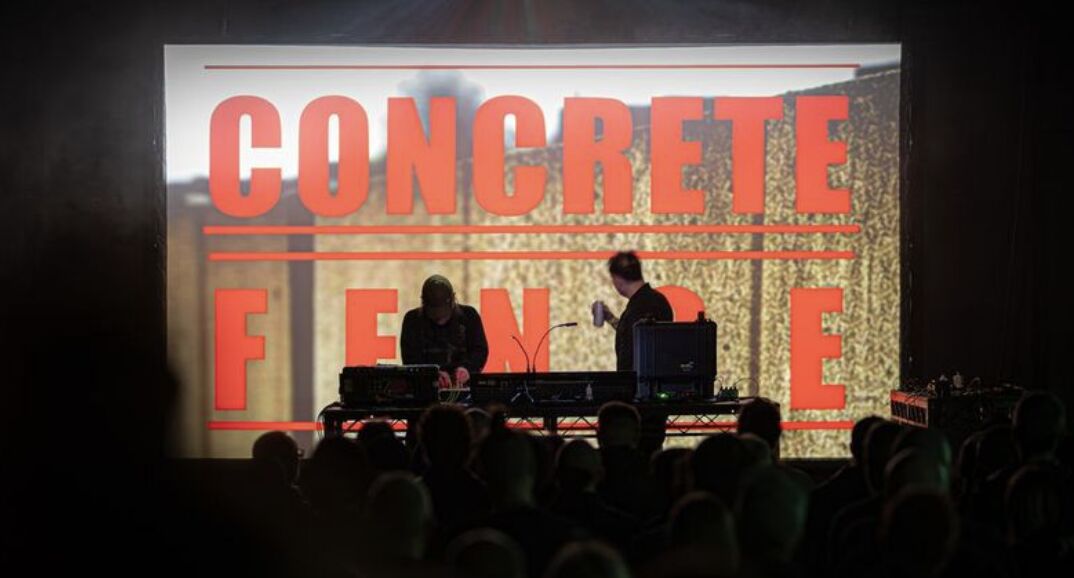
Opening the evening was a dense, corroded mass of sound. Concrete Fence marked the return of the long-dormant collaboration between Regis (Sandwell District, British Murder Boys) and Russell Haswell (Gescom, Haswell & Hecker), presenting new material for the first time in over a decade. At a punishing volume, circuitry melted into low-end rumble, hydraulic pressure built beneath rusted metal. Haswell’s chaotic abrasions and sharp feedback folded into Regis’s sludgy pulses and hypnotic beats, producing an ominous and radioactive cloud.
Behind them, a slideshow cycled through images of concrete fences — literal ones. Monoliths lined side by side covered in graffiti, border walls, gated perimeters under clear blue skies. The political charge was immediate and unambiguous: state violence, segregation, migration, the architecture of control. And yet the tautological gesture carried a dry, deadpan humour. Its bluntness became almost ridiculous when, every so often, the phrase CONCRETE FENCE flashed in glaring red capitals, phones snapping up always too late to catch it.
The visuals didn’t follow the sound. They framed it, acting as an interpretive lens, supplying ideological and symbolic charge to an otherwise indeterminate field. The sound remained primary, yet the frame displaced its affect into a political register, turning industrial abstraction into a social texture: a sonic image of systems of control.
What we might call the framing mode of audiovisual relation works best when the visual element stays restrained enough not to compete, yet semantically potent enough to give context to listening. When that balance holds, the image doesn’t distract or dominate; it reorients listening, adding a layer of meaning that instrumental music alone can only suggest.

Florian Hecker & Marcin Pietruszeswki: The Conversation Mode
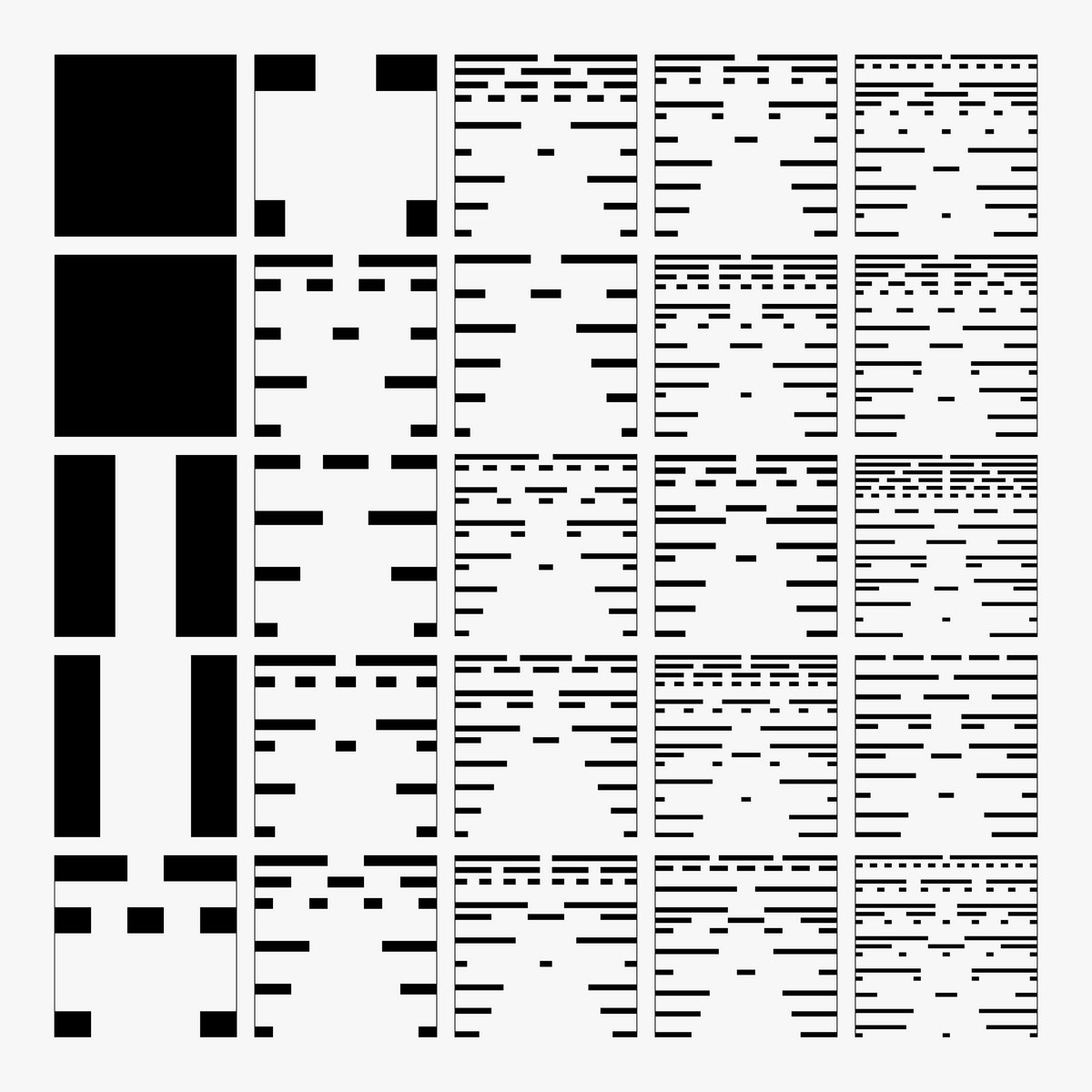
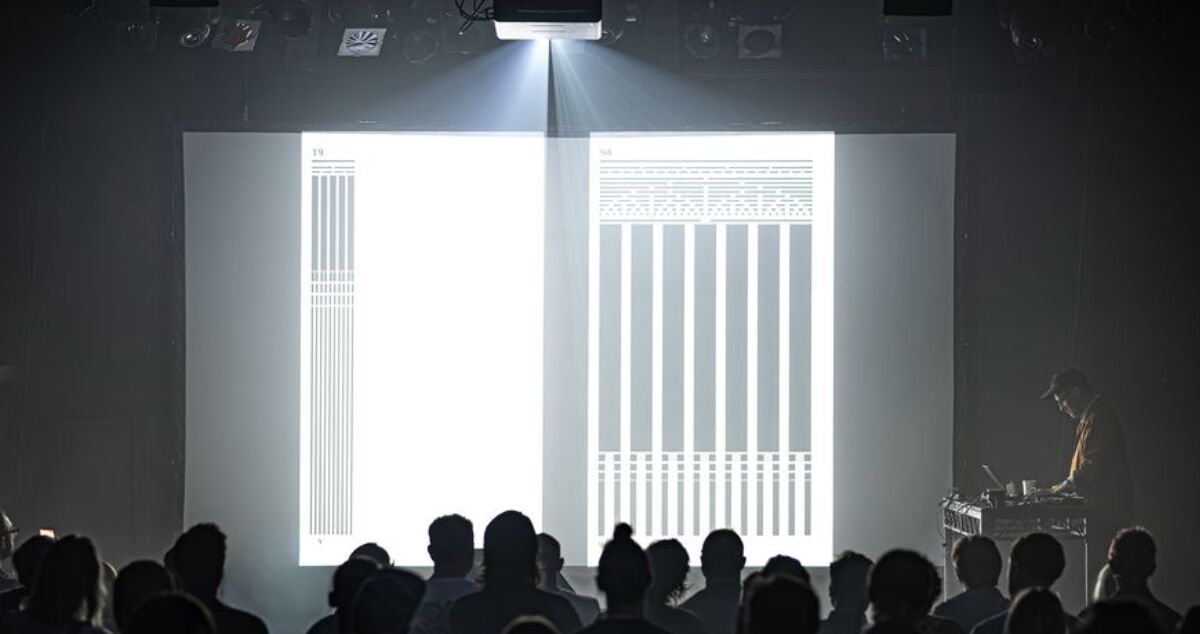
NORMIFICATION was a meticulous, almost hermetic, self-contained system. Algorithms from graphic design became engines for sound synthesis, generating a shared language of pattern and proportion. Here, the audiovisual relation was not one of framing but of conversion: one medium producing the other through the same generative code.
At its best, this mode reveals process: letting the audience hear geometry, see rhythm, feel code. When it works, the translation dissolves the line between visual and sonic thinking, creating a space where form itself becomes sensuous.
On screen, two panels displayed sequences of gridded black-and-white compositions: vertical bars and thin horizontal lines, like pages from a technical manual. The sound unfolded in high-resolution bursts: crystalline tones, synthetic ruptures, sharp shifts in density. A rigorous exercise in process, stretched to abstraction.
In principle, both elements obeyed the same system. I expected layouts, transformations, and algorithmic shifts to mirror each other in an elegant fusion of two procedural expressions. In practice, they did not converge: the correspondence was conceptual rather than perceptual. Not by mistake, to be clear, but the absence of live mirroring left the exercise feeling hollow, with two media orbiting the same idea without ever touching.
Powell: The Immersive Mode
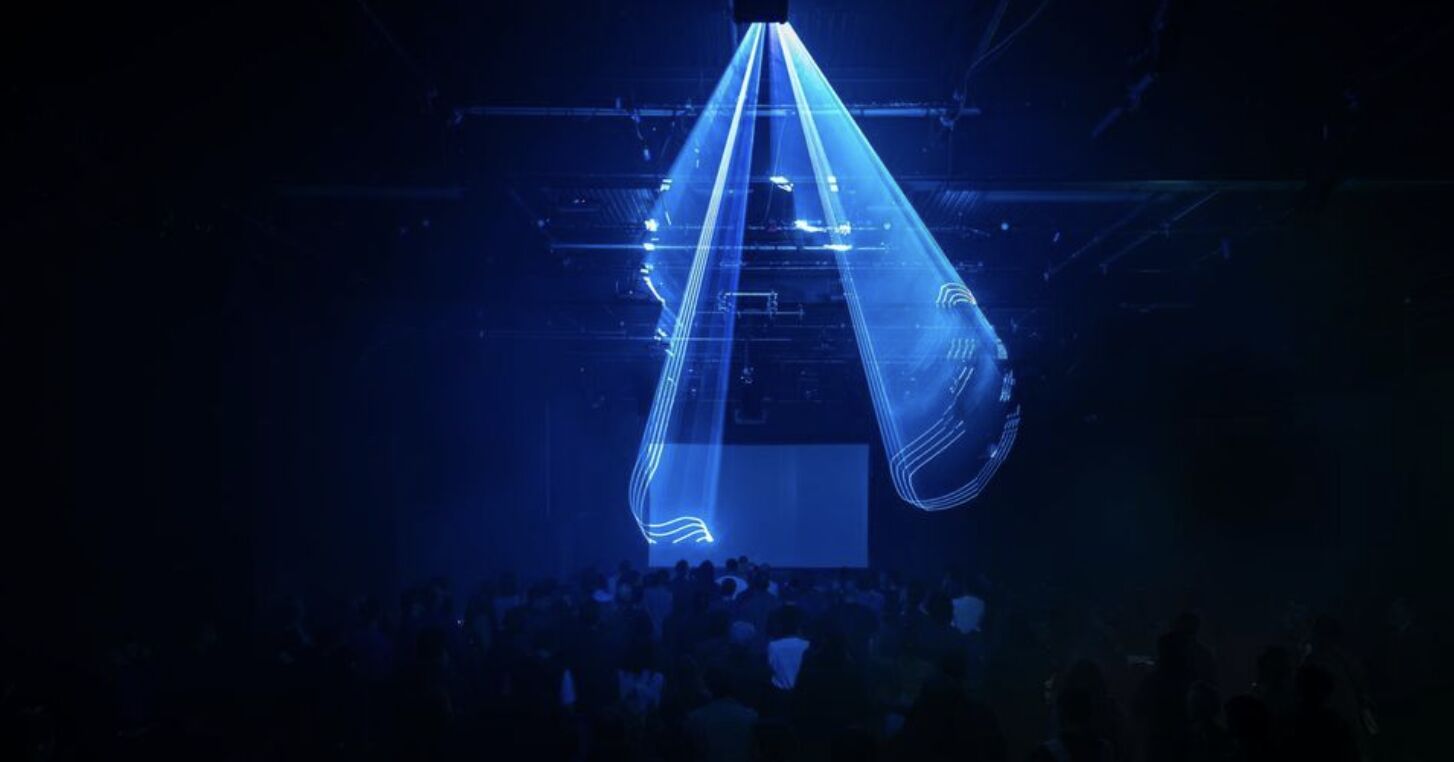
We Do Recover was an expanded A/V performance shaped by grief, addiction, and the fragile work of rebuilding. Music both emotive and ambiguous, shifting between glittering and solemn tones, punctuated by auto-tuned voices reciting, “unable to stop, and unwilling to learn.”
The show unfolded as a collaboration with filmmaker Michael Amstad, visual artist Marte Eknæs, and lighting designer Nicole Gordon. On screen, sharded porcelain dolls twitched and danced; oversaturated seahorses sank and rose in endless loops; taxidermied goats flickered to life. A heart-shaped avatar drifted through arid landscapes of tangled roots, while words like “relapse,” “surrender,” “newborn,” and “life” appeared in gleaming light.
Hypnotic, totalising, almost narcotic; a sensory flood whose intensity was as seductive as it was exhausting. Here, sound and image fused into one immersive continuum. But immersion has its risks: when the visuals dominate, listening becomes passive. Music turns into a cinematic atmosphere, an emotional carrier rather than an autonomous composition. Meaning becomes entirely directed, and reflection disappears.
Reactions were divided. Many found the imagery too literal — ironic, after Concrete Fence’s slideshow — even clichéd. Yet the event’s own tagline read, “Embrace cliché.” I keep thinking about that. The language of recovery easily falls into tropes of stages, journeys, and rebirths, but clichés endure because they touch something universal: grief, loss, survival, renewal. They don’t necessarily erase the depth of the feeling but rather expose its familiarity. Perhaps that’s why Powell’s show felt both moving and awkward: sincere in feeling but formulaic in form.
By the end, each performance had traced its own uneasy negotiation between eye and ear, between the pull of the image and the autonomy of sound. What was at stake, ultimately, wasn’t only aesthetic coherence but the politics of attention itself. What emerged was less a hierarchy of success or failure than a question of balance: how much vision can music bear before listening becomes impossible?